
The Harbor of Ithaca Myth Meaning & Symbolism
A myth of exile and return, where the hero's final struggle to reach his home harbor mirrors the soul's journey to its core identity.
The Tale of The Harbor of Ithaca
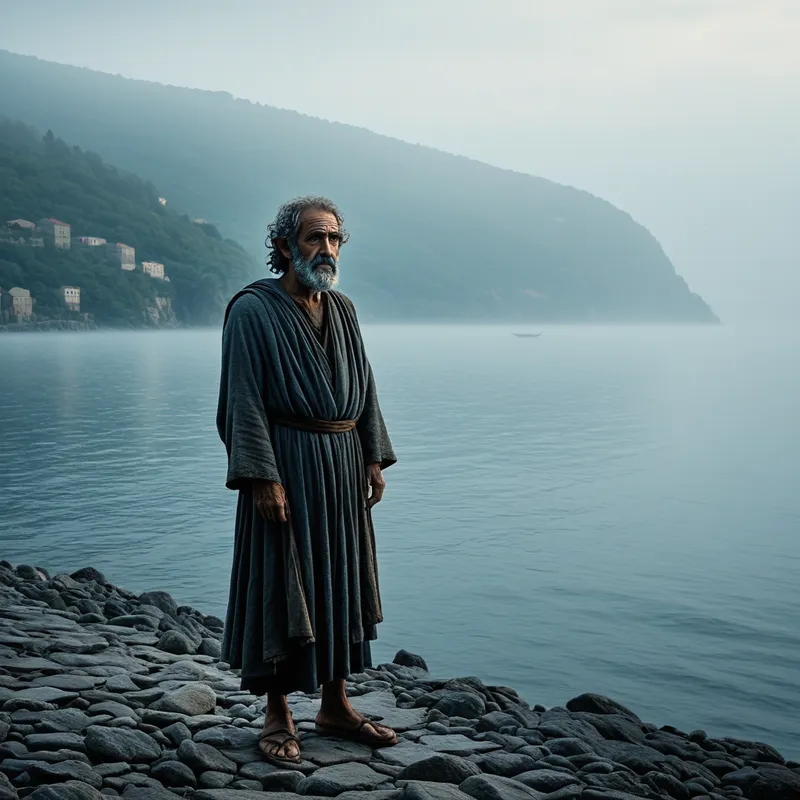
Hear now the tale not of the journey, but of its end. Not of the monster-filled seas, nor the songs of [sirens](/myths/sirens “Myth from Greek culture.”/), nor the wrath of gods, but of the silence that comes after. For twenty years, [the sea](/myths/the-sea “Myth from Greek culture.”/) had been his prison and his road, a salt-scoured expanse of memory and loss. His name was [Odysseus](/myths/odysseus “Myth from Greek culture.”/), and his soul was a map with only one destination: a small, rocky island cradling a specific curve of shore—the Harbor of Ithaca.
He did not arrive in glory. The gods, in their final test, cast a thick, grey mantle of mist over the island he had fought a war to leave and a lifetime to regain. His own home was rendered strange, a phantom shape in the fog. His heart, which had beaten the rhythm of oars for so long, now hammered against his ribs with a new terror: the terror of the unrecognizable familiar. The Phaeacian sailors, gifts of [Poseidon](/myths/poseidon “Myth from Greek culture.”/)’s wrath, laid him, deep in enchanted sleep, upon the sand. They departed, and he awoke alone.
The sand was cold. The air smelled of [thyme](/myths/thyme “Myth from Greek culture.”/) and damp stone, a scent that bypassed his mind and spoke directly to a part of him he thought drowned. He rose, and the great sacker of cities, the man who blinded the Cyclops and descended to the House of [Hades](/myths/hades “Myth from Greek culture.”/), did not know his own land. Athena appeared then, not in shimmering majesty, but disguised as a young shepherd. To his desperate questions, she spoke the name of Ithaca, and watched the storm of anguish and joy break upon his weathered face. This was the final wound of his exile: to be a stranger in the place that defined him.
She lifted [the mist](/myths/the-mist “Myth from Celtic culture.”/), and there it was. Not the grand palaces of his memories, but the specific, humble truth of it: the twisting path, the olive tree, [the cave](/myths/the-cave “Myth from Platonic culture.”/) of the Naiads, the harbor itself—a blue eye staring back at him from the land’s embrace. This recognition was not visual, but cellular. It was the harbor of his bones. Yet, the homecoming was not celebration. It was strategy. Disguised by Athena’s art into a wrinkled, broken beggar, he walked his own land unseen. He tasted the bread of his suitors, heard the lies in his own hall, and saw the enduring faith of his son, [Telemachus](/myths/telemachus “Myth from Global/Universal culture.”/), and his wife, [Penelope](/myths/penelope “Myth from Greek culture.”/). The harbor was reached, but the kingdom of his self had to be reclaimed, not from foreign monsters, but from the parasitic shadows that had taken root in his absence. The final battle was not at sea, but in the great hall, a brutal, intimate reclamation. Only then, with the usurpers cleansed and the true hearth fire re-lit, did the Harbor of Ithaca cease to be a destination and become, once more, a home.
Cultural Origins & Context
This culminating episode of the Odyssey was not merely a poet’s end to an adventure. Composed in the 8th century BCE and attributed to [the bard](/myths/the-bard “Myth from Celtic culture.”/) [Homer](/myths/homer “Myth from Greek culture.”/), the epic was performed orally at aristocratic feasts and public festivals. Its function was foundational. For a culture defined by sea-faring, colonization, and warfare, the fear of losing one’s way—geographically and culturally—was profound. The Harbor of Ithaca represented the nostos (homecoming), a core concept in Greek heroic poetry. It was the ultimate prize, a validation of identity and kleos (glory). The story served as a cultural anchor, reinforcing the values of cunning ([metis](/myths/metis “Myth from Greek culture.”/)), endurance, and the sacredness of the oikos (household). To hear of Odysseus’s return was to be reminded that no matter how far one wandered, the point was to return, transformed but rooted, to one’s proper place in the order of things.
Symbolic Architecture
The [Harbor](/symbols/harbor “Symbol: A harbor symbolizes safety, rest, and the arrival at a destination, representing a place of shelter and emotional refuge.”/) of Ithaca is not a geographical [location](/symbols/location “Symbol: The symbol of ‘Location’ signifies a sense of place, context, and the environment in which experiences unfold.”/), but a psychic state. It is the point of [origin](/symbols/origin “Symbol: The starting point of a journey, often representing one’s roots, source, or initial state before transformation.”/) and the point of return, [the self](/myths/the-self “Myth from Jungian culture.”/) before it was shaped by [trauma](/symbols/trauma “Symbol: A deeply distressing or disturbing experience that overwhelms the psyche, often manifesting in dreams as unresolved emotional wounds or psychological injury.”/), ambition, and [the world](/myths/the-world “Myth from Tarot culture.”/)’s storms. Odysseus’s initial failure to recognize it is the myth’s deepest [truth](/symbols/truth “Symbol: Truth represents authenticity, honesty, and the quest for knowledge beyond mere appearances.”/).
We spend our lives building an identity in the world, only to return to our essence and find it clothed in the fog of our own experiences.
The harbor symbolizes the core, authentic self. The mist Athena casts represents the necessary [dissolution](/symbols/dissolution “Symbol: The process of breaking down, dispersing, or losing form, often representing transformation, release, or the end of a state of being.”/) of [the ego](/myths/the-ego “Myth from Jungian culture.”/)’s grandiose self-[image](/symbols/image “Symbol: An image represents perception, memories, and the visual narratives we create in our minds.”/)—the “[hero](/symbols/hero “Symbol: A hero embodies strength, courage, and the ability to overcome significant challenges.”/)” must become a “[beggar](/symbols/beggar “Symbol: A symbol representing vulnerability, need, and social inequality, often reflecting the dreamer’s feelings of lack, dependence, or neglected aspects of self.”/)” to see truly. The suitors in his hall are not just external enemies; they are the psychic parasites—the doubts, the compromises, the false identities—that infest the [psyche](/myths/psyche “Myth from Greek culture.”/) when the ruling [consciousness](/symbols/consciousness “Symbol: Consciousness represents the state of awareness and perception, encompassing thoughts, feelings, and experiences.”/) (the [king](/symbols/king “Symbol: A symbol of ultimate authority, leadership, and societal order, often representing the dreamer’s inner power or external control figures.”/)) is absent. The final, bloody reclamation is the unavoidable [shadow](/symbols/shadow “Symbol: The ‘shadow’ embodies the unconscious, repressed aspects of the self and often represents fears or hidden emotions.”/)-work of [integration](/symbols/integration “Symbol: The process of unifying disparate parts of the self or experience into a cohesive whole, often representing psychological wholeness or resolution of internal conflict.”/). One cannot simply walk back into one’s untarnished self; one must confront and clear out what has grown in the darkness of one’s neglect.
The Dreamer’s Resonance
When this myth stirs in the modern dreamer, it often manifests as dreams of near-misses and frustrating returns. You dream of your childhood home, but the key doesn’t fit. You see your family, but they don’t recognize you. You are trying to reach a safe, known shore, but the [water](/myths/water “Myth from Chinese culture.”/) turns to syrup or the land recedes. These are somatic dreams of psychic dislocation.
The psychological process is one of re-orientation. The dream ego is experiencing the gap between who it has become and who it fundamentally is. The “harbor” is in sight—a feeling of integrity, wholeness, or purpose—but access is barred. This is the soul’s signal that the journey inward requires not just arrival, but a stripping away. The dreamer is in the phase Odysseus spent disguised: a necessary period of humility, observation, and re-acquaintance with the neglected landscapes of their own inner world before the final, often difficult, integration can occur.

Alchemical Translation
The alchemical process mirrored here is the opus contra naturam—the work against nature, which in psychological terms is the work against the habitual, dispersed personality. The long voyage is the [nigredo](/myths/nigredo “Myth from Alchemical culture.”/), the blackening, a dissolution in the chaotic sea of experience. The misty arrival is the albedo, the whitening, where all color and certainty are washed away, leaving a blank, unrecognizable purity.
The treasure hard to attain is not a golden fleece or a holy grail out in the world, but the re-discovery of the sovereign self within the familiar, now-ruined palace of the psyche.
Odysseus’s disguise is the crucial phase of [separatio](/myths/separatio “Myth from Alchemical culture.”/)—separating his eternal identity (the king) from his temporary, suffering [persona](/myths/persona “Myth from Greek culture.”/) (the beggar). The battle with the suitors is the [rubedo](/myths/rubedo “Myth from Alchemical culture.”/), the reddening, a fierce, passionate engagement with the inner complexes that claim sovereignty. The final reunion with Penelope, where he proves his identity by describing their immovable marriage bed rooted in a living olive tree, symbolizes the coniunctio—[the sacred marriage](/myths/the-sacred-marriage “Myth from Various culture.”/) of the conscious mind with the enduring, rooted soul. The Harbor of Ithaca, once reached, is not an end but the fertile ground from which a new, conscious life, tempered by exile and return, can finally grow. The journey ends where it began, but the hero is no longer the same man who left; he is the man who knows the harbor for the first time.
Associated Symbols
Explore related symbols from the CaleaDream lexicon: