The Hanukkah Miracle Myth Meaning & Symbolism
A small cruse of sacred oil, meant to last one day, burns for eight, rekindling a desecrated temple and a people's spirit.
The Tale of The Hanukkah Miracle
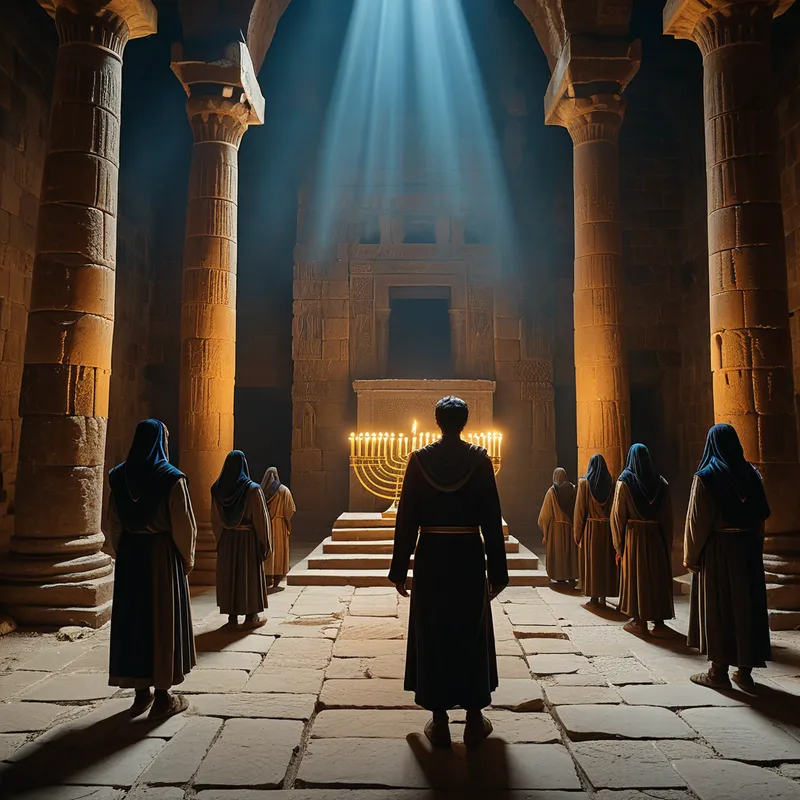
Listen, and let the chill of a long winter’s dusk settle around you. The air in the hills of Judea is sharp with the scent of crushed olives and cold stone, but beneath it lies the metallic tang of fear. The great city, [Jerusalem](/myths/jerusalem “Myth from Biblical culture.”/), lies under a shadow not cast by any cloud. A foreign king, drunk on the wine of empire, has decreed that the old ways must die. His soldiers have marched into the heart of [the world](/myths/the-world “Myth from Tarot culture.”/), the Holy Temple, and defiled it. They have shattered the altar, torn the sacred scrolls, and in the place of the one, invisible God, they have raised statues of gleaming, smiling gods of stone and placed upon the altar the flesh of swine.
But in the hills, a fire yet smolders. It is the fire in the hearts of a family—the Hasmoneans, led by a man they call Judah Maccabee. They are not an army, but farmers and priests with fury forged in their souls. They rise, a rebellion of spirit against the overwhelming machine of assimilation. Their war is not just for land, but for the right to whisper the old prayers, to keep the flame of their identity alive. After years of desperate, guerrilla struggle, against all odds and reason, they push the invaders back. They retake the mountain, they walk through the broken gates of their sacred city.
And there, in the inner sanctum, they find not victory, but desolation. [The Temple](/myths/the-temple “Myth from Jewish culture.”/) is a carcass of its former self, cold, polluted, and dark. The great [Menorah](/myths/menorah “Myth from Judeo-Christian culture.”/), the symbol of divine wisdom and the light of the world, lies toppled, its gold tarnished. The silence is a weight. Their task now is not battle, but the infinitely more delicate work of re-consecration—of making the space holy again. They scrub the stones, they rebuild the altar, they craft a new [Menorah](/myths/menorah “Myth from Judeo-Christian culture.”/). But for [the Menorah](/myths/the-menorah “Myth from Biblical culture.”/) to be lit, they need pure, consecrated olive oil, sealed with the stamp of the High Priest. They search the ravaged chambers, turning over debris with trembling hands.
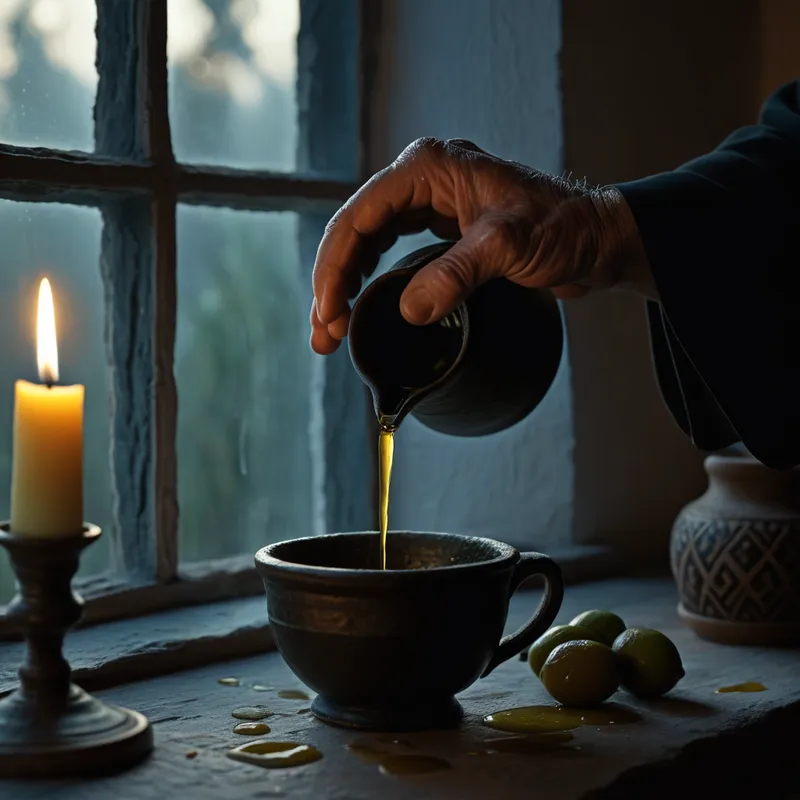
Then, a discovery. Not a treasure, but a testament to a forgotten faithfulness. In a hidden niche, they find a single, small cruse of oil. The seal of the High Priest is unbroken. It is pure. But it is only enough. Enough for one day. [The law](/myths/the-law “Myth from Biblical culture.”/) is clear, the ritual demands an unbroken flame. To press the olives, to prepare new oil, would take eight days. A choice hangs in the air: wait in the renewed darkness, or light the flame knowing it will die, a brief, beautiful failure.
They choose the flame. With a collective breath held tight in their chests, the priest pours the precious oil. He lights the wick. A fragile, golden tongue of fire leaps to life in the vast, shadowy chamber. It is a tiny defiance in an ocean of night. They tend it, they watch it, as the sun sets and rises. One day passes. The flame burns. A second day. It burns still. A third, a fourth… each sunrise a miracle, each sunset a wonder. For eight days, the single cruse feeds the flame, a physical impossibility that becomes a spiritual fact. On the eighth day, as the new, properly prepared oil is finally brought in, the original flame is still dancing, undimmed. The darkness, both physical and spiritual, is pushed back not by a sword, but by a sustained, impossible light.
Cultural Origins & Context
The story is rooted in the historical Maccabean Revolt (c. 167-160 BCE), a pivotal moment of Jewish resistance against the forced Hellenization policies of the Seleucid king Antiochus IV Epiphanes. The primary source is the Books of the Maccabees, preserved in the Catholic and Orthodox biblical canons but not in the Hebrew Tanakh.
Significantly, the “miracle of the oil” is a later rabbinic tradition, first recorded in the Talmud (Tractate Shabbat 21b), compiled centuries after the events. This is a crucial distinction. The historical victory was military and political, but the rabbinic myth transforms it into a theological and spiritual metaphor. The rabbis, living under subsequent foreign dominations (Roman, Persian), shifted the focus from the bloody, nationalist [triumph](/myths/triumph “Myth from Roman culture.”/) of the Maccabees—a model potentially dangerous to preach under empire—to a divine miracle of light. The myth was thus passed down not as a call to arms, but as a domestic, family-centered ritual of lighting the Hanukkiah, increasing light each night. Its societal function became one of cultural endurance, a way to celebrate identity and hope in the face of assimilation and darkness, without explicitly challenging temporal powers.
Symbolic Architecture
At its core, the myth is not about [military](/symbols/military “Symbol: The military symbolizes discipline, authority, and often the need for structure or control in one’s life.”/) might, but about the sustenance of [spirit](/symbols/spirit “Symbol: Spirit symbolizes the essence of life, vitality, and the spiritual journey of the individual.”/) in a world that seeks to extinguish it. The [Temple](/symbols/temple “Symbol: A temple often symbolizes spirituality, sanctuary, and a deep connection to the sacred aspects of life.”/) represents the inner sanctum of the [soul](/symbols/soul “Symbol: The soul represents the essence of a person, encompassing their spirit, identity, and connection to the universe.”/) or the core of a culture—the place of ultimate value and [connection](/symbols/connection “Symbol: Connection symbolizes relationships, communication, and bonds among individuals.”/). Its desecration is the experience of profound violation, whether through [trauma](/symbols/trauma “Symbol: A deeply distressing or disturbing experience that overwhelms the psyche, often manifesting in dreams as unresolved emotional wounds or psychological injury.”/), oppression, or the slow [erosion](/symbols/erosion “Symbol: Erosion in dreams represents gradual decay, loss of structure, or the wearing away of foundations over time through persistent forces.”/) of meaning.
The miracle is not that the oil lasted, but that they lit the lamp at all, with so little certainty of a future flame.
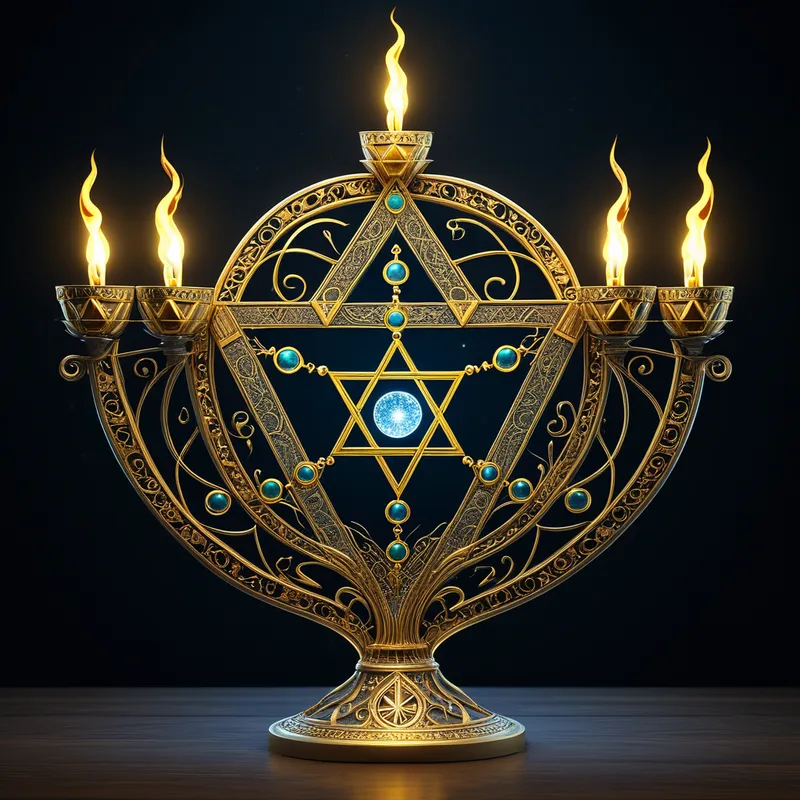
The single cruse of oil is the [symbol](/symbols/symbol “Symbol: A symbol can represent an idea, concept, or belief, serving as a powerful tool for communication and understanding.”/) of the seemingly inadequate resource: a fragment of [faith](/symbols/faith “Symbol: A profound trust or belief in something beyond empirical proof, often tied to spiritual conviction or deep-seated confidence in people, ideas, or outcomes.”/), a sliver of hope, a [remnant](/symbols/remnant “Symbol: A fragment or leftover piece of something larger that once existed, often carrying emotional or historical weight from what has been lost or transformed.”/) of tradition, or a small, pure part of [the self](/myths/the-self “Myth from Jungian culture.”/) that has been protected and preserved against all odds. It is the “still, small voice” after the [earthquake](/symbols/earthquake “Symbol: An earthquake in a dream often symbolizes a sudden disruption or transformation that shakes the foundation of one’s life.”/) and fire. The eight days represent a complete cycle of time, a [period](/symbols/period “Symbol: Periods in dreams can symbolize cyclical patterns, renewal, and the associated emotions of loss or change throughout life.”/) of transition from profane to sacred, from [chaos](/symbols/chaos “Symbol: In Arts & Music, chaos represents raw creative potential, uncontrolled expression, and the breakdown of order to forge new artistic forms.”/) to order. The miracle asserts that when one acts from that place of pure, albeit limited, integrity, the [universe](/symbols/universe “Symbol: The universe symbolizes vastness, interconnectedness, and the mysteries of existence beyond the individual self.”/)—or the [psyche](/myths/psyche “Myth from Greek culture.”/)—conspires to sustain it beyond rational expectation. The light of the [Menorah](/symbols/menorah “Symbol: A seven-branched candelabrum central to Judaism, symbolizing divine light, wisdom, and the enduring covenant between God and the Jewish people.”/) is [consciousness](/symbols/consciousness “Symbol: Consciousness represents the state of awareness and perception, encompassing thoughts, feelings, and experiences.”/) itself, the light of [awareness](/symbols/awareness “Symbol: Conscious perception of self, surroundings, or internal states. Often signifies awakening, insight, or heightened sensitivity.”/), [identity](/symbols/identity “Symbol: Identity represents the sense of self, encompassing personal beliefs, cultural background, and social roles.”/), and moral [clarity](/symbols/clarity “Symbol: A state of mental transparency and sharp focus, often representing resolution of confusion or attainment of insight.”/) that must be kept burning against the outer and inner shadows.
The Dreamer’s Resonance
When this myth pattern stirs in the modern dreamer, it often surfaces during times of profound inner “desecration”—a crisis of faith, a loss of identity, burnout, or the feeling that one’s core values have been polluted by external demands or trauma. The dreamer may find themselves in a ruined, inner temple: a childhood home in decay, a library with burnt books, or a familiar church now empty and cold.
The somatic sensation is one of searching through this wreckage with a deep, quiet urgency. The discovery of the “small cruse” in a dream might be a forgotten talent, a childhood memory of wholeness, a single affirming word from the past, or simply the raw, persistent fact of one’s own breath. The act of “lighting [the lamp](/myths/the-lamp “Myth from Alchemical culture.”/)” in the dream is the commitment, however tentative, to honor that small, pure [thing](/myths/thing “Myth from Norse culture.”/). The psychological process is one of re-consecration: the slow, deliberate work of clearing out psychic pollution (shame, cynicism, others’ expectations) and deciding, day by day, to tend that fragile, inner flame, even when logic says it cannot last.
Alchemical Translation
The alchemical journey mirrored here is the opus contra naturam—the work against nature, or more precisely, against the expected, decaying course of events. The “base matter” is the desecrated temple of the psyche, [the ego](/myths/the-ego “Myth from Jungian culture.”/) in a state of collapse and contamination. The “[prima materia](/myths/prima-materia “Myth from Alchemical culture.”/),” the starting point for transformation, is that one sealed cruse of oil: the uncontaminated complex, the core Self that has remained untouched by the [persona](/myths/persona “Myth from Greek culture.”/)‘s compromises.
The eight-day burn is the process of solutio and coagulatio—dissolution of the old, rigid structures and coagulation of a new, authentic consciousness around a sustained, inner light.
The miracle is the alchemical secret: the tiny, pure seed contains within it the potential for its own sustenance, but only if it is courageously activated. For the modern individual, this models the individuation process of moving from a state of being defined by external forces (Hellenistic assimilation) to being illuminated from within. One must first engage in the necessary “Maccabean” rebellion—the conscious rejection of inner tyrants and false selves. But the final, enduring work is not rebellion, but maintenance: the daily, ritualized act of kindling attention on the authentic Self. The increasing light of the Hanukkiah over eight nights is the gradual illumination of the psyche’s totality, proving that a little pure oil, tended with faithful attention, can eventually light up the entire inner world.
Associated Symbols
Explore related symbols from the CaleaDream lexicon: