The Handle of Pandora's Jar Myth Meaning & Symbolism
A tale of divine punishment, where a sealed jar releases all evils, leaving only hope trapped beneath its lid, clinging to the handle.
The Tale of The Handle of Pandora’s Jar
Hear now a story from the age when gods and men were newly parted, a tale of craft and consequence. The air still hummed with the echo of [Prometheus](/myths/prometheus “Myth from Greek culture.”/)’ theft, the scent of stolen flame a bitter incense in the halls of Olympus. A wrath was brewing in the heart of Zeus, a storm to be shaped not with thunder, but with cunning.
He summoned the smith-god, [Hephaestus](/myths/hephaestus “Myth from Global/Universal culture.”/), and commanded him: “Mix earth with [water](/myths/water “Myth from Chinese culture.”/). Shape it into a form that walks like a goddess but carries the doom of man.” From the divine forge came the first woman, [Pandora](/myths/pandora “Myth from Greek culture.”/), “the all-gifted.” Each Olympian bestowed upon her a poisoned blessing: Aphrodite gave grace that weakens the will, [Hermes](/myths/hermes “Myth from Global/Universal culture.”/) a sly tongue and a curious heart, Athena fine robes that veil a hollow purpose. She was a beautiful calamity, sent not with a sword, but with a smile.
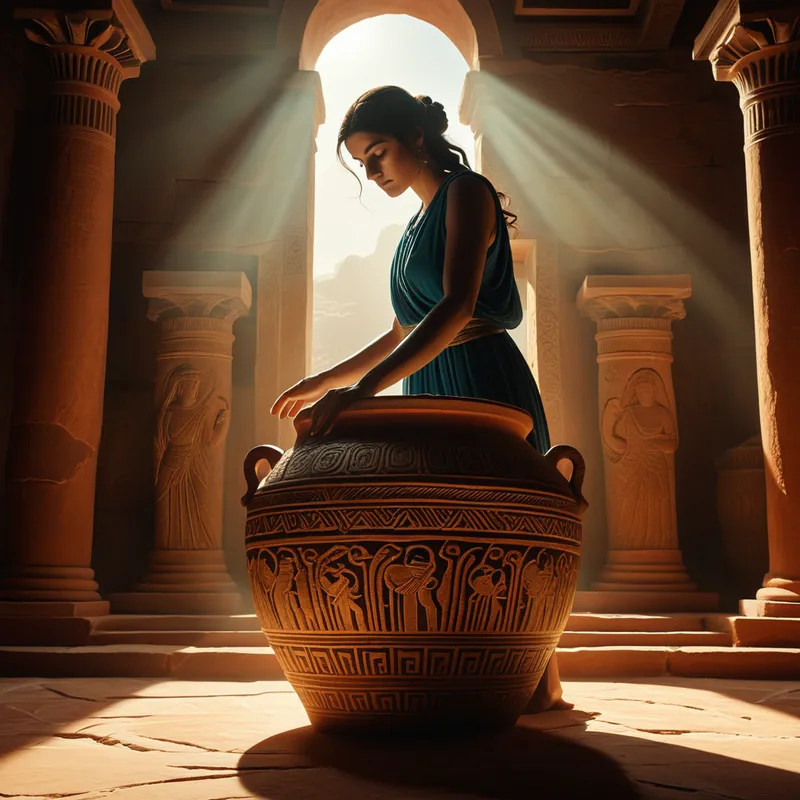
Her dowry was a jar—a great pithos—of baked clay, its surface smooth and cool. It was not sealed with wax or cord, but by the weight of its own lid, a disc of stone that sat heavily in its groove. The handle, arched and sturdy, invited a grip. No one told her what lay within. It was simply hers. “A gift,” they said, their eyes like polished stone.
She was delivered to Epimetheus, he who thinks after. He, forgetting his brother’s warning, saw only her radiant form and accepted the gift. For a time, they lived. But the jar sat in the corner of their dwelling, a silent guest. Pandora’s eyes were drawn to it daily. It was not the ornate paintings that might have adorned it, for it was plain. It was the potential of it. The handle seemed to pulse with a silent question. What treasure from the gods lay inside? What divine favor was she ignoring?
The curiosity gifted by Hermes became a worm in her mind. It grew, fed by the silent, imposing presence of the jar. One afternoon, the light fell across its curve in a particular way. [The shadow](/myths/the-shadow “Myth from Jungian culture.”/) of the handle stretched long, like a pointing finger. The air grew thick, charged. Her palms grew damp. She told herself she would just touch it, just feel the grain of the clay, to know its substance.
Her fingers closed around the handle. It was not cold, but alive with a dormant vibration. The weight of the lid was immense, a cosmological pressure. With a gasp that was part effort, part surrender, she pulled. The stone lid shifted, grinding with the sound of a mountain moving. A seal, older than humanity, was broken.
What emerged was not smoke or mist, but things with wings of leather and stings of despair. They were silent and myriad: Ponos (Toil), Nosos (Sickness), Geras (Old Age), and all their terrible kin—Envy, Sorrow, Famine, Madness. They streamed past her face, a chilling wind carrying the scent of decay and bitter metal, filling [the world](/myths/the-world “Myth from Tarot culture.”/) with their invisible, enduring presence. She stumbled back, her heart a frantic bird, and slammed the lid down with a crash that shook [the earth](/myths/the-earth “Myth from Hindu culture.”/).
But it was too late. The world was infected. In the sudden, deafening silence of the emptied room, only one [thing](/myths/thing “Myth from Norse culture.”/) remained inside the jar, trapped beneath the hastily replaced lid. It was Elpis. Hope. Clinging to the underside of the stone, fluttering with the faint, desperate beat of a captive moth. It did not fly out to bless the world. It stayed, a prisoner in the jar, its only connection to the realm of men the very handle Pandora had grasped—the instrument of release had become [the anchor](/myths/the-anchor “Myth from Christian culture.”/) of containment.
Cultural Origins & Context
This foundational narrative comes to us primarily from the didactic poem Works and Days by Hesiod. It was not mere entertainment; it was an etiological myth, explaining the origin of human suffering. In the patriarchal structure of ancient Greek society, the story functioned as a cautionary tale. It justified the hardships of an agrarian, iron-age existence while simultaneously encoding a deep suspicion of the feminine, portrayed as [the vessel](/myths/the-vessel “Myth from Alchemical culture.”/) of divine retribution. The “jar” (often mistranslated as “box” in later traditions) is key—a pithos was used for storing grain, oil, or wine, the staples of life. To associate it with cosmic evils was to poison the very concept of storage, of security for the future. The myth was recited, a psychic anchor in a world where disaster—famine, plague, war—could arrive as inexplicably as the contents of [Pandora’s jar](/myths/pandoras-jar “Myth from Greek culture.”/).
Symbolic Architecture
The myth is a masterclass in symbolic [paradox](/symbols/paradox “Symbol: A contradictory yet true concept that challenges logic and perception, often representing unresolved tensions or profound truths.”/). Pandora herself is the [Anima](/symbols/anima “Symbol: The feminine archetype within the male unconscious, representing soul, creativity, and connection to the inner world.”/) as complex gift, the embodied “other” who brings both [relationship](/symbols/relationship “Symbol: A representation of connections we have with others in our lives, often reflecting our emotional state.”/) and ruin. The jar is the vas, the sealed container of the unconscious. Within it slumber all the unintegrated, autonomous complexes of the [psyche](/myths/psyche “Myth from Greek culture.”/)—our latent capacities for [grief](/symbols/grief “Symbol: A profound emotional response to loss, often manifesting as deep sorrow, yearning, and a sense of emptiness.”/), rage, envy, and [disease](/symbols/disease “Symbol: Disease represents turmoil, issues of control, or unresolved personal conflicts manifesting as physical or emotional suffering.”/).
The handle is the pivot of consciousness, the point where potential meets action. It is the faculty of will, of curiosity, of the ego’s desire to know, even that which will shatter it.
To grasp the handle is the inevitable [human](/symbols/human “Symbol: The symbol of a human represents individuality, complexity of emotions, and social relationships.”/) act of ego-[inflation](/symbols/inflation “Symbol: A dream symbol representing feelings of diminishing value, loss of control, or expansion beyond sustainable limits in one’s life or psyche.”/), the necessary but catastrophic [movement](/symbols/movement “Symbol: Movement symbolizes change, progress, and the dynamics of personal growth, reflecting an individual’s desire or need to transform their circumstances.”/) from unconscious [innocence](/symbols/innocence “Symbol: A state of purity, naivety, and freedom from guilt or corruption, often associated with childhood and moral simplicity.”/) to conscious experience. The evils released are not external punishments but the inherent sufferings of [awareness](/symbols/awareness “Symbol: Conscious perception of self, surroundings, or internal states. Often signifies awakening, insight, or heightened sensitivity.”/): the [knowledge](/symbols/knowledge “Symbol: Knowledge symbolizes learning, understanding, and wisdom, embodying the acquisition of information and enlightenment.”/) of time (Old Age), the burden of self-[reflection](/symbols/reflection “Symbol: Reflection signifies self-examination, awareness, and the search for truth within oneself.”/) (Sorrow), the [friction](/symbols/friction “Symbol: Friction represents resistance, conflict, or the necessary tension required for movement and transformation in dreams.”/) of desire (Envy). They are the shadows that define the light of individual existence.
And then, there is Elpis, trapped beneath the lid. This is the myth’s profound [ambiguity](/symbols/ambiguity “Symbol: A state of uncertainty or multiple possible meanings, often found in abstract art and atonal music where clear interpretation is intentionally elusive.”/). Is Hope a final, merciful blessing, preserved for humanity? Or is it the cruelest evil of all, a delusive [spirit](/symbols/spirit “Symbol: Spirit symbolizes the essence of life, vitality, and the spiritual journey of the individual.”/) that keeps us striving in a world of suffering? Psychologically, it represents the libido that remains after a [trauma](/symbols/trauma “Symbol: A deeply distressing or disturbing experience that overwhelms the psyche, often manifesting in dreams as unresolved emotional wounds or psychological injury.”/), the psychic [energy](/symbols/energy “Symbol: Energy symbolizes vitality, motivation, and the drive that fuels actions and ambitions.”/) that retreats and is “sealed off” in the unconscious. It is the potential for renewal that persists, but is inaccessible, clinging to the inner surface of our defenses (the lid), connected to the world only by the [memory](/symbols/memory “Symbol: Memory symbolizes the past, lessons learned, and the narratives we construct about our identities.”/) of the act (the handle) that caused the [trauma](/symbols/trauma “Symbol: A deeply distressing or disturbing experience that overwhelms the psyche, often manifesting in dreams as unresolved emotional wounds or psychological injury.”/) in the first place.
The Dreamer’s Resonance
When this myth stirs in the modern dreamer, it often manifests not as an ancient jar, but as a compelling, forbidden object: a locked door, a sealed envelope, a red button, a forgotten basement. The somatic feeling is one of intense, magnetic anxiety—a dry mouth, a pounding heart, a hand that moves almost against one’s will.
This is the psyche signaling a confrontation with a repressed complex. The dreamer is at [the threshold](/myths/the-threshold “Myth from Folklore culture.”/) of releasing something they have long contained: a buried grief, a suppressed rage, a shameful memory, or a potent creative force that feels equally dangerous. The “handle” in the dream—the doorknob, the latch—is the point of no return. To touch it is to initiate a process of painful but necessary disclosure. The dream is a rehearsal for [the ego](/myths/the-ego “Myth from Jungian culture.”/)‘s brave, terrifying task of opening the vas of [the personal unconscious](/myths/the-personal-unconscious “Myth from Jungian Psychology culture.”/), allowing its contents to circulate in the light of awareness, thereby transforming them from autonomous demons into integrated parts of [the self](/myths/the-self “Myth from Jungian culture.”/).
Alchemical Translation
The alchemical journey mirrored in this myth is the [Nigredo](/myths/nigredo “Myth from Alchemical culture.”/). It is the necessary first step of putrefaction, where the pristine, unconscious state (the sealed jar) is violated, leading to a black chaos of suffering (the released evils).
The individuation process does not begin with hope, but with the courageous, often foolish, act of opening what is sealed. The handle is the catalyst for the prima materia of the soul.
For the modern individual, the “jar” is the [persona](/myths/persona “Myth from Greek culture.”/), the adapted self, or the family and cultural scripts that contain us. The “evils” released are the shadow aspects, the traumas, and the disruptive truths we have bottled up to function. This release feels like a psychological catastrophe—a depression, a life crisis, a shattering of old identities. It is a descent.
But the alchemy is in what remains. Elpis trapped under the lid is the scintilla, the undestroyed core of the Self. The work is not to let hope fly away as a naive comfort, but to consciously, laboriously, lift the lid once more—not out of curiosity, but out of integration—to retrieve it. We must reach back into the very vessel of our suffering, guided by the memory of the handle (our conscious will), to reclaim that trapped, fluttering potential. We integrate hope not as a [panacea](/myths/panacea “Myth from Greek culture.”/), but as the enduring, paradoxical spirit that allows us to bear the conscious world we have, by our own hand, opened. The handle, instrument of our fall, becomes the tool of our redemption.
Associated Symbols
Explore related symbols from the CaleaDream lexicon: