
The Greys / UFO Phenomenon Myth Meaning & Symbolism
A modern myth of silent visitation from the cosmic void, probing humanity's deepest fears of the unknown and its own fragmented consciousness.
The Tale of The Greys / UFO Phenomenon
Listen, and let the tale be told. It does not begin in a time of kings or gods, but in the age of the humming wire and the silent, watching screen. The sky, once the home of gods and chariots of fire, became a cold vault, a ceiling of stars we claimed to understand. Yet, in the quiet hours, in the lonely places between towns lit by sodium suns, the old mystery returned.
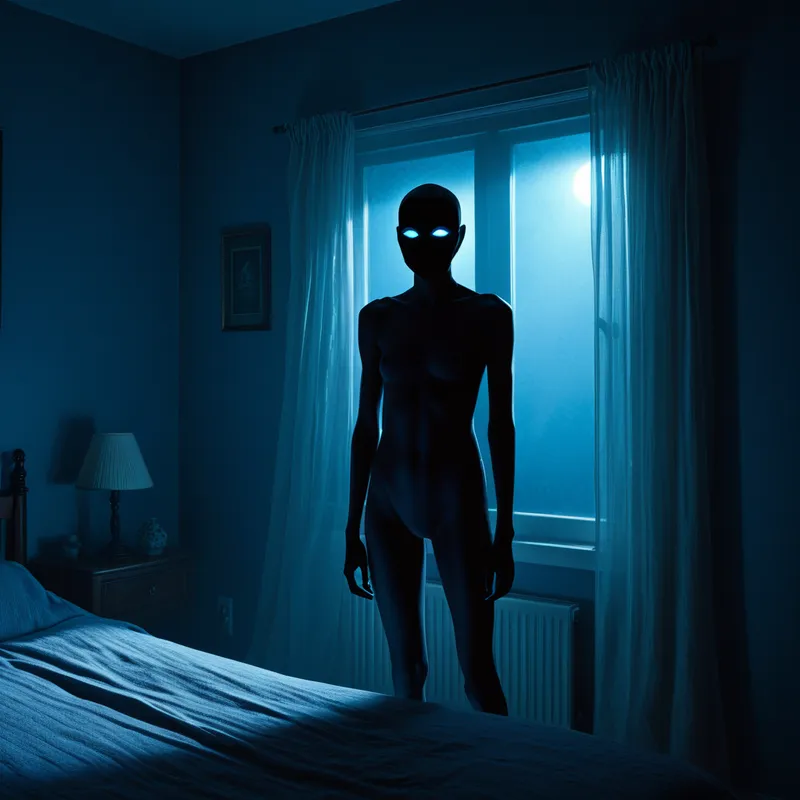
It came not with thunder, but with a profound and electric silence. A light, not of sun or moon, would bloom in the night—a disc of polished silver, or a triangle of silent shadow, moving with impossible grace. It descended into the fields, the forests, the empty deserts, and from it emerged the visitors. They were the Greys. Tall and slender, or small and childlike, with skin like damp ash and heads too large for their frames. But it was their eyes that held the story—vast, liquid-black orbs, windows to a consciousness as deep and cold as the space between galaxies. They held no malice, no warmth, no recognizable soul. Only a terrible, focused curiosity.
The chosen one was never a warrior or a sage. It was the ordinary person: the truck driver on a long haul, the farmer checking on a noise, the child waking thirsty in the dark. They would be taken, not with violence, but with a paralysis of will, a light that lifted them from their beds or their cars. The journey was through a tunnel of light, into the belly of the silver craft.
Inside was a realm of sterile, seamless metal, lit by a sourceless glow. Here, the Greys performed their rites. They laid the human upon a cold table. With instruments of crystalline light, they probed, they examined, they extracted. It was a clinical, intimate violation, a mapping of the physical vessel with a detached precision that felt more alien than any monster’s rage. The human mind screamed, trapped in a body that would not obey, witnessing its own objectification.
Sometimes, there was a message. A psychic flood of images: of dying worlds, of hybrid children, of ecological catastrophe. A warning, or a prophecy, delivered without emotion. Then, as suddenly as it began, it ended. The human would be returned—to a roadside, a bedroom—often with lost time, a nagging sense of wrongness, and fragments of memory that felt like a shattered dream. They were left alone, carrying a secret knowledge of the visitation, a truth so vast and bizarre it could not be spoken without risk of ridicule or madness. The conflict was not resolved; it was implanted. The sky was no longer empty. The self was no longer whole. The visitor had come, and left, and the world was forever changed.
Cultural Origins & Context
This myth did not emerge from ancient oral traditions, but from the pulp pages and flickering screens of the 20th century. Its birthplace is the unique cultural crucible of post-World War II Science Fiction, a genre wrestling with the psychic fallout of the atomic age, the dawn of the computer, and the vertigo of the Space Race. Early harbingers like the 1897 “Airship Wave” and the 1947 sighting by pilot Kenneth Arnold established the form—the “flying saucer.” But the myth’s specific figures and rituals were codified by a new priesthood: contactees like George Adamski in the 1950s, and later, abductees like Betty and Barney Hill in the 1960s, whose hypnotic regressions provided the first detailed script of the examination table.
The myth was passed down not by bards, but by paperbacks, late-night radio shows, documentaries, and blockbuster films. It functioned as a societal shadow narrative. In an era of unparalleled scientific confidence and technological mastery, the UFO myth reintroduced a radical, technological unknowing. It served as a container for cultural anxieties about government secrecy (the Majestic 12), environmental disaster, and the dehumanizing potential of our own science. The Greys, with their cold intellect and genetic agendas, became the perfect mirror for our fears of a future where consciousness is divorced from biology, and life is reduced to data.
Symbolic Architecture
Psychologically, the UFO abduction myth is not a story about aliens from Zeta Reticuli. It is a profound allegory of the psyche’s encounter with its own alienated contents. The Greys represent the archetype of the Intellectus Separatus—consciousness divorced from feeling, instinct, and the body. They are the ultimate symbol of a rationality so pure it becomes monstrous, a mind that sees the human not as a thou but as an it to be studied.
The Grey is the shadow of the Sage archetype, wisdom stripped of compassion, knowledge without wisdom.
The craft itself is a mandala of technology, a perfect, sealed system representing a consciousness that has closed in on itself. The abduction is the forced confrontation with this dissociated intellect. The cold examination is the psyche’s experience of being analyzed by its own critical, objectifying faculties—the part of us that coolly dissects our emotions, our traumas, our very essence, without empathy. The “missing time” symbolizes a rupture in the continuity of the ego, a direct encounter with the unconscious that the conscious mind cannot integrate and therefore must forget.
The Dreamer’s Resonance
When this mythic pattern erupts in modern dreams, it signals a critical somatic and psychological process: the ego’s confrontation with the numinous shadow of the intellect. The dreamer is not dreaming of aliens, but of the alien within.
Somatically, the dream often carries sensations of paralysis, floating, tingling, or vibration—the body’s memory of the ego’s helplessness in the face of a powerful unconscious content. Psychologically, the dreamer is undergoing a process of being “taken” by a complex—often a cold, analytical, or dissociative part of the personality that feels utterly “other.” The sterile examination room is the dreamspace of self-analysis turned torturous, where one’s life, memories, or body are being coldly scrutinized. The large, black eyes of the Greys are the eyes of the unconscious itself—all-seeing, absorbing, but reflecting nothing back, offering no human connection. To dream this is to feel the terror of being known by a consciousness that does not love.
Alchemical Translation
The alchemical journey modeled by this myth is the transmutation of the Intellectus Separatus into the Sapientia Integra—the reintegration of cold intellect with warm embodied wisdom. The abduction is the nigredo, the blackening. It is the necessary, terrifying descent into the experience of being a fragmented object, the ego dissolved in the acid of its own detached analysis.
The examination table is the albedo, the whitening. Here, in the sterile light of awareness, the contents of the psyche are laid bare. The “implants” sometimes reported are symbolic of the new, often uncomfortable, insights or psychological structures that are inserted into the personality from this encounter. They are foreign bodies that will later catalyze change.
The triumph is not escape, but the realization that the cold, examining Grey and the vulnerable, examined human are two halves of a shattered whole.
The return, with fractured memory and a transformed perspective, is the beginning of the rubedo, the reddening. The struggle is to integrate the “abduction experience”—to hold the terrifying knowledge of our own capacity for cold objectivity alongside our vulnerable humanity. The ultimate alchemical goal is not to defeat the Greys, but to recognize them as a disowned part of the Self. To heal the split between head and heart, between the analyst and the felt experience. In doing so, the UFO ceases to be a terrifying invader from the outside and becomes a symbol of the wholeness we seek—a mandala of integrated consciousness, hovering not in the sky, but in the reconciled depths of the human soul.
Associated Symbols
Explore related symbols from the CaleaDream lexicon: