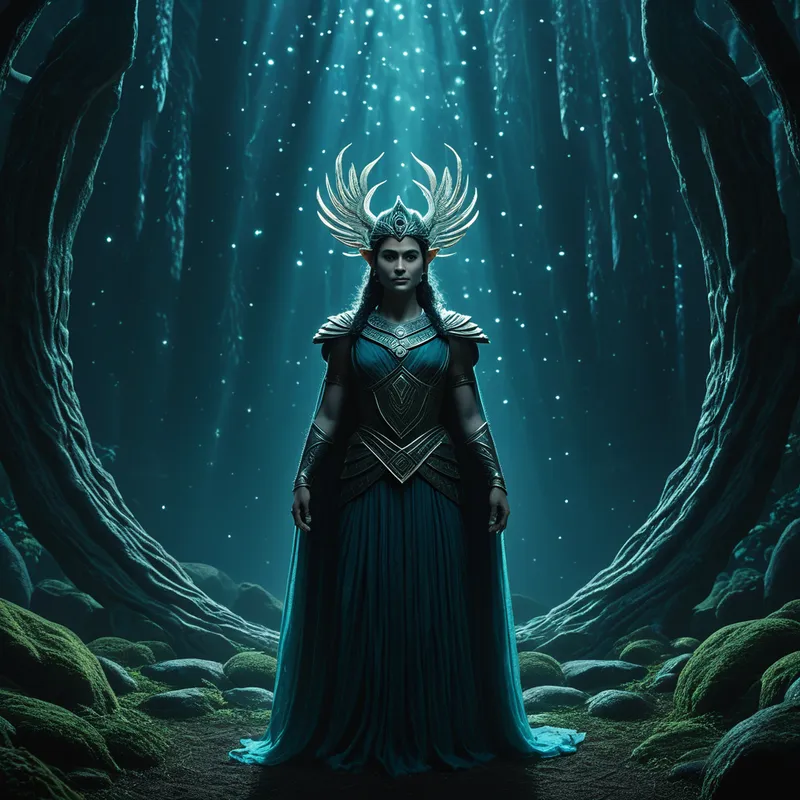
The Grey Wolf
A mystical guardian in Slavic lore, the grey wolf guides heroes through enchanted forests and protects ancient secrets from the unseen world.
The Tale of The Grey Wolf
In the deep, murmuring heart of the primeval forest, where the light falls in dappled pools and the roots of ancient trees know the secrets of [the earth](/myths/the-earth “Myth from Hindu culture.”/), there walks a figure of silent power. He is not merely a wolf, but the Grey Wolf, a being whose pelt holds the color of twilight, of mist over forgotten marshes, and of wisdom earned through countless turnings of the seasons. His story is not one of a single hero, but a thread woven through many tales, a constant presence at [the threshold](/myths/the-threshold “Myth from Folklore culture.”/) where the human world meets the nawie—the Slavic [otherworld](/myths/otherworld “Myth from Celtic culture.”/).
One such tale whispers of a young prince, Ivan Tsarevich, sent on an impossible quest. His path leads not to a clear road, but into the trackless, whispering woods, a place where direction is lost and the soul is tested. It is here, in the profound solitude of the forest, that the Grey Wolf finds him. The beast does not attack, nor does he flee. He stands, a living statue of watchful intelligence, and in his eyes burns a knowledge that transcends animal cunning. He speaks, not with a human tongue, but with a voice that resonates directly within the prince’s spirit, offering not servitude, but guidance. “I know your thoughts,” the wolf might say, “I have eaten your horse. Now, sit upon my back, and do not ask where we are going.”
What follows is a journey of impossible speed and silent understanding. The forest, once a [labyrinth](/myths/labyrinth “Myth from Various culture.”/) of fear, becomes a fluid realm under the wolf’s paws. He carries Ivan across impossible distances, to the foot of a burning oak tree where [the Firebird](/myths/the-firebird “Myth from Slavic culture.”/) nests, or to the high-walled garden of a sleeping princess. The wolf is the agent of fate, the embodied shortcut through the trials of space and time. He instructs, he warns, and when the prince’s human folly leads to failure—seizing the golden cage and awakening the kingdom—the Grey Wolf does not abandon him. He returns, orchestrating a deeper, more cunning strategy, often involving transformation: turning the prince into a beggar, or himself into a counterfeit treasure or a beautiful maiden. He is the sage who knows that the direct path is often the longest, and that true attainment requires guile, patience, and a surrender to a wisdom greater than one’s own desires.
Cultural Origins & Context
The Grey Wolf emerges from the Slavic dvoeverie (dual faith), a stratum of belief where the veneration of natural forces and spirits persisted long beneath the surface of organized religion. Wolves held an immense and ambivalent place in this worldview. They were feared as predators of the flock, yet revered as creatures of formidable strength, intelligence, and potent family bonds. They belonged utterly to the forest, the les, which was not just a collection of trees but a sacred, animate, and often perilous realm—the dwelling place of the [leshy](/myths/leshy “Myth from Slavic culture.”/) and the threshold to the land of the dead.
The Grey Wolf transcends this ambiguity. He is not a spirit of the forest, but a master of it. His color, grey, is significant. It is the color of [the horizon](/myths/the-horizon “Myth from Various culture.”/) at dawn and dusk, of [the veil between worlds](/myths/the-veil-between-worlds “Myth from Celtic culture.”/), of ash (the residue of transformative fire), and of aged wisdom. He operates under the tacit patronage of [Veles](/myths/veles “Myth from Slavic culture.”/), the chthonic god of cattle, wealth, poetry, and [the underworld](/myths/the-underworld “Myth from Greek culture.”/). [Veles](/myths/veles “Myth from Slavic culture.”/), [the shapeshifter](/myths/the-shapeshifter “Myth from Celtic culture.”/) and lord of hidden knowledge, often sent the wolf as his emissary. Thus, the Grey Wolf becomes a [psychopomp](/myths/psychopomp “Myth from Greek culture.”/) of a particular kind—not guiding souls to the afterlife, but guiding living heroes through the symbolic afterlife of the deep woods, the realm of trials and initiations, to retrieve a prize (the Firebird, the princess, the magical horse) that represents a lost or stolen wholeness.
Symbolic Architecture
The Grey [Wolf](/symbols/wolf “Symbol: Wolves in dreams symbolize instinct, intelligence, freedom, and a deep connection to the wilderness and primal instincts.”/) is an archetypal embodiment of the instinctual guide. He represents a form of intelligence that is not rational but deeply knowing—the intelligence of the [body](/symbols/body “Symbol: The body in dreams often symbolizes the dreamer’s self-identity, personal health, and the relationship they have with their physical existence.”/), of the track, of the [pattern](/symbols/pattern “Symbol: A ‘Pattern’ in dreams often signifies the underlying structure of experiences and thoughts, representing both order and the repetitiveness of life’s situations.”/) hidden within [chaos](/symbols/chaos “Symbol: In Arts & Music, chaos represents raw creative potential, uncontrolled expression, and the breakdown of order to forge new artistic forms.”/). He appears when the conscious ego (the [prince](/symbols/prince “Symbol: A prince symbolizes nobility, leadership, and aspiration, often representing potential or personal authority.”/)) is lost, its resources (the horse) exhausted, and its plans rendered useless. His [arrival](/symbols/arrival “Symbol: The act of reaching a destination, marking the end of a journey and the beginning of a new phase or state.”/) signals that the [journey](/symbols/journey “Symbol: A journey in dreams typically signifies adventure, growth, or a significant life transition.”/) must now proceed on a different level, governed by different laws.
He is the embodied intuition that bypasses the labyrinth of the conscious mind. To ride the Grey Wolf is to surrender personal will to the direction of the deeper Self, trusting a wisdom that sees the whole map where the ego sees only walls.
His [role](/symbols/role “Symbol: The concept of ‘role’ in dreams often reflects one’s identity or how individuals perceive their place within various social structures.”/) is never to perform the [task](/symbols/task “Symbol: A task represents responsibilities, duties, or challenges one faces.”/) for the [hero](/symbols/hero “Symbol: A hero embodies strength, courage, and the ability to overcome significant challenges.”/), but to make the impossible journey possible and to teach the hero how to succeed. He provides the means, the [strategy](/symbols/strategy “Symbol: A plan of action designed to achieve a long-term or overall aim, often involving competition, resource management, and foresight.”/), and the transformative disguises. This reflects a profound psychological [truth](/symbols/truth “Symbol: Truth represents authenticity, honesty, and the quest for knowledge beyond mere appearances.”/): the guiding wisdom of the unconscious does not solve our problems for us, but it arranges the circumstances, provides the symbolic tools, and opens the paths that allow our conscious selves to enact the necessary transformations.
Furthermore, his [capacity](/symbols/capacity “Symbol: A measure of one’s potential, limits, or ability to contain, process, or achieve something, often reflecting self-assessment or external demands.”/) for shapeshifting underscores his [nature](/symbols/nature “Symbol: Nature symbolizes growth, connectivity, and the primal forces of existence.”/) as a being of the threshold. He is fluidity itself, able to wear the form required by the [situation](/symbols/situation “Symbol: The ‘situation’ symbolizes the junction between the subconscious and conscious realms, often reflecting the current challenges or dynamics in the dreamer’s waking life.”/). He teaches that [identity](/symbols/identity “Symbol: Identity represents the sense of self, encompassing personal beliefs, cultural background, and social roles.”/) is not a fixed [prison](/symbols/prison “Symbol: Prison in dreams typically represents feelings of restriction, confinement, or a lack of freedom in one’s life or mind.”/) but a garment that can be donned or doffed in service of a greater goal. His [guidance](/symbols/guidance “Symbol: The act of receiving or seeking direction, advice, or leadership in a dream, often representing a need for clarity, support, or a higher purpose on one’s life path.”/) is ultimately toward [integration](/symbols/integration “Symbol: The process of unifying disparate parts of the self or experience into a cohesive whole, often representing psychological wholeness or resolution of internal conflict.”/)—helping the hero retrieve and reconcile with what has been lost or kept hidden (the golden fire of [spirit](/symbols/spirit “Symbol: Spirit symbolizes the essence of life, vitality, and the spiritual journey of the individual.”/), the feminine principle, the magical steed of vitality).
The Dreamer’s Resonance
To encounter the Grey Wolf in a dream is to receive a summons from the deepest strata of the [psyche](/myths/psyche “Myth from Greek culture.”/). He does not appear in the curated spaces of daily life, but in the primal, tangled woods of our inner world. His presence suggests that you have come to a point where conventional thinking, willpower, and known roads have led you to a standstill. The wolf’s gaze, steady and unblinking, asks a silent question: Are you ready to stop driving and be carried?
This figure resonates with the feeling of being guided by a force that feels both utterly foreign and intimately familiar—a sudden intuition, a synchronicity that opens a door, a gut feeling that insists on a path logic would reject. He represents the part of us that knows [the way](/myths/the-way “Myth from Taoist culture.”/) through grief, through creative block, through a life transition, even when the conscious mind is terrified and blind. Riding the wolf in a dream can feel terrifying, exhilarating, or peacefully inevitable. It is an image of trust in a process larger than the individual ego, a consent to be taken into the dark woods of the unknown, with faith that the guide knows the destination your waking self cannot fathom.

Alchemical Translation
In the alchemical process of the soul, the Grey Wolf represents the [prima materia](/myths/prima-materia “Myth from Alchemical culture.”/) in its animal, instinctual form—the raw, powerful, and intelligent substance from which the philosopher’s stone is forged. He is the [Mercurius](/myths/mercurius “Myth from Alchemical culture.”/) of the forest, the quick-silver spirit that is both the guide and the substance of the work. The hero’s initial failure—grabbing the golden cage—is the [nigredo](/myths/nigredo “Myth from Alchemical culture.”/), the blackening, the moment of despair and putrefaction when [the ego](/myths/the-ego “Myth from Jungian culture.”/)’s greed ruins the first attempt. The wolf’s return with a new, cunning plan initiates the [albedo](/myths/albedo “Myth from Alchemical culture.”/), the whitening, where the situation is purified through strategy, disguise, and indirect action.
The wolf’s grey pelt is the cauda pavonis, the peacock’s tail, that shimmering, iridescent stage between black and white, where all possibilities of color and form are held in potential. He is the living embodiment of the transformative medium itself.
The final success of the quest is the [rubedo](/myths/rubedo “Myth from Alchemical culture.”/), the reddening, the attainment of the goal. Yet, crucially, the wolf often departs once his work is done, returning to the forest. This signifies that the instinctual guide is not meant to be permanently domesticated. Its wisdom is integrated not by keeping it as a pet, but by internalizing the lessons of fluidity, cunning, and trust in the unseen pattern. The wolf returns to the unconscious, leaving the hero conscious, whole, and forever changed by the journey.
Associated Symbols
Explore related symbols from the CaleaDream lexicon:
- Forest — The ancient, animate realm of the unknown and the unconscious, a labyrinthine testing ground where ordinary laws are suspended and profound transformation is seeded.
- Guide — An emissary from a deeper order of intelligence, appearing at the threshold of confusion to offer direction not through maps, but through embodied knowing and symbolic action.
- Transformation Cocoon — The protected, hidden state of metamorphosis orchestrated by the guide, where the old identity is dissolved so a new, more capable form can emerge.
- Journey — The fundamental movement of the soul from a state of lack or questioning through trials and guidance toward a hard-won wholeness or revelation.
- Threshold — The liminal space, often guarded, where one world ends and another begins, requiring a guide or a surrender to cross.
- Wolf — The archetype of fierce intelligence, loyalty to the pack (the greater Self), and a profound connection to the untamed, instinctual layers of existence.
- Cunning — The strategic wisdom of the deep psyche, which knows that straight lines are not always true and that indirect, symbolic action often achieves what force cannot.
- Shadow — The initially feared or unknown aspect of [the self](/myths/the-self “Myth from Jungian culture.”/) which, when encountered and integrated like the wolf, reveals itself as a vital source of power and guidance.
- Fate — The underlying pattern or destiny that the instinctual guide serves and reveals, moving the individual toward an appointment with their own deepest story.
- Bridge — The living connection the guide provides between the conscious world and the unconscious, the possible and the impossible, the seeker and the sought.