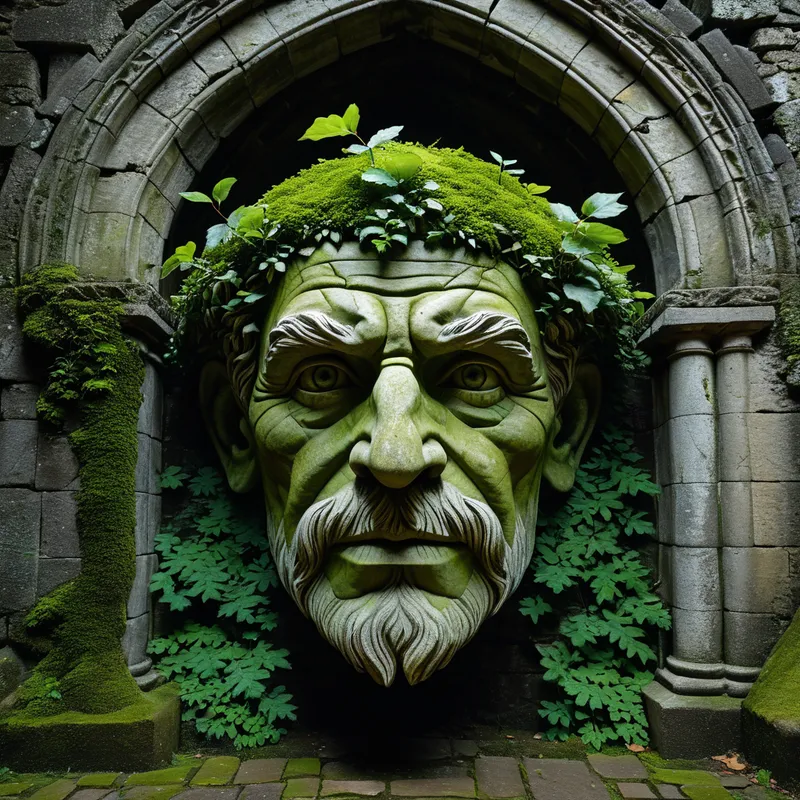
The Green Man Myth Meaning & Symbolism
The ancient face of leaves and vines, a spirit of the wild wood who dies and is reborn with the seasons, symbolizing nature's untamed, cyclical soul.
The Tale of The Green Man
Listen. The story is not written, but grown. It is whispered by [the wind](/myths/the-wind “Myth from Various culture.”/) in the beechwood and murmured by the sap rising in the spring.
Before the first city’s foundation stone was laid, when [the world](/myths/the-world “Myth from Tarot culture.”/) was a garment of unbroken green, the spirit of the wood was awake. He was not a god of high places, but of the low and the deep. His bones were the roots of the oldest yew, his breath [the mist](/myths/the-mist “Myth from Celtic culture.”/) that clung to morning [ferns](/myths/ferns “Myth from Celtic culture.”/), his voice the creak of bough and the rustle of the fox’s passage. He was the anima mundi of the wild places, the guardian of the untamed cycle.
He dwelt in the heart of the forest, a kingdom of dappled light and profound silence. In his presence, berries swelled fat and red, nuts hardened in their shells, and the deer grew sleek. His laughter brought the blossom; his thoughtful pause brought the deep, slow growth of trunk and bole. He was the greening force itself.
But the cycle turns, as it must. The air grew sharp. The sun’s arc lowered, and a pallor touched the leaves. This was his time of trial, not by monster or hero, but by the iron law of the world he embodied. You could hear it in the forest—a slowing, a sigh. The [Green Man](/myths/green-man “Myth from Celtic culture.”/)’s vibrant form began to still. The ivy threading his hair browned at the edges. The moss on his cheeks grew dry. He did not fight it. He walked to a sacred clearing, a place of exposed root and stone, and lay down upon [the earth](/myths/the-earth “Myth from Hindu culture.”/).
The cold came. It painted him in rime and silence. His body seemed to crumble, to become one with the leaf litter, a mound of decay under the grey sky. The world above slept. But below, in the secret, frozen dark, a different work was being done. His essence sank into the mycelial web, a ghost in the roots, a promise held in the sleeping seed.
Then, a softening. A drip from an icicle. A scent of wet earth. Deep in the ground, where death and life are lovers, the promise stirred. A green shoot, tender and impossibly bold, pierced the mound in the clearing. Then another. And another. They twined and climbed, weaving a new form from willow withe and [hawthorn](/myths/hawthorn “Myth from Celtic culture.”/) spike, stitching flesh from new grass and petal. From the heart of decay, from his own dissolution, the Green Man opened eyes of fresh beech leaf. He drew a first breath of spring air, tasting of snowdrop and damp soil. He had not been reborn; he had become the rebirth. The forest exhaled, and the cycle began anew.
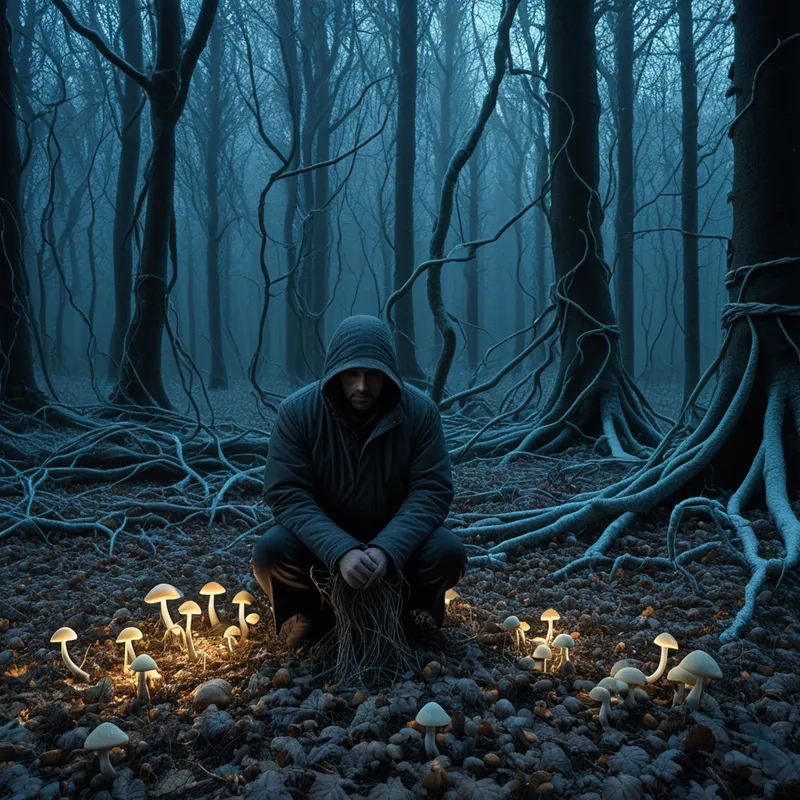
Cultural Origins & Context
The figure we name the Green Man is a paradox: a specific term for a universal whisper. He has no single origin story, no canonical scripture. His lineage is written in stone and leaf across continents and millennia. We find his leafy gaze in the temples of [Tammuz](/myths/tammuz “Myth from Mesopotamian culture.”/), in the Dionysian thiasus, in the foliate masks of Celtic Cernunnos, the Horned God of the wild wood. He stares down from the roof bosses and misericords of medieval European cathedrals—a pagan spirit comfortably ensconced in the house of God, suggesting a deep, syncretic understanding.
He was not primarily a myth told, but an image seen and a presence felt. His stories were enacted in the seasonal rituals of agricultural societies—the May King crowned with greenery who must, in some symbolic or remembered way, yield to the winter. He was the embodied answer to the most urgent human question: will the green world return? His “myth” was the annual drama of the seasons, and his priests were the farmers, the foresters, and the folk who knew the land’s face. He represents a pre-literate, somatic relationship with nature, where the cycle of life, death, and regeneration was not a metaphor but the fundamental rhythm of existence.
Symbolic Architecture
Psychologically, the Green Man is not merely a [symbol](/symbols/symbol “Symbol: A symbol can represent an idea, concept, or belief, serving as a powerful tool for communication and understanding.”/) of [nature](/symbols/nature “Symbol: Nature symbolizes growth, connectivity, and the primal forces of existence.”/), but of nature within—the untamed, instinctual, and cyclical [psyche](/myths/psyche “Myth from Greek culture.”/) that exists beneath the cultivated [persona](/symbols/persona “Symbol: The social mask or outward identity one presents to the world, often concealing the true self.”/).
He is the face of the unconscious itself, forever growing through and around the structures of consciousness, both adorning and unsettling them.
His foliage-spewing mouth symbolizes the [eruption](/symbols/eruption “Symbol: A sudden, violent release of pent-up energy or emotion from beneath the surface, often representing transformation or crisis.”/) of vegetative, non-verbal [life](/symbols/life “Symbol: The symbol of ‘Life’ represents a journey of growth, interconnectedness, and existential meaning, encompassing both the joys and challenges that define human experience.”/) into the [realm](/symbols/realm “Symbol: The symbol of ‘Realm’ often signifies the boundaries of one’s consciousness, experiences, or emotional states, suggesting aspects of reality that are either explored or ignored.”/) of thought and speech. He is the raw stuff of dreams and instincts pushing into the light. He is not the civilized garden, but the wildwood at the edge of the settlement, representing all we have repressed, forgotten, or deemed “uncultivated” in ourselves: primal creativity, fierce vitality, and the [acceptance](/symbols/acceptance “Symbol: The experience of being welcomed, approved, or integrated into a group or situation, often involving validation of one’s identity or actions.”/) of decay as part of growth.
His perpetual cycle of [dissolution](/symbols/dissolution “Symbol: The process of breaking down, dispersing, or losing form, often representing transformation, release, or the end of a state of being.”/) and re-[emergence](/symbols/emergence “Symbol: A process of coming into being, rising from obscurity, or breaking through a barrier, often representing birth, transformation, or revelation.”/) models the process of psychological [death](/symbols/death “Symbol: Symbolizes transformation, endings, and new beginnings; often associated with fear of the unknown.”/) and renewal. [The ego](/myths/the-ego “Myth from Jungian culture.”/), like the [summer](/symbols/summer “Symbol: Summer often symbolizes warmth, growth, and abundance, representing a time of vitality and fruition.”/) canopy, must sometimes fall away for new growth to occur. The Green Man teaches that [identity](/symbols/identity “Symbol: Identity represents the sense of self, encompassing personal beliefs, cultural background, and social roles.”/) is not a [static](/symbols/static “Symbol: Static represents interference, disruption, and the breakdown of clear communication or signal, often evoking feelings of frustration and disconnection.”/) [statue](/symbols/statue “Symbol: A statue typically represents permanence, ideals, or entities that are revered.”/), but a perennial process. He symbolizes the coniunctio oppositorum of life and [death](/symbols/death “Symbol: Symbolizes transformation, endings, and new beginnings; often associated with fear of the unknown.”/), showing them not as enemies but as phases of a single, green [breath](/symbols/breath “Symbol: Breath symbolizes life, vitality, and the connection between the physical and spiritual realms.”/).
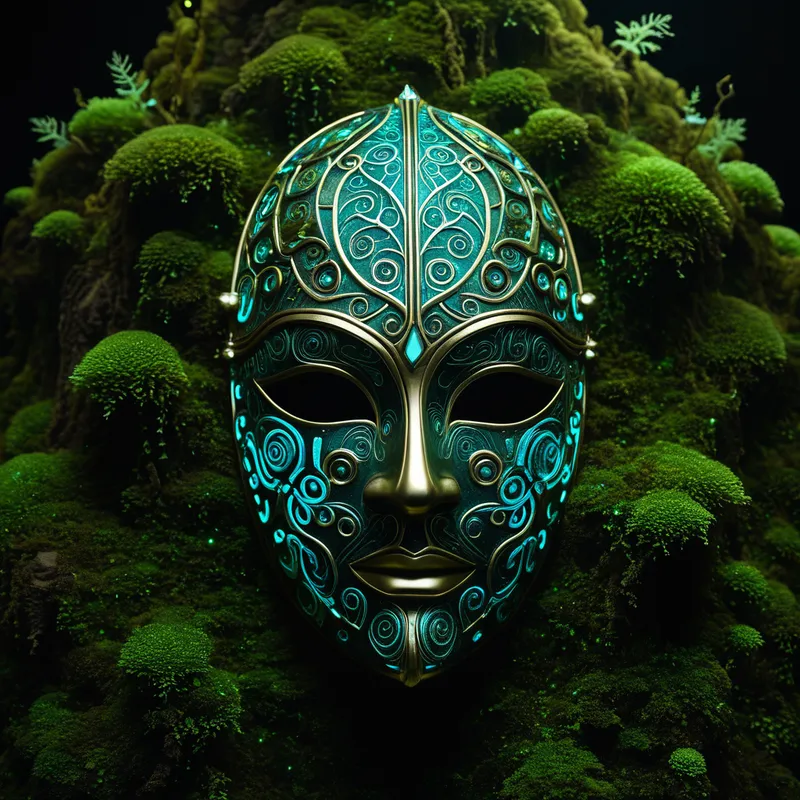
The Dreamer’s Resonance
When the Green Man appears in a modern dream, he is often an envoy from an overgrown inner landscape. He appears when the dreamer’s life has become too arid, too controlled, or too linear. The psyche sends this verdant vision to re-initiate a vital, neglected process.
Somatically, this might coincide with feelings of stagnation, chronic fatigue (a psychic winter), or conversely, with restless, undirected energy (a sap-rise with no outlet). To dream of his face emerging from a wall might signal the breakthrough of instinctual wisdom through the rigid structures of one’s daily life or beliefs. To dream of becoming the Green Man—feeling leaves sprout from one’s skin—often speaks to a profound, sometimes frightening, process of metamorphosis. It is the somatic feeling of the personality dissolving and reforming around a deeper, more authentic core. The dream is an invitation to engage with one’s own wildness, to allow a part of the old self to compost so that a new, more vital form of being can take root.

Alchemical Translation
The alchemical journey mirrored in the Green Man’s myth is the [nigredo](/myths/nigredo “Myth from Alchemical culture.”/) and albedo—the blackening of decay and the greening of renewal. For the modern individual pursuing individuation, his story provides a map for psychic transmutation.
First, one must enter the “forest”—the complex, shadowed realm of the personal and collective unconscious. The conflict is the ego’s resistance to its own necessary “winter,” the dissolution of outdated attitudes, identities, and complexes. This is the nigredo: the feeling of being lost, crumbling, and reduced to base matter. The Green Man’s passive surrender to the cycle is key; the ego does not will this death, but must consent to it as part of a larger, natural law.
The triumph is not in avoiding dissolution, but in discovering that the core of being is not the form that dissolves, but the greening force that re-forms.
The albedo and subsequent citrinitas (yellowing) are the emergence of new consciousness from this dark matter. The new shoot from the old mound is the nascent symbol, the fresh insight, the creative life that can only emerge from the compost of lived experience. To integrate the Green Man is to align one’s personal development with this organic, cyclical tempo. It is to become both [the gardener](/myths/the-gardener “Myth from Christian culture.”/) and the wildwood, to build a consciousness that does not wall out nature’s rhythm but is built upon it, allowing for periods of fruitful decay as essential to all true and lasting growth. One becomes, in a sense, a living cathedral, with the foliate face of the wild forever looking out from within.
Associated Symbols
Explore related symbols from the CaleaDream lexicon:
- Grassy
- Resort
- Biodegradable Technology
- Floral Pants
- Festive Partygoer
- Weather Vane
- Golf Cart
- Mint Green
- Cinnamon Brown
- Olivine Stone
- Chrysoprase Stone
- Malachite Necklace
- Dolomite Gem
- Lithium Leaf
- Flowering Vine
- Wildflower Meadow
- Geranium Bloom
- Heather Low
- Moss-Covered Roots
- Eucalyptus Leaf
- Mint Leaves
- Vines Entwined
- Poison Ivy
- Verdant Grass
- Elven Archery Bow
- Scarecrow Guardian
- Athletic Socks
- Scented Pinecone
- Leaf Pile
- Eco-Friendly Spade
- Wicker Chair
- Flowered Armchair
- Organic House
- Craftsman Cottage
- Eco-Friendly Home
- Overgrown Ruins
- Lush Forest Glade
- Moss-Covered Ruins
- Tangled Vines
- Symbiotic Unity
- Floral Vines
- Leaf Veins
- Floral Wallpaper
- Dewy Fern
- Bearberry Bush
- Dandelion Root
- Herbal Remedy
- Hushed Forests
- Trampled Grass
- Moss Cake
- Foraged Greens
- Thicket
- Sapling Shelter
- Barking Tree Branches
- Sapling Grove
- Woodland Canopy
- Knotty Pine
- Maple Leaves
- Mossy Steps
- Moss Garden
- Stinging Nettle
- Maple
- Moss