The Green Knight's Girdle Myth Meaning & Symbolism
Sir Gawain accepts a deadly challenge from a supernatural knight, a journey testing his chivalry and revealing the profound meaning of a magical girdle.
The Tale of The Green Knight’s Girdle
Hear now a tale from the high-towered halls of Camelot, when the fire roared and the wine flowed, and the world was young with the promise of chivalry. It was a Yuletide feast, a time for games and boasting. But into that warm circle of light and laughter rode a chill from the world’s oldest wood.
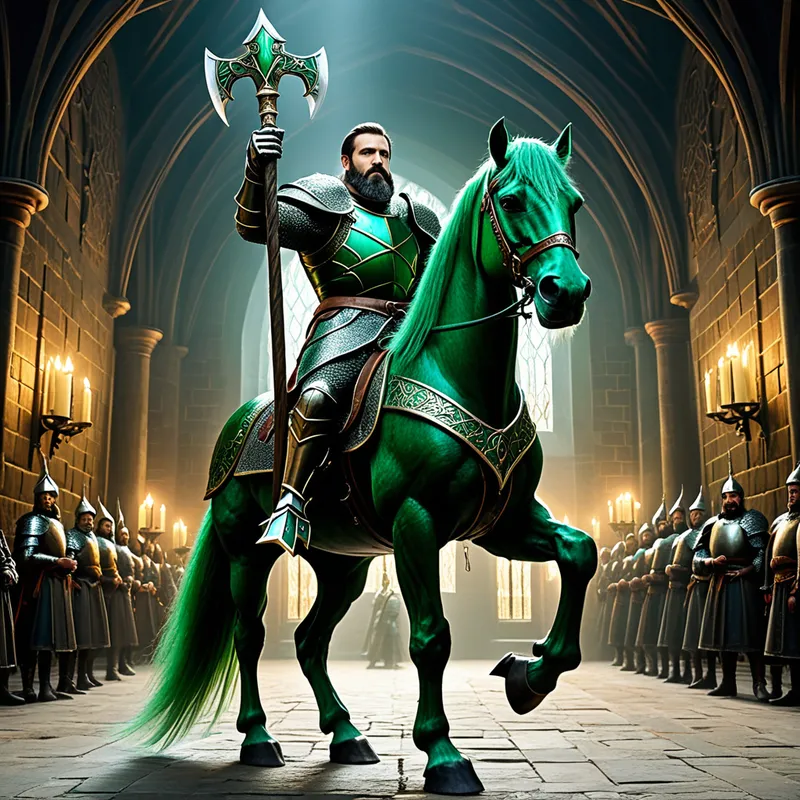
The doors burst open. There stood a figure to still the heart. A knight, but like no other—his skin the deep green of a mossy stone, his hair and great beard like a thicket of holly, his armor all of green and gold. He rode a horse, green and mighty as a storm-tossed hill. In one hand, a branch of holly for peace; in the other, a Danish axe, its edge cruel and bright. This was the Green Knight, and he offered a game: a blow for a blow. Let any knight strike him once with this axe, if he would dare to receive the same blow in a year and a day.
Silence gripped the hall. Then Sir Gawain, in his youth and valor, rose. To protect the honor of his king and court, he took the axe. With one swift stroke, he cleaved the Green Knight’s head from his shoulders. The head rolled on the rushes, blood dark as yew-berry. But the green body did not fall. It strode forward, picked up its own head by the hair, and the eyelids opened. The lips spoke, reminding Gawain of his pledge: to seek the Green Chapel in one year’s time to receive his stroke.
The seasons turned. Leaves fell, snows came, and Gawain’s quest began. Through a wilderness of wolf-haunted forests and bone-chilling frost, he rode, his shield bearing the pentangle, the endless knot of his virtues. On Christmas Eve, lost and weary, he found a castle of strange hospitality. Its lord, a jovial, red-faced giant of a man, welcomed him warmly. His lady, however, was a vision of such beauty and grace she seemed otherworldly. For three days, the lord proposed a game: he would go hunting, and whatever he won in the forest, he would give to Gawain. In return, Gawain must give him whatever he had gained in the castle.
Each morning, the lord rode out. And each morning, the lady came to Gawain’s chamber. With silken words and gentle pressure, she tested his courtesy and chastity. She offered kisses, one, then two, then three, which Gawain, bound by chivalry, accepted and later dutifully passed to her husband as his daily “winnings.” But on the third day, she offered a gift beyond kisses: a girdle of green silk, woven with gold. “It possesses a virtue,” she whispered. “No man wearing it can be killed by any blow on earth.”
Here was the serpent in the garden of his virtue. Fear of the looming axe-stroke coiled in his heart. Thinking of the Green Chapel, thinking of death, Gawain accepted the girdle. But he broke the covenant with his host; he gave the three kisses but kept the girdle secret, a hidden talisman against his fate.
The day came. Gawain found the Green Chapel—a mere mossy barrow, a pagan mound by a rushing stream. The Green Knight emerged, axe in hand, vibrant as spring. Gawain bared his neck. The axe swung once, twice, each time halting to taunt his flinch. On the third swing, it bit—but only nicking the skin, drawing a thin line of blood.
Then the revelation came. The Green Knight revealed himself as Bertilak, the lord of the castle, transformed by the magic of Morgan le Fay. The three feinted blows were for the three days of honest exchange; the tiny cut was for the one day of deceit—the hidden girdle. Gawain had passed the test of courage and courtesy but failed in absolute honesty. He was, in the end, human.
Shame burned in Gawain like a fever. He cried out against his cowardice and covetousness, vowing to wear the green girdle forever as a badge of his fault. He returned to Camelot, not in triumph, but in humbled truth, telling the whole tale. And the court, in a gesture of deep fellowship, each knight adopted the green baldric, transforming a symbol of personal shame into one of shared human frailty and solidarity.
Cultural Origins & Context
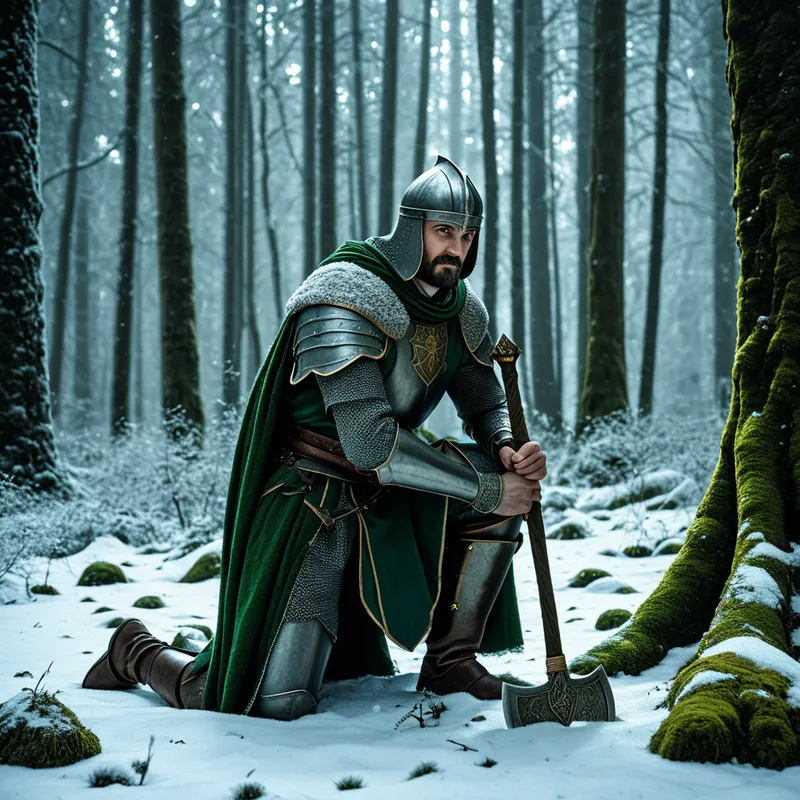
This myth comes to us from the late 14th-century poem Sir Gawain and the Green Knight, a masterpiece of the Alliterative Revival in the Northwest Midlands of England. It exists in a single manuscript, alongside other profound works like Pearl. Its anonymous author was likely a cleric or a deeply learned courtier, weaving together the high French romance tradition of Arthur’s court with older, darker Celtic motifs of vegetative deities, seasonal cycles, and beheading games.
The tale functioned as more than entertainment. In an age where chivalric ideals were both celebrated and seen as impossibly rigid, the poem served as a sophisticated interrogation of those very codes. It was told in noble halls, a mirror held up to the knightly class. It asked: What happens when perfect virtue meets the imperfect human heart? The myth provided a narrative container for societal anxieties about honor, integrity, and the fear of death, ultimately arguing for a compassion grounded in acknowledged fallibility rather than impossible perfection.
Symbolic Architecture
The myth is a perfect symbolic engine. The Green Knight himself is the ultimate Shadow and the Self archetype combined. He is the untamed, immortal force of nature and fate that interrupts the civilized, conscious world of Camelot. He is the inevitable challenge that life presents to test the integrity of the persona—the knightly identity Gawain has constructed.
The Green Knight is not an enemy to be slain, but a truth to be faced. He is the embodiment of the pact we make with life itself: to live fully is to accept mortality.
The journey to the Green Chapel is the night sea journey, a descent into the wilderness of the psyche. The castle represents a liminal space of testing, where the rules of the conscious world are suspended for a deeper game. The lord and lady are twin aspects of the challenge: the overt, masculine bargain and the covert, feminine seduction, testing different facets of the ego’s integrity.
The green girdle is the central, transformative symbol. Initially, it is a talisman of the ego’s fear—a magical attempt to cheat fate, to avoid the necessary wound. It represents the secret compromises we make, the small dishonesties we hide to preserve our self-image and safety. Gawain’s acceptance of it is his moment of human failing, his choice of literal survival over symbolic integrity.

The Dreamer’s Resonance
When this myth stirs in modern dreams, it signals a profound psychological crossroads. To dream of accepting a seemingly impossible challenge from a formidable, otherworldly figure points to a deep, unconscious recognition of a necessary but feared life transition—a career change, the end of a relationship, a confrontation with illness or loss. The Green Knight is the dream’s way of personifying this daunting call to growth.
Dreaming of the girdle itself—a belt, a ribbon, a piece of protective clothing offered in secret—is particularly telling. It signifies an active, somatic process of bargaining with fear. The dream ego is seeking a shortcut, a magical solution to avoid the full, terrifying impact of a necessary ordeal. The shame Gawain feels upon revelation is the dream’s precursor to the conscious feeling of guilt or self-betrayal we experience when we realize we have been acting from a place of hidden fear, not integrity. Such dreams often precede a conscious decision to “face the axe”—to stop avoiding a difficult conversation, to cease a self-deception, or to accept a painful but truthful aspect of oneself.
Alchemical Translation
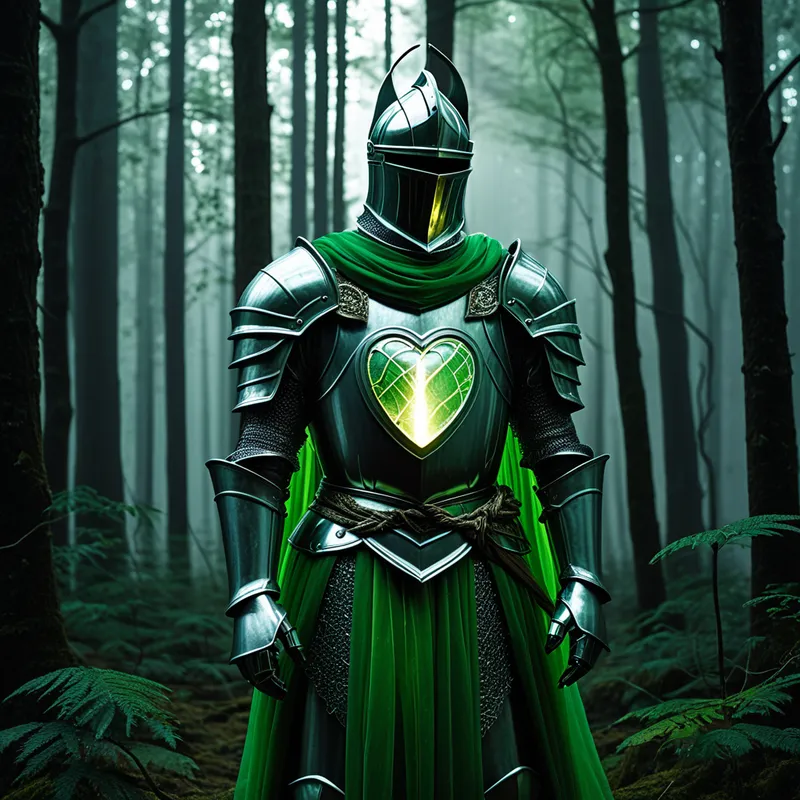
The myth models the alchemical process of nigredo and albedo in the crucible of individuation. Camelot represents the initial, unconscious status quo of the personality. The Green Knight’s challenge is the shocking, often traumatic opus that initiates the work. Gawain’s journey is the necessary dissolution (solutio)—the melting away of his certainties in the wilderness.
The castle games represent the intricate stage of separatio and coniunctio—separating and recombining elements of the self. Gawain must navigate between the demands of courtesy (his persona) and desire, between honesty and survival. His failure with the girdle is not the end of the work, but its crucial centerpiece.
The nick from the axe is the sacred wound. It is not a punishment, but the precise, surgical incision that allows the poison of self-illusion to drain out.
This is the moment of mortificatio—the symbolic death of the ego’s pretension to perfect control and fearlessness. The acceptance of the wound and the shame, the conscious donning of the girdle as a mark of fault, is the albedo, the whitening. The green of nature and life, once a threat, is now integrated as a mark of humbled, mortal humanity. The ego is not destroyed, but radically humbled and brought into relationship with the larger, immortal Self (the Green Knight). Gawain returns not as a perfect hero, but as an integrated individual, and his community’s adoption of the symbol completes the process, showing that individuation, while personal, ultimately serves the collective by modeling authentic, flawed humanity. The magical girdle of avoidance becomes the baldric of conscious, shared limitation—the final gold of the alchemical process.
Associated Symbols
Explore related symbols from the CaleaDream lexicon: