The Green Chapel Myth Meaning & Symbolism
Sir Gawain faces a supernatural test of honor at the Green Chapel, confronting mortality and the raw, untamed power of the natural world.
The Tale of The Green Chapel
Listen, and hear a tale of a test, not of strength, but of the heart’s true mettle. In the high hall of Camelot, where the fire roared and the wine flowed like a red river, a feast was laid for the New Year. King Arthur sat among his shining company, a brotherhood of the bravest and best. Yet into this circle of light came a shadow—or rather, a figure of impossible, vibrant life.
The doors burst open, and the cold rushed in. Upon a horse as green as summer holly rode a knight. A giant of a man, his skin, his hair, his very armor were the deep, living green of the forest. In one hand he bore a holly branch, a token of peace. In the other, a great axe of green steel, its edge cruel and bright. His challenge echoed in the stunned silence: a blow for a blow. He would suffer one stroke of an axe upon his own neck, if the champion of [the Round Table](/myths/the-round-table “Myth from Arthurian culture.”/) would seek him out in a year and a day to receive the same.
A hush fell. Then, to preserve the honor of his king and court, [Sir Gawain](/myths/sir-gawain “Myth from Arthurian culture.”/) rose. He took the axe. With a single, swift stroke, he severed [the Green Knight](/myths/the-green-knight “Myth from Arthurian culture.”/)’s head from his shoulders. The company gasped as the head rolled upon the rushes, its eyes still open. But the body did not fall. It strode forward, gathered up the grinning head by its green hair, and mounted its steed. The head spoke, its voice a rustle of leaves: “Seek me, Gawain, at the Green Chapel. A year hence, we shall finish our covenant.”
The seasons turned. As the next winter’s bite sharpened the air, Gawain rode forth from Camelot, his shield bearing the golden pentangle, symbol of his flawless virtues. He journeyed through a dying world, through forests where the trees were bones against the grey sky, until he came to a wild, northern land. There, he found refuge in a magnificent castle, where the lord, Bertilak, was as hearty as his home was warm. For three days, as Gawain rested, a game was proposed: the lord would hunt each day, and Gawain would stay in the castle, exchanging whatever they had gained by evening.
Each day, the lord hunted the beasts of the forest—the deer, the boar, the fox. And each day, the lady of the castle, beautiful and cunning as a serpent, sought out Gawain in his chamber, offering kisses that he, bound by courtesy, reluctantly accepted and dutifully exchanged with her husband at night. But on the third day, she offered a gift he could not in honor exchange: a green silk girdle, enchanted, she said, to protect the wearer from all harm. Thinking of the axe-stroke to come, Gawain, in a moment of human fear, accepted it and hid it from his host.
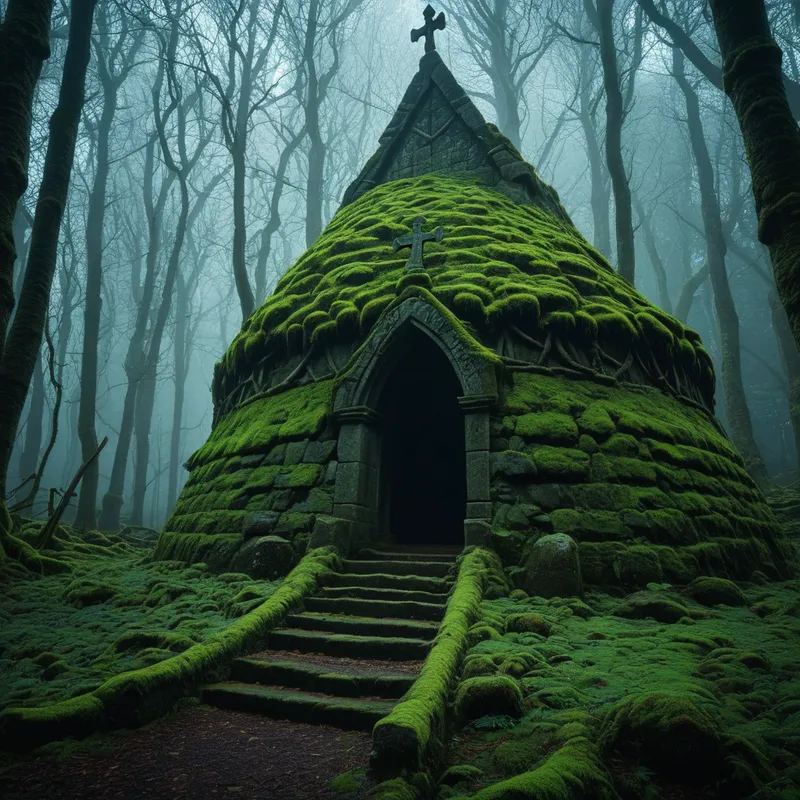
The fateful morn arrived. Guided by a grim servant through a frozen landscape, Gawain came at last to a desolate valley. No chapel of stone stood there, but only a grassy, overgrown barrow—an ancient burial mound by a rushing stream. This was the Green Chapel. From within [the earth](/myths/the-earth “Myth from Hindu culture.”/) itself, the sound of a blade being whetted echoed. Then the [Green Knight](/myths/green-knight “Myth from Arthurian culture.”/) emerged, whole and terrible, his axe gleaming.
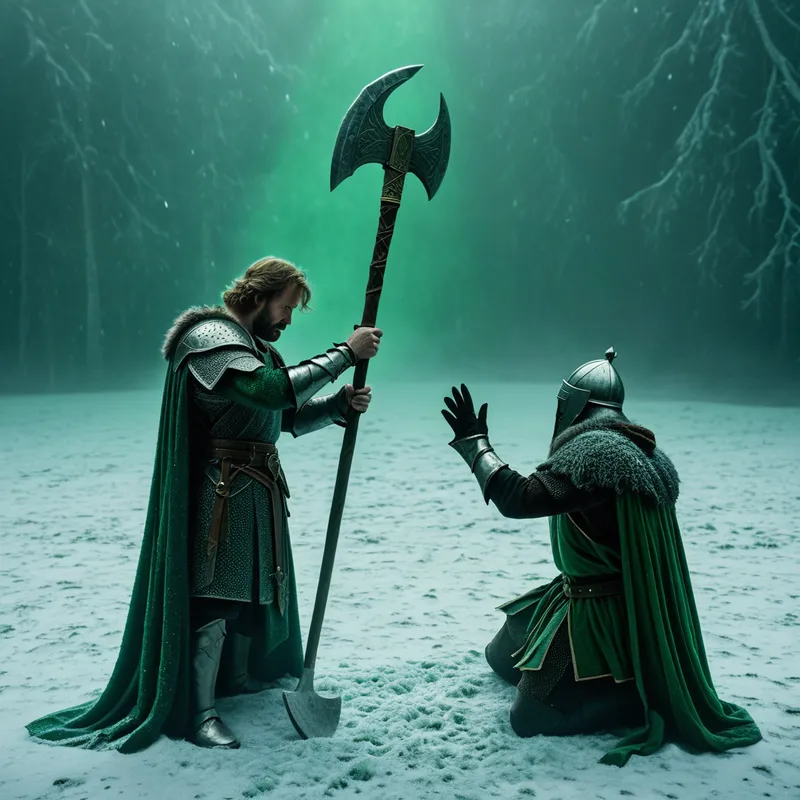
“Now, Sir Gawain, make ready,” he boomed. Gawain bared his neck. The axe swung once, twice, each time halting just above the skin, testing his flinch. The third swing bit, but only nicked Gawain’s flesh, drawing a thin line of blood. Then the Green Knight stood straight, and his form seemed to shift, revealing himself as Bertilak, the lord of the castle. The entire ordeal was a test devised by the sorceress [Morgan le Fay](/myths/morgan-le-fay “Myth from Celtic culture.”/). The three swings were for the three days of the exchange; the nick was for his one fault—the concealed girdle, a token of his desire for life over perfect integrity.
Shamed, Gawain clutched the girdle as a badge of his failing. But the Green Knight laughed, a sound like wind in oak leaves, and declared him the most honorable knight in all the land, for he was flawed, and thus, truly human. Gawain returned to Camelot, not in [triumph](/myths/triumph “Myth from Roman culture.”/), but in sober wisdom, his golden pentangle forever joined by the green belt of humility.
Cultural Origins & Context
The tale of Sir Gawain and the Green Knight survives in a single, exquisite manuscript from the late 14th century, written in a dialect of Middle English. It is a chivalric romance, but one that stands apart, deeply rooted in the soil of Celtic Britain and the older, pagan world that lingered in its forests and hills. The anonymous poet was likely a courtly writer, blending the French romance tradition popular in aristocratic circles with native British folklore.
The story functioned as more than entertainment. In an age where the code of chivalry was both an ideal and a rigid social construct, the poem served as a profound ethical inquiry. It asked: What happens when perfect courtesy conflicts with the instinct for survival? Can honor survive a crack? It was told in halls not unlike Bertilak’s, a winter’s tale for a society grappling with its own contradictions, where Christian virtue sat uneasily alongside older, more visceral loyalties and the ever-present shadow of mortality. The Green Chapel itself is not a Christian space but a tumulus, a direct link to the ancestral, animistic landscape.
Symbolic Architecture
The myth is a masterful [architecture](/symbols/architecture “Symbol: Architecture in dreams often signifies structure, stability, and the framing of personal identity or life’s journey.”/) of symbols, each [layer](/symbols/layer “Symbol: Layers often symbolize complexity, depth, and protection in dreams, representing the various aspects of the self or situations.”/) revealing a confrontation between the cultivated self and the wild [soul](/symbols/soul “Symbol: The soul represents the essence of a person, encompassing their spirit, identity, and connection to the universe.”/).
The Green [Knight](/symbols/knight “Symbol: The knight symbolizes honor, chivalry, and the pursuit of noble causes, reflecting the ideal of the noble warrior.”/) is not a [villain](/symbols/villain “Symbol: A character representing opposition, moral corruption, or suppressed aspects of self, often embodying fears, conflicts, or societal threats.”/), but an embodiment of the [shadow](/symbols/shadow “Symbol: The ‘shadow’ embodies the unconscious, repressed aspects of the self and often represents fears or hidden emotions.”/) of [nature](/symbols/nature “Symbol: Nature symbolizes growth, connectivity, and the primal forces of existence.”/) itself—relentless, cyclical, and brutally honest. He is the challenge the civilized world must face to remain vital. His color is the green of [life](/symbols/life “Symbol: The symbol of ‘Life’ represents a journey of growth, interconnectedness, and existential meaning, encompassing both the joys and challenges that define human experience.”/), decay, and [regeneration](/symbols/regeneration “Symbol: The process of renewal, restoration, and growth following damage or depletion, often representing emotional healing, transformation, or a fresh start.”/), a hue absent in the [stone](/symbols/stone “Symbol: In dreams, a stone often symbolizes strength, stability, and permanence, but it may also represent emotional burdens or obstacles that need to be acknowledged and processed.”/) and [tapestry](/symbols/tapestry “Symbol: The tapestry represents interconnected stories, creativity, and the weaving of personal and collective experiences into a cohesive narrative.”/) of Camelot.
The Green Chapel is not a place of worship, but a place of meeting—where the human contract with the raw, unmediated world is renewed through a covenant of blood and truth.
Gawain’s [shield](/symbols/shield “Symbol: A symbol of protection, defense, and boundaries, representing personal security, resilience, and the need to guard against external threats or emotional harm.”/), with its endless [knot](/symbols/knot “Symbol: A knot symbolizes connections, commitments, complications, and the binding or untying of relationships and situations.”/) of the pentangle, represents his idealized, conscious self—his five virtues, his [connection](/symbols/connection “Symbol: Connection symbolizes relationships, communication, and bonds among individuals.”/) to the divine. The green girdle, conversely, is the [symbol](/symbols/symbol “Symbol: A symbol can represent an idea, concept, or belief, serving as a powerful tool for communication and understanding.”/) of the unconscious bargain, the hidden flaw, the instinctual desire to preserve the mortal self. The nick on his [neck](/symbols/neck “Symbol: The neck in dreams often symbolizes communication, vulnerability, and the connection between thoughts and emotions.”/) is the sacred wound of [initiation](/symbols/initiation “Symbol: A symbolic beginning or transition into a new phase, status, or awareness, often involving tests, rituals, or profound personal change.”/), the permanent [mark](/symbols/mark “Symbol: A ‘mark’ often symbolizes identity, achievement, or a defining characteristic in dreams.”/) that proves the encounter was real and transformative. He does not transcend his humanity; he is inscribed into it more deeply.
The Dreamer’s Resonance
When this myth stirs in the modern [psyche](/myths/psyche “Myth from Greek culture.”/), it often manifests in dreams of profound testing. One may dream of being summoned to a mysterious, overgrown location—a forgotten basement that becomes a cavern, a park that deepens into a primeval forest. The feeling is one of dread and obligation. The “Green Knight” may appear not as a figure, but as a demanding boss, a stern parent, or simply an immovable, ecological force (a storm, a rising flood).
Somatically, the dreamer may feel the tension in the neck and shoulders—the place of the awaited blow. This is the body holding the anticipation of a reckoning, a confrontation with a truth they have avoided. The psychological process is one of integration under pressure. The dream signals that a period of evasion or polite exchange (like Gawain’s castle games) is over. [The self](/myths/the-self “Myth from Jungian culture.”/) is being called to the “chapel” of its own conscience or circumstances to face the consequence of a hidden compromise, to acknowledge where self-preservation has chipped away at integrity. The resolution is not about victory, but about receiving the wound that makes one whole.

Alchemical Translation
The journey of Gawain is a perfect map of the alchemical individuation process. It begins with the [nigredo](/myths/nigredo “Myth from Alchemical culture.”/), the blackening: the shocking, decapitating challenge that shatters the comfortable, courtly consciousness (Gawain’s identity as the perfect knight). His journey north in winter is the albedo, the whitening—a purification through solitude and hardship, a stripping away of courtly supports.
The castle represents the deceptive citrinitas, the yellowing—a stage of complex exchanges and reflections, where the hero must engage with the anima (the lady) and [the shadow](/myths/the-shadow “Myth from Jungian culture.”/) (the lord) in a dance of temptation and hidden bargains. Here, the psyche’s contents are stirred and brought into relation.
The final meeting at the Green Chapel is the rubedo, the reddening: the confrontation where spirit and matter, ideal and instinct, meet. The drawing of blood is the crucial act of transmutation.
The nick is not a failure, but the creation of the philosopher’s stone—the integrated self. Gawain returns not with gold, but with the green girdle worn as a badge of acknowledged imperfection. This is the alchemical gold: the realization that wholeness includes the flaw, that life (the green) is preserved not by perfect armor, but by the humility of the scar. The myth teaches that individuation is not about achieving sinless perfection, but about having the courage to keep one’s appointment with the wild, green truth of one’s own nature, and to be marked by it forever.
Associated Symbols
Explore related symbols from the CaleaDream lexicon: