The Greek underworlda Myth Meaning & Symbolism
A profound exploration of the Greek underworld, the realm of Hades, as a mythic map for the soul's descent into the unconscious and its confrontation with the shadow.
The Tale of The Greek underworlda
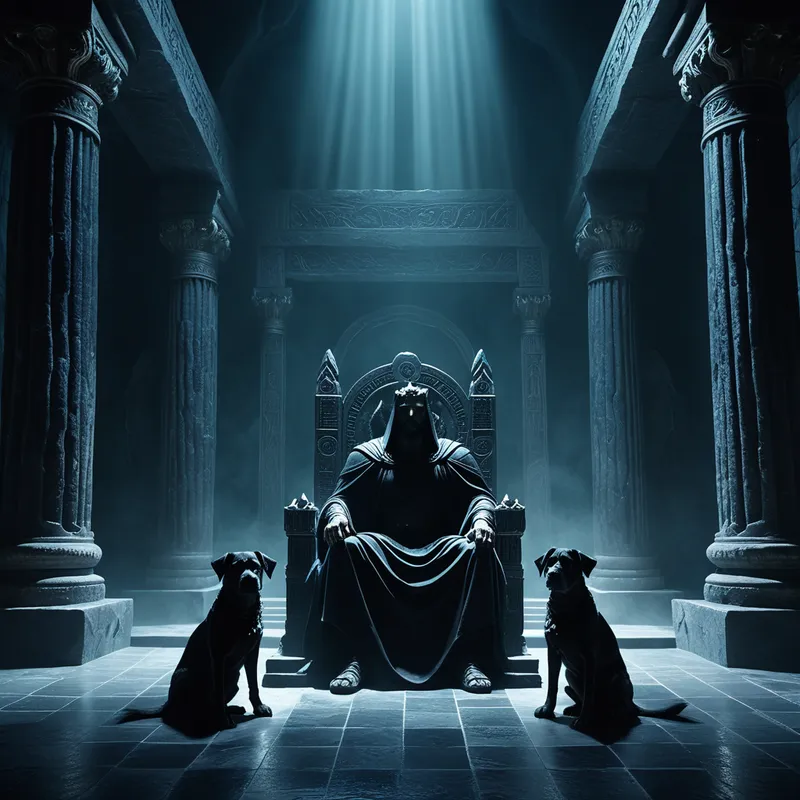
Listen. Beyond the last setting sun, past the western ocean where the world grows cold and memory fades, lies a land where the light of Helios never falls. This is Hades, the Unseen. Its gates are not of iron, but of sighing mist and the weight of finality. Here, the great, somber Hades rules from a throne of black rock, his gaze as deep and still as a forgotten well. Beside him, his queen Persephone holds a pomegranate, its seeds like frozen rubies, a taste of both life and eternal binding.
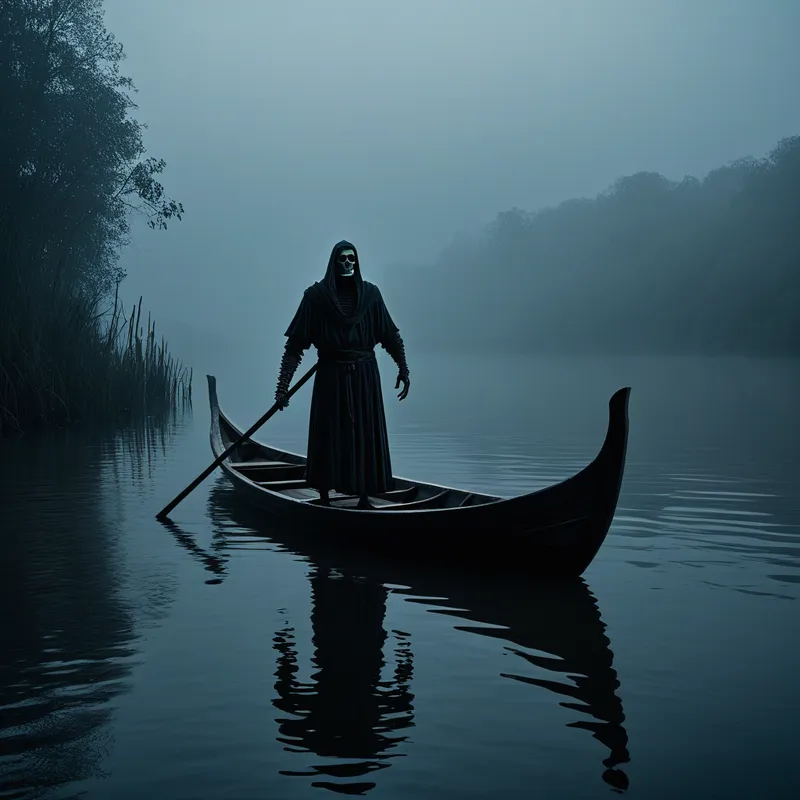
To enter, a soul must first cross a river. Not with a bridge, but with a coin for passage. The water is the Styx, black and slow, a current of oaths and endings. The ferryman, Charon, is a wraith in a hood, his pole dipping into waters that swallow sound. On the far bank, the three-headed hound Cerberus waits, a living gate, his growls the only music in that silent place.
The land within is not one of fire, but of shades. The Asphodel Meadows stretch, grey and endless, where the common dead wander, whispering like dry reeds, their identities bleached by time. To the left, the Fields of Punishment echo with distant, futile cries. To the right, the Elysian Fields glow with a soft, borrowed light, a memory of sun on grass.
But at the heart, in the deepest pit, lies Tartarus. Here, the old Titans churn in darkness, and the truly damned enact their eternal sentences—Sisyphus heaves his stone, Tantalus reaches in vain, and the Danaides pour water into a vessel with no bottom. This is the foundation stone of the unseen world, the absolute end of the road.
And yet, a thread runs back to the world above. For part of the year, Persephone ascends, and the earth blooms with her mother Demeter’s joy. For the other part, she returns, and the world grows cold. This is the rhythm of the depths—not just an end, but a turning. The gate is one-way for most, but the story itself is a circle, sealed with six pomegranate seeds.
Cultural Origins & Context
This mythic geography was not scripture, but a living, breathing framework woven into the fabric of ancient Greek life. It emerged from a civilization deeply connected to the earth, the sea, and the stark realities of mortality. The tales were passed down by poets like Homer in the Odyssey and Iliad, and later systematized by Hesiod in his Theogony. They were performed by bards at feasts, enacted in the tragic dramas of Aeschylus, Sophocles, and Euripides, and formed the bedrock of mystery cults, most notably the Eleusinian Mysteries.
Its societal function was profound. In a world without a centralized religious doctrine promising heavenly reward, the underworld myth provided a cosmology of justice (the judges Minos, Rhadamanthys, and Aeacus), a map for the afterlife that explained the fate of heroes and common folk alike, and a crucial narrative for understanding the seasonal cycles of agriculture through the tale of Demeter and Persephone. It was a collective story about limits, memory, and the consequences of a life lived—a cultural container for humanity’s deepest anxiety and curiosity about what lies beyond the final breath.
Symbolic Architecture
The Greek underworld is not merely a place of death; it is the ultimate symbolic map of the human unconscious. It represents everything that is hidden, repressed, forgotten, or deemed unacceptable to the conscious self.
The descent into Hades is the soul’s necessary journey into its own forgotten basement, where the ghosts of unlived life and unresolved pain await acknowledgment.
Each feature is a psychic landmark. The River Styx is the boundary of the ego, the point of no return in self-confrontation. Charon is the internal gatekeeper, the part of the psyche that demands payment (conscious attention) to access deeper truths. Cerberus represents the fierce, instinctual defenses that guard the threshold between conscious and unconscious content. The Asphodel Meadows symbolize a life of passive, unexamined existence, where the soul becomes a shade through a lack of engagement. Tartarus is the repository of the most profound psychic wounds, traumas, and complexes—the “buried alive” aspects of the self.
Most critically, the figures of Hades and Persephone represent the rulers of this inner realm. Hades is the shadow king, the powerful, often feared lord of all we have cast down into darkness. Persephone is the anima, the soul-image, who becomes queen of this realm, indicating that relating to the depths (eating the pomegranate seeds) transforms and enriches the very core of one’s being, even as it creates a sense of cyclical binding to the process of inner work.

The Dreamer’s Resonance
When the motifs of the Greek underworld surface in modern dreams, the dreamer is almost invariably in a process of profound psychological descent. This is not a nightmare of mere fear, but a somber, weighty journey.
Dreaming of crossing a dark river, wandering in a grey, featureless landscape, or encountering a silent, imposing figure often signals the beginning of a confrontation with the shadow. The dream ego is being led into territories of the psyche it normally avoids: repressed grief, old shame, dormant anger, or unintegrated aspects of personality. The somatic feeling is one of gravity, density, and often a chilling stillness. It is the psyche’s way of initiating a rite of passage that the conscious mind may be resisting—a necessary depression, a dark night of the soul, where the glittering identities of the waking world hold no currency. The dream asks: What have you left unburied? What oath (Styx) have you forgotten? What price must be paid to Charon to move forward?
Alchemical Translation
The myth models the alchemical process of nigredo, the blackening, which is the essential first stage of psychic transmutation and individuation. One cannot become whole without first descending into the parts of oneself that feel fragmented, dark, and base.
Individuation does not begin in the light, but in the voluntary acknowledgment of one’s personal Hades. The gold of the Self is found by sifting through the black earth of the shadow.
The modern individual’s “journey to the underworld” might be a period of depression, a major life failure, the dissolution of a cherished identity, or a deep therapy process. It is the confrontation with one’s personal Cerberus—the addictive patterns, defensive rage, or frozen fears that guard the gate to deeper healing. To “meet Hades” is to sit with the powerful, often uncomfortable truths of one’s nature without fleeing. To “eat the pomegranate seeds” is to consciously choose to engage with this process, knowing it will change you and create a binding commitment to inner truth.
The triumphant return is not to a former state, but to a new one, just as Persephone returns changed, as a Queen who knows both light and dark. The individual who integrates this journey carries the authority of one who has seen the foundations of their own soul. They understand the cycles of death and rebirth not as literal events, but as the eternal, interior rhythm of psychological growth. The underworld, once a place of fear, becomes the fertile ground from which authentic life can finally, resiliently, spring.
Associated Symbols
Explore related symbols from the CaleaDream lexicon: