The Greek myth of Sisyphus Myth Meaning & Symbolism
The cunning king condemned by the gods to eternally roll a boulder up a mountain, only for it to roll back down each time he nears the summit.
The Tale of The Greek myth of Sisyphus
Hear now the tale of the cleverest of mortals, the man who thought he could outwit death itself. In the sun-drenched realm of Corinth, there ruled a king named [Sisyphus](/myths/sisyphus “Myth from Greek culture.”/). His mind was a [labyrinth](/myths/labyrinth “Myth from Various culture.”/), his tongue silver, and his ambition as vast as [the sea](/myths/the-sea “Myth from Greek culture.”/) that lapped at his city’s walls. He saw the [threads of fate](/myths/threads-of-fate “Myth from Greek culture.”/) not as chains, but as ropes to be pulled.
But the gods on Olympus watch such men with cold eyes. Sisyphus had betrayed their secrets, tricked his guests, and claimed a river’s bounty as his own. His greatest crime, however, was played out in the silent halls of the dead. When [Hades](/myths/hades “Myth from Greek culture.”/) came to claim him, Sisyphus, with a laugh that held no mirth, ensnared the Lord of the Dead himself in chains. For a time, no mortal died. [The world](/myths/the-world “Myth from Tarot culture.”/) grew still and strange, until Zeus in his fury sent the war-god Ares to break the chains and deliver [the trickster](/myths/the-trickster “Myth from Various culture.”/) to his fate.
Yet even in the shadowy realm of Hades, Sisyphus’s cunning did not sleep. He whispered to [Persephone](/myths/persephone “Myth from Greek culture.”/), spinning a tale of unfinished business among the living, a wife who had dishonored him with improper rites. Grant me but three days, he pleaded, to see [justice](/myths/justice “Myth from Tarot culture.”/) done. Moved by his false grief, she let him go. Sisyphus returned to the sunlight, to his palace, to his wine, and laughed at the gods once more. He lived out his days in defiant joy, until finally, inevitably, [the Furies](/myths/the-furies “Myth from Greek culture.”/) dragged him back.
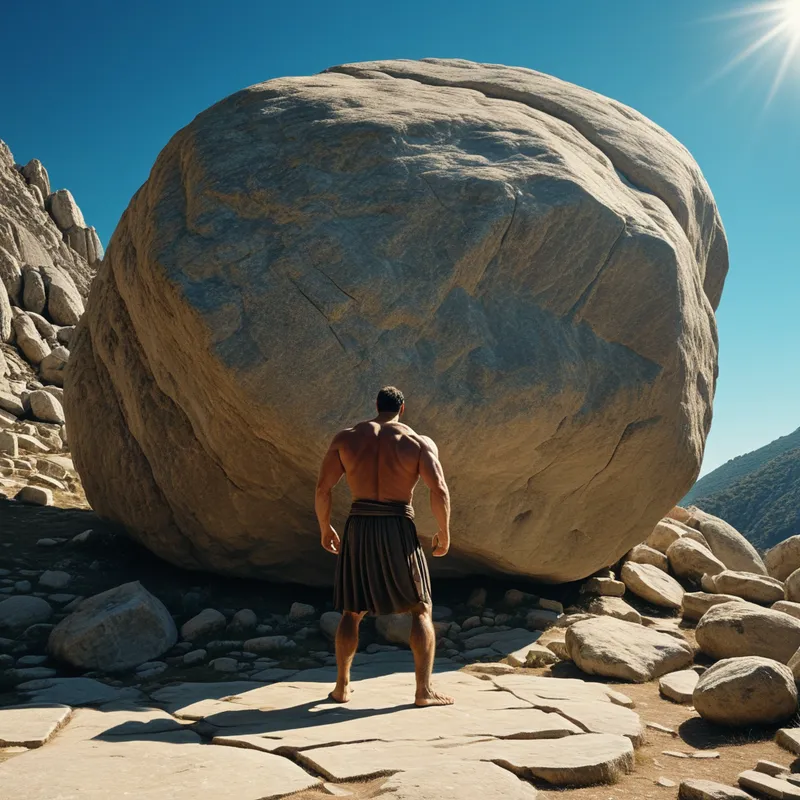
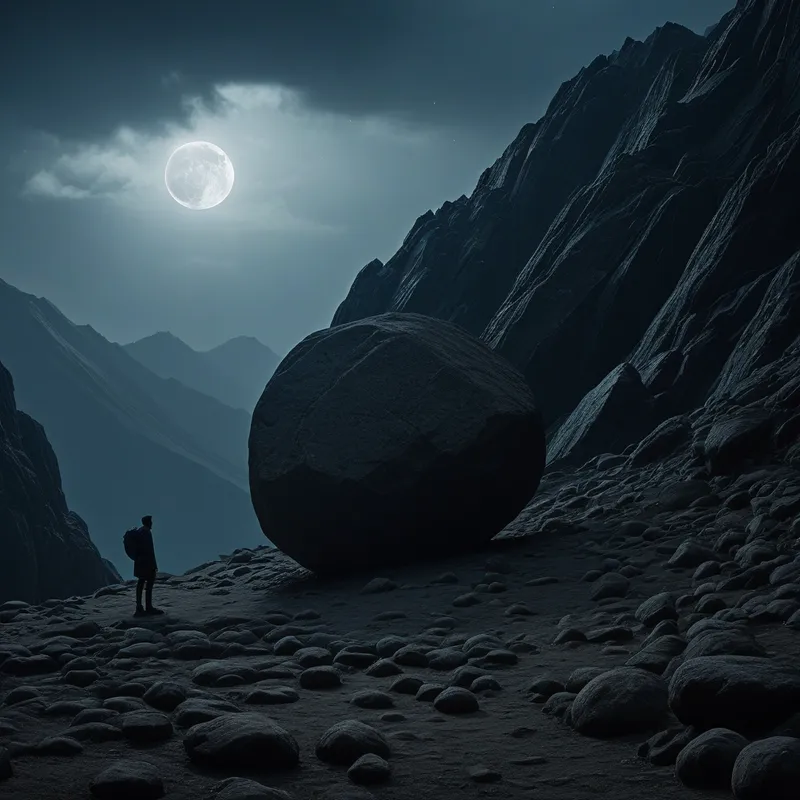
This time, there would be no trick. The judgment was final, and it was exquisite. In a sunless valley of [Tartarus](/myths/tartarus “Myth from Greek culture.”/), a mountain of sheer, grey stone rose from the dust. At its base lay a boulder, immense, perfectly round, and impossibly heavy. The sentence was spoken: Sisyphus must push this stone to [the summit](/myths/the-summit “Myth from Taoist culture.”/). He set his shoulder to the cold, unyielding mass. The climb was agony—a slow, grinding ascent where every muscle burned, every breath was fire, and the dirt bit into his hands and knees. For hours, for days, he labored, inching upward, the peak drawing tantalizingly near.
And then, at the very crest, as victory seemed to touch his fingertips, the weight would shift. The boulder would tremble, roll from his grasp, and with a gathering roar, plunge back down the mountainside, kicking up a cloud of grey dust, coming to rest exactly where he began. A moment of crushing silence. Then, with a slow, deliberate turn, Sisyphus would walk back down, place his hands upon the stone once more, and begin again. Forever.
Cultural Origins & Context
[The myth of Sisyphus](/myths/the-myth-of-sisyphus “Myth from Modern culture.”/) is a cornerstone of the Greek mythological corpus, primarily preserved for us in the epic poetry of [Homer](/myths/homer “Myth from Greek culture.”/)’s Iliad and later elaborated by poets and tragedians. It belongs to a class of stories concerning divine punishment, serving as a powerful etiological narrative about the limits of human cleverness ([metis](/myths/metis “Myth from Greek culture.”/)) and the ultimate authority of the cosmic order (dike). Told in symposia and by traveling bards, it functioned as both a cautionary tale and a darkly fascinating exploration of existential themes. It warned against the hubris of challenging the gods’ domain—particularly the natural order of life and death—while simultaneously immortalizing a figure whose defiant spirit refused to be broken, even by eternity itself. The myth resonated because it framed a universal human anxiety: the fear of meaningless, repetitive toil, of effort that yields no lasting fruit, a concept as relevant to the ancient farmer as to the modern soul.
Symbolic Architecture
The myth’s power lies in its stark, brutal [symbolism](/symbols/symbolism “Symbol: The use of symbols to represent ideas or qualities, often conveying deeper meanings beyond literal interpretation. In dreams, it’s the language of the unconscious.”/). Sisyphus is not just a punished [king](/symbols/king “Symbol: A symbol of ultimate authority, leadership, and societal order, often representing the dreamer’s inner power or external control figures.”/); he is the [archetype](/symbols/archetype “Symbol: A universal, primordial pattern or prototype in the collective unconscious that shapes human experience, behavior, and creative expression.”/) of the conscious [human](/symbols/human “Symbol: The symbol of a human represents individuality, complexity of emotions, and social relationships.”/) being trapped in a cycle of their own making, yet also possessing a spark of unquenchable will.
The Boulder represents the [weight of existence](/symbols/weight-of-existence “Symbol: This symbol embodies the burden of consciousness and the inherent challenges of being aware and alive, often leading to feelings of gravity and introspection.”/) itself—our burdens, our responsibilities, our past mistakes, the sheer inertia of [life](/symbols/life “Symbol: The symbol of ‘Life’ represents a journey of growth, interconnectedness, and existential meaning, encompassing both the joys and challenges that define human experience.”/). It is the [task](/symbols/task “Symbol: A task represents responsibilities, duties, or challenges one faces.”/) that never ends, the [problem](/symbols/problem “Symbol: Dreams featuring a ‘problem’ often symbolize internal conflicts or challenging situations that require resolution and self-reflection.”/) that recurs, the psychological complex we believe we have conquered only to find it waiting for us once more. It is perfectly round, offering no grip, no [leverage](/symbols/leverage “Symbol: Using a small force to create a large effect; gaining advantage through strategic positioning or influence.”/), symbolizing the futility of seeking an easy handhold on the essential difficulties of being.
The [Mountain](/symbols/mountain “Symbol: Mountains often symbolize challenges, aspirations, and the journey toward self-discovery and enlightenment.”/) is the slope of ambition, of striving, of the human desire for [achievement](/symbols/achievement “Symbol: Symbolizes success, mastery, or reaching a goal, often reflecting personal validation, social recognition, or overcoming challenges.”/), transcendence, or completion. It is the [path](/symbols/path “Symbol: The ‘path’ symbolizes a journey, choices, and the direction one’s life is taking, often representing individual growth and exploration.”/) of life, with its promise of a [summit](/symbols/summit “Symbol: The highest point of a mountain, representing achievement, perspective, and the culmination of effort.”/), a goal, a meaning.
The Cycle—the endless push, the near-success, the catastrophic rollback—is the core of the [symbol](/symbols/symbol “Symbol: A symbol can represent an idea, concept, or belief, serving as a powerful tool for communication and understanding.”/). It is the [pattern](/symbols/pattern “Symbol: A ‘Pattern’ in dreams often signifies the underlying structure of experiences and thoughts, representing both order and the repetitiveness of life’s situations.”/) of addiction, of destructive relationships, of Sisyphean labors in careers and personal growth. It embodies the feeling that one is not progressing, merely moving.
Sisyphus is the part of us that knows the task is futile, yet chooses to engage with it fully. His punishment is not the labor, but the consciousness of its absurdity.
Yet, within this [architecture](/symbols/architecture “Symbol: Architecture in dreams often signifies structure, stability, and the framing of personal identity or life’s journey.”/) lies a secret [chamber](/symbols/chamber “Symbol: A private, enclosed space representing the inner self, hidden aspects, or a specific stage in life’s journey.”/). Sisyphus’s walk back down the mountain, the [moment](/symbols/moment “Symbol: The symbol of a ‘moment’ embodies the significance of transient experiences that encapsulate emotional depth or pivotal transformations in life.”/) between efforts, is where the myth transforms. In that descent, he is free. The boulder has run its [course](/symbols/course “Symbol: A course represents direction, journey, or progression in life, often choosing paths to follow.”/); for a brief span, he is unburdened. This is the [space](/symbols/space “Symbol: Dreaming of ‘Space’ often symbolizes the vastness of potential, personal freedom, or feelings of isolation and exploration in one’s life.”/) for [reflection](/symbols/reflection “Symbol: Reflection signifies self-examination, awareness, and the search for truth within oneself.”/), for [breath](/symbols/breath “Symbol: Breath symbolizes life, vitality, and the connection between the physical and spiritual realms.”/), for the realization that the struggle itself, and his stance toward it, is the only domain over which he has sovereignty.

The Dreamer’s Resonance
When the pattern of Sisyphus appears in modern dreams, it rarely manifests as a literal man and a stone. Instead, the dreamer may find themselves in an endless loop: running on a treadmill that goes nowhere, filling a bottomless vessel, climbing a staircase that collapses beneath them, or preparing for an exam they are eternally destined to fail. The somatic feeling is one of profound exhaustion, frustration, and trapped energy—a grinding sense of effort without progress.
Psychologically, this dream points to an area of life where the dreamer feels stuck in a cycle they perceive as meaningless or unavoidable. It often correlates with burnout, a demanding job with no fulfillment, a repetitive relational conflict, or a personal habit they cannot break. The dream is the [psyche](/myths/psyche “Myth from Greek culture.”/)’s stark illustration of the cost of this cycle. It asks: What is the boulder you are pushing? What mountain do you believe you must summit? And what might happen if, in the moment of the descent, you were to look up and see [the sky](/myths/the-sky “Myth from Persian culture.”/)?
Alchemical Translation
The alchemical work modeled by Sisyphus is not the transmutation of the boulder into gold, but the transmutation of his own consciousness in relation to the boulder. This is [the opus](/myths/the-opus “Myth from Alchemical culture.”/) of embracing the absurd—the philosophical cornerstone later articulated by Camus. The process of individuation here involves a radical, internal rebellion against the very premise of the punishment.
First, one must fully acknowledge the weight and the cycle ([Nigredo](/myths/nigredo “Myth from Alchemical culture.”/)). This is the dark night, the acceptance of the burden and the apparent futility. There is no bypassing the labor.
Then, one must find the point of separation between [the self](/myths/the-self “Myth from Jungian culture.”/) and the task (Albedo). This is the clarity found in the walk downhill. In that space, [the ego](/myths/the-ego “Myth from Jungian culture.”/), which identifies solely with the success or failure of pushing the stone, is washed clean. One realizes, “I am not the pusher. I am the one who chooses to push.”
Finally, there is the integration of the rebel’s defiance into a serene, personal victory ([Rubedo](/myths/rubedo “Myth from Alchemical culture.”/)). This is the alchemical gold. When Sisyphus turns from the crashed boulder and walks down, he is not defeated. He is gathering his strength, not just physically, but in spirit. He is reclaiming the interval. The [triumph](/myths/triumph “Myth from Roman culture.”/) is that he continues, conscious of the absurdity, and in that very consciousness, he asserts a freedom that even the gods cannot take. He makes of his rock a kingdom.
The final alchemical secret is this: The mountain is also within. By pushing the boulder, Sisyphus is, grain by grain, polishing the stone of his own soul, carving resilience into his very being with every futile, essential effort.
Thus, the myth ceases to be a simple tale of punishment and becomes a manual for the soul engaged in the ultimate task: finding meaning not in spite of the struggle, but within its very grain. We are all Sisyphus, and our task is to imagine ourselves happy.
Associated Symbols
Explore related symbols from the CaleaDream lexicon: