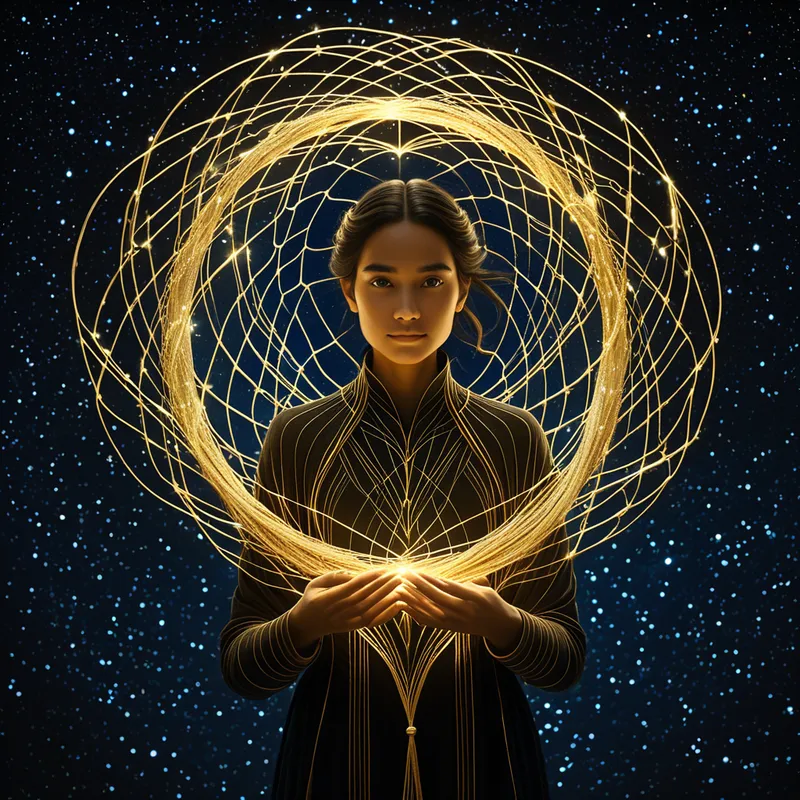
The Greek myth of Philotes Myth Meaning & Symbolism
The story of Philotes, primordial spirit of friendship and social bonds, born from Nyx's night, weaving the essential glue of cosmos and consciousness.
The Tale of The Greek myth of Philotes
Before the sun carved its first path, before the mountains knew their own weight, there was the Chaos. And from that yawning, formless potential, the first powers stirred. Greatest among the early shadows was Nyx, Night herself, a presence vast and velvet-dark, from whose womb tumbled the raw forces of existence.
She bore Erebus, and with him, the lighter Hemera. She bore the cruel twins, Eris and Moros, whose voices were the first cracks in the silence. She bore the relentless Moirai, who would one day spin, measure, and cut the thread of every life. Her children were the architects of necessity and torment, weaving a cosmos of stark, solitary forces destined to clash.
But in a quiet corner of her boundless dark, Nyx brought forth another. Not with a cry of strife, but with a sigh softer than the space between stars. This was Philotes. No towering titan, no dreadful deity, but a subtle emanation, a fragrance on the breath of the abyss. Where her siblings defined separation, conflict, and end, Philotes was the whisper of between. She was the inclination, the gentle gravity that pulls one note toward another to create a chord. She was the first blush of recognition, the unspoken pact before a touch.
In that primordial realm, where Eros was a blind, generative force and Eris a catalyst for division, Philotes moved differently. She did not command or conquer. She connected. As the raw elements of the world—earth, water, air, and fire—swirled in chaotic indifference, it was the spirit of Philotes that suggested their first alliances. The caress of air on water that creates a mist, the embrace of earth holding fire to forge metal, the companionship of roots in soil. She was the hidden principle in the binding of atoms, the affinity that makes a molecule more than its parts.
Her work was not recorded in thunderous battles or the founding of thrones. It was etched in the silent spaces: the way night does not fight day but yields to it; the way the river seeks the sea not out of compulsion, but longing. She was the glue in the mortar of the cosmos, the sympathy that made a universe of isolated powers into a world.

Cultural Origins & Context
The figure of Philotes appears in the foundational theogonies of ancient Greece, most notably in Hesiod’s Theogony, composed around the 8th century BCE. This was not a myth told around campfires for mere entertainment, but a sacred cosmology, a map of reality’s origins recited by bards and poets to define the very architecture of existence. In this context, Philotes is not a minor nymph but a fundamental, Protogenoi deity, a daughter of the mighty Nyx.
Her inclusion in this family is profoundly significant. She emerges from the same source as Death (Thanatos), Strife (Eris), and Doom (Moros). This placement suggests that the ancient Greek worldview did not see friendship and affection as later, civilized inventions, but as primordial forces, as elemental to the fabric of reality as conflict and fate. Philotes represented the essential social bond, the philia that holds families, friendships, and city-states together. In a society where survival depended on complex social alliances and guest-friendship (xenia), Philotes was the divine sanction of that essential glue. She modeled that even from the deepest night of chaos and isolation, the impulse toward connection is born.
Symbolic Architecture
Philotes symbolizes the fundamental psychic principle of relation. She is not Love (Eros) in its passionate, consuming form, but the quieter, more enduring force of affinity, mutual respect, and bonding. She represents the space between entities where meaning is generated.
Philotes is the archetype of the connective tissue of consciousness itself. Where the ego asserts “I am,” Philotes whispers, “I am with.”
Psychologically, she embodies the libido not as sexual drive alone, but as the general psychic energy that seeks attachment, synthesis, and harmony. In a psyche dominated by inner critics (the voice of Eris) or fatalistic despair (the shadow of Moros), Philotes is the inner capacity for self-relating, for making peace between conflicting parts. She is the function that allows thought to connect with feeling, the conscious mind to dialogue with the unconscious. Her birth from Nyx (Night/Unconscious) tells us that true connection often has its roots in the dark, unknown parts of ourselves and others—it is not merely a product of bright, conscious intention.

The Dreamer’s Resonance
When the archetype of Philotes stirs in the modern dreamscape, it often manifests as imagery of weaving, mending, or discovering hidden connections. One might dream of finding a fragile, glowing thread attached to their sternum, leading off into the darkness toward another person or a forgotten part of themselves. There may be dreams of repairing a shattered vase with gold (kintsugi-style), symbolizing the beauty and strength of healed relationship. Conversely, dreams of severed cords, frayed nets, or isolated rooms in a vast house point to a lack of Philotes—a disconnection from one’s social ecosystem or internal parts.
Somatically, this process may feel like a softening in the chest, a release of long-held tension in the shoulders (the burden of carrying isolation), or an intuitive “pulling” toward reconciliation or community. It is the psyche working to integrate the solitary ego into a wider web of belonging, urging the dreamer to acknowledge their inherent relational nature and mend the tears in their personal and collective fabric.

Alchemical Translation
The alchemical journey modeled by Philotes is the opus contra naturum of transforming primal isolation into conscious communion. We all emerge from our own Chaos and personal Nyx—a night of undifferentiated potential, inner conflicts, and shadowy, unintegrated forces (our personal Eris, Moros, etc.). The first, often unconscious, step is the birth of that inner Philotes—the faint, often ignored impulse toward inner and outer connection.
The alchemy of Philotes is the slow, patient weaving of the vinculum, the sacred bond, first within the self, then radiating outward. It is the creation of soul-relationships.
This psychic transmutation involves several stages: Recognizing the Primordial Night (acknowledging one’s inner chaos and isolation), Sensing the Whisper (heeding the gentle pull toward mending, therapy, friendship, or creative collaboration), and Acting as the Weaver (consciously engaging in the work of bonding—listening, empathizing, setting healthy boundaries, integrating opposites within). The goal is not to eliminate the other primal forces (strife, fate, death are part of life), but to introduce the binding agent of Philotes, which allows these forces to be held in a cohesive psyche and a resilient community. The triumph is the realization that one is not a solitary atom, but a nexus in a living web, and that individuation is not about becoming a perfect, isolated whole, but a consciously connected node in the great weaving. In this, the modern individual performs the myth, giving birth to the connective spirit anew, forging unity from their own primordial night.
Associated Symbols
Explore related symbols from the CaleaDream lexicon: