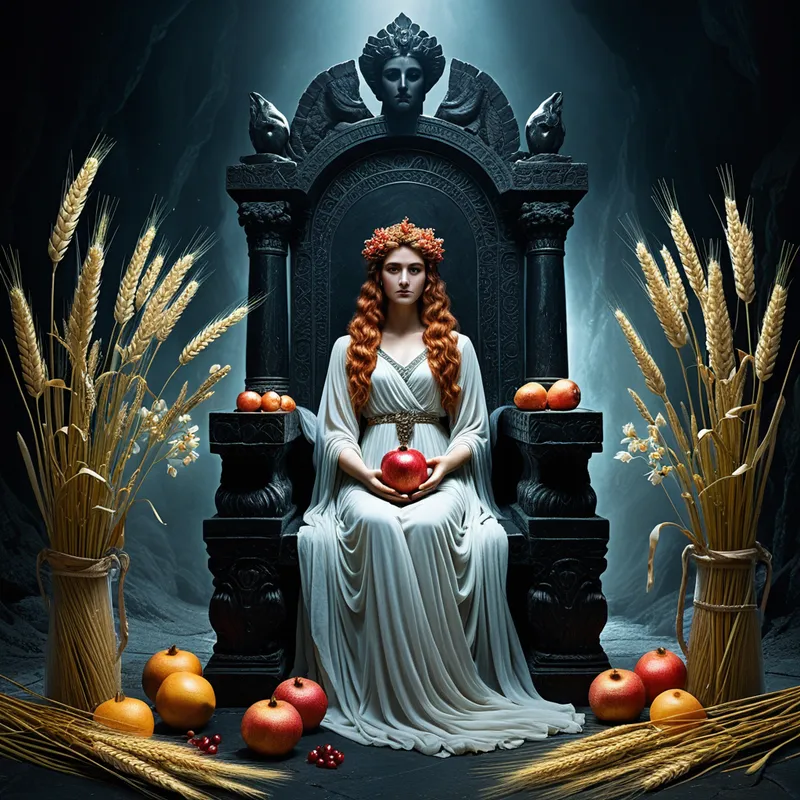
The Greek myth of Persephone Myth Meaning & Symbolism
The goddess of spring abducted into the underworld, whose cyclical return models the soul's journey through loss, sovereignty, and profound transformation.
The Tale of The Greek myth of Persephone
Hear now the story that binds the world above to the world below, the tale of the maiden who became a queen and in doing so, taught the earth itself to grieve and rejoice.
In the first days, when the world was young with green, Demeter tended the fields with a mother’s fierce love. Her joy was her daughter, Persephone, whose laughter caused crocuses to bloom and whose footsteps left trails of violets. She was Kore, the maiden, all sunlight and soft petals, dancing with her nymphs in the meadows of Nysa.
But deep beneath the roots of the world, in a palace of black rock and silent rivers, a longing stirred. Hades, lord of the unseen realms, watched from the darkness. He saw not just a maiden, but a queen who could bring a different kind of life to his kingdom. He went to his brother, Zeus, and received a silent, fateful consent.
The betrayal came on a day like any other, under a sun too bright. Persephone reached for a narcissus of stunning beauty—a flower placed by the earth itself at Hades’ command. As her fingers closed around the stem, the meadow cracked open with a sound like a mountain breaking. From the yawning chasm, Hades rose in his chariot of jet, his horses breathing shadows. He seized her. Her cry was swallowed by the rushing dark as the earth sealed itself above them, leaving only a scatter of flowers on untroubled grass.
Above, the world began to die. Demeter, her heart a raw wound, roamed the earth in a grief that turned to fury. She hid her divine form, becoming an old woman, and let her sorrow freeze the land. No seed sprouted; no fruit swelled. Famine gripped humanity, and the gods received no smoke from sacrificial fires.
Meanwhile, in the Underworld, a transformation began. Persephone, the captive maiden, refused all food, a ghost among ghosts. But sovereignty whispers in the dark. Hades offered her not a prisoner’s meal, but a queen’s due: a pomegranate, its leathery skin hiding a clutch of ruby seeds. Drawn by its strange beauty, or perhaps by a dawning understanding of her own power, she ate six seeds. The sweet-tart juice was a contract, binding her soul to the realm of the dead.
Her fate was thus divided. For her abduction, Zeus decreed her return. But for the six seeds, eaten in the kingdom of shadows, she must return to Hades for six months each year. When Hermes led her up the long path to the light, Demeter’s embrace brought a surge of life so violent it shook the barren trees into blossom. But when Persephone descends again, donning her mantle of quartz and gloom, Demeter’s tears fall as frost, and the earth holds its breath, waiting for the return of its queen.

Cultural Origins & Context
This is the Homeric Hymn to Demeter, composed likely in the 7th century BCE, our most complete ancient source. It was not mere entertainment but a central mystery of the Eleusinian Mysteries, the most famous and revered initiatory cult of the ancient Greek world. For over a millennium, initiates—from slaves to emperors—traveled to Eleusis to undergo rites that promised a blessed afterlife and liberation from the fear of death. The myth was the sacred narrative at the cult’s heart, performed and revealed in stages. It functioned as societal glue, offering a divine model for the most universal human experiences: catastrophic loss, the search for meaning in darkness, and the hope of cyclical renewal. It explained the seasons, yes, but more importantly, it sanctified the seasons of the soul.
Symbolic Architecture
The myth is a perfect symbolic map of a profound psychological initiation. Persephone is the ego, the innocent “maiden” consciousness, living in the perpetual spring of parental protection (Demeter as the Great Mother). Her abduction is not a random tragedy but a necessary, if violent, call to depth.
The soul cannot flower in eternal sunlight; it requires the fertile darkness of the underworld to bear the fruit of wisdom.
Hades represents the shadow and the deep, structuring principles of the unconscious—the parts of ourselves we fear to meet. The pomegranate seeds are the kernels of conscious choice made in the realm of the unconscious; they are the insights, the traumas, the commitments that, once ingested, forever change us. We are bound to our depths because we have tasted their truth. Demeter’s grief is the anguish of the conscious mind when its cherished identity is taken into the unknown. The cyclical resolution models a fundamental psychic law: wholeness requires a rhythmic dialogue between the conscious and unconscious worlds, between our social persona and our inner sovereign.

The Dreamer’s Resonance
When this myth stirs in modern dreams, it signals a profound initiation underway. To dream of being pulled into the earth, of finding a lush garden in a basement, or of eating a strange, compelling fruit in a dark place is to dream the Persephone pattern. Somatically, this may coincide with feelings of depression, enclosure, or a “dark night of the soul”—not as pathology, but as the psyche’s necessary descent.
The dreamer is undergoing a process of psychic abduction: a life event—a loss, a betrayal, an illness, a deep depression—has severed them from their familiar “meadow.” The ego is in Hades’ realm. The psychological task is not to immediately claw back to the light, but to do as Persephone did: first, to refuse nourishment from the old, surface-level stories (the initial fast), and then, crucially, to consciously engage with what the depth offers. The pomegranate seeds in a dream are those fateful recognitions: “This is my truth.” “This wound is part of me.” “This darkness holds my authority.” Eating them is an act of integration, painful and binding, but the very source of future sovereignty.

Alchemical Translation
The alchemical journey of this myth is the transmutation of the Maiden (Kore) into the Queen (Persephone). It is the path of individuation through necessary suffering.
The first stage is nigredo: the blackening, the abduction itself—the crushing of the old, naive identity. The ego is dissolved in the waters of Styx. The second is albedo: the whitening, represented by Persephone’s initial refusal and isolation, a purifying confrontation with the shades of one’s own past. The third is rubedo: the reddening, the crucial ingestion of the pomegranate seeds. This is the moment of conscious suffering and commitment, where the psychic substance is tinged with the blood of experience.
The queen is crowned not in the sunlight, but in the acknowledgment of her own bond to the dark.
For the modern individual, this models the process of turning a passive victimhood (“this happened to me”) into an active, complex sovereignty (“this experience is now part of my authority”). We descend not to be punished, but to claim the throne of our own underworld—to integrate our grief, our rage, our shadows, and return to the world bearing not just flowers, but the hard-won seeds of wisdom. We become cyclical beings, capable of holding joy and despair, growth and decay, knowing each descent prepares for a more authentic return.
Associated Symbols
Explore related symbols from the CaleaDream lexicon: