The Greek Kairos - the fleetin Myth Meaning & Symbolism
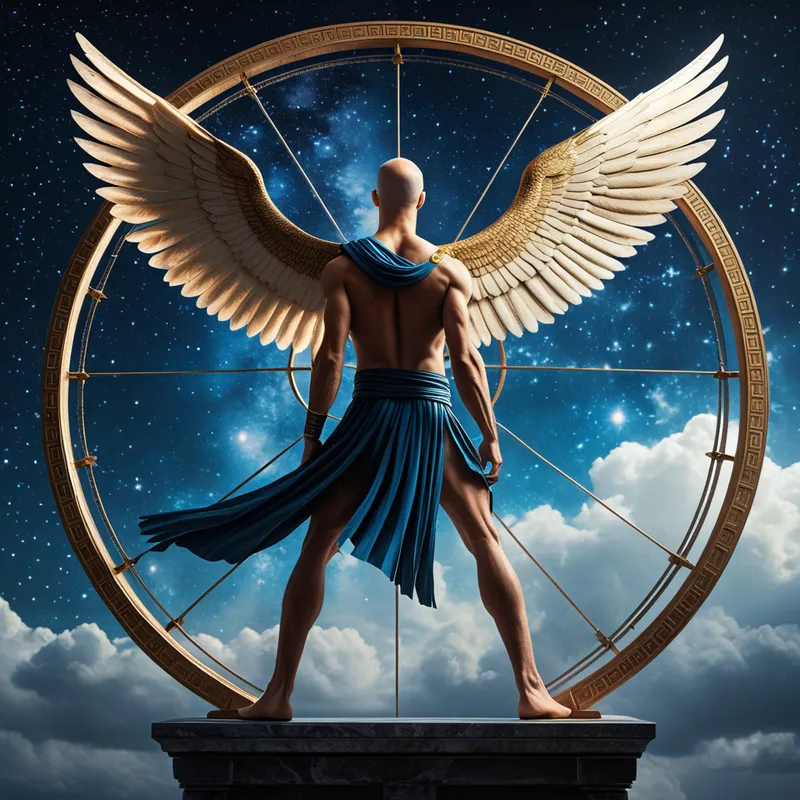
The myth of the winged god Kairos, who represents the critical, fleeting moment of opportunity that must be seized by the forelock as it passes.
The Tale of The Greek Kairos - the fleetin
Hear now of the moment that is not a moment, of the god who is never still. In the spaces between the ticks of the cosmic clock, where Chronos plods his weary, measured path, there dances another. His name is [Kairos](/myths/kairos “Myth from Global/Universal culture.”/), and he is [the child](/myths/the-child “Myth from Alchemy culture.”/) of opportunity itself.
He appears not in the fullness of day, but in the gasp between heartbeats, in the crack of a door before it shuts. He is a youth of breathtaking speed and beauty, forever poised on the blade of a razor’s edge. Upon his shoulders and his winged heels are feathers of iridescent light, humming with the vibration of potential. In one hand, he holds a delicate balance, its scales empty, waiting for the decisive weight of an action. His hair is his most telling feature: a luxurious forelock tumbles over his brow, rich and graspable. But the back of his head is bald, smooth as a river stone.
You do not find Kairos; he finds you. He descends like a sudden shift in [the wind](/myths/the-wind “Myth from Various culture.”/), a change in the light. He is the exact instant when the crowd parts, revealing the path to the king. He is the perfect silence after a question, ripe for the right word. He is the fleeting alignment of stars, of skill, and of need.
He does not speak. He only is—a shimmering, urgent presence. To see him is to feel a profound tension, a pull in the soul. He offers his forelock, but only for the duration of a single, indrawn breath. Hesitate, be slow of thought or heavy of limb, and he is gone. You are left clutching at the air where his bald pate has already vanished, the scales in his hand tipping irrevocably toward “never.” The moment has passed. The door, which was never fully open, is closed. He leaves behind only the echo of wings and the haunting, indelible knowledge of what almost was.
This is his eternal dance: the approach, the offering, the vanishing. He is [the crucible](/myths/the-crucible “Myth from Alchemical culture.”/) of fate, testing not strength, but readiness. Not power, but perception.
Cultural Origins & Context
The figure of Kairos emerges from the rich soil of ancient Greek thought, a culture deeply preoccupied with concepts of fate (Moira), time, and human agency. While not a central Olympian with grand temples, Kairos was a potent daimon, a personified force of nature. His most famous physical depiction was a lost statue by the sculptor Lysippos of Sicyon, described by poets and historians. This statue was not housed in a major sanctuary but was perhaps a philosophical and artistic touchstone, a visual proverb for the educated elite.
The myth was passed down not through epic cycles of heroes, but through the teachings of philosophers, rhetoricians, and poets. The orator Isocrates invoked Kairos to teach the importance of timely speech. Pythagoreans saw in him the principle of the “right moment” in the harmony of the cosmos. His story functioned as a societal and psychological compass, a reminder that destiny is not a pre-written scroll but a series of critical intersections. It taught that wisdom lies not just in knowledge, but in the application of knowledge at the precise time it is needed. In a culture that valued excellence (arete), Kairos represented its most volatile and essential ingredient: timing.
Symbolic Architecture
Kairos is not time, but a quality of time. He is the psychological and existential embodiment of the opportune [moment](/symbols/moment “Symbol: The symbol of a ‘moment’ embodies the significance of transient experiences that encapsulate emotional depth or pivotal transformations in life.”/). His [symbolism](/symbols/symbolism “Symbol: The use of symbols to represent ideas or qualities, often conveying deeper meanings beyond literal interpretation. In dreams, it’s the language of the unconscious.”/) is a perfect, self-contained [system](/symbols/system “Symbol: A system represents structure, organization, and interrelated components functioning together, often reflecting personal or social order.”/) of urgency.
The moment of decision is a god with wings. It presents itself face-first, offering a handhold, but once it passes, its back is smooth and offers no purchase for regret.
The razor’s edge signifies the precarious, non-[linear](/symbols/linear “Symbol: Represents order, predictability, and a direct, step-by-step progression. It symbolizes a clear path from cause to effect.”/) [nature](/symbols/nature “Symbol: Nature symbolizes growth, connectivity, and the primal forces of existence.”/) of critical decisions. It is not a broad road but a fine line between success and failure, [action](/symbols/action “Symbol: Action in dreams represents the drive for agency, motivation, and the ability to take control of situations in waking life.”/) and stagnation. The scales represent the delicate [equilibrium](/symbols/equilibrium “Symbol: A state of balance, stability, or harmony between opposing forces, often representing inner peace or external order.”/) of circumstances that creates the opening—the [convergence](/symbols/convergence “Symbol: The merging of separate elements into a unified whole, representing synthesis, destiny, or resolution.”/) of preparation, external conditions, and inner resolve. His wings are the essence of transience; the moment is inherently fleeting, it cannot be owned or held.
Most profoundly, his [hair](/symbols/hair “Symbol: Hair often symbolizes identity, power, and self-expression, reflecting how we perceive ourselves and how we wish to be perceived by others.”/) encodes the entire philosophy. The forelock is the only part that can be grasped. This symbolizes that [opportunity](/symbols/opportunity “Symbol: The symbol ‘opportunity’ signifies potential for advancement, growth, and new beginnings in various life aspects.”/) can only be seized as it approaches, in the forward-moving, nascent phase. The bald back of the head is the brutal [truth](/symbols/truth “Symbol: Truth represents authenticity, honesty, and the quest for knowledge beyond mere appearances.”/): once the moment has passed, you cannot grab it, retrieve it, or undo the inaction. Regret has nothing to hold onto. Psychologically, Kairos represents the acute [awareness](/symbols/awareness “Symbol: Conscious perception of self, surroundings, or internal states. Often signifies awakening, insight, or heightened sensitivity.”/) that punctures the autopilot of chronological living. He is the call to [consciousness](/symbols/consciousness “Symbol: Consciousness represents the state of awareness and perception, encompassing thoughts, feelings, and experiences.”/) itself.

The Dreamer’s Resonance
When the archetype of Kairos stirs in the modern unconscious, it often manifests in dreams of profound urgency and elusive thresholds. One might dream of desperately running to catch a train that is perpetually pulling away, or of seeing a phone ring with a crucial caller ID only for the hand to move in slow motion. Another common motif is finding a key that fits a mysterious lock, but the door begins to dissolve as you reach for it.
Somatically, these dreams are accompanied by a visceral feeling of anxiety, a racing heart, and a tension in the gut—the body’s intelligence screaming about a closing window. Psychologically, this is the dream-ego confronting a “Kairotic” moment in its own life. The process is one of synchronization: the unconscious is highlighting a dissonance between the dreamer’s readiness and an objective opportunity in the waking world. It may be a relationship that needs a vulnerable conversation, a career leap that requires a decision, or a creative project demanding its final push. The dream is not a prophecy, but an alarm clock for the soul, signaling that the linear, safe path of Chronos is being intersected by the transformative potential of Kairos.

Alchemical Translation
In the alchemy of individuation—the process of becoming psychologically whole—Kairos models the critical phase of transmutation. This is not the slow, steady heat of the [nigredo](/myths/nigredo “Myth from Alchemical culture.”/) (the initial suffering), but the sudden, white-hot flash of the albedo or [rubedo](/myths/rubedo “Myth from Alchemical culture.”/), where base metal turns to silver or gold.
Individuation is not a marathon; it is a series of sprints initiated at the precise crack of the starting pistol only you can hear.
The modern individual lives largely in Chronos-time: schedules, deadlines, and linear progression. The [psyche](/myths/psyche “Myth from Greek culture.”/)’s Self, however, operates in Kairos-time. The “alchemical translation” is learning to perceive and act from this deeper rhythm. The “preparation” is the long work of analysis, shadow integration, and building ego strength—filing the metal. The “Kairotic moment” is when that prepared self encounters a synchronicity, a dream symbol that suddenly becomes lucid, or an external event that perfectly mirrors an inner need, offering a chance for a quantum leap in consciousness.
Seizing the forelock is the act of courageous commitment in that moment: saying the difficult truth, leaving the stagnant job, finally creating the art, choosing vulnerability. Letting it pass by clinging to the safety of the known is the equivalent of spiritual stagnation; the opportunity for that specific transmutation is lost, and the psyche must wait for the next cyclical alignment. Thus, Kairos teaches that wholeness is not a destination reached by plodding, but a state claimed through a series of perfectly timed, conscious choices in the crucible of the now. He is the god of the leap of faith, demanding we trust our readiness when the universe presents the ledge.
Associated Symbols
Explore related symbols from the CaleaDream lexicon: