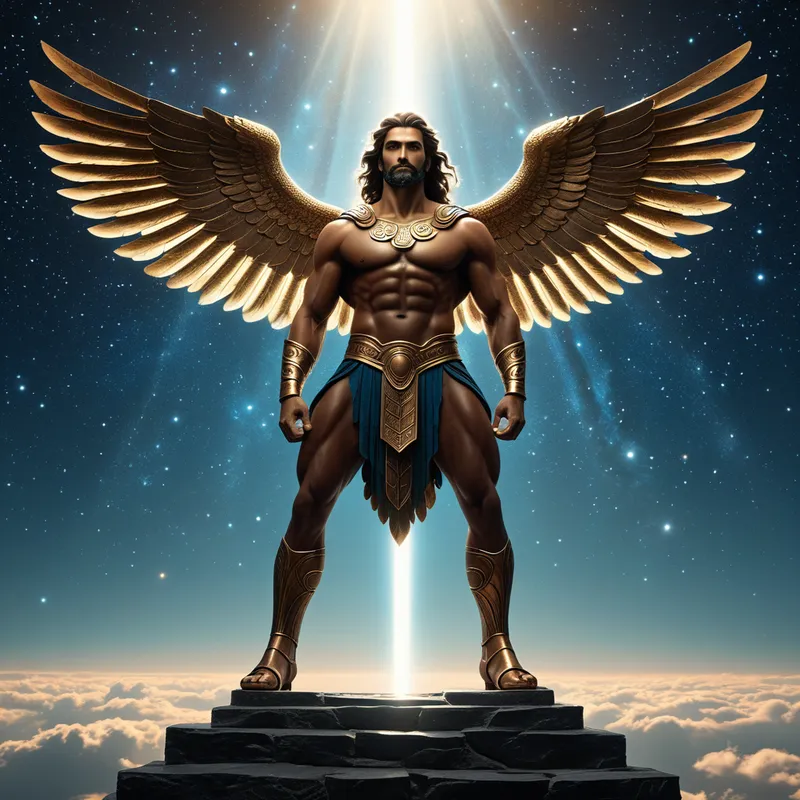
The Greek god Kairos (Opportun Myth Meaning & Symbolism
The myth of the winged god Kairos, who represents the critical, evanescent moment of opportunity that must be seized by the forelock before it passes.
The Tale of The Greek god Kairos (Opportun
Listen. There is a moment between the inhalation and the exhalation, a sliver of time so fine it can cut the soul. In that sliver, he walks.
He is not like his brothers, the lumbering, measurable Chronos or the all-devouring Aion. He is Kairos, and he moves with the silence of a thought. His feet, winged at the heels, never truly touch the earth, for he is always arriving and departing in the same instant. His shoulders bear wings, not for lofty flight, but for the desperate, forward-leaning sprint of the moment that cannot be held.
He appeared once, not in the clamor of Olympus, but in the quiet desperation of a mortal field. A young athlete, his muscles burning with the final stretch of a race, saw a blur of bronze at the edge of his vision. It was not a man, but the idea of a man—the embodiment of the peak effort, the precise second where victory is decided not by strength alone, but by the will to push now. The athlete lunged, and the moment was his.
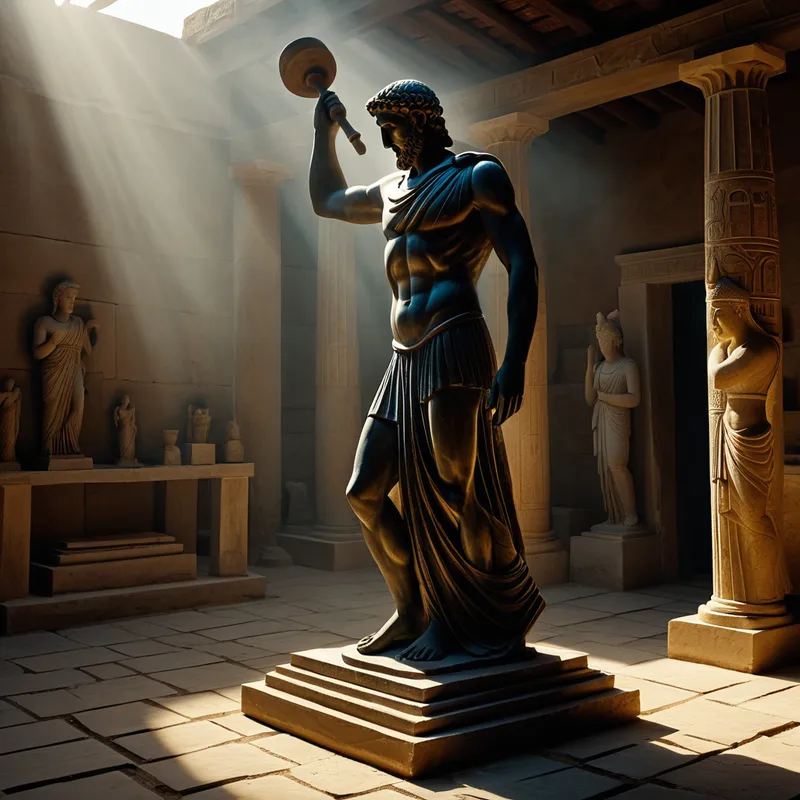
But the most famous visitation was to the sculptor Lysippos. In the still, dusty air of his workshop, as the sun slanted low and the world held its breath, Kairos manifested. The air shimmered. There he stood, balanced on a blade’s edge, a sphere of perfect potential cupped in one hand. His face was serene yet urgent, gazing into a future only he could see. And his hair… ah, his hair. From the back of his head, it was shorn close, impossible to grasp. But from his brow, a single, lush forelock tumbled forward, ripe for the taking.
Lysippos froze, his chisel hovering. He understood the silent sermon. The moment—the opportune, the decisive, the ripe—approaches from ahead. You can seize it by the forelock as it arrives. But once it has passed, the back of its head is bald, slick, offering no handhold. To hesitate is to watch it flee, forever out of reach, leaving only the echo of what might have been. The sculptor’s hands moved not by thought, but by revelation, carving the divine paradox into stone: the god of the instant, captured for eternity.
Cultural Origins & Context
Kairos was a daimon, a personified force, rather than one of the Olympian pantheon. His worship was not centered in grand temples with animal sacrifice, but in the minds of philosophers, the strategies of orators, and the hands of artisans. He was a concept given form, emerging from the rich soil of Greek thought that sought to categorize the nuances of existence.
The poet Ion of Chios and the sophist Protagoras spoke of him. For rhetoricians, Kairos was the supreme principle of speech—the perfect moment to make an argument, to sway a jury, to land a point when the audience’s soul was most open. In athletics, he was the split-second advantage. In medicine, the critical juncture for intervention. He represented a qualitative, subjective time—the “right time”—as opposed to the quantitative, objective tick of Chronos.
His myth was passed down not in epic cycles, but in epigrams, philosophical fragments, and the silent testimony of statues like that of Lysippos, which was described by poets and historians. He was the god of the pivot, the fulcrum upon which fate could be tipped by a conscious, courageous act of timing.
Symbolic Architecture
Kairos is the archetype of the decisive moment, a psychological constellation of supreme awareness and action. His symbolism is a precise map of the opportunity’s nature.
The wings on his heels signify the fleeting, transient quality of opportunity. It is always in motion, never static. The razor’s edge upon which he balances illustrates that the opportune moment is often a precarious, knife-edge decision between success and failure, action and inaction. It is not a broad, safe road.
The forelock of hair is the core symbol. It represents the one graspable aspect of the future as it becomes the present. It is the “handle” on the moment, available only as it approaches.
To seize the forelock is to act with decisive awareness in the pregnant now. To grasp at the bald back of the head is the essence of regret—the futile attempt to clutch what is already psychologically past.
The scales he sometimes holds are not of justice, but of potential. They tip with the infinitesimal weight of a choice, measuring the balance of a situation ripe for change. Kairos thus represents the intersection of fate and free will: the moment fate presents is given, but the act of seizing it is ours.
The Dreamer’s Resonance
When Kairos enters the modern dreamscape, he rarely appears as a clear figure. He is felt as an atmosphere of urgent potential. The dreamer may find themselves in a train station, watching their train depart as they fumble with a ticket. They may be handed a key that begins to dissolve in their grasp. They may see a door closing slowly, with a brilliant light on the other side, and feel their limbs heavy with sleep paralysis.
These are somatic dreams of kairosis—the body processing a critical juncture in the psyche that is being missed or resisted. The heaviness, the fumbling, the paralysis: these are the defenses of the ego, terrified of the change that the moment demands. The dream is a rehearsal, and often a warning. It signals that a developmental threshold is active—a career change, a necessary confrontation, a creative leap, the end of a relationship. The psyche is presenting the opportunity in its symbolic form, highlighting the dreamer’s current relationship to it: are they reaching for the forelock, or staring at the bald, retreating head?

Alchemical Translation
In the alchemy of individuation, the process of becoming whole, Kairos is the catalyst. The “base metal” of our unconscious, habitual life must be exposed to the fierce, precise heat of the right moment to transmute.
The first stage is nigredo, the blackening—often felt as depression, stagnation, or a sense of life being out of sync. This is the rule of Chronos, empty quantity. Then, a crack appears: an insight, a sudden loss, an unexpected offer. This is Kairos knocking. The alchemical work is to recognize this not as mere event, but as symbolic opportunity—a call from the Self to move toward greater integration.
The forelock is the hook of consciousness upon which the future self can be pulled into being. To seize it is to perform the ultimate alchemical act: turning time itself into substance of the soul.
Hesitation is the poison. It allows the moment to pass, and the psyche regresses to nigredo, now compounded with the shadow of regret—the “bald head” we cannot forget. But to act in the kairos is the rubedo, the reddening. It is a commitment to one’s own destiny, a willing descent into the necessary risk that forges consciousness. We do not control Kairos; he is a force of the objective psyche. But we can align with him, developing the acute inner sensitivity—the kairic sense—that feels the texture of time changing, that hears the unique click of the lock for which we hold the key. In that alignment, fate becomes destiny.
Associated Symbols
Explore related symbols from the CaleaDream lexicon: