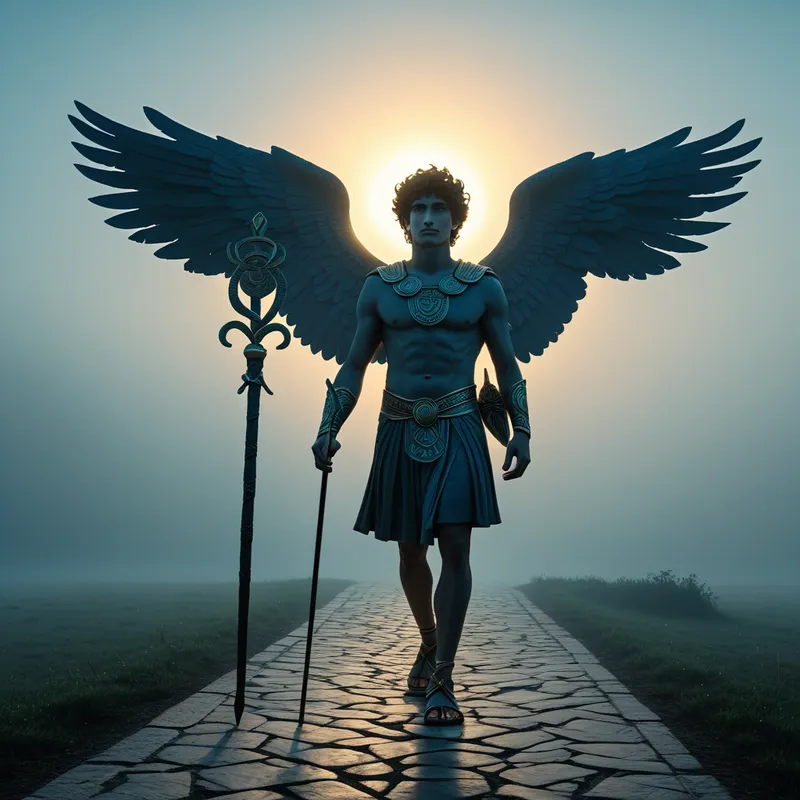
The Greek god Hermes as the di Myth Meaning & Symbolism
The story of the god who stole divine fire at dawn, forging a path between worlds, turning theft into a gift, and chaos into a new order.
The Tale of The Greek god Hermes as the di
Before [the world](/myths/the-world “Myth from Tarot culture.”/) was set in its daily order, in the deep violet hour just before dawn, a child was born in a secret cave on Mount Cyllene. His mother, the shy nymph Maia, had scarcely finished wrapping him in swaddling bands when he slipped from her arms. His eyes, old as the first thought, scanned the dim cavern. This was no ordinary babe. He was [Hermes](/myths/hermes “Myth from Global/Universal culture.”/), and [the world](/myths/the-world “Myth from Tarot culture.”/) outside was already calling.
With a strength that belied his infant form, he padded to [the cave](/myths/the-cave “Myth from Platonic culture.”/)’s mouth on feet that seemed to barely touch [the earth](/myths/the-earth “Myth from Hindu culture.”/). The air was cool, smelling of [thyme](/myths/thyme “Myth from Greek culture.”/) and damp stone. In the distance, on the plains of Pieria, he heard a lowing—the divine cattle of his elder brother, Apollo. A smile, sharp and clever, touched his lips. A plan, whole and perfect, unfolded in his mind like a flower in fast motion.
He fashioned sandals from myrtle branches and bark, binding them to his feet not for walking, but for flying, leaving no trace. He journeyed not as a thief in the night, but as a shadow at dawn’s edge. Finding the magnificent herd, he did not simply steal them. He wrought a great deception, driving fifty backwards, their hooves pointing the wrong way, and crafting strange sandals for himself that left tracks leading into the cave, not out. The confusion was a spell he wove into the very earth.
But the theft was not the end; it was the first note of a symphony. On his return, finding a [tortoise](/myths/tortoise “Myth from Greek culture.”/) at the cave entrance, he saw not an animal, but an instrument. With a divine shudder of inspiration, he hollowed its shell, stretched sinews across it, and fashioned the first lyre. His tiny fingers plucked the strings, and a sound never before heard in heaven or earth poured forth—a music that was both laughter and longing.
The sun rose, and with it, Apollo’s wrath. The god of light, radiant and furious, descended upon the cave, following a trail of divine insight that bypassed all earthly trickery. He confronted the babe, still in his cradle. Hermes did not deny it. Instead, he looked up with those ancient eyes and plucked a new melody on his lyre. The music wrapped around Apollo’s anger, disarming it, transforming it into wonder. The theft of cattle became the gift of music. In that moment, a pact was forged not in [justice](/myths/justice “Myth from Tarot culture.”/), but in awe. Hermes gave Apollo the lyre, and in return, received [the caduceus](/myths/the-caduceus “Myth from Greek culture.”/) and a place among the Olympians as the messenger, the one who moves between all realms.

Cultural Origins & Context
This myth, preserved in the Homeric Hymn to Hermes, is not merely a story of a precocious god. It is a foundational narrative from a culture that understood the divine as intimately connected to the raw, often chaotic, processes of human ingenuity and social formation. Hermes’ story was told by bards and poets, functioning as an etiological myth explaining the origins of music, commerce, and diplomacy. In a society where travel, trade, and communication across city-states were vital yet perilous, Hermes embodied the necessary spirit of cunning, adaptability, and negotiation. He was the patron of the herm, which stood at crossroads and boundaries, marking the transition from the known to the unknown. His myth served to sanctify the tricky, ambiguous spaces of life—the deal, the journey, the clever lie that prevents war, the inspired idea born of mischief.
Symbolic Architecture
Hermes is the [archetype](/symbols/archetype “Symbol: A universal, primordial pattern or prototype in the collective unconscious that shapes human experience, behavior, and creative expression.”/) of the liminal, the personification of [the threshold](/myths/the-threshold “Myth from Folklore culture.”/) itself. His [birth](/symbols/birth “Symbol: Birth symbolizes new beginnings, transformation, and the potential for growth and development.”/) at [dawn](/symbols/dawn “Symbol: The first light of day, symbolizing new beginnings, hope, and the transition from darkness to illumination.”/), his theft at [the border](/symbols/the-border “Symbol: A liminal space representing boundaries between identities, territories, or states of being, often symbolizing transition, conflict, or separation.”/) of [night](/symbols/night “Symbol: Night often symbolizes the unconscious, mystery, and the unknown, representing the realm of dreams and intuition.”/) and day, and his [role](/symbols/role “Symbol: The concept of ‘role’ in dreams often reflects one’s identity or how individuals perceive their place within various social structures.”/) as messenger between [Olympus](/symbols/olympus “Symbol: In Greek mythology, Mount Olympus is the divine home of the gods, representing ultimate power, perfection, and spiritual transcendence.”/), [Earth](/symbols/earth “Symbol: The symbol of Earth often represents grounding, stability, and the physical realm, embodying a connection to nature and the innate support it provides.”/), and the [Underworld](/symbols/underworld “Symbol: A symbolic journey into the unconscious, representing exploration of hidden aspects of self, transformation, or confronting repressed material.”/) all speak to this core function. He does not create from nothing, like a supreme deity, nor does he govern a settled domain. He operates in the in-between, transforming what already exists through cleverness and guile.
The trickster does not destroy order; he reveals its fluidity. He steals the static property (Apollo’s cattle) and returns it as dynamic culture (the lyre).
Psychologically, Hermes represents the mercurial intellect, [intuition](/symbols/intuition “Symbol: The immediate, non-rational understanding of truth or insight, often described as a ‘gut feeling’ or inner knowing that bypasses conscious reasoning.”/), and the adaptive ego. He is the quick thought that solves an impossible [problem](/symbols/problem “Symbol: Dreams featuring a ‘problem’ often symbolize internal conflicts or challenging situations that require resolution and self-reflection.”/), the sudden inspiration that connects disparate ideas, and the psychological flexibility needed to navigate [life](/symbols/life “Symbol: The symbol of ‘Life’ represents a journey of growth, interconnectedness, and existential meaning, encompassing both the joys and challenges that define human experience.”/)’s transitions. His theft is not mere criminality, but a symbolic act of [differentiation](/symbols/differentiation “Symbol: The process of distinguishing or separating parts of the self, emotions, or identity from a whole, often marking a developmental or psychological milestone.”/)—taking something from the established, solar [consciousness](/symbols/consciousness “Symbol: Consciousness represents the state of awareness and perception, encompassing thoughts, feelings, and experiences.”/) of Apollo (order, law, [clarity](/symbols/clarity “Symbol: A state of mental transparency and sharp focus, often representing resolution of confusion or attainment of insight.”/)) to fuel the [emergence](/symbols/emergence “Symbol: A process of coming into being, rising from obscurity, or breaking through a barrier, often representing birth, transformation, or revelation.”/) of a new, more complex psychic faculty. The [lyre](/symbols/lyre “Symbol: The lyre symbolizes harmony, creativity, and the connection between the divine and human experiences.”/) is the [symbol](/symbols/symbol “Symbol: A symbol can represent an idea, concept, or belief, serving as a powerful tool for communication and understanding.”/) of this [alchemy](/symbols/alchemy “Symbol: A transformative process of purification and creation, often symbolizing personal or spiritual evolution through difficult stages.”/): raw [material](/symbols/material “Symbol: Material signifies the tangible aspects of life, often representing physical resources, desires, and the physical world’s influence on our existence.”/) (the [tortoise shell](/symbols/tortoise-shell “Symbol: The tortoise shell symbolizes protection, stability, and longevity, reflecting a natural armor against life’s challenges.”/)) is transformed into an [instrument](/symbols/instrument “Symbol: An instrument symbolizes creativity, communication, and the means by which one expresses oneself or influences the world.”/) that creates [harmony](/symbols/harmony “Symbol: A state of balance, agreement, and pleasing combination of elements, often associated with musical consonance and visual or social unity.”/), showing that [chaos](/symbols/chaos “Symbol: In Arts & Music, chaos represents raw creative potential, uncontrolled expression, and the breakdown of order to forge new artistic forms.”/) and cunning can give birth to [beauty](/symbols/beauty “Symbol: This symbol embodies aesthetics, harmony, and the appreciation of life’s finer qualities.”/) and [connection](/symbols/connection “Symbol: Connection symbolizes relationships, communication, and bonds among individuals.”/).
The Dreamer’s Resonance
When the Hermes pattern stirs in the modern dreamer, it often manifests as dreams of swift movement, missed connections, or ingenious solutions. You may dream of navigating labyrinthine airports, finding secret passages in familiar houses, or receiving a cryptic, vital message you struggle to decipher. Somatically, this can feel like a buzzing restlessness, a mind that won’t settle, or a sudden, nervous energy.
These dreams signal a psychological process of transition. The dream ego is being called to act as its own messenger between different parts of [the self](/myths/the-self “Myth from Jungian culture.”/)—perhaps between a stagnant, “orderly” conscious attitude (the sleeping Apollo) and a burgeoning, instinctual insight (the thieving Hermes). The anxiety in such dreams is the friction of the threshold. The dream is rehearsing the Hermetic function: how to take a risk, cross a boundary, and translate an inner “theft” (an unsettling new feeling, a disruptive idea) into a creative gift for the [psyche](/myths/psyche “Myth from Greek culture.”/).

Alchemical Translation
The individuation process modeled by Hermes is one of psychic transmutation through communication. It is not the hero’s journey of conquering a monster, but [the magician](/myths/the-magician “Myth from Tarot culture.”/)’s journey of turning base metal into gold through clever application of principle.
[The first stage](/myths/the-first-stage “Myth from Alchemical culture.”/) is the Hermetic Theft: the unconscious, or a neglected part of the psyche, “steals” energy from a dominant, perhaps overly rigid, conscious complex. This feels like a crisis, a loss of control, or a compulsive new interest that disrupts the status quo. The second stage is the Crafting of the Lyre: [the ego](/myths/the-ego “Myth from Jungian culture.”/), employing Hermetic cunning and adaptability, must not reject this stolen energy, but must work with it. It must “invent” a new inner structure—a new perspective, a creative outlet, a mode of dialogue—to contain and express this raw force.
The caduceus, with its intertwined serpents, symbolizes the ultimate alchemical goal: the reconciliation of opposites (conscious/unconscious, spirit/instinct) not through force, but through the mediating, guiding principle of the wand.
The final stage is the Exchange at Olympus: the transformed product is offered back to the psyche’s ruling consciousness. The disruptive impulse becomes a source of enrichment. What was initially experienced as chaos or deceit becomes recognized as a necessary messenger, facilitating a deeper communion within the self. One becomes, like Hermes, a guide of one’s own soul, able to travel between its heights and depths, translating shadow into music, and turning every crossroads into a place of potential revelation.
Associated Symbols
Explore related symbols from the CaleaDream lexicon: