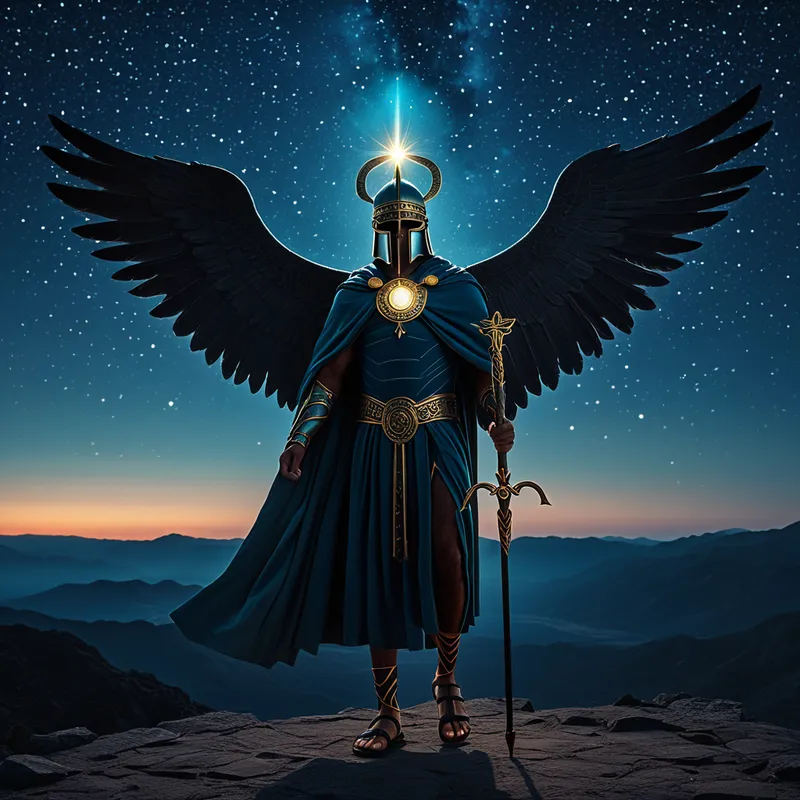
The Greek god Hermes as messen Myth Meaning & Symbolism
A story of the fleet-footed god who stole divine fire, invented the lyre, and became the eternal mediator between worlds.
The Tale of The Greek god Hermes as messen
Before [the world](/myths/the-world “Myth from Tarot culture.”/) was fixed in its ways, when the boundaries between divine and mortal, night and day, were still soft as new clay, a child was born in a secret hour. His mother, the shy Maia, hid him in the shadowy depths of a mountain cave in Kyllene. But this was no ordinary babe. From his first breath, the air shimmered with a restless, cunning energy. He was [Hermes](/myths/hermes “Myth from Global/Universal culture.”/), son of [the sky](/myths/the-sky “Myth from Persian culture.”/)-father Zeus.
While his mother slept, wrapped in the deep blues of night, the infant’s eyes—bright as polished obsidian—opened. An itch was in his fingers, a hum in his bones. He would not be swaddled. He slipped from his cradle, a tiny form moving with impossible grace, and stepped out into the cool, grey world of dawn. His feet, even then, seemed to kiss [the earth](/myths/the-earth “Myth from Hindu culture.”/) and leave no mark.
He wandered, and his gaze fell upon a [tortoise](/myths/tortoise “Myth from Greek culture.”/), slow and ancient, grazing on dewy grass. A laugh, clear and sharp as a bell, escaped him. “A welcome guest,” he whispered to the creature, though his words held the edge of a plan. With a swift, shocking motion, he ended its life, hollowed its shell, and stretched sinews across it. He plucked them, and a sound never before heard in the world rippled forth—the first music of the lyre, a sound that held both joy and a profound, stealing silence.
But the music sparked a deeper hunger. He thought of his glorious half-brother, Apollo, who drove the sun chariot and owned herds of magnificent white cattle. A grin touched the infant’s lips. Under the cover of twilight, the tiny god journeyed to the pastures of Pieria. With breathtaking audacity, he stole fifty of the finest cattle. Yet, he was a thief of genius. He drove them backwards, their hoofprints pointing toward [the sea](/myths/the-sea “Myth from Greek culture.”/), and fashioned sandals of bark and myrtle to disguise his own tiny tracks. He led them to a hidden grove, sacrificed two to the twelve great gods (though he was one of them), and hid the rest.
Returning to his cave as the first true light threatened exposure, he slipped back into his cradle, the innocent babe, the lyre hidden beside him. But the sun sees all. Apollo, radiant and furious, stormed into [the cave](/myths/the-cave “Myth from Platonic culture.”/), his light scorching the shadows. He accused the babe before their father, Zeus. Hermes, wide-eyed, spun a tale of breathtaking innocence. “How could I, a newborn, steal your mighty herds?” he cooed, even as the smell of roasted meat still lingered in the air.
Zeus, throned in Olympus, did not rage. He laughed, a sound of thunder and delight. He saw the cunning, the brilliant, impossible spark. He commanded the truth. And Hermes, caught but unbroken, led Apollo to the hidden herd. To placate his furious brother, he offered the lyre. At the first touch of the strings, Apollo’s anger melted into awe. The god of light was enchanted by this new art born of trickery. In exchange, Apollo gave Hermes the golden staff of heraldry, the caduceus, and a sacred duty: to be the messenger between the high gods, the dark [underworld](/myths/underworld “Myth from Greek culture.”/), and the realm of mortal men. The thief was transformed, in a single day, into the divine communicator, the one who walks all roads.

Cultural Origins & Context
The hymns to Hermes, particularly the grand Homeric Hymn to Hermes, are our primary source for this foundational myth. These hymns were not mere stories but sacred narratives performed in ritual contexts, likely during festivals or as preludes to epic recitations. They served a societal function far beyond entertainment. In a world perceived as layered—with the domains of the gods, the living, and the dead strictly, yet perilously, separated—Hermes’ myth established the necessary principle of mediation.
He was the god of the in-between: of thresholds (herms), of trade (which requires communication between strangers), of shepherds (who dwell between wilderness and civilization), and of thieves (who operate outside societal laws). His myth provided a divine blueprint for navigating a universe full of boundaries. It explained the origin of music and the lyre, gifts born not from solemn creation but from playful, even violent, ingenuity. The myth was told and retold to affirm that connection was possible, that messages could pass, that commerce and discourse could flow, precisely because there existed a deity whose very nature was to cross, to translate, and to transform what he touched.
Symbolic Architecture
At its core, the myth of Hermes is an [allegory](/symbols/allegory “Symbol: A narrative device where characters, events, or settings represent abstract ideas or moral qualities, conveying deeper meanings through symbolic storytelling.”/) of [consciousness](/symbols/consciousness “Symbol: Consciousness represents the state of awareness and perception, encompassing thoughts, feelings, and experiences.”/) itself, specifically the function that connects disparate parts of the [psyche](/myths/psyche “Myth from Greek culture.”/). Hermes represents the [psychopomp](/myths/psychopomp “Myth from Greek culture.”/)—not just a guide of souls to the [afterlife](/symbols/afterlife “Symbol: A symbolic journey beyond death, representing transition, the unknown, and ultimate questions about existence, purpose, and what follows life.”/), but the guiding principle that facilitates communication between the conscious ego and the unconscious, between our lofty ideals ([Olympus](/symbols/olympus “Symbol: In Greek mythology, Mount Olympus is the divine home of the gods, representing ultimate power, perfection, and spiritual transcendence.”/)) and our hidden, instinctual drives (the stolen cattle, the [underworld](/symbols/underworld “Symbol: A symbolic journey into the unconscious, representing exploration of hidden aspects of self, transformation, or confronting repressed material.”/)).
The messenger does not create the message; he makes its passage possible. He is the spark in the synapse, the meaning in the medium.
His theft is not mere criminality but a necessary promethean act of transferring [energy](/symbols/energy “Symbol: Energy symbolizes vitality, motivation, and the drive that fuels actions and ambitions.”/) from one [realm](/symbols/realm “Symbol: The symbol of ‘Realm’ often signifies the boundaries of one’s consciousness, experiences, or emotional states, suggesting aspects of reality that are either explored or ignored.”/) to another. Apollo’s cattle symbolize raw, instinctual, solar vitality—untamed creative power. Hermes, the nascent intellect and [trickster](/symbols/trickster “Symbol: A boundary-crossing archetype representing chaos, transformation, and the subversion of norms through cunning and humor.”/), “steals” this [energy](/symbols/energy “Symbol: Energy symbolizes vitality, motivation, and the drive that fuels actions and ambitions.”/) to fuel his own inventions (the [lyre](/symbols/lyre “Symbol: The lyre symbolizes harmony, creativity, and the connection between the divine and human experiences.”/)). The [resolution](/symbols/resolution “Symbol: In arts and music, resolution refers to the movement from dissonance to consonance, creating a sense of completion, release, or finality in a composition.”/) is not [punishment](/symbols/punishment “Symbol: A dream symbol representing consequences for actions, often tied to guilt, societal rules, or internal moral conflicts.”/) but a sublime trade: raw power (cattle) is alchemized into culture ([music](/symbols/music “Symbol: Music in dreams often symbolizes the harmony between the conscious and unconscious mind, illustrating emotional expression and communication.”/)), and in return, the [trickster](/symbols/trickster “Symbol: A boundary-crossing archetype representing chaos, transformation, and the subversion of norms through cunning and humor.”/) is integrated into the cosmic order as the essential connector. The [caduceus](/symbols/caduceus “Symbol: A winged staff entwined by two serpents, symbolizing healing, commerce, and divine messenger status.”/), with its entwined serpents, becomes the ultimate [symbol](/symbols/symbol “Symbol: A symbol can represent an idea, concept, or belief, serving as a powerful tool for communication and understanding.”/) of this reconciliation of opposites—a balanced channel through which opposing forces can communicate.

The Dreamer’s Resonance
When the archetype of Hermes stirs in the modern dreamer, it often manifests as dreams of urgent messages, missed communications, or finding unexpected pathways. You may dream of receiving a crucial text you cannot read, of discovering a hidden door in a familiar room, or of being a courier in a labyrinthine city. Somatically, this can feel like a restless energy in the limbs, a “tingling” at the periphery of awareness, or anxiety centered in the throat (the center of communication).
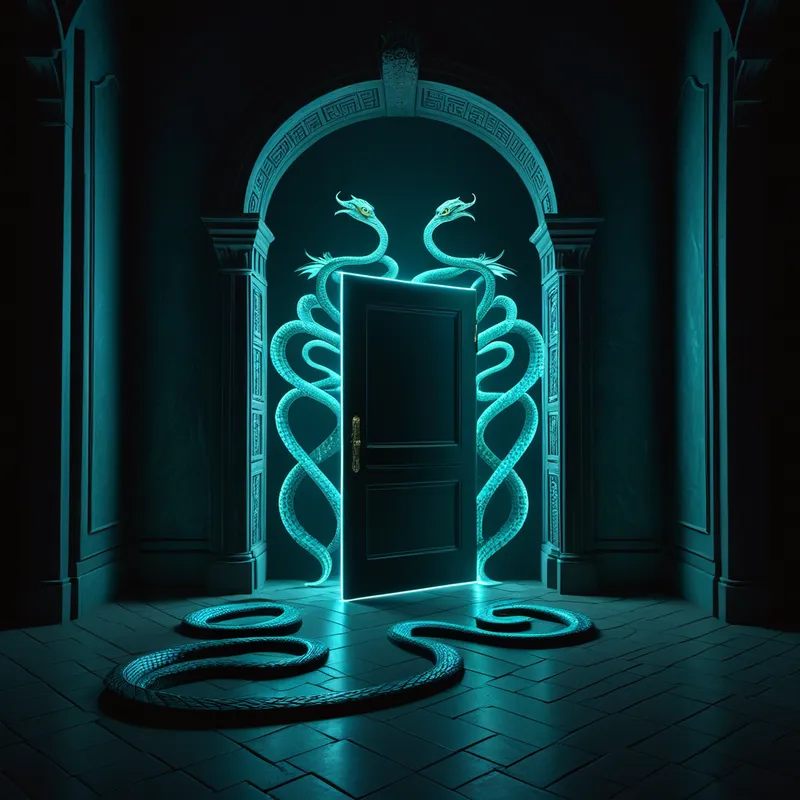
Psychologically, this Hermes-energy indicates a process of internal mediation is attempting to occur. The dream ego is being called to carry information between a repressed content (the “stolen cattle” of the unconscious) and the conscious mind (the “Apollo” of light and order). The frustration of missed messages points to a blockage in this psychic function. The dream is the caduceus itself, appearing not as a staff but as the very architecture of the dreamscape, urging the dreamer to become their own messenger, to translate the raw, instinctual material into a form the conscious self can hear and understand—to make the inner lyre sing.
Alchemical Translation
The individuation journey modeled by Hermes is not one of heroic conquest but of cunning integration. It is the alchemy of [the trickster](/myths/the-trickster “Myth from Various culture.”/) who serves [the self](/myths/the-self “Myth from Jungian culture.”/). The modern individual embarks on this Hermetic path when they recognize that their growth depends not on vanquishing their “shadow” aspects (the thief, the liar, the restless wanderer), but on recruiting their energy for a higher synthesis.
The first stage is the theft: acknowledging a dormant, instinctual power within (a talent, a repressed emotion, a wild creativity) that the conscious, orderly self (Apollo) has corralled but not utilized. One must “steal” it back, often through unconventional or socially unsanctioned means—a sudden career shift, embracing a taboo feeling, or indulging in “unproductive” play.
The second is the invention: crafting this raw material into something new. The tortoise shell of hardened defense mechanisms is hollowed out and strung with the sinews of experience to create a unique voice, a personal art, a new way of communicating one’s truth. This is the birth of the individual’s “lyre.”
The final, crucial stage is the exchange and appointment. One must offer this new creation to the broader psyche, to the “gods” of one’s internal [pantheon](/myths/pantheon “Myth from Roman culture.”/) (values, superego, ideals). In return, one receives the caduceus—the recognized authority to move freely between all levels of one’s being. The individual becomes their own psychopomp, capable of carrying insights from dreams to waking life, of translating trauma into narrative, of guiding lost parts of the soul home. They are no longer just a resident of one psychic territory but the sacred messenger of the whole self, finding meaning in every crossroads.
Associated Symbols
Explore related symbols from the CaleaDream lexicon: