
The Greek god Hermes Myth Meaning & Symbolism
The story of Hermes, the divine messenger and trickster, whose first act was to steal Apollo's cattle, embodying the spirit of cunning, communication, and transformation.
The Tale of The Greek god Hermes
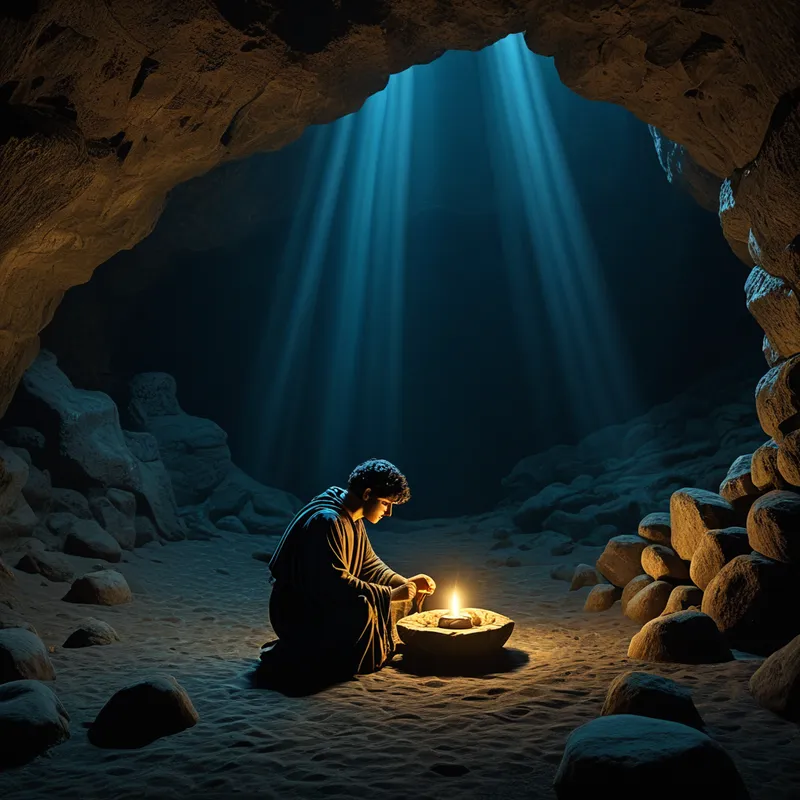
In the deep, violet hour before dawn, when [the world](/myths/the-world “Myth from Tarot culture.”/) holds its breath between night and day, a child was born. Not in a golden hall, but in a shadowy cave on the slopes of Mount Cyllene. His mother, the shy Maia, had sought solitude, but [the child](/myths/the-child “Myth from Alchemy culture.”/) she bore was solitude’s opposite. He was [Hermes](/myths/hermes “Myth from Global/Universal culture.”/), son of Zeus, and he entered [the world](/myths/the-world “Myth from Tarot culture.”/) not with a cry, but with a cunning, silent smile.
While his mother slept, exhausted, the infant’s eyes, sharp and old as stars, scanned the dim cavern. Restlessness, a divine itch, was in his limbs. He slipped from his cradle, not stumbling, but stepping with a grace that defied his hours. He found a great [tortoise](/myths/tortoise “Myth from Greek culture.”/) at [the cave](/myths/the-cave “Myth from Platonic culture.”/)’s mouth and with a laugh that held no malice but pure inventive joy, he transformed it. From its shell, he strung sinews, crafting the first lyre. His small fingers plucked a melody that seemed to weave the very moonlight into sound.
But the melody stirred a deeper hunger—not for milk, but for action. He peered out at the world, and his gaze fell upon the sun-touched hills of Pieria, where the magnificent cattle of his elder brother, Apollo</ab title=“God of the sun, light, music, and prophecy”>, grazed. A plan, brilliant and audacious, unfolded in his mind. He stole forth, not as a thief in darkness, but as a artist of mischief. To confuse the trail, he crafted sandals of brushwood and myrtle to reverse the hoof-prints. He drove the cattle backwards. He even persuaded an old farmer to see nothing, say nothing—binding him with the first spell of persuasive speech.
He hid the herd in a grove, offering two as sacrifice to the twelve gods (himself included, a cheeky addition). Then, as the first true light of dawn gilded the clouds, he returned to his cradle in Cyllene’s cave, curling up as if he had never left, the lyre hidden beside him.
The sun rose, and with it came Apollo’s fury. The god of light, whose knowledge was perfect and clear, found only chaos and contradiction. The trail lied. [The earth](/myths/the-earth “Myth from Hindu culture.”/) itself seemed to mock him. His rage was a heat that scorched the hillsides as he tracked the impossible path back to Maia’s cave. He stormed inside, accusing the innocent-seeming babe.
Hermes looked up with wide, feigned eyes. “How could I, a newborn, steal your mighty cattle? I, who seek only sleep and my mother’s warmth?” But his eyes sparkled with untold truth. Apollo, though enraged, was not foolish. He saw the intelligence shining through the deceit. He dragged the infant before their father, Zeus, on high Olympus.
Before the throne of the thunder king, Hermes did not cower. He told his tale again, a masterpiece of half-truths and charming defiance. Zeus, the great strategist, threw back his head and laughed, a sound of rolling thunder that shook the halls. He saw not a crime, but a promise. He commanded the brothers to reconcile.
Hermes, [the peacemaker](/myths/the-peacemaker “Myth from Indigenous Canadian culture.”/) now, led Apollo to the hidden cattle. To soothe his brother’s pride, he took up the lyre and played. The music he drew forth was not of this world—it held the laughter of streams, the sigh of [the wind](/myths/the-wind “Myth from Various culture.”/) in lonely places, the joy of a secret perfectly kept. Apollo’s anger melted away, replaced by awe and desire. The god of music had been given a gift by the god of cunning. In that moment, a trade was made: the lyre for the cattle, and more. Apollo, in his delight, gave Hermes the golden caduceus and a domain: he would be the messenger, the guide of souls, the god of the in-between.
And so the thief became the diplomat, the liar became the speaker of truths, the restless child became the essential connector of all things. He earned his place not by birthright alone, but by the brilliant, disruptive act of crossing every line he found.
Cultural Origins & Context
The myths of Hermes are woven into the earliest layers of Greek storytelling, preserved in the Homeric Hymns—poetic compositions likely used in ritual and performance from the 8th century BCE onward. The Hymn to Hermes is our primary source for his miraculous infancy. This was not a story confined to dusty scrolls; it was a living narrative performed by bards, a foundational tale explaining the origin of a god integral to daily life. Hermes was ubiquitous. As [Psychopomp](/myths/psychopomp “Myth from Greek culture.”/), he attended life’s final threshold. As god of trade, thieves, and travel, he presided over the risky, vital exchanges that fueled society. His herms—stone pillars with a head and phallus—stood at boundaries, doorways, and crossroads, both protecting and marking zones of transition. The myth served a societal function: it explained the presence of a capricious, intelligent force in the unpredictable realms of commerce, communication, and fortune, a force that could be propitiated but never fully controlled.
Symbolic Architecture
Hermes is the archetypal embodiment of the [Trickster](/symbols/trickster “Symbol: A boundary-crossing archetype representing chaos, transformation, and the subversion of norms through cunning and humor.”/), a psychological force necessary for growth and [adaptation](/symbols/adaptation “Symbol: The process of adjusting to new conditions, often involving psychological or physical change to survive or thrive.”/). He represents the liminal—[the threshold](/myths/the-threshold “Myth from Folklore culture.”/) state itself.
He is not the message, but the movement of the message; not the boundary, but the act of crossing it.
His theft is not mere larceny, but a primal act of [differentiation](/symbols/differentiation “Symbol: The process of distinguishing or separating parts of the self, emotions, or identity from a whole, often marking a developmental or psychological milestone.”/). By taking Apollo’s cattle (symbols of tangible, solar [wealth](/symbols/wealth “Symbol: Wealth in dreams often represents abundance, security, or inner resources, but can also symbolize burdens, anxieties, or moral/spiritual values.”/) and [stability](/symbols/stability “Symbol: A state of firmness, balance, and resistance to change, often represented by solid objects, foundations, or steady tools.”/)), he asserts his own [identity](/symbols/identity “Symbol: Identity represents the sense of self, encompassing personal beliefs, cultural background, and social roles.”/) against a powerful established order. The crafted [lyre](/symbols/lyre “Symbol: The lyre symbolizes harmony, creativity, and the connection between the divine and human experiences.”/) signifies the alchemical power to transform raw [material](/symbols/material “Symbol: Material signifies the tangible aspects of life, often representing physical resources, desires, and the physical world’s influence on our existence.”/) (the [tortoise](/symbols/tortoise “Symbol: Tortoises symbolize wisdom, longevity, and the importance of patience in achieving goals.”/)) into culture ([music](/symbols/music “Symbol: Music in dreams often symbolizes the harmony between the conscious and unconscious mind, illustrating emotional expression and communication.”/)), turning something [earth](/symbols/earth “Symbol: The symbol of Earth often represents grounding, stability, and the physical realm, embodying a connection to nature and the innate support it provides.”/)-bound into an [instrument](/symbols/instrument “Symbol: An instrument symbolizes creativity, communication, and the means by which one expresses oneself or influences the world.”/) of divine [connection](/symbols/connection “Symbol: Connection symbolizes relationships, communication, and bonds among individuals.”/). The [caduceus](/symbols/caduceus “Symbol: A winged staff entwined by two serpents, symbolizing healing, commerce, and divine messenger status.”/), with its intertwined serpents, is a profound [symbol](/symbols/symbol “Symbol: A symbol can represent an idea, concept, or belief, serving as a powerful tool for communication and understanding.”/) of reconciliation, healing, and the balanced union of opposites—a direct result of his conflict with Apollo. Psychologically, Hermes represents the quick, intuitive intelligence of the unconscious (the “divine [child](/symbols/child “Symbol: The child symbolizes innocence, vulnerability, and potential growth, often representing the dreamer’s inner child or unresolved issues from childhood.”/)”) that disrupts the rigid, conscious order (Apollo’s [logic](/symbols/logic “Symbol: The principle of reasoning and rational thought, often representing order, structure, and intellectual clarity in dreams.”/)) to create new possibilities, new connections, and ultimately, a more complex wholeness.

The Dreamer’s Resonance
When the Hermes pattern stirs in the modern dreamer, it often manifests as dreams of clever escapes, finding secret passages in familiar buildings, or receiving cryptic messages (a phone call with static, a note in unknown script). You may dream of being a courier with a vital, unknown package, or of negotiating a deal in a chaotic marketplace. Somaticlly, this can feel like nervous energy, restlessness, or “butterflies”—the body’s intelligence preparing for a shift. Psychologically, this signals that an unconscious content is seeking to “communicate” itself to the conscious mind. The dreamer is in a psychically liminal state, where an old structure or belief (Apollo’s cattle) is being “stolen” by a smarter, more adaptive part of the [psyche](/myths/psyche “Myth from Greek culture.”/) to fuel a new creation. The anxiety or excitement in the dream is the friction of this psychic boundary-crossing.

Alchemical Translation
The myth of Hermes is a masterclass in the alchemy of individuation—the process of becoming an integrated, authentic self. It models the necessary “trickster” phase of that journey.
The Self cannot be built only by solar will and order (Apollo). It requires the cunning, mercurial intelligence that steals from our own entrenched complexes to fund the creation of our unique “music.”
The process begins in the “cave” of unconscious potential (our latent talents, ignored intuitions). The “theft” is the often-disruptive act of claiming energy and resources from a dominant life complex—perhaps stealing time from a rigid career (“Apollo’s cattle”) to feed a nascent artistic pursuit (the “lyre”). The ensuing “conflict with Apollo” is the inner critic, the voice of order and “shoulds,” raging against this change. The resolution is not victory for one side, but a sacred exchange mediated by the greater Self (Zeus). We offer our new creation—the integrated talent, the honest communication—to our inner authority, and in return, we receive the caduceus: the capacity to navigate between all parts of ourselves, to heal splits, and to guide our own soul through transitions. We become our own messenger, fluent in the language of both the conscious and the unconscious, forever moving, forever connecting.
Associated Symbols
Explore related symbols from the CaleaDream lexicon: