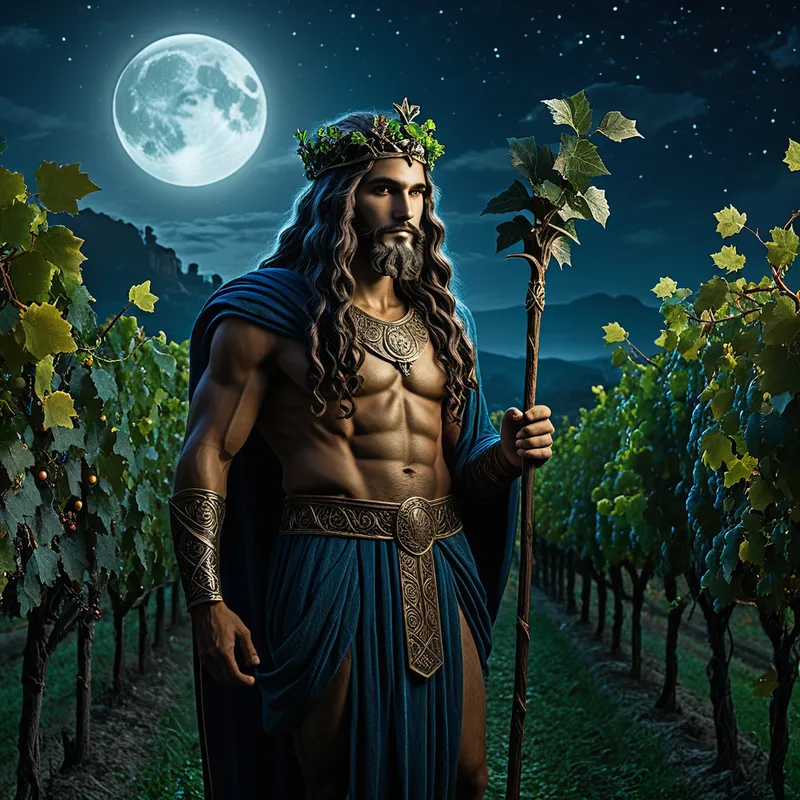
The Greek god Dionysus Myth Meaning & Symbolism
The twice-born god of ecstasy, wine, and madness, whose myth embodies the terrifying and liberating power of the unconscious breaking into the ordered world.
The Tale of The Greek god Dionysus
Hear now the tale of the god who arrives not with thunder, but with the scent of crushed grapes and the sound of unseen flutes. He is the stranger, the one who walks into the city from the wild woods, smiling a smile that holds both boundless joy and bottomless terror.
His story begins in fire and secrecy. From the womb of the mortal princess Semele, consumed by the unveiled glory of her divine lover, Zeus, the god was saved. His father sewed the unborn child into his own thigh, a second womb of flesh and sky. Thus was Dionysus born twice: once from woman, once from god. A secret kept from the jealous eye of Hera, he was spirited away, disguised as a girl, to be raised by nymphs in the hidden, dappled valleys of Nysa.
But a god cannot stay hidden. When he came of age, he wandered the world, a beautiful, long-haired youth with a crown of ivy. He discovered the vine and the magic of the grape. Where he walked, wine flowed and the earth grew fertile without ploughing. He gathered a following: wild-eyed women called Maenads, who danced with serpents and wore fawnskins; and strange, rustic beings like the wise, wine-loving Silenus and the goat-legged Satyrs. Their music was not of the lyre, but of the shrieking aulos and the frantic beat of the drum.
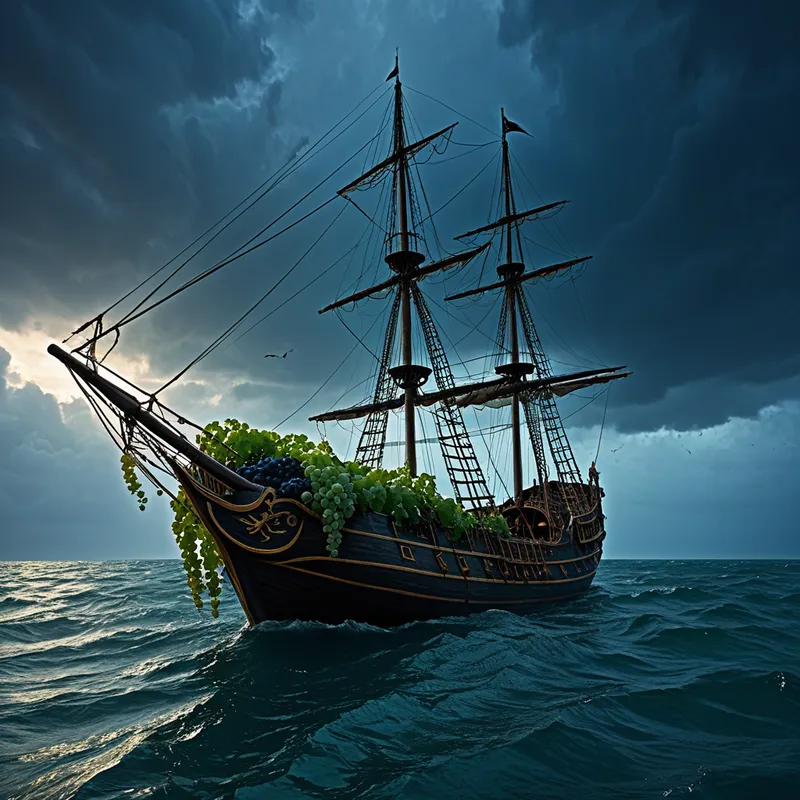
His journey was one of resistance. In Thrace, the king Lycurgus drove the god and his followers into the sea with an ox-goad. For this impiety, the king was driven mad, and in his frenzy, he hacked at his own son, thinking him a vine. On the wine-dark sea, Dionysus was captured by Tyrrhenian pirates who saw only a wealthy youth to ransom. They bound him with ropes, but the bonds fell like water from his limbs. The mast of their ship sprouted into a great, fruit-laden vine; the sails dripped with dark wine. The air filled with the sound of flutes and the phantom shapes of beasts. Driven mad with terror, the pirates leaped overboard and were transformed into dolphins, their souls forever changed by the touch of the god.
But his greatest trial was his return to his mother’s city, Thebes. His own cousin, King Pentheus, refused him. Pentheus saw only a corrupting foreign cult, a threat to civic order and masculine control. He imprisoned the god, mocking his effeminate beauty. Dionysus did not rage; he simply smiled and let himself be bound. The prison doors swung open of their own accord. With gentle, terrible persuasion, he convinced the rigid king to spy on the Maenads—including Pentheus’s own mother, Agave—as they worshipped on the mountain. Disguising Pentheus as a woman, Dionysus led him to a tall pine tree to watch.
What Pentheus saw was not debauchery, but divine madness. The women, possessed by the god, moved with superhuman strength. They suckled wolf cubs; they made milk and honey spring from the earth with a touch. And when they saw the spy in the tree, they did not see a king. In their god-filled eyes, he was a mountain lion. With a collective cry that was neither human nor animal, they tore the tree from the earth. Agave, leading the frenzy, was the first to lay hands on her son. And there, on the sun-dappled slopes of Mount Cithaeron, the ordered world of Thebes was utterly unmade. Pentheus was torn apart, limb from limb. Agave returned to the city in triumph, carrying her son’s head on her thyrsus, boasting of her hunt, only to slowly, horrifyingly, return to her senses under the gaze of the serene, smiling god.
Thus was Dionysus recognized. Not through conquest, but through a rupture. He is the god who is always arriving, the power that cannot be locked away, the ecstasy that dissolves the self to reveal a more terrible, more beautiful truth.
Cultural Origins & Context
The myths of Dionysus are woven from threads far older than Olympus. His figure likely emerged from the meeting of indigenous Aegean ecstatic cults—centered on fertility, vegetation, and direct communion with the divine through trance—with the incoming pantheon of the Indo-European Greeks. He is a god of paradox: both Greek and foreign, divine and mortal, male and effeminately beautiful, life-giving and brutally destructive.
His stories were passed down not just in epic poetry but in the very fabric of civic and religious life. The Great Dionysia in Athens was the birthplace of tragedy and comedy, art forms that served as a sanctioned, communal container for exploring the chaotic, tragic, and liberating forces the god represented. The rituals of his cult, particularly those involving the Maenads (Bacchae), provided a structured, if transgressive, outlet for emotions and energies—especially for women—that were strictly suppressed in the polis. The myth was a social safety valve and a profound warning: the forces of nature, instinct, and ecstasy cannot be denied without catastrophic consequence.
Symbolic Architecture
Dionysus is not merely the god of wine; he is the archetypal embodiment of the unconscious itself—the raw, undifferentiated life force that exists before and beyond the ego’s categories of order and control.
The vine is the symbol of the connected, entangled psyche: its roots in the dark earth of the unconscious, its fruit the intoxicating revelation that shatters the isolated self.
His thyrsus (a fennel stalk tipped with a pine cone) is a wand of transformative power, linking the fertile earth (pine cone) with the growing stalk of consciousness. His dual birth signifies the emergence of divine, transpersonal energy (numinosum) through a mortal, psychological crisis (the destruction of Semele). The resistance he meets—from Lycurgus, the pirates, Pentheus—symbolizes the ego’s desperate, often violent, attempt to repress what it cannot understand or control. The horrific sparagmos (the tearing apart of Pentheus) is the ultimate symbolic act: the complete deconstruction of the rigid, identificatory ego-structure by the very psychic contents it sought to deny.
The Dreamer’s Resonance
To dream of Dionysian imagery is to dream of a psychic pressure cooker reaching its limit. Dreaming of wild, overgrown vines engulfing a house or office signals the unconscious contents threatening to overwhelm conscious structures. A dream of frenzied, ecstatic dancing may point to a somatic release of long-held tension or repressed creative/sexual energy. The appearance of a smiling, ambiguous, or masked stranger often heralds the approach of the Self—the total, integrated psyche—in a form the ego initially perceives as threatening or alien.
These dreams are somatic messages. The body is speaking of energies that have been intellectualized, medicated, or disciplined into silence. The psychological process is one of enantiodromia—the emergence of the unconscious opposite. The more rigidly one clings to control, order, and persona, the more powerfully the Dionysian current builds in the depths, preparing for a disruptive, potentially transformative, eruption into life.

Alchemical Translation
The myth of Dionysus models the alchemical stage of solutio—dissolution. This is not the hero’s journey of conquering external monsters, but the rebel’s path of allowing the inner monster to speak, to dismantle the tyranny of a one-sided consciousness.
Individuation is not about building a better fortress for the ego, but about learning to host the divine madness—to let the vine grow through the cracks in our marble facades.
The modern individual’s “Pentheus” is the hyper-rational, performative, controlled identity. The “Dionysian initiation” is the inevitable crisis—breakdown, burnout, loss, or explosive creative insight—that dissolves this brittle structure. The goal is not permanent ecstatic madness, but the integration of that wildness. It is to move from being torn apart (sparagmos) to a sacred communion (omophagia—the ritual eating of the raw flesh, symbolizing internalization of the god). We are asked to take the raw, instinctual, emotional, and creative life we have denied, and consciously, reverently, make it part of our substance. To become, like the god, twice-born: first into the world of order, and second, through a willing descent into our own chaos, into a more complete, fluid, and authentic wholeness. The rebel god’s final lesson is that true sovereignty comes not from ruling over nature, but from recognizing oneself as an expression of it.
Associated Symbols
Explore related symbols from the CaleaDream lexicon: