
The Greek centaur Chiron Myth Meaning & Symbolism
The immortal centaur, wounded by a poisoned arrow, surrenders his immortality to end his agony, becoming the archetype of the wounded healer.
The Tale of The Greek centaur Chiron
Listen. In the deep, green shadows of Mount Pelion, where the air smells of pine and damp earth, a different kind of centaur walked. He was not born of cloud and lust, like his wild brethren who roared through the valleys. No. He was a child of betrayal and divine pity, Kronos, taking the form of a stallion, and the ocean nymph Philyra. When Philyra saw her son—half-infant, half-foal—she recoiled in horror, crying out to the gods to change her form. They granted her wish, transforming her into a linden tree, her scent forever sweet on the mountain wind. Thus, abandoned by his mother at birth, Chiron was found and raised by Apollo and his twin sister Artemis.
Under their tutelage, the outcast became the master. His cave was not a den of chaos, but a hall of wisdom. The walls were lined with herbs for healing, scrolls of prophecy, and lyres for harmony. He walked with a gentle gait, his hooves quiet on the moss, his human hands skilled in surgery, astronomy, and the art of the hunt. To him came the raw clay of future legends: Jason, Heracles, Asclepius, and the warrior Achilles. He shaped them, teaching the hero not just to fight, but to heal; not just to rule, but to understand the music of the spheres.
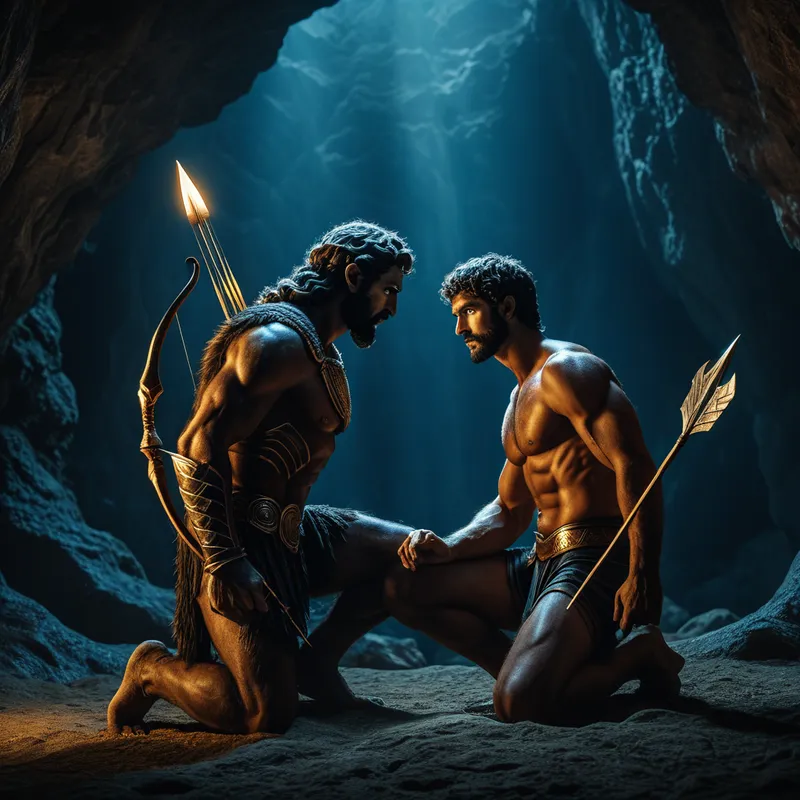
But fate, woven by the Moirai, is a tangled thread. Heracles, his former student, visited the centaurs of Pelion. A quarrel erupted over a jar of sacred wine, and in the violent melee, Heracles let fly his arrows, dipped in the venomous blood of the Lernaean Hydra. One arrow, shot wildly, found not a foe, but a friend. It pierced Chiron’s thigh.
A scream, not of rage but of profound, cosmic irony, echoed through the caves. The agony was instant and unending—a divine poison meant to kill, coursing through the veins of one who could not die. For Chiron was immortal. The gift of his divine father became his eternal curse. The greatest healer in all the world lay wounded by a wound he could not cure, tormented by a pain that would never release him. He wandered the familiar slopes, now a landscape of torture, his wisdom turned inward to confront the abyss of endless suffering.
Years passed. The agony was a constant companion. Then, a new cry echoed in the heavens—that of Prometheus, bound to his rock, his liver eternally devoured by an eagle. To be released, an immortal being had to willingly descend into the realm of Hades. Chiron saw the exchange, the alchemy of his boundless pain. He raised his eyes from his own festering wound to the suffering of another. He went to Zeus and offered a trade: his own immortality for Prometheus’s freedom, and an end to his agony.
The king of gods consented. The unbearable pain, held for so long, finally found its purpose. Released from the bonds of eternal life, Chiron’s spirit ascended. But he was not erased. In honor of his wisdom and his ultimate sacrifice, Zeus placed him among the stars, his form immortalized not in flesh, but in light—the constellation Sagittarius, forever aiming his bow at the heart of the Scorpion, the symbol of poison and death he had overcome.
Cultural Origins & Context
The myth of Chiron originates in the rich oral traditions of ancient Greece, finding its most coherent form in the epic poetry of Hesiod and later in the works of poets like Pindar and Apollonius of Rhodes. Unlike the chaotic, lustful centaurs who represented untamed nature and barbarism, Chiron was a singular figure, a bridge between the wild and the civilized, the animal and the divine. His story was told not just as a fantastical tale, but as an etiological myth explaining the origins of medicinal knowledge (passed to Asclepius) and the celestial maps used by heroes and sailors.
He functioned as the archetypal pedagogue for the aristocratic class, embodying the Greek ideal of paideia—holistic education encompassing ethics, arts, warfare, and healing. His cave on Mount Pelion served as a mythical prototype for the later philosophical schools. His myth was societal medicine: it presented a model for transforming raw, heroic potential (aretē) into wise and compassionate leadership through mentorship. His ultimate sacrifice also provided a theological resolution to the problem of unending suffering, offering a narrative where pain could be exchanged for a greater cosmic good.
Symbolic Architecture
Chiron is the ultimate symbol of the Wounded Healer. His very body is a union of opposites: the instinctual, terrestrial horse and the conscious, celestial human. This hybrid nature signifies the fundamental human condition—the struggle to elevate conscious understanding from the base clay of our biological and instinctual selves.
The wound that does not kill, but will not heal, is the forge where the ego is shattered and the Self begins to emerge.
His immortality represents the eternal, inescapable nature of certain core wounds—trauma, loss, a fundamental sense of alienation or “otherness” that begins, like Chiron’s story, with a primal abandonment. The Hydra’s venom symbolizes a toxic, complex pain that resists simple cure, often inflicted inadvertently by those closest to us (Heracles, the student). The central, agonizing paradox is that the source of his profound suffering (immortality) is also the very thing that prevents escape, mirroring psychological defenses that both protect and imprison us.
His resolution is not a cure, but a sacrificial translation. He does not conquer his wound; he redeems it by offering it up for a purpose beyond himself. This transforms passive suffering into active, meaningful sacrifice. His stellification as Sagittarius the Archer points the way: the healed healer aims his consciousness (the arrow) at the heart of the primal poison (the Scorpion), mastering it through understanding, not force.
The Dreamer’s Resonance
To dream of Chiron is to dream into a process of profound somatic and psychic integration. The dreamer may encounter a wise but limping animal-human guide, a teacher figure who is themselves injured, or feel a piercing, chronic pain in the leg or thigh that has no medical cause. This is the psyche signaling a confrontation with an incurable complex—a core wound tied to identity, often related to mentorship, inheritance, or a sense of being fundamentally “different.”
The somatic experience in the dream—the heaviness of the horse-body, the sharpness of the wound—indicates that this process is not merely intellectual. It is lodged in the body and the instincts. The dream is an invitation to stop trying to “cure” this wound through force of will (the Heracles approach) and instead begin the difficult work of holding it consciously. The dreamer is in the cave, learning that their deepest pain is also the seat of their unique wisdom and capacity to guide others. It is a call to move from identification with the heroic, invulnerable student to embracing the role of the wounded, compassionate teacher.

Alchemical Translation
The Chiron myth is a precise map of the individuation process, specifically the nigredo and albedo. The initial abandonment and hybrid nature represent the innate sense of psychic conflict and alienation that initiates the journey. The poisoning is the nigredo—the descent into the blackness of unavoidable, debilitating suffering where the old, immortal ego-structure is dissolved by venomous insight.
The sacrifice of immortality is the death of the illusion of a pain-free, perfect self. What ascends is not the cured individual, but the conscious vessel through which the wound becomes a source of light.
Holding the wound without succumbing to despair is the immense work of the albedo. Here, in the white heat of enduring pain, a new consciousness is purified. Chiron’s teachings to others during his agony symbolize this: by tending to the development of other psychic contents (the inner heroes, the healing function represented by Asclepius), we objectify and give form to our own suffering, gaining mastery over it.
The final trade—immortality for release—is the ultimate alchemical transmutation. It is the conscious decision to let go of the ego’s demand for specialness, invulnerability, or eternal blamelessness (the immortality). In doing so, the wound loses its destructive, personal charge and becomes a universal, symbolic gift. The psyche is no longer a cave of torment but is constellated into a stable, guiding pattern in the inner cosmos—a fixed point of hard-won wisdom that can aim true and guide the soul’s journey through the dark. We become, not victims of our wound, but its compassionate custodians and, through that, healers for the world.
Associated Symbols
Explore related symbols from the CaleaDream lexicon: