The Great Work Myth Meaning & Symbolism
The ancient quest to transmute base matter into gold, a symbolic journey of purifying the soul and achieving ultimate unity and enlightenment.
The Tale of The Great Work
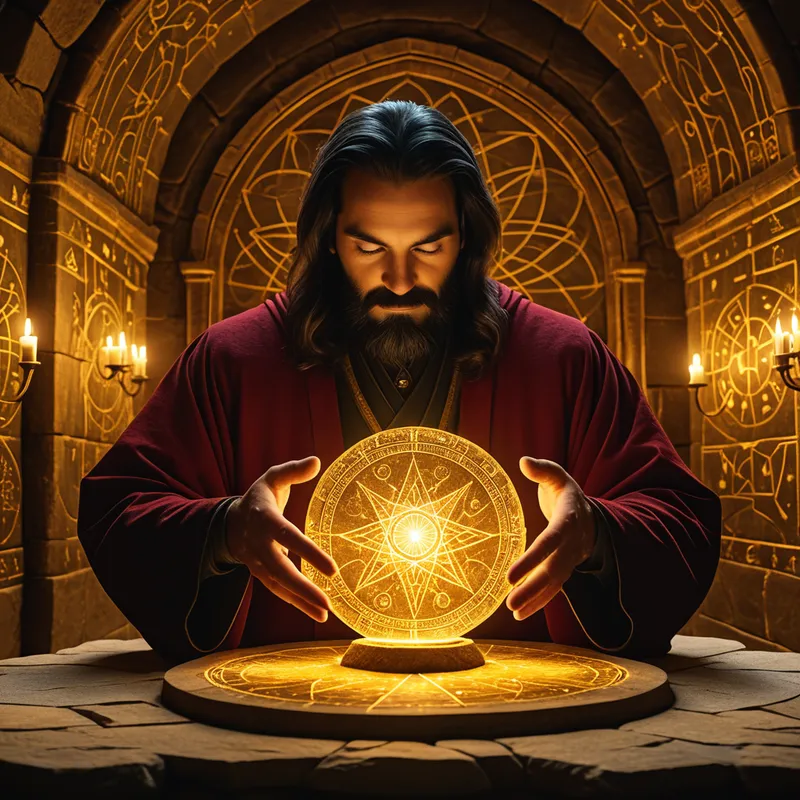
In the beginning, there was the One [Thing](/myths/thing “Myth from Norse culture.”/), the [Prima Materia](/myths/prima-materia “Myth from Alchemical culture.”/)—a chaos of potential, dark and formless as [the void](/myths/the-void “Myth from Buddhist culture.”/) before dawn. From this womb of shadow, [the Alchemist](/myths/the-alchemist “Myth from Various culture.”/) was born, not as a man or woman, but as a yearning. A spark of divine discontent flickered in the heart of the mundane world.
This Alchemist, cloaked not in robes but in profound longing, entered the [Vas Hermeticum](/myths/vas-hermeticum “Myth from Alchemical culture.”/). This was no mere flask of glass, but the sealed chamber of the soul, [the crucible](/myths/the-crucible “Myth from Alchemical culture.”/) of existence itself. Within, they found the base matter of their being: the heavy, cold Lead of ignorance, the chaotic [Mercury](/myths/mercury “Myth from Roman culture.”/) of a scattered spirit, and the burning, corrosive [Sulfur](/myths/sulfur “Myth from Alchemical culture.”/) of untamed passion. These were the Three Essentials, locked in a war that produced only the blackest ash—the [Nigredo](/myths/nigredo “Myth from Alchemical culture.”/). In this absolute midnight, all color fled. The Alchemist knew despair, a dissolution so complete they forgot their own name.
But in that blackness, a secret fire was kindled. Not with bellows, but with patience. Not with logs, but with unwavering attention. This was the fire of the Athanor. Slowly, agonizingly, the mass within [the vessel](/myths/the-vessel “Myth from Alchemical culture.”/) began to change. The blackness gave way to a peacock’s tail of fleeting, iridescent colors—the Albedo. The chaotic Mercury was washed in the tears of [the moon](/myths/the-moon “Myth from Tarot culture.”/), becoming a silver-white purity. A white rose bloomed in the ashes.
Then, the fire was raised. The white matter was subjected to a fiercer heat, the heat of a conscious ordeal. It blushed with the crimson of dawn, then burned with the deep, royal red of passion refined—the [Rubedo](/myths/rubedo “Myth from Alchemical culture.”/). The red Sulfur and the white Mercury, long at odds, began to dance. They circled each other, faster and faster, in [the sacred marriage](/myths/the-sacred-marriage “Myth from Various culture.”/) of the Coniunctio. From their ecstatic union, a new substance was born.
It did not shine at first. It was a dense, heavy stone, unremarkable to the eye. But when the Alchemist lifted it, it held the weight of the cosmos. This was the [Lapis Philosophorum](/myths/lapis-philosophorum “Myth from Alchemical culture.”/), the Philosopher’s Stone. A single drop of its essence, the [Panacea](/myths/panacea “Myth from Greek culture.”/), fell upon the mass of remaining Lead. Before the Alchemist’s eyes, the dull, base metal trembled, shed its grey skin, and awoke as the Sun’s own child—pure, incorruptible Gold. The Work was complete. The One Thing had returned to itself, but now conscious, perfected, and radiant.
Cultural Origins & Context
The myth of The Great Work is not the property of a single culture, but a perennial philosophy that found its most elaborate expression in the Hellenistic, Islamic, and later European alchemical traditions, spanning from Alexandria to the laboratories of Renaissance Prague. It was never merely a recipe for metallurgy; it was a coded spiritual doctrine, passed down in cryptic texts like the [Tabula Smaragdina](/myths/tabula-smaragdina “Myth from Alchemical/Hermetic culture.”/) and lavishly illustrated manuscripts known as Mutus Liber—the “wordless books.”
Its tellers were sages, monks, and natural philosophers operating at the fraught boundary between sanctioned religion, proto-science, and esoteric heresy. The myth served a vital societal function: it provided a container for the forbidden. In an age where direct mystical experience could be dangerous, the language of furnaces, solvents, and metals offered a safe allegory for the inner transformation of the soul, the Opus Internum. It was a map for the individual’s direct relationship with the divine, hidden in plain sight.
Symbolic Architecture
At its core, the myth is a profound [blueprint](/symbols/blueprint “Symbol: A blueprint represents the foundational plan or design for something, often symbolizing potential, structure, and the mapping of one’s inner self or future.”/) for psychological [integration](/symbols/integration “Symbol: The process of unifying disparate parts of the self or experience into a cohesive whole, often representing psychological wholeness or resolution of internal conflict.”/). The [laboratory](/symbols/laboratory “Symbol: A controlled environment for experimentation, discovery, and analysis, representing the pursuit of knowledge through methodical processes.”/) is the totality of the [psyche](/myths/psyche “Myth from Greek culture.”/). The base metals are the raw, unintegrated aspects of [the self](/myths/the-self “Myth from Jungian culture.”/): our prejudices (Lead), our neurotic fluctuations ([Mercury](/symbols/mercury “Symbol: Mercury symbolizes communication, intellect, and swift movement, often representing the messenger between realms in spiritual and mythological contexts.”/)), our destructive angers and lusts (Sulfur).
The Nigredo is not a failure, but the necessary descent into the shadow. One must become fully acquainted with the darkness within to find the seed of light.
The [Albedo](/symbols/albedo “Symbol: In alchemy, the whitening stage representing purification, spiritual ascension, and the emergence of consciousness from darkness.”/) represents the arduous work of [consciousness](/symbols/consciousness “Symbol: Consciousness represents the state of awareness and perception, encompassing thoughts, feelings, and experiences.”/)—washing, clarifying, and making conscious what was unconscious. The white stage is [the ego](/myths/the-ego “Myth from Jungian culture.”/)’s attempt at purity and order. The Rubedo and the Coniunctio symbolize the final, terrifying step: the [marriage](/symbols/marriage “Symbol: Marriage symbolizes commitment, partnership, and the merging of two identities, often reflecting one’s feelings about relationships and social obligations.”/) of the conscious mind (often symbolized by the [King](/symbols/king “Symbol: A symbol of ultimate authority, leadership, and societal order, often representing the dreamer’s inner power or external control figures.”/) or Sulfur) with the unconscious [soul](/symbols/soul “Symbol: The soul represents the essence of a person, encompassing their spirit, identity, and connection to the universe.”/) (the [Queen](/symbols/queen “Symbol: A queen represents authority, power, nurturing, and femininity, often embodying leadership and responsibility.”/) or Mercury). This is not an intellectual union, but an emotional and spiritual conflagration that births a new governing center—the Self, symbolized by the [Stone](/symbols/stone “Symbol: In dreams, a stone often symbolizes strength, stability, and permanence, but it may also represent emotional burdens or obstacles that need to be acknowledged and processed.”/).
The Philosopher’s Stone is the achieved state of psychic wholeness. It is the point where the individual is no longer ruled by complexes but from a centered, timeless essence that can “transmute” the leaden experiences of life into golden wisdom.
The Dreamer’s Resonance
When this myth stirs in the modern unconscious, it often manifests in dreams of profound transformation within confined spaces. One might dream of a basement furnace that must be tended, of a cluttered attic being cleaned to reveal a hidden jewel, or of a murky pond in one’s own backyard slowly clearing to reveal a brilliant, strange fish at its bottom.
Somatically, this can correlate with feelings of heavy depression (the Nigredo), followed by periods of cleansing illness or cathartic release (the Albedo), and finally, surges of integrative energy that feel both fiery and healing (the Rubedo). The dreamer is undergoing a process of Introversion so deep that the very foundations of their identity are being broken down and reconstituted. The vessel of their life feels hermetically sealed, under pressure, because a radical inner work is occurring that cannot be shared with the outer world until it is complete.
Alchemical Translation
For the modern individual, The Great Work models the journey of Individuation. Our “base metal” is the inherited, conditioned personality—the false self built from parental expectations, societal roles, and unlived lives. The first step is recognizing this leaden weight, this Nigredo of meaninglessness or crisis.
The analytical work of therapy, introspection, and shadow work is the Albedo—the washing and separating. We learn to distinguish what is truly “us” from what we have merely absorbed. But analysis alone can leave one in a sterile, white state. The Rubedo is the courageous reintroduction of passion, blood, and commitment—the fire of Eros and deep feeling—into this clarified structure. It is falling in love with one’s own destiny, with all its red-hot difficulty.
The sacred marriage is the moment when your deepest, often contradictory, needs—for security and freedom, for spirit and flesh—cease their civil war and agree to co-create your life.
The resulting “Stone” is not a state of perfect, static bliss. It is the embodied capacity for inner stability and transformative action. It is the ability to meet the “lead” of a failure, a loss, or a trauma, and, through the conscious application of your hard-won essence, find the “gold” of growth, resilience, and meaning within it. You become the alchemist of your own experience, and your life becomes the ongoing Great Work.
Associated Symbols
Explore related symbols from the CaleaDream lexicon: