The Great Wall Myth Meaning & Symbolism
A mythic tale of a grieving emperor, a celestial dragon, and the monumental wall forged from sacrifice to shield the world from primordial chaos.
The Tale of The Great Wall
Hear now a tale not of mortar and stone, but of breath and bone. In the age when the world was still soft, when mountains were thoughts and rivers were veins, a shadow stirred in the northern wastes. It was not an army of men, but the Hundun—the Chaos That Howls. It was the wind that unmakes names, the frost that stills the heart’s beat, the entropy that seeks to return all ordered things to the silent, featureless dust from which they came.
In the heart of the Middle Kingdom, the Emperor Qin Shi Huang felt this chill in his spirit long before it touched his borders. He was a man who had forged a nation from warring states, imposing a single script, a single law, a single will upon the land. Yet, in the quiet of his jade-inlaid chamber, he heard it: the whispering dissolution at the edge of all things. His greatest achievement felt as fragile as a spider’s web against a gale. He consulted oracles who read the cracks in tortoise shells, and they spoke with one voice: “From the barren north, the Unformed comes. It has no face to reason with, no hunger to sate. It only un-creates.”
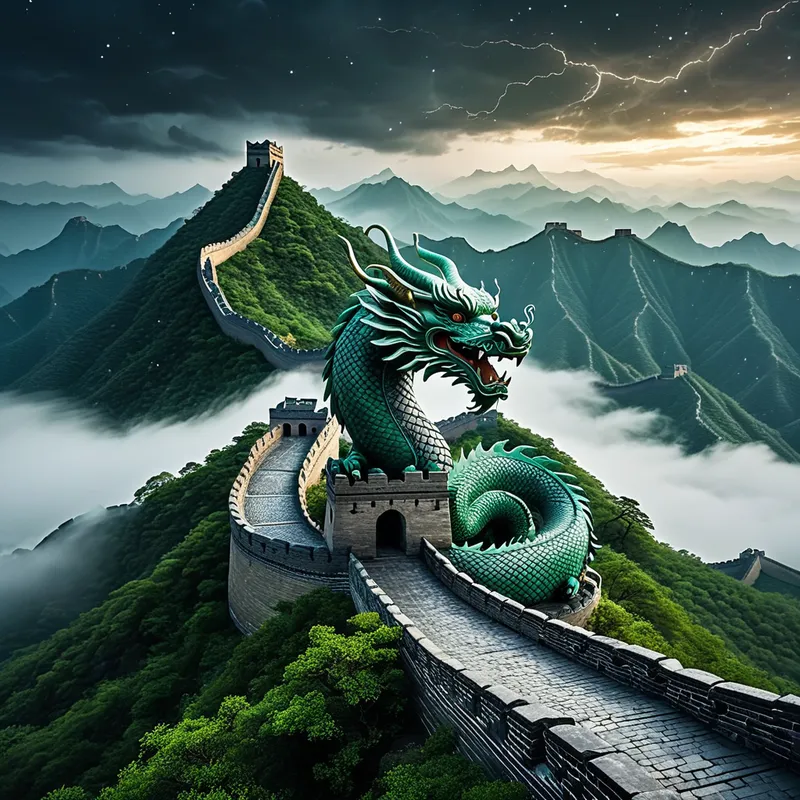
Despair threatened to swallow him. Armies could not fight a concept. Walls of earth would be scoured away. Then, in a dream, a vision came. A being of immense, coiled power, its form the green of deep rivers and the sheen of aged bronze—the Long, the Celestial Dragon. It did not speak with words, but poured understanding into the emperor’s mind. “Order must be given a spine,” the vision thrummed. “A boundary must be drawn not just on the earth, but in the world-soul. But such a line cannot be drawn with ink. It must be inscribed with sacrifice and sealed with a sovereign’s tears.”
The emperor awoke, his resolve crystallized. He issued a decree that echoed across the land: all people, from every former kingdom, were to send their strongest, their most skilled, to a single, impossible project. They came—farmers, potters, blacksmiths, scholars—a river of humanity flowing to the northern frontiers. But the Dragon’s wisdom was specific. The foundation stones must be laid by those who understood the cost of chaos: parents who had lost children to war, children who had lost homes to flood. Their grief became the mortar.
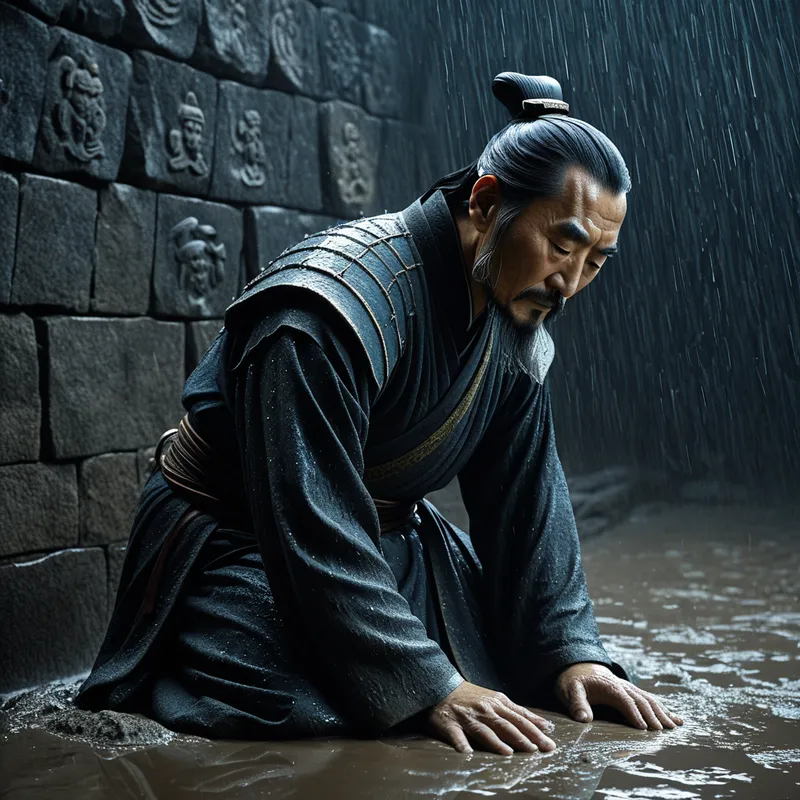
The work was titanic, a symphony of suffering and hope. As the wall began to snake across the dragon’s spine of the mountains, the Hundun’s breath arrived. It came as a blizzard that froze tools to hands, as a despair that made laborers forget why they toiled. The wall faltered. Seeing this, the emperor journeyed to the highest, most exposed section. He did not command. He knelt in the frozen mud alongside a widow from Qi and an orphan from Chu. He took a stone, heavy with the frost of the coming chaos, and with his own blistered hands, set it in place.
As he did, he thought not of his empire, but of every single life spent in its forging. A single tear, hot against the cold, traced a path through the dust on his cheek and fell upon the stone. Where it landed, a faint, shimmering pattern emerged, like the ghost of a dragon’s scale. A ripple passed through the line of workers, a silent shock of shared purpose. The wall was no longer just a barrier; it had become a testament. Stone by stone, sacrifice by sacrifice, they built not just away from the chaos, but toward each other. Finally, as the last block was fitted on a windswept peak at dawn, a sound like a great sigh passed over the land. The howling wind from the north broke against an invisible rampart—not of rock, but of collective will. The Hundun was held at bay, not destroyed, but defined against. The Wall stood. It had been paid for in the currency of the human heart.
Cultural Origins & Context
The myth of the Great Wall as a metaphysical bulwark is a narrative stratum that lies beneath the immense historical fact of its construction. While the physical Wall, built and rebuilt over millennia primarily during the Ming Dynasty, served a practical military function, its mythic dimension speaks to a deeper cultural psyche. This story is not found in a single canonical text like the Jing, but is woven from folk tales, local legends, and the poetic imagination of a civilization perpetually conscious of the tension between the cultivated center (Zhongguo, the Middle Kingdom) and the untamed, often threatening periphery.
It was told by village elders during the long winter nights, by mothers to children to explain the purpose of the distant, looming structure on the horizon, and by scholars who saw in it an allegory for the Confucian virtues of collective duty, sacrifice for the greater good (Yi), and the ruler’s burden to maintain cosmic and social order (Li). The myth served to transform an immense, often brutal state project into a shared, sacred endeavor. It answered the “why” that mere history could not: we build the Wall not just to keep others out, but to preserve what we are within. It is a story of Wen defining itself against Wu, of consciousness fortifying itself against the unconscious, formless deep.
Symbolic Architecture
Psychologically, the myth presents a powerful map of the ego’s struggle to establish and maintain a coherent identity.
The Wall is not a rejection of the outer world, but the definition of an inner one. It is the psychic membrane where “I” ends and “Other” begins, necessary for existence but permeable to the exchanges that sustain life.
The Emperor Qin Shi Huang represents the organizing principle of consciousness—the ego that seeks to unify disparate parts of the psyche (the warring states) into a coherent self. His despair mirrors the ego’s terror when faced with the formless, annihilating potential of the unconscious (the Hundun). The Long, appearing in a dream, is a manifestation of the Self—the central, archetypal authority of the total psyche that guides the ego toward wholeness. Its message is crucial: defense through rigidity leads to brittleness; true strength comes from integration.
The Wall itself is the ultimate symbol of this integrated boundary. It is built from the “grief” and “sacrifice” of the internal populace—the repressed memories, forgotten pains, and unacknowledged aspects of the self. Only when the emperor (the ego) kneels and adds his own tear (the acknowledgment of his own vulnerability and connection to these repressed parts) does the Wall become spiritually potent. It transforms from a simple barrier of suppression into a living structure of containment, holding the chaos at bay not through brute force, but through the acknowledged weight of one’s own lived experience.
The Dreamer’s Resonance
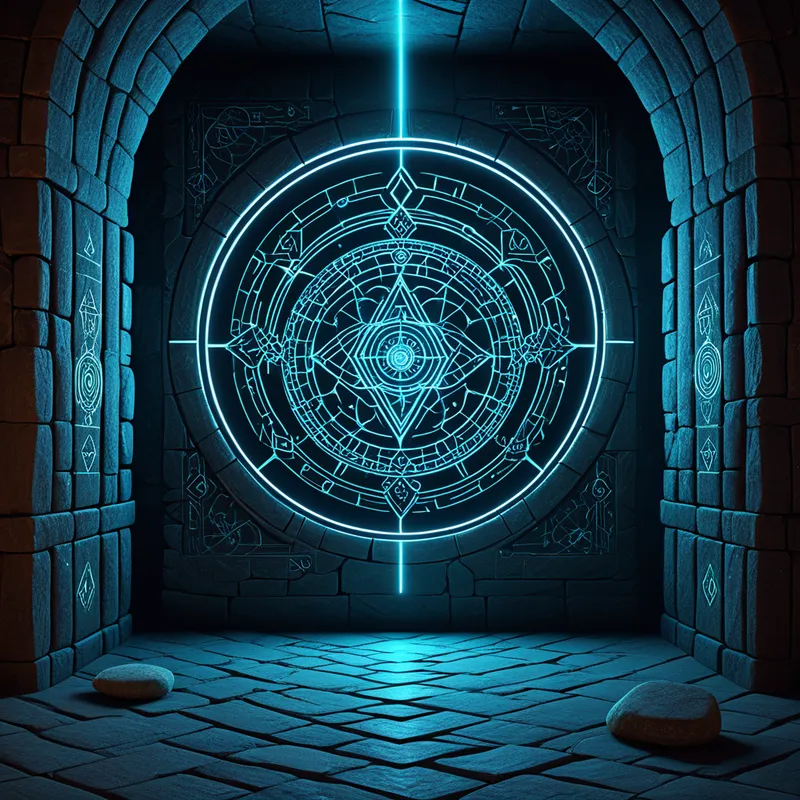
When this mythic pattern stirs in the modern dreamer, it often manifests as dreams of building, repairing, or finding breaches in vast, endless walls, fortifications, or dams. The somatic experience is one of profound fatigue, of endless labor, or of chilling dread as a cold wind or dark water seeps through a crack.
Psychologically, this signals a critical phase of boundary-work in the psyche. The dreamer is likely engaged in the exhausting task of establishing or re-establishing healthy ego boundaries—perhaps after a period of enmeshment, trauma, or personal dissolution. The “chaos” threatening to flood in may be overwhelming emotions, the demands of others, or a loss of personal identity. The dream is a snapshot of the psyche’s attempt to gather its resources (the workers) to construct a necessary defense. The feeling of futility (“the wall is crumbling as I build”) points to a purely ego-driven effort, lacking the integrative, sacrificial element the myth prescribes. The dream calls for the dreamer to identify what personal “grief” or ignored aspect of the self must be consciously acknowledged and woven into the structure of their identity to make it resilient.
Alchemical Translation
The alchemical process modeled here is the transformation of separation into definition, and of defense into integrity. The prima materia is the formless, chaotic potential of the un-lived life and the unprocessed past (the Hundun). The initial, failed attempts to build represent the ego’s misguided alchemy: trying to create order through willpower alone (the emperor’s decree), which produces only a brittle, lifeless substance.
The philosopher’s stone in this myth is not a thing, but a relationship—the conscious, tearful connection between the ruling principle and the suffering substance.
The crucial operation is the mortificatio—the killing of the old, isolated ego. The emperor kneeling in the mud is this death. His tear is the aqua permanens, the divine water that dissolves the hard boundaries between ruler and subject, between conscious intention and unconscious material. This allows for the coniunctio oppositorum, the sacred marriage. The collective grief of the people (the shadow, the repressed) is united with the sovereign will (the ego) under the guidance of the dragon (the Self).
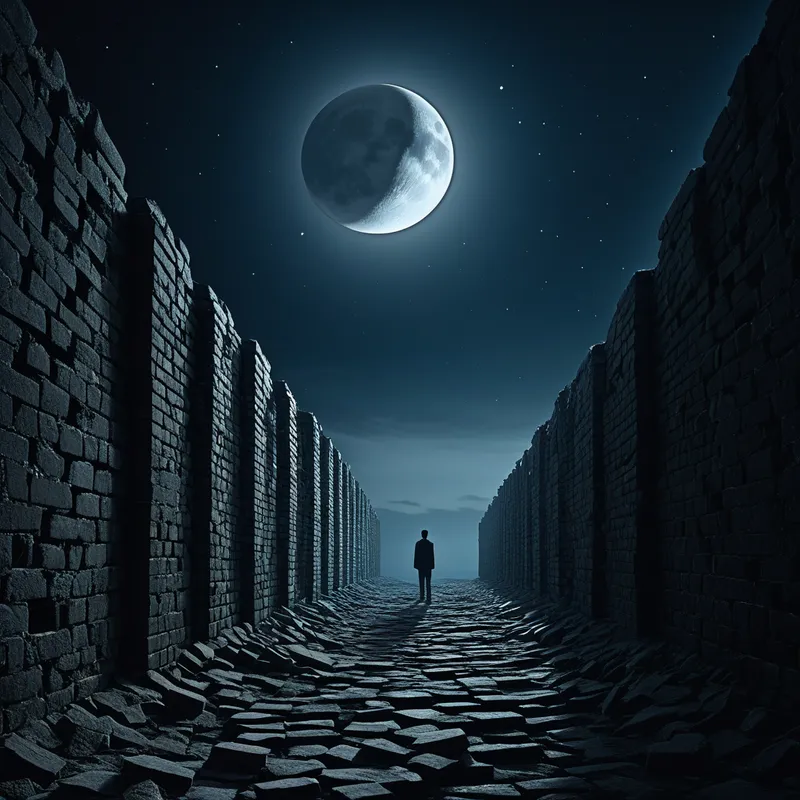
The resulting Wall is the lapis philosophorum—the stone of the philosophers. It is a psychic structure that is both solid and alive, a boundary that defines the self without isolating it. It performs the ultimate alchemy: it does not destroy the chaos (the Hundun), but holds it in a dynamic, creative tension. The chaos becomes the very thing that gives the Wall its purpose and meaning. For the modern individual, the myth instructs that true strength and protection do not come from walling off our pain, vulnerability, or “chaotic” emotions, but from consciously integrating them into the fabric of who we are. Our wholeness, our completed Self, is the only Great Wall that can truly hold.
Associated Symbols
Explore related symbols from the CaleaDream lexicon: