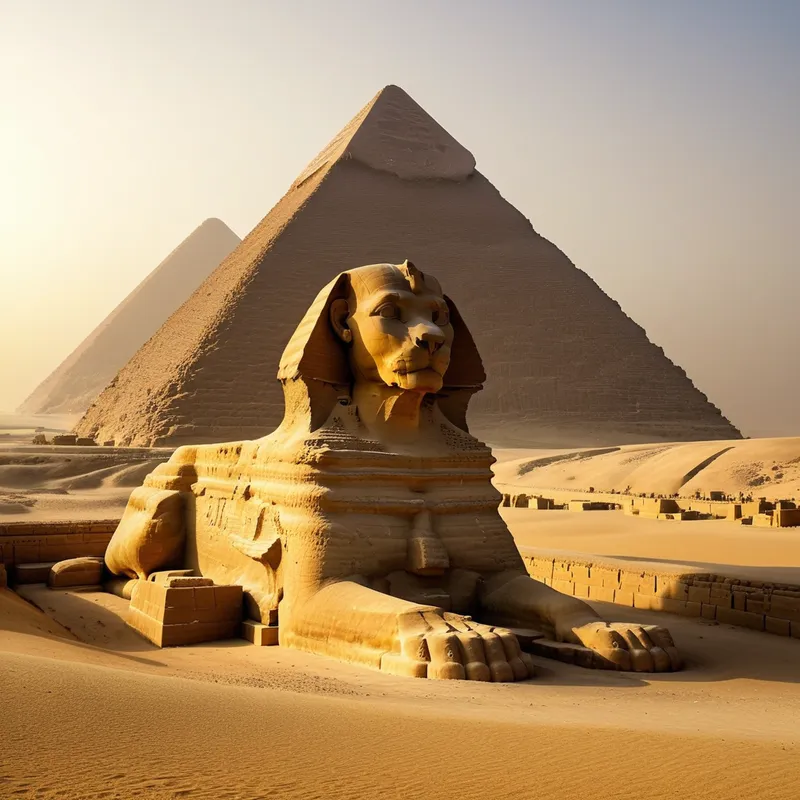
The Great Sphinx of Giza Myth Meaning & Symbolism
A colossal guardian of the horizon, part lion, part king, holding the riddle of the sun's journey and the soul's passage between worlds.
The Tale of The Great Sphinx of Giza
Hear now the whisper of the wind over the Necropolis. The sun, Ra, has fled the sky, plunging the land into the embrace of Kuk. But on the horizon of the west, where the dead travel, a sentinel waits. It does not sleep.
It was born from the living rock in the time of kings, when the horizon was a sacred line between the ordered world of Ma’at and the chaos of the outer dark. The king, a son of Ra, commanded the mountain itself to take a form that would guard the passage for eternity. With the relentless patience of the desert, stone was coaxed and carved. The mighty body of a lion, king of all beasts, capable of terrible swiftness and crushing strength, emerged from the plateau. Upon this formidable base was set the serene, unmoving face of the king himself, crowned with the royal nemes. This was no mere statue. It was a Living Image, a vessel for a mighty power.
They named it Shesep-ankh, and its duty was solemn and eternal. Each evening, as Ra’s solar barque sank into the perilous waters of the Duat, the Sphinx’s gaze would hold the dying light. It was the guardian of the threshold, ensuring the sun’s dangerous journey through the night would begin from a place of order. It watched over the silent, eternal houses of the kings—the pyramids—ensuring their sleep was undisturbed by the creeping chaos that longed to seep back into the world.
But its guardianship was not passive. It possessed a voice, not of air, but of silence and presence. To the unworthy, its gaze was a weight that could crush the spirit, a riddle written in stone and sand. It asked without asking: What being has one voice, yet becomes four-footed, two-footed, and three-footed? This was the whisper in the desert wind, the challenge etched in its very form—the lion, the man, the king supported by the staff of age. To pass by it, to understand the horizon it guarded, one had to understand the nature of time, of life, of the self. It stood not to bar the way, but to test it. The rising sun, Khepri, born anew in the east each morning, was its answer and its reward, proving the guardian had once again held the line through the long, star-filled night.
Cultural Origins & Context
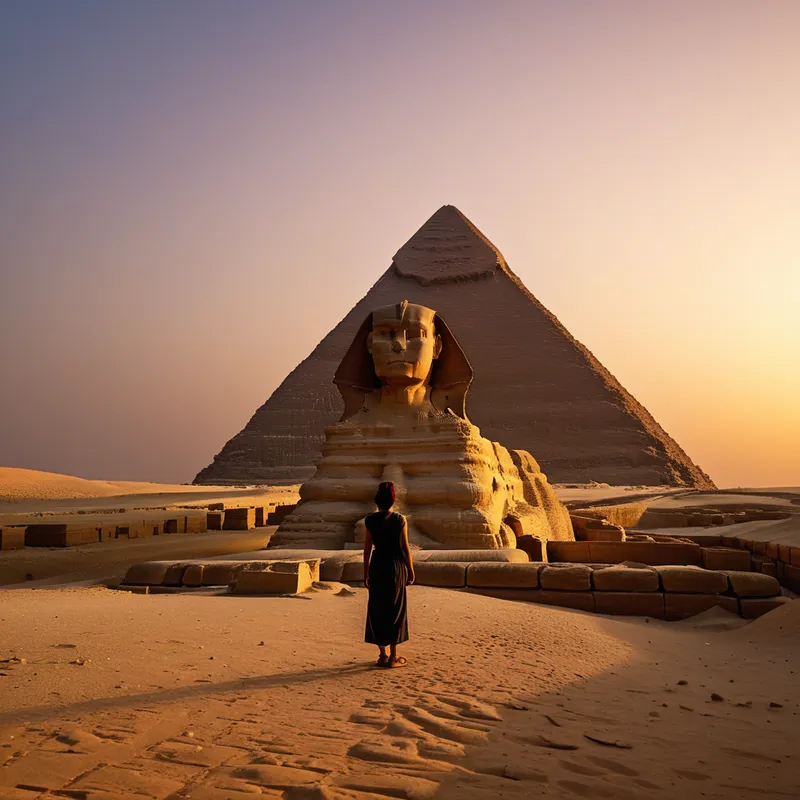
The Great Sphinx is not the subject of a single, codified narrative like the myths of Osiris or Set. Its “myth” is architectural, royal, and cosmological. Most Egyptologists associate its construction with Pharaoh Khafre (c. 2570 BCE), whose pyramid complex it guards. Its primary cultural function was as a divine guardian statue, a Solar Temple in the form of a beast.
Its myth was lived, not merely told. It was embedded in the Royal Ideology. The pharaoh was the living embodiment of Horus, the rightful ruler who maintained Ma’at against chaos. The Sphinx, with its lion’s body (symbolizing raw, solar power and kingship) and its human face (the specific king’s intelligence and order), was the ultimate expression of this fused authority. It was a permanent, stone declaration that the king’s power to protect the cosmic order was as enduring as the bedrock itself. Later, in the New Kingdom, it was worshipped as a form of the solar god Harmakhet, “Horus-in-the-Horizon,” directly linking it to the daily cycle of the sun, which it faced.
Symbolic Architecture
The Sphinx is the ultimate symbol of the integrated self facing the existential horizon. It is not a monster to be slain, but a condition to be understood and incorporated.
The guardian at the threshold is not an enemy, but the embodiment of the threshold itself. To pass, you must become the question it poses.
Its hybrid form is its primary language. The lion represents the immense, instinctual power of the unconscious—territorial, fierce, and grounded in the earthly realm. The human head represents consciousness, intellect, and individual identity, specifically that of the sovereign self. The Sphinx declares that true authority (kingship) arises not from suppressing the animal nature, but from consciously mounting it, directing its vast energies toward a purpose that transcends the self: the guardianship of meaning (Ma’at). It stares eternally eastward, toward the source of consciousness (the rising sun), but its body is rooted in the west, the land of death and the unconscious. It is the psyche itself, straddling the known and the unknown.
Its famed “riddle” (though a later Greek addition, it resonates deeply with the symbol’s nature) speaks of the phases of life—crawling, walking, leaning—but at a deeper level, it speaks of the nature of the integrated being. The answer, “a human,” is only correct if that human contains the quadruped, the biped, and the supported elder within. The Sphinx is that riddle in stone.
The Dreamer’s Resonance
When the Sphinx appears in a modern dream, it rarely roars. Its power is in its silent, immovable presence. It often manifests when the dreamer is at a profound life threshold—a career change, the end of a relationship, a spiritual crisis—a personal “horizon” between one state of being and another.
The somatic experience is one of being watched and measured. One might dream of standing before it, feeling small, unable to move past. The sand might be shifting, threatening to bury it, or revealing it. This mirrors a psychological process where a foundational aspect of the self (the “bedrock” personality) feels both exposed and immobilized. The dream Sphinx confronts the ego with the parts of itself it has neglected or deemed “animalistic”—raw anger, primal fear, instinctual desire—and challenges it to integrate them into a conscious, sovereign identity. The dream is an encounter with the Self (in the Jungian sense), the total, archetypal blueprint of the psyche, which often feels alien, immense, and enigmatic at first.
Alchemical Translation
The journey of individuation—becoming who one inherently is—is modeled perfectly by the Sphinx’s silent vigil. The process is not one of conquest, but of facing and synthesizing.
The first stage is confrontation with the hybrid. We must acknowledge the seemingly contradictory forces within: the civilized person and the primal creature. The lion-body of instinct and passion cannot be discarded; it is the source of our vitality and power. The alchemical work is to stop seeing this as a shameful secret and start seeing it as the foundational power of our being.
The second stage is assuming the guardianship. The integrated self, having faced the Sphinx, does not destroy it but becomes it. The conscious ego (the human head) learns to steward the immense power of the unconscious (the lion body). This is the “sovereign” function. One becomes the guardian of one’s own inner horizon, responsible for maintaining inner order (Ma’at) against the chaos of unresolved complexes and external pressures.
The ultimate alchemy is when the question mark of the psyche becomes the exclamation point of existence. The riddle dissolves not because it is answered, but because you have become the living answer.
The final stage is the eternal orientation. The Sphinx gazes toward the dawn, the ever-renewing source of consciousness. For the individual, this translates to a lifelong orientation toward growth, awareness, and renewal. The work of integration is never finished; it is a perpetual vigil at the horizon of the self, ensuring that each new day’s consciousness is born from a foundation that includes and honors the entire journey—the four-footed, two-footed, and three-footed phases of one’s being. You become the stable plateau from which both your power and your peace emanate.
Associated Symbols
Explore related symbols from the CaleaDream lexicon: