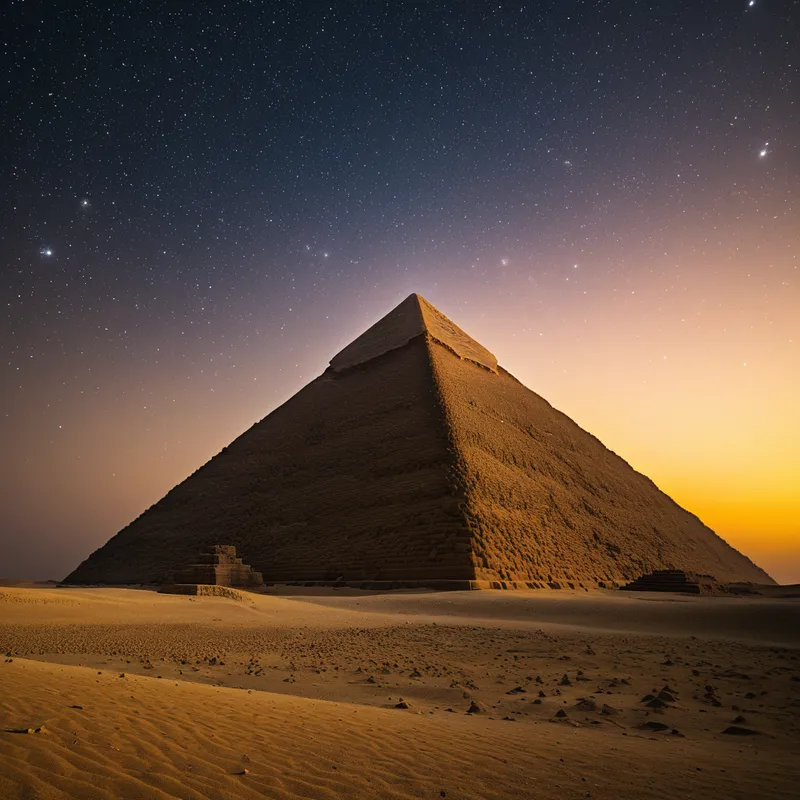
The Great Pyramid of Giza Myth Meaning & Symbolism
A mythic tale of a king's divine ambition to build a stairway to the stars, merging earth with heaven in eternal stone.
The Tale of The Great Pyramid of Giza
Hear now a tale not of gods walking the earth, but of a king who dared to make a mountain that touched the sky. In the time when the sun-god Ra sailed his barque from dawn to dusk, and the black, fertile earth of Kemet was young, there ruled a son of the sun named Khufu. His heart was vast as the desert, his will firm as granite, yet a shadow lay upon it—the shadow that falls on every mortal king: the fear of the western horizon, the fear of being swallowed by the Duat and forgotten.
He walked the plateau of Giza, where the wind sang secrets of eternity. The sand was pale, the sky a bowl of burning blue. He looked not at the earth, but up, at the imperishable Ikhemu-sek, the stars that never die. A longing, sharp as a flint knife, pierced him. “I shall not merely descend to the Duat,” he declared to his architects and priests. “I shall ascend. I will build a stairway that Ra himself might use, a mountain that is a machine, a vessel of stone to catch the first and last light.”
And so the great work began. It was not construction; it was a summoning. From the quarries of Tura came white limestone, singing as it was cut. From Aswan came rose granite, heavy with the memory of the earth’s core. Thousands moved as one body, a river of humanity flowing to the chants of priests. They did not build block upon block; they wove a mountain. They aligned its sides with the four pillars of heaven. They angled its passages to the heart of the northern stars and the journey of the sun. The air shimmered with dust and purpose. The sound was a symphony of chisels, ropes groaning, and the steady, deep-throated hymns to Ptah and Seshat.
The conflict was not with monsters, but with chaos itself—with entropy, with time, with the slipping sand that claims all things. The rising action was the pyramid itself, growing like a crystalline seed from the desert floor, its geometry holding back the void. For twenty years, the mountain rose. It became a fact of the world, a new organ in the body of the land.
At its completion, under a sky pregnant with stars, the final, gleaming pyramidion was set. It was not an end, but a beginning. In that moment, the pyramid ceased to be mere stone. It became a frozen ray of sunlight, a petrified echo of the first mound of creation. It was a door, forever shut and forever open. Khufu looked upon his work, and the shadow left his heart. He had built not a tomb, but a launchpad for the soul. The king would enter its hidden chambers, and through the silent, precise magic of its angles and alignments, his Ba would be launched, not down into the earth, but out, along the shining path of the sun-ray, to merge with the light that never dies. The mountain stood. It waits still.
Cultural Origins & Context
The narrative of the Great Pyramid is a myth woven not from spoken epic, but from stone and celestial alignment. It emerges from the Old Kingdom (c. 2686–2181 BCE), a period defined by the absolute centrality of the divine king, the Horus-on-earth. This was not a folktale told by firelight, but a state doctrine enacted through architecture. The myth was “told” by the priesthood of Ra and the cult of the king, and its primary audience was the cosmos itself.
Its societal function was multifaceted. On one level, it was the ultimate political and theological statement: the pharaoh was the linchpin between the ordered world (Maat) and the forces of chaos. By building this eternal, perfect form, he guaranteed the stability of the kingdom and the continued cycles of nature. On another, deeper level, it served as a functional guide for the soul’s journey. The pyramid texts, later found in tombs, find their ultimate physical expression in the pyramid’s structure. The building itself was a manual, a machine with instructions baked into its geometry, designed to facilitate the king’s transformation from mortal ruler to immortal star. It was passed down not through scrolls, but through the awe it inspired and the cultural memory of a people who saw their landscape permanently sanctified by this attempt to bridge worlds.
Symbolic Architecture
The pyramid is perhaps humanity’s most potent geometric symbol. Psychologically, it represents the concretization of consciousness aspiring to its own source.
The pyramid is the psyche in mineral form: a broad, unconscious base rising through disciplined layers to a singular point of transcendent awareness.
Its square base, aligned with the cardinal directions, symbolizes the ordered, material world—the four elements, the four seasons, the grounded reality of the ego. The four triangular sides converging at the apex represent the dynamic process of sublimation, where the disparate aspects of the self are drawn upward and integrated. The apex itself is the Atman or the Self, the point of unity where all opposites dissolve into pure being.
The internal chambers—the Subterranean Chamber (the chaotic underworld of the unconscious), the Queen’s Chamber (the receptive, transformative space), and the King’s Chamber (the seat of integrated consciousness)—map a vertical journey of initiation. The long, narrow Grand Gallery is the arduous path of awakening, a birth canal leading from one state of being to a higher one. The structure is not a static tomb but a dynamic model of psychic ascension.
The Dreamer’s Resonance
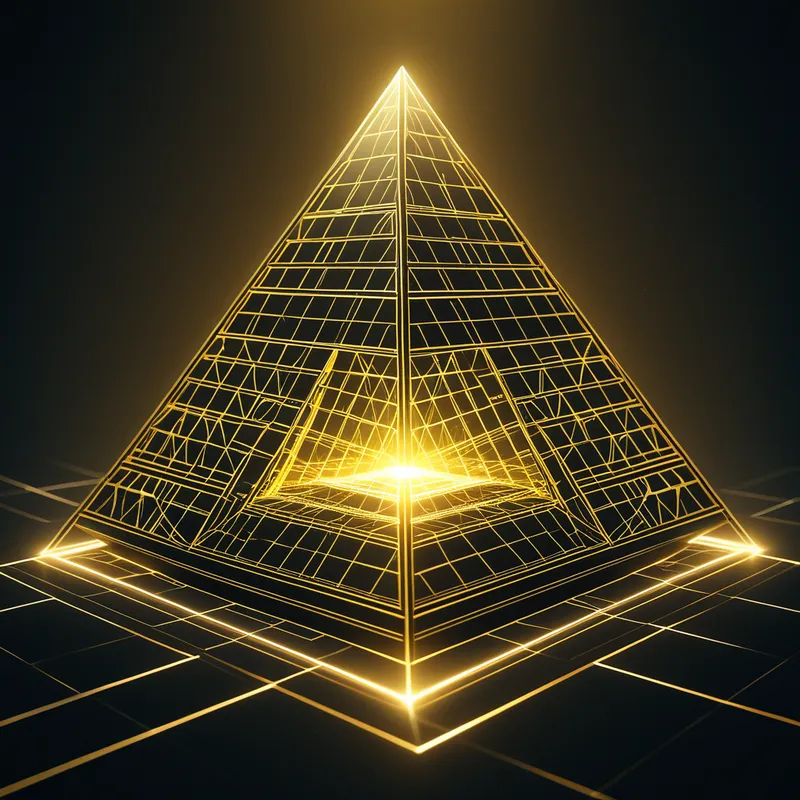
When the Great Pyramid appears in a modern dream, it rarely manifests as a tourist site. It appears as an immense, silent, and often overwhelming geometric presence. It may be made of light, glass, or shifting stone. Dreaming of it signals that the psyche is engaged in a profound process of restructuring.
Somatically, one might feel a pressure at the crown of the head, a sense of being “drawn up,” or a grounding heaviness in the legs and base of the spine—mirroring the pyramid’s own pull between earth and sky. Psychologically, the dreamer is likely confronting the need for monumental, enduring change. They are building something permanent within themselves. This can feel isolating (the lone pyramid on a vast plain) and require Herculean effort. The dream may evoke awe mixed with dread: the structure is perfect, but its scale highlights the dreamer’s smallness. It speaks to a confrontation with the archetype of the Magician, who understands and manipulates the fundamental laws of reality to achieve a transcendent goal. The dream is an invitation to become the architect of your own soul.
Alchemical Translation
The myth of the pyramid models the alchemical opus, the great work of individuation. The raw, chaotic matter of the personality (the desert sand) must be quarried, shaped, and assembled according to a divine, pre-existing pattern (the celestial blueprint).
The alchemical process is not one of addition, but of subtraction and refinement, removing all that does not align with the perfect, latent form within.
Calcinatio (The Burning Will): Khufu’s burning ambition is the initial fire that purifies the intent, burning away trivial desires to leave only the opus magnum. Coagulatio (The Solidification): The gathering of materials and the slow, laborious construction represents the ego committing to the difficult, tangible work of self-development, giving form to spirit. Sublimatio (The Ascent): The raising of the stones, the climbing of the Grand Gallery—this is the elevation of consciousness, where base instincts and complexes are transformed into higher understanding. Coniunctio (The Union): The placement of the pyramidion, the alignment with the stars, symbolizes the sacred marriage of the human and the divine, the ego’s conscious alignment with the Self. The king’s soul merging with the sun is the final stage of the unio mystica.
For the modern individual, the pyramid myth teaches that individuation is an architectural feat. It requires a blueprint (a vision of the Self), a foundation in reality (grounded work), precise alignment with one’s own inner truths (the cardinal directions of one’s nature), and the relentless, patient will to build, layer by layer, the eternal structure of an authentic life. The goal is not to escape the earth, but to build from it a monument that connects it to the heavens.
Associated Symbols
Explore related symbols from the CaleaDream lexicon: