
The Great Plains of Creation Myth Meaning & Symbolism
A myth of primal unity where the world is born from the sacrifice of a cosmic entity on the Great Plains, establishing balance between sky and earth.
The Tale of The Great Plains of Creation
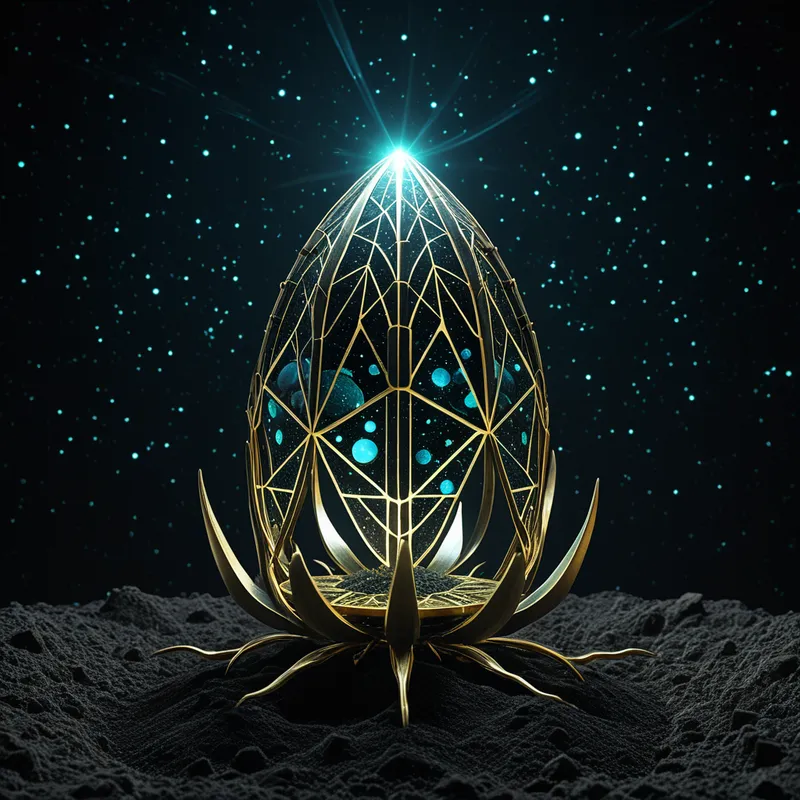
In the time before time, there was only the Great Silence and the Great Plains. The Plains were not of grass or soil, but of a substance like molten amber and starlight, a seamless, gently breathing expanse that stretched forever in every direction. Upon this plain rested Olorun-Iye, the Vast Vessel. Olorun-Iye was not a being as we know beings, but a dreaming presence, a totality containing all possibilities—light and dark, song and silence, mountain and valley, beast and breath—swirling in perfect, motionless harmony within its boundless form.
But within the Great Silence, a thought arose. It was not Olorun-Iye’s thought, nor any other’s. It was the First Urge, a whisper of “apartness.” This Urge echoed across the Plains and vibrated within the heart of Olorun-Iye. The harmony stirred. The possibilities within began to yearn for expression, to be more than potential. They pressed against the vessel’s unity, creating a profound, resonant tension. Olorun-Iye felt a great longing, a pull to become what it contained.
And so, Olorun-Iye began to sing. It was a song without sound, a vibration that made the amber-starlight plain tremble. The song was a story of separation, of distinction. As it sang of “Sky,” a portion of its essence—light, air, and fire—strove upward, pulling away. As it sang of “Earth,” another portion—density, depth, and water—sank downward, resisting the pull. The tension became an agony of stretching, a cosmic rift within the one being.
The Plains themselves groaned. A great cracking sigh echoed through the Silence. Olorun-Iye, in an act of unimaginable will, did not resist. It embraced the tearing. With a final, silent note of release, the Vast Vessel sundered.
From its upward-streaming essence, the Sky was born—Olorun, vast and luminous. From its downward-rooting essence, the Earth was formed—Iye, broad and fertile. And what remained of Olorun-Iye’s core, the very spark of the sacrifice, fell upon the now-quieting Plains. Where it touched, the Plains transformed. The amber-starlight cooled into rich, dark soil. The echo of the song became the first wind. The tears of the separation condensed and fell as the first rain, and where each drop struck the soil of the Great Plains, life burst forth—first grasses, then trees, then all creatures of land and air.
The Sky gazed down at the Earth. The Earth reached up towards the Sky. Between them, where the sacrifice had occurred, hung a shimmering mist—the memory of unity, the bridge of longing. And so the world was not made from a command, but from a sacred, painful becoming. The Great Plains of Creation were now the living world, forever bearing the mark of the primal unity from which it was born.

Cultural Origins & Context
This narrative finds its roots in the cosmological traditions of several West African peoples, particularly the Yoruba and related ethnic groups, though its core motifs of primal unity and sacrificial creation resonate across the continent. It is important to note that “African” culture is not monolithic; this telling synthesizes a profound archetypal pattern found in many origin stories. It was not a single, fixed text, but a living oral tradition, passed down through generations by Griots and elders.
The myth was recited during rites of passage, seasonal ceremonies, and at the enthronement of rulers. Its function was multifaceted: it was a cosmological map, explaining the origin of the fundamental dichotomy (Sky/Earth) that structures reality. It was a moral and social template, teaching that creation and order arise from sacrifice and the balancing of complementary forces. It grounded the community in the understanding that their world was born from a sacred act of becoming, not an arbitrary act of will, connecting daily life—farming under the sky, drawing water from the earth—to the primordial drama.
Symbolic Architecture
The myth is a profound allegory for the birth of consciousness from the unconscious. The Great Silence represents the primal, unconscious state of the psyche. The Great Plains symbolize the fertile ground of potential within that state, the prima materia of the soul.
The first act of creation is not an addition, but a division. Consciousness is born from the sacrifice of undifferentiated wholeness.
Olorun-Iye is the archetypal Self in its pre-conscious, all-containing form. The “First Urge” is the dawn of ego-consciousness, the initial impulse to differentiate, to know oneself as distinct. The ensuing tension and eventual sundering represent the inevitable and painful process of individuation—the separation of the conscious mind (Sky/Olorun) from the unconscious matrix (Earth/Iye). This is not a tragedy, but a necessary genesis. The “shimmering mist” between them is the ongoing relationship between conscious and unconscious, the symbolic life that flows when the two are in dialogue, not fused and not utterly estranged.
The Dreamer’s Resonance
When this myth activates in the modern psyche, it often manifests in dreams of vast, open landscapes—endless plains, deserts, or tundras. The dreamer may feel simultaneously exposed and full of potential. They might witness a division or cracking in the landscape, or find themselves trying to hold together two opposing forces within the dream space.
Somatically, this can correlate with feelings of being “stretched” or “torn” in life—perhaps between career and family, logic and intuition, or independence and connection. The dream is mapping the psychic tension that precedes a major life transition or a new phase of self-awareness. It signifies the psyche preparing for a creative act that requires a sacrifice of an old, comfortable unity (a stagnant relationship, a limiting self-concept) to give birth to a new, more complex reality. The anxiety in the dream is the echo of Olorun-Iye’s tension; the resolution, if the process is allowed, is the rain of new life upon the transformed plain of one’s being.

Alchemical Translation
The alchemical journey mirrored here is the opus of Separatio, followed by the yearning for Coniunctio. Our initial state is often one of unconscious identification—we are fused with our family, our culture, our assumptions. To become who we are, we must endure the sundering: differentiating our own values from inherited ones, our true voice from the chorus of expectations.
The Plains of Creation are not left behind; they become the very ground of our individuated life. The sacrifice is not a loss, but an investment in complexity.
This myth models that the goal is not to return to the blissful, unconscious unity of Olorun-Iye. That is impossible and would be regression. The goal is to become the living world that results from the sacrifice. We are to become the Plains themselves—the terrain where Sky and Earth (spirit and matter, thought and feeling) interact. Our conscious mind (Sky) must learn to send down the nourishing rain of attention and order. Our unconscious (Earth) must be allowed to send up the fertile growth of instinct and symbol. The “mist” between them is our creative and relational life. The modern individual’s psychic transmutation is the ongoing stewardship of this inner landscape, honoring the sacrifice that made it possible by fostering a dynamic, respectful relationship between all that we have had to distinguish within ourselves. We don’t heal the rift; we learn to build bridges across it, making the tension itself the source of all creativity.
Associated Symbols
Explore related symbols from the CaleaDream lexicon: