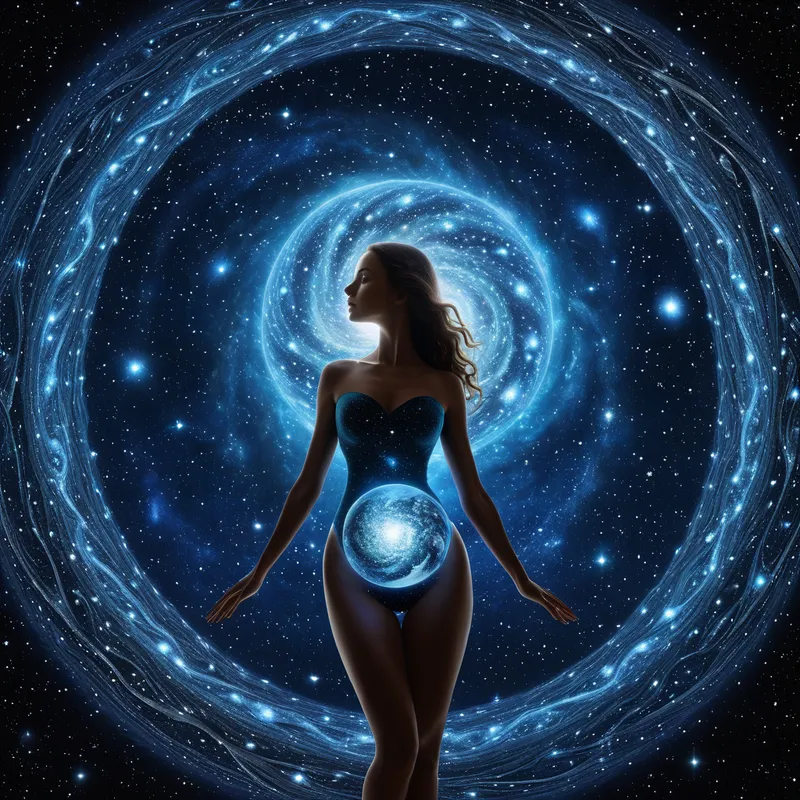
The Great Mother Myth Meaning & Symbolism
The story of the primordial psyche, the source of all life and consciousness, whose cycles of creation and dissolution forge the soul's journey.
The Tale of The Great Mother
In the beginning, before time was a line, there was a dreaming. Not a void, but a potential—a deep, pulsing, fecund darkness. From this dreaming, she stirred. She was not born; she simply was. The Uroboros, the serpent that eats its own tail, was her first breath, the circle of her being.
She dreamed of forms, and the world sprouted from her flesh. Mountains were the bones of her repose, oceans the amniotic fluid of her womb, forests the lush hair of her body. All life drank from her: the crawling thing, the rooted thing, the thing that sang. She was the warm, damp earth that received the seed, the dark cave that offered shelter, the crushing tidal wave that reclaimed. Her love was absolute and terrifying, for it knew no distinction between nurture and annihilation. To be held by her was to be dissolved into her.
Then, within her own boundless body, a new kind of spark flickered—a point of light that called itself “I.” It was consciousness, the ego, a child of her substance yet separate in its knowing. This spark looked upon the Mother and saw both paradise and prison. It felt the bliss of her embrace and the terror of being swallowed back into her undifferentiated night.
A great tension was born. The spark desired to know itself, to name things, to build towers upon her plains. The Mother, in her infinite cycle, would send seasons of abundance, filling the spark with joy, and then seasons of barrenness, pulling all creations back into her soil. She was the giver of milk and the bearer of the scythe. Her face was twofold: the Good Mother who sings lullabies with the wind, and the Terrible Mother whose embrace is the grave.
The myth is not of her defeat, but of the eternal dance. The conscious spark must journey away from her hearth, into the perilous world of distinction and action, carrying her blessing as courage and her curse as the fear of oblivion. It must learn to stand on the earth she is, without demanding she remain only a garden. And in the end, the greatest task is to return—not to be consumed, but to behold her. To see the Mother whole, to kneel not as a helpless child but as a conscious being who can finally say, “I am of you, and I am myself.” The resolution is the trembling, awe-filled moment when the spark sees the entire cycle—the cradle and the tomb—as one gesture of a single, unimaginable love.

Cultural Origins & Context
The “myth” of the Great Mother within Jungian culture does not originate from a single, lost tribe or scripture. It is an emergent narrative, pieced together from the fragments of a thousand world myths, the silent language of ancient artifacts, and the recurring visions of the modern analysand on the therapy couch. This culture is the culture of the collective unconscious.
Its storytellers are the dreamers, the artists, the mad, and the healers. It was passed down not on papyrus but in the symbolic logic of fairy tales, in the iconography of Neolithic Venus figurines, in the global worship of goddesses like Isis, Inanna, Demeter, and the Virgin Mary. Carl Jung and his successors acted as anthropologists of this inner realm, mapping its contours by comparing these external myths with the internal experiences of their patients. The societal function of this myth, in Jungian terms, is foundational: it provides the psychic blueprint for our relationship to the source of life itself—to nature, to the body, to the unconscious, and to the feminine principle that exists within all people.
Symbolic Architecture
The Great Mother is the archetype of the anima mundi, the world soul. She symbolizes the unconscious in its totality, prior to the discrimination of the conscious mind.
She is the sea from which the ego, like a fragile island, emerges and into which it fears it will one day dissolve.
Her dual nature—nurturing and devouring—maps directly onto the psyche’s experience of the unconscious. It is the source of inspiration, healing, and regenerative sleep (the Good Mother), but also of overwhelming complexes, psychotic breaks, and the existential pull toward passivity and non-being (the Terrible Mother). The hero’s journey away from her represents the necessary, painful process of individuation—the differentiation of the ego from the maternal matrix of the unconscious. The return to her is not a regression, but the integration of this vast, impersonal ground of being into conscious life. She symbolizes the coincidentia oppositorum; in her, life and death, creation and destruction, are not opposites but phases of one process.
The Dreamer’s Resonance
When this myth stirs in modern dreams, it announces a profound engagement with the foundational layers of the psyche. Dreaming of immense, nurturing landscapes—vast oceans, deep forests, welcoming caves—often signals a need for psychic nourishment, a call to reconnect with creative or emotional sources. The dreamer may be experiencing a period of fertile growth or seeking solace.
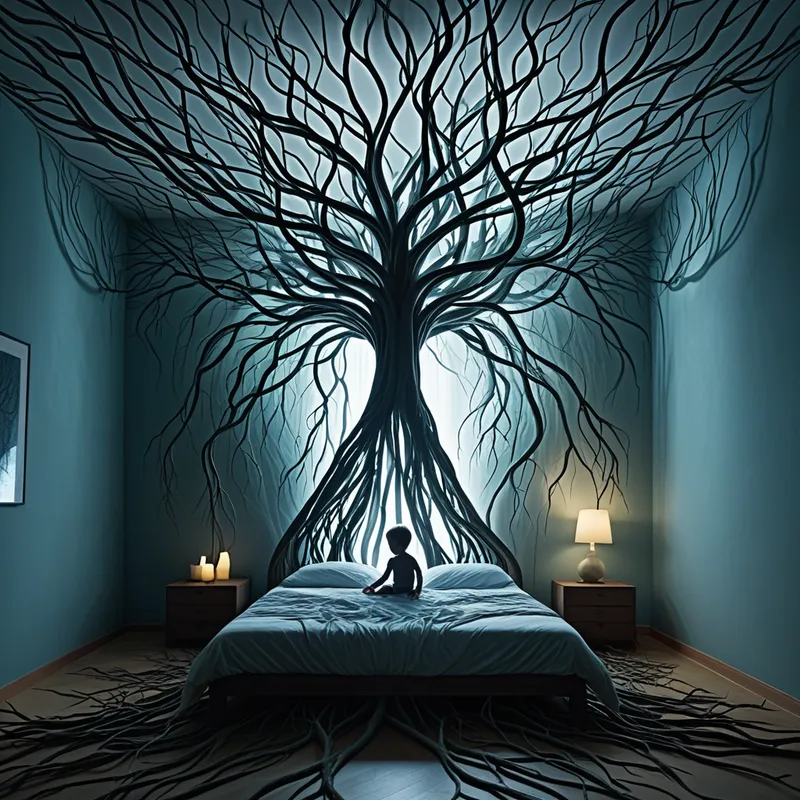
Conversely, dreams of being swallowed by the earth, chased by tidal waves, or trapped in endless, winding tunnels speak to the activity of the Terrible Mother. Somatic feelings of suffocation, weight, or paralysis often accompany these dreams. Psychologically, this indicates an ego feeling overwhelmed by contents of the unconscious—perhaps by a depression that feels like quicksand, an addiction that consumes, or a relationship dynamic that is psychologically engulfing. The dream is not a prophecy of doom, but a stark depiction of the inner reality. It marks a critical threshold where one must either consciously confront the devouring aspect of their own psyche or remain in its thrall.
Alchemical Translation
The alchemical work modeled by this myth is the opus contra naturam—the work against nature—which here means the work against mere unconscious, instinctual existence. The prima materia, the base substance of the soul, is our original, undifferentiated unity with the Mother archetype. The first stage, nigredo (blackening), is the painful separation, the “death” of the child who believed the Mother existed solely for his comfort. This is the confrontation with the Terrible Mother, with one’s own dependency, vulnerability, and fear of annihilation.
The alchemical vessel is the conscious ego that agrees to endure the heat of this conflict without shattering.
The subsequent stages—albedo (whitening), citrinitas (yellowing)—involve purifying the relationship. One learns to receive nurture without infantilization and to face destruction without despair. The final stage, rubedo (reddening), the creation of the lapis philosophorum, is the conscious integration of the Great Mother archetype. This is the “return.” The individual no longer relates to the unconscious as a terrified child to a capricious parent, but as a conscious co-creator to the source of all being. The feminine principle, both creative and destructive, is internalized as a guiding function. One becomes, in a sense, a steward of the Mother’s garden within one’s own soul, capable of both cultivating life and accepting necessary endings, thereby achieving a profound and hard-won wholeness.
Associated Symbols
Explore related symbols from the CaleaDream lexicon: