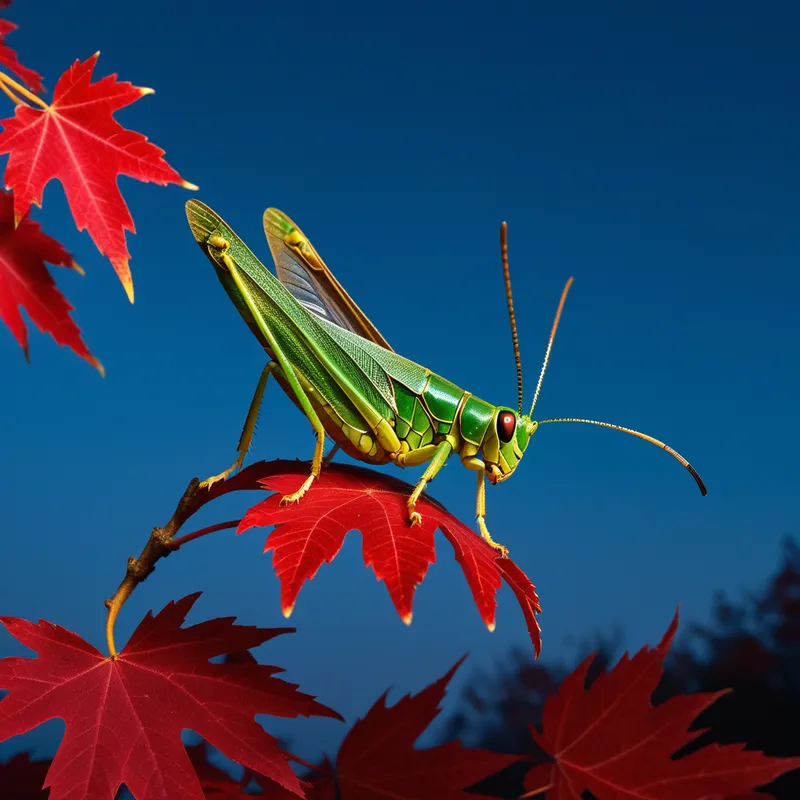
The Grasshopper in the Autumn Myth Meaning & Symbolism
A proud grasshopper, singing through summer, faces the silent, inevitable arrival of autumn, embodying the confrontation with time and consequence.
The Tale of The Grasshopper in the Autumn
Listen, and hear the song that ends in silence.
In the long, [golden age](/myths/golden-age “Myth from Universal culture.”/) of [the world](/myths/the-world “Myth from Tarot culture.”/), when summer held the land in a gentle, green fist, there lived a grasshopper. He was no ordinary insect. His carapace shone like a sliver of the sun itself, and his song—oh, his song! It was a cascade of liquid notes, a boastful, joyous symphony that filled the heavy air from dawn until the stars pricked the velvet dark. He perched on the broadest leaf of the tallest reed, a tiny emperor surveying his domain of endless abundance. The wheat grew fat, the streams ran slow and warm, and [the world](/myths/the-world “Myth from Tarot culture.”/) seemed an eternal banquet laid out for his pleasure.
“Why toil?” he sang to the ants who marched in ceaseless lines below him, their backs bent under grains many times their size. “The sun is generous! [The earth](/myths/the-earth “Myth from Hindu culture.”/) is kind! Sing with me, and let the future worry for itself!” The ants, creatures of a different rhythm, offered only silent glances and continued their work, building their granaries deep in the cool, dark earth.
But the Tian observes all rhythms. The Wheel of the Seasons, turned by the unseen hand of Dao, does not pause. A whisper, cooler than the rest, slipped into the evening breeze. The green of the world began to deepen, then to blush at the edges with hints of flame and gold. The days, once languid and endless, began to shorten their stride.
Still, the Grasshopper sang. He sang as the first Bailu frost silvered the grass at dawn. He sang as the north wind began to sharpen its teeth. His song grew louder, more frantic, a brilliant defiance against the gathering twilight. He was singing the summer back, he believed. His music was a spell against the turning sky.
Then came the day [the wind](/myths/the-wind “Myth from Various culture.”/) won. It swept down from the barren mountains, stripping the trees in a single, roaring breath. The Grasshopper’s reed throne snapped. He tumbled into a world transformed—a landscape of skeletal branches, hard ground, and a silence so profound it felt like a physical weight. His vibrant shell was now a stark contrast against the grey earth. His legs, made for leaping through soft grasses, scratched against frozen clods. He opened his mandibles to sing his defiance once more, but the only sound that emerged was the dry rasp of emptiness.
The cold, patient and absolute, settled into his joints. Looking up, he saw the orderly line of ants, now sealed safe within their earthen fortress, their winter secured by the labor he had mocked. In that final, crystalline moment, beneath a sky of relentless, beautiful blue, the Grasshopper did not hear a voice from the heavens. He heard only the vast, cyclical truth of the world itself: the song had its season, and the season for singing was over. There was no punishment, only consequence. No malice, only the serene, inevitable arrival of Autumn.
Cultural Origins & Context
This narrative, often known in the West through Aesopian parallels, finds one of its most resonant forms in the rich soil of Chinese agrarian philosophy. It is less a formal “myth” of gods and heroes and more a profound yuyan, or philosophical parable, whose roots intertwine with Confucian ethics and Daoist naturalism.
Passed down not by bards in courts, but by elders in villages, teachers with students, and parents with children, its primary function was pedagogical and societal. It was a story told at the end of harvest, as the community prepared for Lidong. It served as a foundational lesson in qin (diligence) and yuanjian (far-sightedness), virtues essential for survival in a civilization built upon cyclical agriculture and collective responsibility. The tale reinforced the Confucian ideal of preparing for the future through present action and respecting one’s role within the family and community—the ants representing the harmonious, diligent collective.
Simultaneously, it carries a deep Daoist undertone: a warning against jiao’ao, the arrogant pride that believes it can stand outside the wuxing, the five phases of natural transformation. The Grasshopper’s failure is, in a Daoist sense, a failure to listen to and align with the jieqi, the seasonal currents of Qi.
Symbolic Architecture
The myth’s power lies in its stark, elegant [symbolism](/symbols/symbolism “Symbol: The use of symbols to represent ideas or qualities, often conveying deeper meanings beyond literal interpretation. In dreams, it’s the language of the unconscious.”/). The [Grasshopper](/symbols/grasshopper “Symbol: Symbolizes agility, taking a leap of faith, and adaptability in the face of challenges.”/) is the unintegrated ego in its purest form. He is the [spirit](/symbols/spirit “Symbol: Spirit symbolizes the essence of life, vitality, and the spiritual journey of the individual.”/) of the present [moment](/symbols/moment “Symbol: The symbol of a ‘moment’ embodies the significance of transient experiences that encapsulate emotional depth or pivotal transformations in life.”/) divorced from the [continuum](/symbols/continuum “Symbol: A philosophical concept representing an unbroken sequence or progression where all points are connected without gaps, often symbolizing the flow of time, existence, or consciousness.”/) of time, the pleasure principle denying the [reality](/symbols/reality “Symbol: Reality signifies the state of existence and perception, often reflecting one’s understanding of truth and life experiences.”/) principle. His song is not just [music](/symbols/music “Symbol: Music in dreams often symbolizes the harmony between the conscious and unconscious mind, illustrating emotional expression and communication.”/); it is the intoxicating narrative of exceptionalism, the belief that the rules of [nature](/symbols/nature “Symbol: Nature symbolizes growth, connectivity, and the primal forces of existence.”/)—of cause and effect, of preparation and consequence—apply to others, but not to oneself.
The Autumn is not an enemy, but a truth the Grasshopper refused to dream of in Summer.
The Ants symbolize the often-denigrated but essential forces of the [Senex](/symbols/senex “Symbol: The wise old man archetype representing spiritual authority, ancestral wisdom, and the integration of life experience into transcendent knowledge.”/) (the old wise man) and the [body](/symbols/body “Symbol: The body in dreams often symbolizes the dreamer’s self-identity, personal health, and the relationship they have with their physical existence.”/). They are [consciousness](/symbols/consciousness “Symbol: Consciousness represents the state of awareness and perception, encompassing thoughts, feelings, and experiences.”/) grounded in reality, labor, and temporal continuity. They do not argue with the Grasshopper; they simply embody the alternative, building the “[granary](/symbols/granary “Symbol: The granary symbolizes abundance, storage of resources, and the cyclical nature of life, embodying both nourishment and the need for preservation.”/)” of the enduring Self.
[Autumn](/symbols/autumn “Symbol: A season symbolizing transition, harvest, and decay, representing life’s cycles between abundance and decline.”/) itself is the great [symbol](/symbols/symbol “Symbol: A symbol can represent an idea, concept, or belief, serving as a powerful tool for communication and understanding.”/) of Yin ascendant. It is not [death](/symbols/death “Symbol: Symbolizes transformation, endings, and new beginnings; often associated with fear of the unknown.”/), but the necessary withdrawal, the [condensation](/symbols/condensation “Symbol: In dreams, condensation represents the compression of multiple ideas, memories, or emotions into a single image, often revealing hidden connections and subconscious complexity.”/), the moving [inward](/symbols/inward “Symbol: A journey toward self-awareness, introspection, and the exploration of one’s inner world, thoughts, and unconscious mind.”/). It is the psychic [season](/symbols/season “Symbol: Represents cycles of life, change, and the passage of time. Symbolizes growth, decay, renewal, and different phases of existence.”/) where the lush growth of [summer](/symbols/summer “Symbol: Summer often symbolizes warmth, growth, and abundance, representing a time of vitality and fruition.”/) ideas (the Grasshopper’s songs) must be evaluated, harvested, or let go. The Grasshopper’s tragedy is that he mistook a [season](/symbols/season “Symbol: Represents cycles of life, change, and the passage of time. Symbolizes growth, decay, renewal, and different phases of existence.”/) for the eternal summer of the [soul](/symbols/soul “Symbol: The soul represents the essence of a person, encompassing their spirit, identity, and connection to the universe.”/).
The Dreamer’s Resonance
When this myth pattern stirs in the modern dreamscape, it rarely appears as insects and ants. It manifests as somatic and emotional textures. The dreamer may experience themselves giving a brilliant performance to an audience that is slowly, silently leaving the hall. They may be frantically trying to complete a project as the light outside the window fades, their fingers growing numb and clumsy. They may be laughing uproariously at a party while a deep, cold chill settles in their chest.
Psychologically, this is the moment the unconscious sends a bill for [the ego](/myths/the-ego “Myth from Jungian culture.”/)’s excess. It is the somatic recognition that a phase of life—a relationship sustained on charm, a career built on potential, an identity founded on endless youth—has reached its natural conclusion. The “cold” felt in the dream is the shock of reality’s touch, the end of self-deception. The dream is an invitation, often a harsh one, to stop singing the old song and to feel the true season one is in.
Alchemical Translation
The individuation process modeled here is not one of heroic conquest, but of humble, necessary surrender to the laws of psychic time. The alchemical operation is [Nigredo](/myths/nigredo “Myth from Alchemical culture.”/)—the confrontation with [the shadow](/myths/the-shadow “Myth from Jungian culture.”/) of one’ own avoidance.
The first step is the cessation of the “song.” This is the ego’s capitulation, the end of manic productivity, charming distraction, or spiritual bypassing that has been used to avoid an inner autumn. It is a conscious descent into the silence that has been feared.
The granary of the ants is built in the dark, silent earth. So too is the soul’s resilience forged in quiet confrontation, not in celebratory noise.
The second step is to acknowledge the “ants”—those rejected, practical, mundane, and persevering parts of [the self](/myths/the-self “Myth from Jungian culture.”/). This is integrating the capacity for discipline, for planning, for enduring discomfort for a future good. It is making peace with the inner laborer.
Finally, the transmutation occurs when one can look at the barren, autumn landscape of one’s life—the ended relationship, the failed venture, the faded talent—and not see punishment, but consequence; not see an ending, but a phase in the [samsara](/myths/samsara “Myth from Buddhist culture.”/) of the Self. The Grasshopper’s fate is not the final word. In the deepest understanding of the myth, the cold silence of autumn is [the crucible](/myths/the-crucible “Myth from Alchemical culture.”/). Within it, the proud, solar consciousness of the Grasshopper must dissolve, so that its essence may eventually be reborn—not as the singer of an endless summer, but as a creature in harmony with all seasons, knowing when to sing, and when to prepare for the sacred, transformative silence.
Associated Symbols
Explore related symbols from the CaleaDream lexicon: