
The Gospel of Philip
A Gnostic Christian text exploring mystical marriage, spiritual resurrection, and hidden knowledge that offers an alternative vision of salvation.
The Tale of The Gospel of Philip
It is not a story of a single journey, but a map of the soul’s return. The text itself is a fragmented mirror, a collection of sayings and insights discovered in [the desert](/myths/the-desert “Myth from Biblical culture.”/) sands of Nag Hammadi, its pages whispering of a knowledge that does not come from without, but from a forgotten within. It speaks of a world asleep, mistaking the reflection for the light. The central drama is not of sin and repentance, but of ignorance and remembrance.
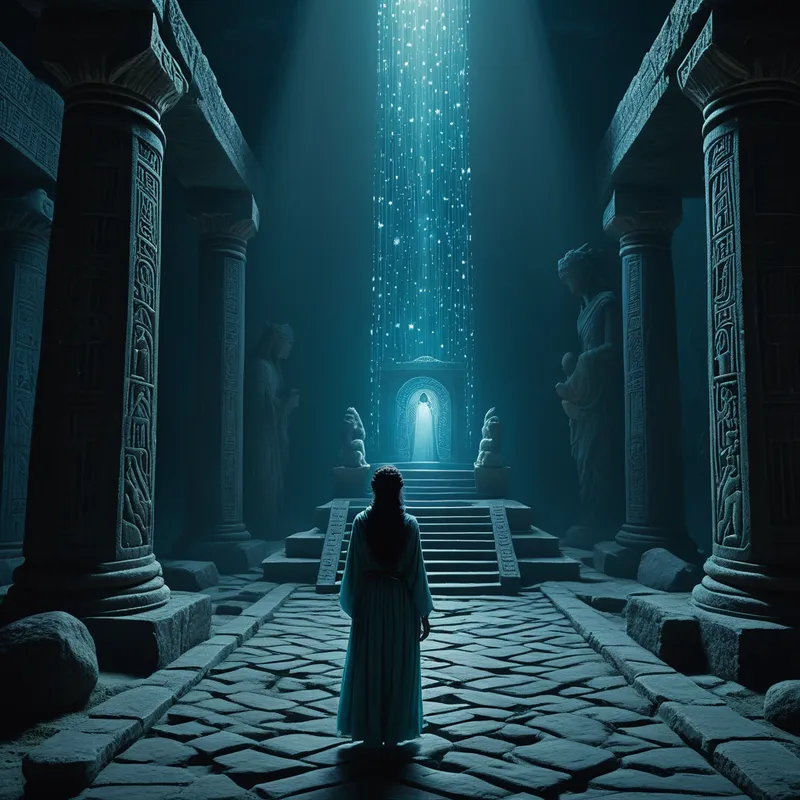
Here, the mystery of the bridal chamber is the heart of the cosmos. It tells of a sacred union, not of man and woman as [the world](/myths/the-world “Myth from Tarot culture.”/) understands, but of the soul and its angelic counterpart, its lost twin, its true complement. This is the hieros gamos, the mystical marriage that restores the primordial wholeness shattered in [the fall](/myths/the-fall “Myth from Biblical culture.”/) into matter. Resurrection, in this gospel, is not a future event for the corpse, but a present awakening from the tomb of the fleshly illusion. “Those who say they will die first and then rise are in error,” it declares. One must receive resurrection while alive, must put on the living garment of light before discarding the garment of skin.
The figure of [Jesus](/myths/jesus “Myth from Christian culture.”/) is not a distant savior but a guide to this inner awakening. He is the one who comes to lead what is scattered back to its source. He kisses [Mary Magdalene](/myths/mary-magdalene “Myth from Christian culture.”/) often upon the mouth, a scandal to the other disciples, but to Philip’s gospel, this is the sacrament of shared breath, of [pneuma](/myths/pneuma “Myth from Greek culture.”/)—the direct transmission of spiritual truth from fullness to readiness. The kiss becomes a symbol for the infusion of gnosis, the knowing that heals the split between seeker and sought.
The path is one of transformation: from being a Christian in name to becoming a [Christ](/myths/christ “Myth from Christian culture.”/) in essence. It is a passage through veils—[the veil of the temple](/myths/the-veil-of-the-temple “Myth from Abrahamic culture.”/) torn not just at a historical moment, but within the heart of the knower, revealing [the holy of holies](/myths/the-holy-of-holies “Myth from Biblical culture.”/) as one’s own divine origin. The text is a series of keys, some lost, some rusted, some gleaming, each meant to unlock a chamber in the inner temple where the soul remembers it is not an orphan, but a child of the boundless.
Cultural Origins & Context
The Gospel of Philip emerged from the rich, turbulent soil of early Christian experimentation in the 2nd or 3rd [century](/myths/century “Myth from Biblical culture.”/) CE. It is a quintessential product of Gnosticism, a constellation of groups who viewed the material cosmos not as the good creation of a benevolent God, but as the flawed or malevolent construct of a lesser, ignorant deity—[the Demiurge](/myths/the-demiurge “Myth from Gnostic culture.”/). Salvation was escape from this cosmic prison through knowledge of one’s true, spiritual origin.
This gospel stands in sharp, deliberate contrast to the theological currents that would solidify into orthodox Christianity. While the emerging church emphasized faith, creed, and the historical resurrection of the physical body, Philip’s community focused on experiential knowledge, symbolic ritual, and spiritual resurrection now. Its setting is likely Syrian or Egyptian, regions where Hellenistic philosophy, Jewish mysticism, and nascent Christian thought fermented together. It was composed for the initiated, for those who had moved beyond the “exoteric” teachings of the faith and into its hidden, mystical core. Its survival only in a Coptic translation, buried in a jar for safekeeping, testifies to its status as forbidden wisdom, a path suppressed by the consolidating authority of the institutional church.
Symbolic Architecture
The gospel builds its [vision](/symbols/vision “Symbol: Vision reflects perception, insight, and clarity — often signifying the ability to foresee or understand deeper truths.”/) not through [linear](/symbols/linear “Symbol: Represents order, predictability, and a direct, step-by-step progression. It symbolizes a clear path from cause to effect.”/) [argument](/symbols/argument “Symbol: An argument symbolizes conflict, communication breakdown, and feelings of frustration or misunderstanding.”/), but through a dense weave of symbols that function as psychological realities. The [material](/symbols/material “Symbol: Material signifies the tangible aspects of life, often representing physical resources, desires, and the physical world’s influence on our existence.”/) world is a [realm](/symbols/realm “Symbol: The symbol of ‘Realm’ often signifies the boundaries of one’s consciousness, experiences, or emotional states, suggesting aspects of reality that are either explored or ignored.”/) of symbolic [language](/symbols/language “Symbol: Language symbolizes communication, understanding, and the complexities of expressing thoughts and emotions.”/), where every earthly [thing](/myths/thing “Myth from Norse culture.”/) points to a heavenly [truth](/symbols/truth “Symbol: Truth represents authenticity, honesty, and the quest for knowledge beyond mere appearances.”/), if one has the eyes to see.
“Truth did not come into the world naked, but it came in types and images. The world will not receive truth in any other way.”
This is the Gnostic method: the world is a cryptogram. The Bridal [Chamber](/symbols/chamber “Symbol: A private, enclosed space representing the inner self, hidden aspects, or a specific stage in life’s journey.”/) is the central architectural [symbol](/symbols/symbol “Symbol: A symbol can represent an idea, concept, or belief, serving as a powerful tool for communication and understanding.”/)—the innermost sanctuary where [separation](/symbols/separation “Symbol: A spiritual or mythic division between realms, states of being, or consciousness, often marking a transition or loss of connection.”/) ends and union is consummated. It is not a physical [room](/symbols/room “Symbol: A room in a dream often symbolizes the self, representing personal space, mental state, or aspects of one’s identity.”/) but the realized state of the integrated self, where the [soul](/symbols/soul “Symbol: The soul represents the essence of a person, encompassing their spirit, identity, and connection to the universe.”/) (often depicted as feminine) is reunited with its divine [spirit](/symbols/spirit “Symbol: Spirit symbolizes the essence of life, vitality, and the spiritual journey of the individual.”/) (masculine). This union produces the “perfect [human](/symbols/human “Symbol: The symbol of a human represents individuality, complexity of emotions, and social relationships.”/).”
“If one becomes a son of the bridal chamber, he will receive the light.”
Other structures are equally potent. The Mirror is a recurring [image](/symbols/image “Symbol: An image represents perception, memories, and the visual narratives we create in our minds.”/): to look into the world and see only a physical [reflection](/symbols/reflection “Symbol: Reflection signifies self-examination, awareness, and the search for truth within oneself.”/) is to remain in ignorance; to look and see one’s true, luminous self is to attain [gnosis](/symbols/gnosis “Symbol: Direct, intuitive spiritual knowledge or enlightenment that transcends ordinary understanding, often associated with mystical experiences and esoteric traditions.”/). Names are powerful but provisional; to be called a “[Christian](/symbols/christian “Symbol: The symbol represents the faith, teachings, and cultural values associated with Christianity, including themes of love, salvation, and morality.”/)” is nothing, to be a “Christ” is everything. The Anointing (with chrism, oil) supersedes [water](/symbols/water “Symbol: Water symbolizes the subconscious mind, emotions, and the flow of life, representing both cleansing and creation.”/) [baptism](/symbols/baptism “Symbol: A ritual of spiritual cleansing, initiation, and rebirth, symbolizing profound transformation and commitment to a new path.”/), representing the direct impartation of spirit over the mere cleansing of the [body](/symbols/body “Symbol: The body in dreams often symbolizes the dreamer’s self-identity, personal health, and the relationship they have with their physical existence.”/). The entire [cosmos](/symbols/cosmos “Symbol: The entire universe as an ordered, harmonious system, often representing the totality of existence, spiritual connection, and the unknown.”/) is an [architecture](/symbols/architecture “Symbol: Architecture in dreams often signifies structure, stability, and the framing of personal identity or life’s journey.”/) of descent and [ascent](/symbols/ascent “Symbol: Symbolizes upward movement, progress, spiritual elevation, or striving toward higher goals, often representing personal growth or transcendence.”/), and the text provides the symbolic keys to navigate it.
The Dreamer’s Resonance
To the modern [psyche](/myths/psyche “Myth from Greek culture.”/), estranged in a disenchanted world, the Gospel of Philip speaks to the profound hunger for authentic self-knowledge and inner union. It resonates with the feeling of being a stranger in a familiar land, of sensing a deeper identity obscured by social roles, trauma, and the daily compromises of life—the “garments of skin.”
The bridal chamber archetype translates into the psychological quest for integration, for healing the splits between conscious and unconscious, [persona](/myths/persona “Myth from Greek culture.”/) and shadow, intellect and emotion. The process of gnosis mirrors the therapeutic and spiritual journey of withdrawing projections, of no longer seeking salvation in external doctrines, leaders, or possessions, but turning inward to confront and reclaim one’s own [divine spark](/myths/divine-spark “Myth from Gnostic culture.”/). The text validates the experience of those for whom conventional religious narratives feel hollow, pointing instead to a direct, unmediated encounter with the sacred within.
It also speaks to the pain of spiritual loneliness—the sense of being a fragment in search of one’s whole. The search for the “angelic twin” or “syzygy” is the search for inner completeness, for the part of oneself that feels lost to history, to trauma, or to [the collective unconscious](/myths/the-collective-unconscious “Myth from Jungian culture.”/). To find it is to experience a resurrection that is not deferred but immediate: a rebirth of meaning, purpose, and connection to the ground of being.

Alchemical Translation
The Gospel of Philip is a manual of psychic alchemy. Its goal is the transmutation of the leaden, sleeping soul into the gold of the awakened, spiritual human.
The [Nigredo](/myths/nigredo “Myth from Alchemical culture.”/), the blackening, is the initial state of ignorance: living in the “world,” identified solely with the body and its passions, ruled by the “[archons](/myths/archons “Myth from Gnostic culture.”/)” or ruling psychic complexes. The [Albedo](/myths/albedo “Myth from Alchemical culture.”/), the whitening, begins with the receiving of the “sayings” or the spark of gnosis—the kiss of truth. This is the purification, the separation of the subtle from the gross, the recognition of the spirit trapped within matter.
“You saw the spirit, you became spirit. You saw Christ, you became Christ. You saw the Father, you shall become Father.”
The Citrinitas, the yellowing, is the illumination of the bridal chamber, [the sacred marriage](/myths/the-sacred-marriage “Myth from Various culture.”/) where the inner opposites (animus/anima, light/dark, male/female principles) are conjoined. This is not a sterile balance but a creative fusion. Finally, the [Rubedo](/myths/rubedo “Myth from Alchemical culture.”/), the reddening, is the production of the “perfect human,” the fully realized and embodied spirit, capable of bearing the full light of the divine without being consumed. [The resurrection](/myths/the-resurrection “Myth from Christian culture.”/) it promises is this [rubedo](/myths/rubedo “Myth from Alchemical culture.”/)—the fully integrated Self, radiant and whole, having passed through the dissolution of the old identity ([death](/myths/death “Myth from Tarot culture.”/)) into a new mode of being.
The rituals it hints at—anointing, bridal chamber sacrament—are not magic but alchemical operations performed on the substance of the soul, using symbols as their reagents. The ultimate product is not a theological opinion, but a transformed human being.
Associated Symbols
Explore related symbols from the CaleaDream lexicon:
- Mirror — The surface of reality that reflects either the illusion of the separate self or the true image of the divine origin, depending on the clarity of the perceiver.
- Bridal Chamber — The sacred inner space where the soul achieves mystical union with its divine counterpart, symbolizing psychological integration and spiritual wholeness.
- Light — The essential substance of the divine realm and the awakened spirit, often contrasted with the darkness of material ignorance.
- Garment — The temporary clothing of the soul, whether the “garments of skin” (the physical body and false identity) or the “garment of light” (the resurrected, spiritual body).
- Door — The point of transition between states of consciousness, from ignorance to knowledge, or from the outer courts of religion to the inner sanctuary of direct experience.
- Key — The fragment of gnosis or the symbolic insight that unlocks the mysteries and opens the door to the bridal chamber and liberation.
- Union — The central goal of the Gnostic path, the reconciliation of all dualities—spirit and soul, divine and human, male and female—into a single, perfected state.
- Name — A provisional label that conceals true identity; to move from bearing a name (Christian) to embodying an essence (Christ) is the journey of transformation.
- Kiss — The intimate transmission of spiritual truth and breath (pneuma) from one awakened being to another, symbolizing direct initiation beyond words.
- Temple — The cosmos and the human being as a layered structure, with the holy of holies representing the innermost core of the divine Self.
- Seed — [The divine spark](/myths/the-divine-spark “Myth from Gnostic culture.”/) or fragment of light buried within the human soul, which must be nurtured by gnosis to grow into its full, tree-like stature.