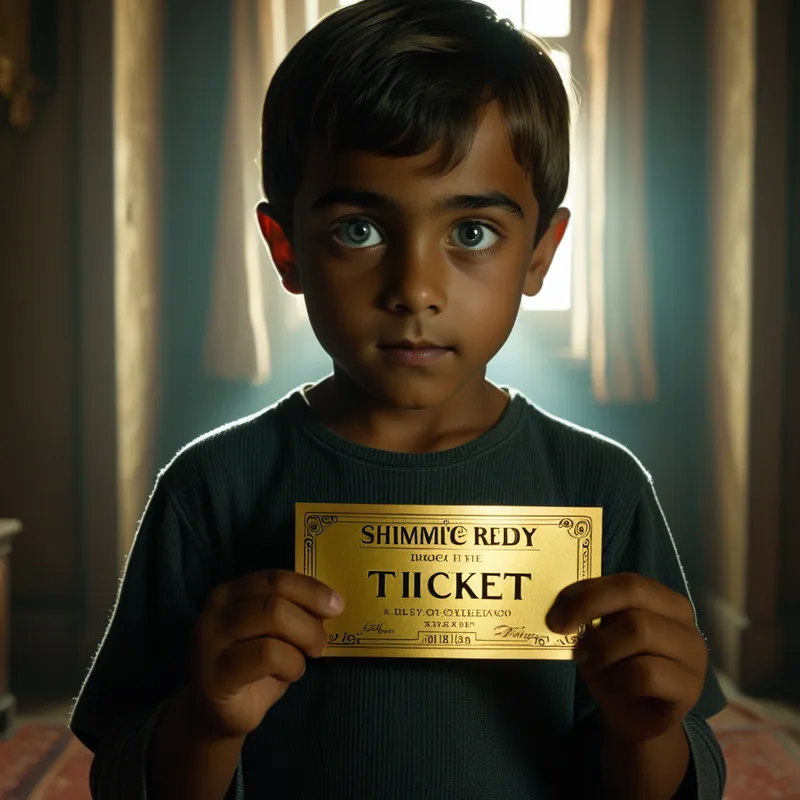
The Golden Ticket from Charlie Myth Meaning & Symbolism
A humble child, through pure-hearted luck, finds a magical ticket that grants passage to a wondrous, impossible factory, ultimately inheriting its entire legacy.
The Tale of The Golden Ticket from Charlie
Listen, and hear the tale spun from the loom of the modern age, a story not of gods on Olympus but of a different kind of miracle, born in the soot and sigh of a great, grey city.
In a place where [the sky](/myths/the-sky “Myth from Persian culture.”/) was the color of old porridge, there lived a boy named Charlie. His world was a small, cold house that leaned wearily against its neighbors, filled with the quiet love of his family and the ever-present, hollow ache of not-enough. His greatest joy was a single, precious chocolate bar once a year, a tiny sun of sweetness in a long winter. But in [the world](/myths/the-world “Myth from Tarot culture.”/) beyond his street, a legend burned bright: the legend of Willy Wonka, and his impossible, hidden factory. No one went in. No one came out. Yet from its chimneys, scents of caramel and dreams drifted over the city.
Then, a proclamation! The great maker had hidden five Golden Tickets within the wrappers of his humble sweets. These were not mere tickets; they were [sigils](/myths/sigils “Myth from Alchemical culture.”/) of fate, keys to a day inside the kingdom of confection itself. The world went mad. Greedy giants and spoiled heirs scoured [the earth](/myths/the-earth “Myth from Hindu culture.”/), buying chocolate by the ton, tearing wrappers with frantic hands, their hearts black with want. The tickets were found, one by one, heralded by blaring trumpets of news, each winner a monument to gluttony or blind chance.
And Charlie? He found a single, silver coin in the gutter—a lost piece of luck. With a heart pounding not with greed, but with a simple, burning hope, he bought a single chocolate bar. In the dim light of a shop, his thin fingers peeled back the wrapper. There was no fanfare. Only the quiet, impossible gleam of gold. He had found the last ticket. Not through wealth, not through force, but through a moment of pure, unlooked-for grace.
His passage through the factory gates was a descent into a living myth. He entered a realm where logic was made of candy, where rivers flowed chocolate, and gardens grew lickable wallpaper. It was a [labyrinth](/myths/labyrinth “Myth from Various culture.”/) of wonders and tests. His fellow travelers, each a caricature of human vice—gluttony, pride, greed, impatience—were, one by one, undone by their own flaws, vanishing with poetic [justice](/myths/justice “Myth from Tarot culture.”/) into tubes or pools of cream. Charlie, with his grandfather by his side, simply witnessed. He was humble. He was kind. He broke no rules but the unspoken one of entitled consumption.
In the final chamber, it was revealed the entire journey was a trial by wonder. The great maker, Wonka, old and strange as a wizard, had sought not just a visitor, but an heir. A soul uncorrupted by the spoiling world. The factory, this entire world of pure imagination, was not a prize to be won, but a sacred trust to be inherited. Charlie, the boy from the cold house, who had known want but never malice, was chosen. The key was not the ticket, but the heart that carried it. The final gift was not a lifetime of candy, but the entire kingdom itself, passed from the weary hands of a creator to the open hands of an innocent.
Cultural Origins & Context
This is a myth of the 20th century, born from the loom of mass production and broadcast media. Its primary bard was the storyteller Roald Dahl, who spun it first into a novel, then saw it amplified into global consciousness through film. Unlike myths passed orally around fires, this one was disseminated through books, television screens, and cinema, becoming a shared story for the industrial and post-industrial age.
Its societal function is profound. It emerged in a world of increasing consumerism, where advertising promised happiness through acquisition. The myth serves as a corrective parable. It uses the very icon of consumer desire—the candy bar—to subvert it, suggesting that true fortune is not bought but received, and that the greatest inheritance goes not to the most voracious consumer, but to the one who consumes with reverence and wonder. It is a bedtime story for a capitalist society, whispering that the system’s promised “golden ticket” is a hollow dream unless it leads to a deeper, more responsible magic.
Symbolic Architecture
At its core, the myth is an [allegory](/symbols/allegory “Symbol: A narrative device where characters, events, or settings represent abstract ideas or moral qualities, conveying deeper meanings through symbolic storytelling.”/) of the [soul](/symbols/soul “Symbol: The soul represents the essence of a person, encompassing their spirit, identity, and connection to the universe.”/)’s [election](/symbols/election “Symbol: The symbolism of an election often reflects themes of choice, power, and societal responsibility.”/) and the [psychology](/symbols/psychology “Symbol: Psychology in dreams often represents the exploration of the self, the subconscious mind, and emotional conflicts.”/) of worthiness.
The Golden Ticket is not a reward for striving, but a sign of being chosen by fate for a destiny one did not dare to imagine.
The [factory](/symbols/factory “Symbol: A symbol of production, labor, and the mechanical aspects of life, representing both creativity and the potential for dehumanization.”/) is the unconscious [psyche](/myths/psyche “Myth from Greek culture.”/) itself—a vast, mysterious, creatively potent, and potentially dangerous inner world. Willy Wonka is the [senex](/symbols/senex “Symbol: The wise old man archetype representing spiritual authority, ancestral wisdom, and the integration of life experience into transcendent knowledge.”/) magician, the old, reclusive genius who has mastered this inner [realm](/symbols/realm “Symbol: The symbol of ‘Realm’ often signifies the boundaries of one’s consciousness, experiences, or emotional states, suggesting aspects of reality that are either explored or ignored.”/) but is isolated by his mastery. He seeks a successor, a new ego-[consciousness](/symbols/consciousness “Symbol: Consciousness represents the state of awareness and perception, encompassing thoughts, feelings, and experiences.”/) that can healthily relate to and steward this incredible inner [wealth](/symbols/wealth “Symbol: Wealth in dreams often represents abundance, security, or inner resources, but can also symbolize burdens, anxieties, or moral/spiritual values.”/).
Charlie represents the eternal [child](/symbols/child “Symbol: The child symbolizes innocence, vulnerability, and potential growth, often representing the dreamer’s inner child or unresolved issues from childhood.”/) [archetype](/symbols/archetype “Symbol: A universal, primordial pattern or prototype in the collective unconscious that shapes human experience, behavior, and creative expression.”/), not in a naive sense, but in its perfected form: the [child](/symbols/child “Symbol: The child symbolizes innocence, vulnerability, and potential growth, often representing the dreamer’s inner child or unresolved issues from childhood.”/) who has known suffering yet retains [empathy](/symbols/empathy “Symbol: The capacity to understand and share the feelings of others, often manifesting as emotional resonance or intuitive connection in dreams.”/), humility, and awe. His [poverty](/symbols/poverty “Symbol: A state of lacking material resources or essential needs, often symbolizing feelings of inadequacy, vulnerability, or spiritual emptiness in dreams.”/) is not just economic; it is a symbolic [emptiness](/symbols/emptiness “Symbol: Emptiness signifies a profound sense of void or lack in one’s life, often related to existential fears, loss, or spiritual quest.”/), a [vessel](/symbols/vessel “Symbol: A container or structure that holds, transports, or protects something essential, representing the self, emotions, or life journey.”/) not yet filled with [the ego](/myths/the-ego “Myth from Jungian culture.”/)’s greed, making him the perfect [receptacle](/symbols/receptacle “Symbol: A container that holds, receives, or stores something, often symbolizing the capacity to accept, contain, or process experiences, emotions, or resources.”/) for a massive influx of psychic [energy](/symbols/energy “Symbol: Energy symbolizes vitality, motivation, and the drive that fuels actions and ambitions.”/) (the inheritance).
The other children are [shadow](/symbols/shadow “Symbol: The ‘shadow’ embodies the unconscious, repressed aspects of the self and often represents fears or hidden emotions.”/) aspects—the gluttonous, the arrogant, the entitled, the impatient. Their spectacular failures in the factory are not punishments, but the natural, logical consequences of their one-sided psyches encountering a realm that demands wholeness and respect. They are consumed by the very forces they sought to consume.
The Dreamer’s Resonance
When this myth pattern surfaces in modern dreams, it often signals a psychological process of synchronicity and the emergence of a calling. To dream of finding a golden ticket is to experience the unconscious presenting a symbol of sudden, life-altering potential. It feels like grace—a chance that arrives not from one’s labor, but from a mysterious alignment.
Somatically, it may be preceded by feelings of constriction, scarcity, or “living in a small, cold house”—a metaphor for a limited sense of self or possibility. The dream itself can bring a visceral sense of shock, trembling hope, and luminous awe. Conversely, dreaming of being inside the wondrous factory but failing the tests points to the dreamer’s anxiety that their own flaws (overindulgence, pride, haste) will cause them to “miss their chance” or be deemed unworthy of a great opportunity or inner gift emerging from the psyche.
Alchemical Translation
The myth perfectly models the alchemical process of individuation. The [prima materia](/myths/prima-materia “Myth from Alchemical culture.”/) (base material) is Charlie’s life of humble poverty—the lead of mundane existence. The Golden Ticket is the first sign of the aurum philosophicum (philosophical gold), the call to adventure that initiates the process.
The inheritance of the factory is not the acquisition of wealth, but the terrifying and glorious responsibility of integrating one’s own vast, creative, and previously unconscious inner world.
The journey through the factory is the [nigredo](/myths/nigredo “Myth from Alchemical culture.”/) and albedo—confronting [the shadow](/myths/the-shadow “Myth from Jungian culture.”/) figures (the other children) and surviving the trials through purity of heart. Willy Wonka, as the guiding spirit, represents the [psychopomp](/myths/psychopomp “Myth from Greek culture.”/) who leads the ego to the center of [the Self](/myths/the-self “Myth from Jungian culture.”/).
The final transmutation is the [rubedo](/myths/rubedo “Myth from Alchemical culture.”/), the reddening. Charlie does not “get” the factory; he becomes its steward. The psychic energy (the factory) that was autonomous, mysterious, and projected onto an external “other” (Wonka) is fully integrated. The innocent child and the wise old man unite; the ego is now in service to the greater Self. For the modern individual, this translates to the moment when a talent, a calling, or a deep inner truth is no longer just a possession, but the very ground of one’s being—a legacy to be lived, not a prize to be spent. The golden ticket was merely the invitation. The real work, and the real [triumph](/myths/triumph “Myth from Roman culture.”/), is the lifelong guardianship of the wondrous world within.
Associated Symbols
Explore related symbols from the CaleaDream lexicon: