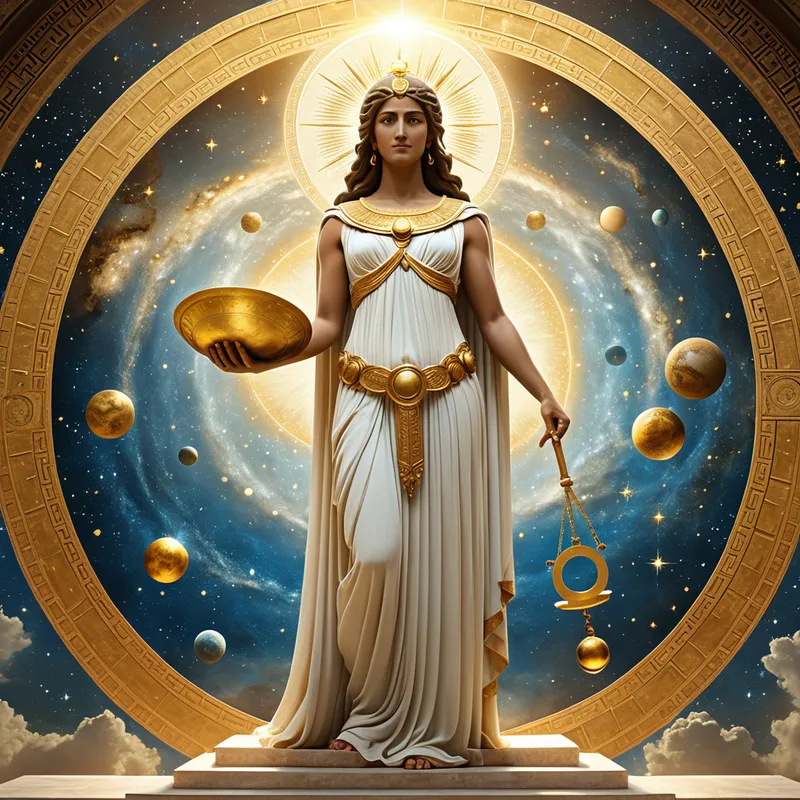
The Golden Mean Myth Meaning & Symbolism
A mythic warning against excess, where the path between extremes is revealed as the sacred, life-giving principle of cosmic and human order.
The Tale of The Golden Mean
Hear now, children of clay and starlight, a tale not of a single hero, but of the very breath of the cosmos. In the age when the gods walked just beyond [the veil](/myths/the-veil “Myth from Various culture.”/) of mist, and [the world](/myths/the-world “Myth from Tarot culture.”/) was young and raw with possibility, there existed a law older than Zeus himself. It was not written on stone, but woven into the fabric of being—the unspoken covenant of The Golden Mean.
It began in the heart of a thriving polis, where men, flush with the gifts of Demeter and the cunning of [Hephaestus](/myths/hephaestus “Myth from Global/Universal culture.”/), began to believe their bounty was born solely of their own hands. They feasted until the wine ran in the streets, built towers that scraped the belly of [the sky](/myths/the-sky “Myth from Persian culture.”/), and spoke to the gods as equals, their voices thick with the honey of pride. They forgot the rhythm of the seasons, the need for fallow ground, the quiet space between notes that makes the music.
High on Olympus, the scales held by Dike, daughter of Zeus and [Themis](/myths/themis “Myth from Global/Universal culture.”/), began to tremble. The golden dish, once perfectly poised, tipped violently. Where there was measure, now was gluttony. Where there was courage, now was reckless fury. Where there was piety, now was slavish superstition. The Mean was shattered.
And so, Dike, whose face was the very image of cosmic balance, turned her gaze away. She folded her wings of light and retreated from the world of men. With her departure, the hidden sinews that held reality together began to slacken. The sun burned too fiercely, then hid for days. The rains, once gentle nourishers, became torrents that drowned the fields, or ceased entirely, leaving [the earth](/myths/the-earth “Myth from Hindu culture.”/) to crack like a parched skull. The people’s passions, unmoored from the center, swung like a wrecking ball—love curdled into possession, ambition into betrayal, grief into despair. The city, once a jewel, became a prison of its own extremes.
The people cried out to the Oracle at Delphi, seeking a hero, a monster to slay, a treasure to win. The [Pythia](/myths/pythia “Myth from Greek culture.”/)’s voice, echoing from the deep stone, gave no simple answer. It spoke a riddle: “Seek not outside, but the path within the storm. Find the center that does not move. Heed the words carved at [the threshold](/myths/the-threshold “Myth from Folklore culture.”/): Meden Agan—Nothing in Excess.”
A wise elder, his eyes clear with the memory of balance, heard the truth in the echoing smoke. He did not call for more sacrifice or louder prayers. Instead, he stood in the ruined agora and spoke of the forgotten way. He spoke of tempering courage with caution, of blending mercy with [justice](/myths/justice “Myth from Tarot culture.”/), of feasting followed by fasting. He pointed to the lyre, where harmony lives only when the string is neither too slack nor too tight. He showed them the seasons, the wax and wane, the dance of day and night.
Slowly, painstakingly, they began to rebuild not just their walls, but their souls. They planted with respect, not greed. They governed with wisdom, not tyranny. They honored the gods from a place of reverence, not fear or demand. And as they sought the center in all things, a subtle warmth returned to the world. The rains softened. The sun found its rhythm. Dike did not return in a blaze of glory, but her presence was felt again—in the equitable deal, in the shared portion, in the quiet mind. The Golden Mean was not a treasure to be possessed, but a path to be walked, forever, with every step.
Cultural Origins & Context
The myth of the Golden Mean is less a singular narrative penned by one poet and more the philosophical and ethical bedrock of Hellenic civilization. It is the cultural DNA expressed through countless channels. We find its earliest, most potent formulation in the maxims inscribed at [the Temple](/myths/the-temple “Myth from Jewish culture.”/) of Apollo at Delphi: “Gnothi Seauton” (Know Thyself) and “Meden Agan” (Nothing in Excess). These were not mere decorations; they were the foundational advice given to every seeker, from peasant to king, before consulting the Oracle.
The concept was philosophically systematized by Aristotle in his Nicomachean Ethics, where he defined virtue as the “mean” between two vices—one of excess, one of deficiency. Courage, for instance, is the golden mean between the excess of rashness and the deficiency of cowardice. But long before Aristotle, this principle lived in the myths and the tragic plays. The downfall of heroes like [Oedipus](/myths/oedipus “Myth from Greek culture.”/) (excess of pursuit) or Achilles (excess of wrath) served as public, sacred lessons in the catastrophic cost of losing one’s center. The myth was passed down by statesmen, playwrights, and philosophers, functioning as the essential guide for cultivating arete—human excellence—and ensuring the stability of the polis.
Symbolic Architecture
At its core, the Golden Mean symbolizes the dynamic, living principle of [equilibrium](/symbols/equilibrium “Symbol: A state of balance, stability, or harmony between opposing forces, often representing inner peace or external order.”/) that sustains the [cosmos](/symbols/cosmos “Symbol: The entire universe as an ordered, harmonious system, often representing the totality of existence, spiritual connection, and the unknown.”/) (kosmos itself means “order”). It is the still point in the turning world, the [axis](/symbols/axis “Symbol: A central line or principle around which things revolve, representing stability, orientation, and the fundamental structure of reality or consciousness.”/) around which [chaos](/symbols/chaos “Symbol: In Arts & Music, chaos represents raw creative potential, uncontrolled expression, and the breakdown of order to forge new artistic forms.”/) and rigidity orbit.
The Mean is not a compromise, but the transcendent third that resolves the tyranny of opposites. It is the point of potency where energy is focused, not dissipated.
The figure of Dike personifies this principle. Her [departure](/symbols/departure “Symbol: A transition from one state to another, often representing change, growth, or leaving behind the familiar.”/) represents not a [punishment](/symbols/punishment “Symbol: A dream symbol representing consequences for actions, often tied to guilt, societal rules, or internal moral conflicts.”/), but a natural consequence—when a [system](/symbols/system “Symbol: A system represents structure, organization, and interrelated components functioning together, often reflecting personal or social order.”/) abandons its center, it loses [the force](/myths/the-force “Myth from Science Fiction culture.”/) that holds it together. The resulting [famine](/symbols/famine “Symbol: A profound lack or scarcity, often of food, representing deprivation, survival anxiety, and systemic collapse.”/) and social decay are symbols of psychic [entropy](/symbols/entropy “Symbol: In arts and music, entropy represents the inevitable decay of order into chaos, often symbolizing creative destruction, impermanence, and the natural progression toward disorder.”/). The extremes—the feasting and the [famine](/symbols/famine “Symbol: A profound lack or scarcity, often of food, representing deprivation, survival anxiety, and systemic collapse.”/), [the tyranny](/symbols/the-tyranny “Symbol: A symbol of oppressive control, unjust authority, and systemic domination that suppresses individual freedom and collective well-being.”/) and the anarchy—are two faces of the same [imbalance](/symbols/imbalance “Symbol: A state of disharmony where opposing forces are unequal, often representing internal conflict or external instability.”/), a frantic oscillation that can only end in exhaustion or destruction. The [lyre](/symbols/lyre “Symbol: The lyre symbolizes harmony, creativity, and the connection between the divine and human experiences.”/) string is a perfect [symbol](/symbols/symbol “Symbol: A symbol can represent an idea, concept, or belief, serving as a powerful tool for communication and understanding.”/): [harmony](/symbols/harmony “Symbol: A state of balance, agreement, and pleasing combination of elements, often associated with musical consonance and visual or social unity.”/) ([health](/symbols/health “Symbol: Health embodies well-being, vitality, and the balance between physical, mental, and spiritual states.”/), [beauty](/symbols/beauty “Symbol: This symbol embodies aesthetics, harmony, and the appreciation of life’s finer qualities.”/), [truth](/symbols/truth “Symbol: Truth represents authenticity, honesty, and the quest for knowledge beyond mere appearances.”/)) is a state of [tension](/symbols/tension “Symbol: A state of mental or emotional strain, often manifesting physically as tightness, pressure, or unease, signaling unresolved conflict or anticipation.”/) that is precisely calibrated. Too little tension and there is only a dull thud ([apathy](/symbols/apathy “Symbol: Apathy in dreams often symbolizes emotional disconnection, suppressed feelings, or a protective withdrawal from overwhelming situations.”/), stagnation); too much, and the string snaps ([breakdown](/symbols/breakdown “Symbol: A sudden failure or collapse of a system, structure, or mental state, often signaling a need for fundamental change or repair.”/), psychosis).
The Dreamer’s Resonance
When the archetype of the Golden Mean stirs in the modern unconscious, it often manifests in dreams of precarious balance or paralyzing polarization. The dreamer may find themselves trying to walk a narrow beam over an abyss, constantly correcting their posture. They may be in a room where the floor is tilting violently from side to side, or be forced to choose between two doors, each representing an unbearable extreme (e.g., icy isolation vs. smothering enmeshment).
Somatically, this can feel like chronic tension—the body itself holding the conflict of opposing impulses. Psychologically, the dreamer is likely caught in a neurotic swing between inflated ego (the excess of the city) and crushing inferiority (the resulting famine). The dream is not a command to “be moderate,” but a signal that the [psyche](/myths/psyche “Myth from Greek culture.”/)’s innate regulating function is impaired. It is a call to stop identifying with either pole of a conflict—the workaholic or the sluggard, the people-pleaser or [the hermit](/myths/the-hermit “Myth from Tarot culture.”/)—and to begin the difficult task of finding the ground of one’s own being between them.

Alchemical Translation
The myth models the alchemical process of individuation, which is fundamentally about integrating opposites to forge the “philosopher’s stone” of the whole Self. The initial state of the prosperous city represents [the ego](/myths/the-ego “Myth from Jungian culture.”/)’s identification with one side of a pair of opposites (success, power, inflation). The catastrophic imbalance and the withdrawal of Dike represent the necessary [nigredo](/myths/nigredo “Myth from Alchemical culture.”/)—a dark night of the soul where one-sidedness leads to suffering and the collapse of the old conscious attitude.
The Oracle’s riddle—“seek the center within the storm”—is the call to active imagination, to turn inward (the <abbr title=“A Latin term meaning ‘inner work’”)>opus contra naturam) rather than seeking a savior in the outer world.
The wise elder represents the emerging archetype of the Self, the inner sage who knows [the law](/myths/the-law “Myth from Biblical culture.”/) of the center. The rebuilding of the city and the soul is the albedo and [rubedo](/myths/rubedo “Myth from Alchemical culture.”/)—the conscious, patient work of recognizing extremes in one’s behavior and attitudes, and deliberately cultivating the middle path. This is not a passive averaging, but an active, creative holding of the tension of opposites until a new, third position emerges—the transcendent function, which is the psychological Golden Mean. One becomes, in a sense, [the vessel](/myths/the-vessel “Myth from Alchemical culture.”/) that contains both the feast and the fast, the string and the note, and in doing so, becomes capable of genuine harmony. The goal is not a life without passion or conflict, but a life where one is centered enough to contain them without being destroyed.
Associated Symbols
Explore related symbols from the CaleaDream lexicon: