The Golden Key Myth Meaning & Symbolism
A timeless tale of a humble seeker who finds a key to a forgotten door, unlocking a profound inner truth that transforms their world.
The Tale of The Golden Key
Listen, and let the dust of forgotten attics settle in your mind. In a time woven between memory and dream, there lived a person of quiet routine. Their days were measured in familiar tasks, their world bounded by the known paths from hearth to field, from market to home. Yet, in the silent hours, a whisper would stir—a feeling that the world held a secret just beyond sight, a note in a song they could almost, but not quite, hear.
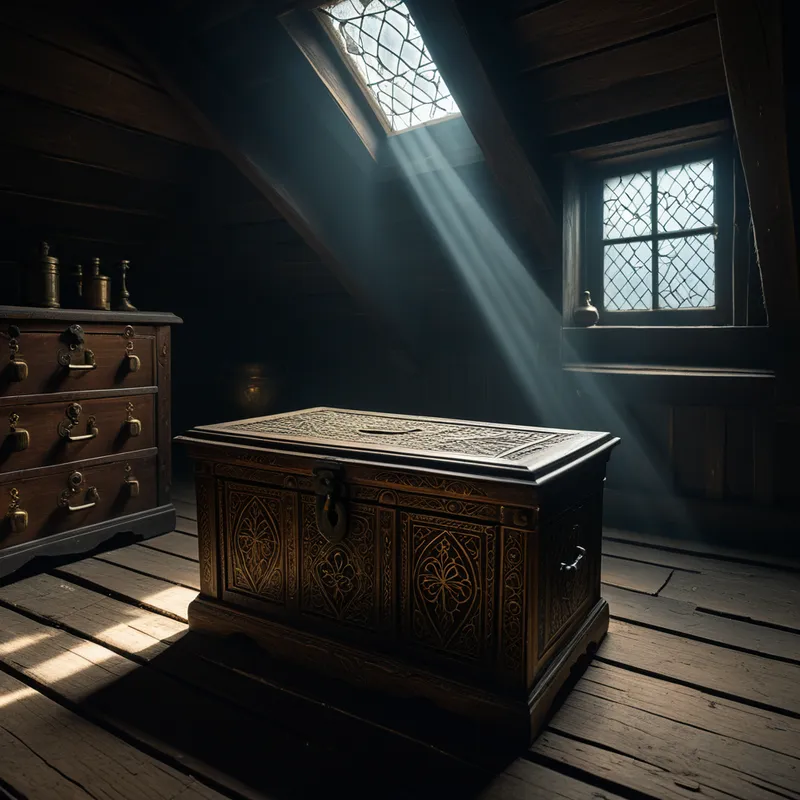
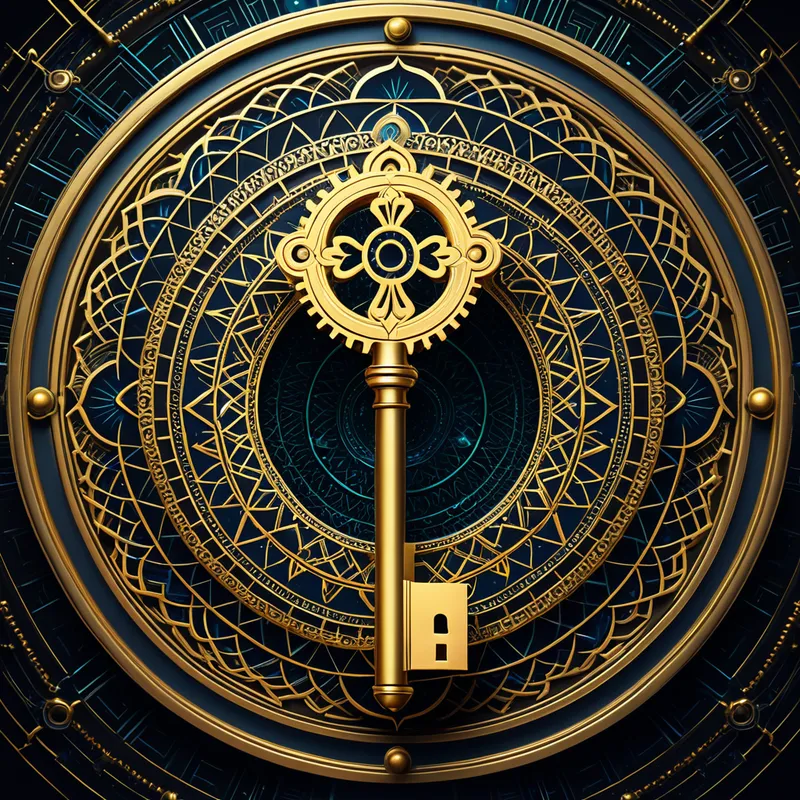
One day, tasked with clearing the oldest, most cobwebbed corner of a family attic—a place that smelled of cedar, dust, and time—their hand brushed against a splintered beam. Something cold and smooth met their touch. Pulling it free from its nest of decayed cloth, they beheld it: a Golden Key. It was not garish or large, but perfectly wrought, its bow an intricate puzzle of spirals, its teeth a cryptic code. It felt both heavy with purpose and light as a promise.
No chest in the attic accepted it. No known lock in the house sighed open at its touch. The key was an answer without a question, a solution to a mystery not yet spoken. It began to hum, a vibration felt in the bones more than heard by the ears, a subtle pull. Compelled, the seeker left the known house and walked. Through fields where the wind spoke in tongues, into a forest where the light fell in cathedral shafts, up a forgotten path marked only by intuition.
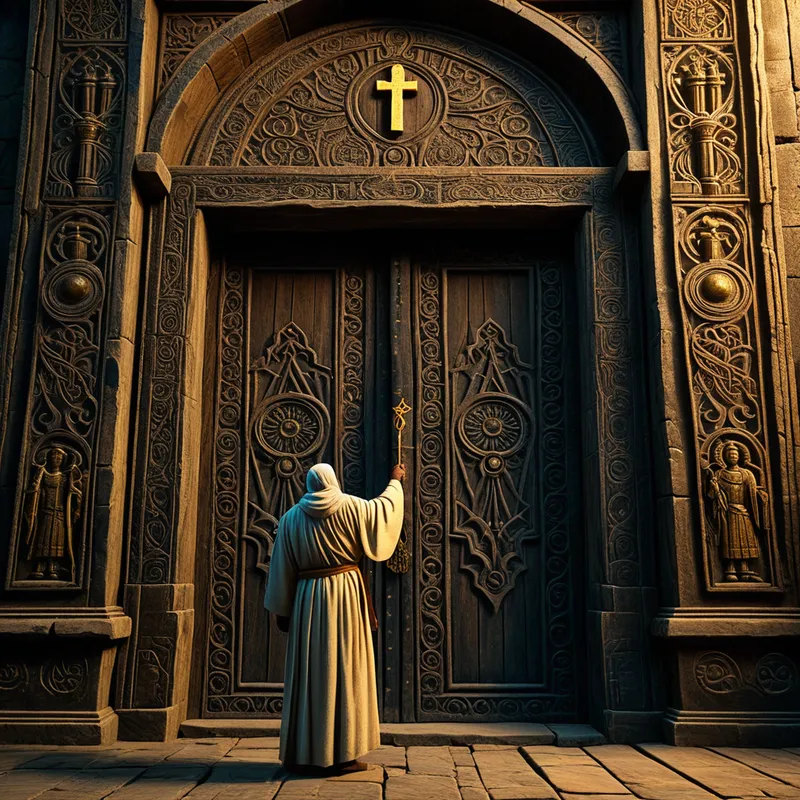
And there, in a hillside embraced by roots of an ancient tree, was the Door. It was not built, but seemed to have grown from the stone, woven into the very fabric of the hill. It was plain, immense, and utterly seamless but for a single, dark keyhole that seemed to drink the light. The humming of the key became a clear, resonant tone. With a breath that felt like their first and last, the seeker placed the key into the void. It fit not with a click of mechanics, but with a sound like a chord resolving, a sigh of the world itself.
The Door did not swing open on hinges. It dissolved into a cascade of light, not blinding, but revealing. Beyond was not a chamber, but a vastness—an interior landscape that was the true reflection of their own soul, a realm of unformed potential and silent, waiting truths. They did not step in; they realized they had always been there. The light from within flowed out, washing over the seeker, the hill, the path, the world. And when the vision settled, the Door was gone. The key remained, warm in their hand, now a simple, quiet thing. They returned, but the world they came back to was not the one they had left. It was the same, yet utterly transformed, seen now with the eyes of one who has beheld the source.
Cultural Origins & Context
The myth of the Golden Key is a folktale of the “Various”—a story so fundamental it appears in countless cultures, from the forests of Europe to the steppes of Asia, often as a humble tale told by the hearth. It belongs to the great family of “numskull” or “simpleton” tales, where the protagonist’s virtue is not strength or cunning, but often patience, humility, or attentiveness to the overlooked. It was told by grandmothers to children, by travelers at crossroads, serving as a narrative touchstone for the value of curiosity and the promise that meaning can be found in the most mundane of tasks.
Its societal function was twofold. On one level, it was a comfort, a validation that even the most ordinary life could be touched by the extraordinary. On another, it was an instruction: pay attention to heirlooms, to dreams, to the odd feeling. The story encodes the wisdom that legacy (the attic, the family) holds latent potentials (the key), but that the final, transformative step requires a personal, often solitary journey (the path to the door) to activate it. It democratizes the mystical quest, placing its starting point not in a royal court or a wizard’s tower, but in the dust of one’s own inheritance.
Symbolic Architecture
The myth’s power lies in its stark, potent symbolism. Each element is a psychic coordinate.
The Attic represents the personal and collective unconscious—the stored, forgotten, or repressed contents of the psyche (memories, ancestral wisdom, unused talents). The Golden Key is the catalyzing element of consciousness that can organize this chaos. It is not the wisdom itself, but the means of access—a sudden insight, a synchronistic event, a dream symbol, or a moment of profound intuition that “fits” a problem we couldn’t previously solve.
The key does not create the door; it reveals that the door has always been there, waiting to be seen.
The Journey is the conscious effort to follow that insight, often moving away from the familiar (the conscious persona) into the unknown (the unconscious). The Door in the Hillside is the threshold of the Self, the point of integration between the conscious ego and the vast, non-egoic psyche. It is often hidden in nature, symbolizing that this wholeness is not a human construction, but a natural state we have lost touch with. The final Dissolution into Light is the unio mystica, the moment of ego-death and rebirth where the seeker realizes their identity with the larger psychic totality. The return with the now-plain key signifies that the transformative experience becomes integrated into ordinary life; the numinous becomes a quiet, enduring part of one’s being.
The Dreamer’s Resonance
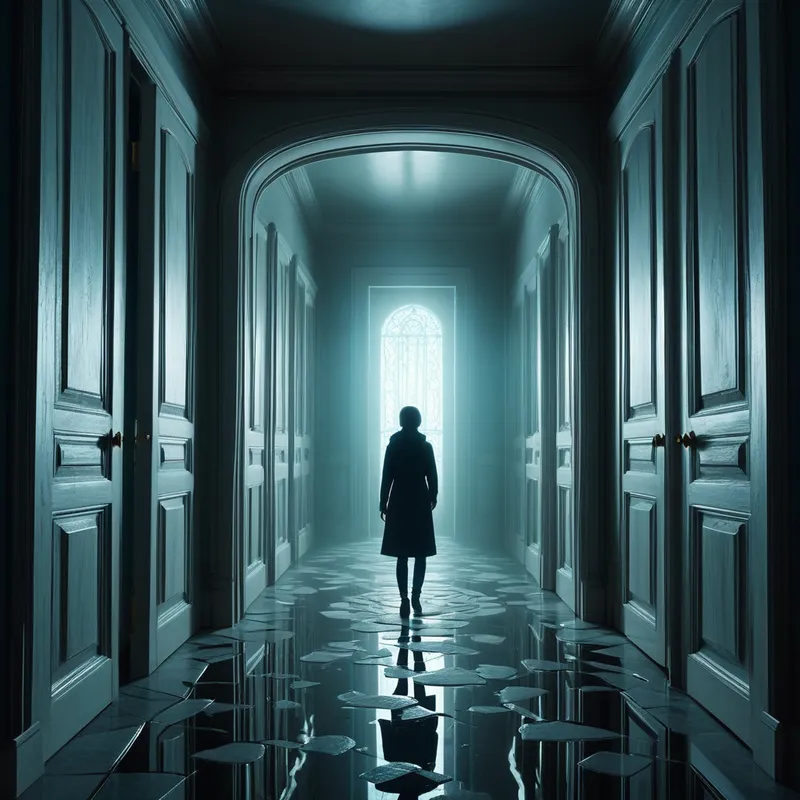
When this myth stirs in the modern dreamscape, it often manifests as dreams of finding hidden rooms in one’s own house, discovering secret passages, or holding a potent, beautiful object whose purpose is unknown. The somatic feeling is one of thrilling discovery mixed with anxiety—the heart beats faster, there is a literal “gut feeling” of significance.
Psychologically, this dream pattern signals that the dreamer’s psyche is preparing for, or is in the midst of, a significant integration. The “attic” or “hidden room” is a new complex or archetypal content pressing for recognition. The key is the emerging conscious attitude or new perspective that can make this content accessible. The dreamer is in the process of “finding the key”—that is, developing the specific quality of attention (perhaps humility, patience, or self-honesty) needed to unlock their next stage of growth. The anxiety reflects the ego’s rightful fear of being overwhelmed by the unknown, while the thrill is the Self’s pull toward wholeness.
Alchemical Translation
In the alchemy of the soul, the myth of the Golden Key models the stage of solutio—dissolution—followed by illumination. The conscious personality (the seeker in the known world) must first engage in the opus of sorting through the massa confusa of one’s personal history and inherited patterns (cleaning the attic). The discovery of the key is the arrival of the lapis, the philosopher’s stone in its initial, raw form—a symbol of the indestructible core of the personality.
The journey is the necessary separatio, leaving behind the safe, known elements to follow the lead of the soul. Placing the key in the door is the supreme conjunction, the hieros gamos or sacred marriage of the conscious mind (the key) with the unconscious totality (the door).
The transmutation occurs not in the finding of the treasure, but in the irreversible act of turning the key. The lock is the psyche’s own resistance; the turning is its surrender.
For the modern individual, this translates to the moment of profound insight where a lifelong pattern is finally understood, not just intellectually, but viscerally. The “light” that floods out is the energy previously bound in that pattern, now liberated and available to the whole personality. The door vanishes because the separation between “inner” and “outer,” between “my life” and “the mystery,” collapses. One returns to daily life not as a different person, but as the same person who now knows the secret: that the golden key was always in your hand, and the door was always the shape of your own becoming.
Associated Symbols
Explore related symbols from the CaleaDream lexicon: