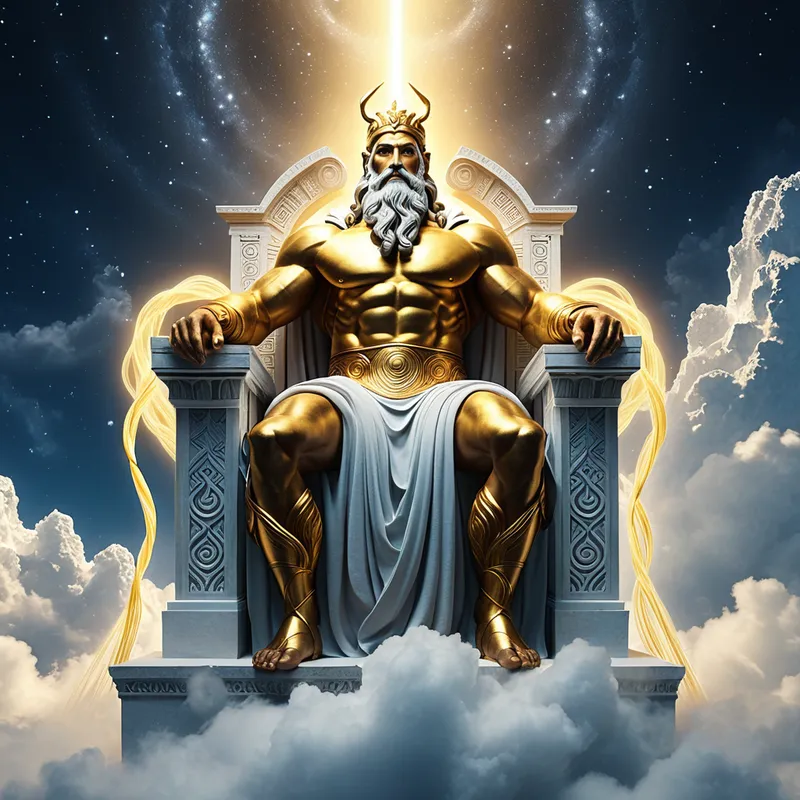
The Golden Cord of Zeus Myth Meaning & Symbolism
Zeus boasts that by pulling a golden cord, he could draw all creation to himself, revealing the absolute nature of divine sovereignty.
The Tale of The Golden Cord of Zeus
Let the hearth-fire grow low and the night grow deep. Listen, and I will tell you of a moment not of thunder or war, but of a quiet, chilling truth spoken in the halls of the gods themselves.
High upon Olympus, where the air is the breath of eternity and the floors are polished by centuries of divine footsteps, a council was gathered. The scent of ambrosia was thick, and the light was not of sun or moon, but the cold, clear radiance that precedes creation. Zeus, the Cloud-Gatherer, sat upon his throne of polished ether. His brow was not furrowed with anger, but with a profound and terrible certainty. Around him, the other Olympians waited—Hera with her watchful eyes, Poseidon with his restless energy, Athena with her silent calculation.
The conversation had turned, as it often did among immortals, to the nature of power. Claims were made, domains asserted. A tension, subtle as a shift in the wind, filled the hall. It was then that Zeus raised his hand, and all sound ceased.
He did not summon a lightning bolt. He did not shake the earth. Instead, he spoke, and his voice was the low rumble of tectonic plates settling into their final, destined place.
“Hear me,” he said, and the words were not a request. “You speak of your strength, of your portion of the world. You debate and scheme as if the tapestry of all-that-is hangs by many threads.”
He paused, letting the silence become a weight. Then, from the air beside his throne, he manifested it. A cord, not of hemp or silk, but of pure, spun gold. It glowed with an inner light, cool and absolute. It was at once infinitely strong and delicate as a thought.
“Behold,” Zeus continued, his gaze encompassing all of creation—the hall, the mountain, the spinning earth below, and the star-strewn vault above. “All of you, all of this, the gods, the mortals, the earth, the sea, and the starry heavens… they are bound to this.”
He held the cord loosely, yet it was taut, as if anchored to the very axis of the cosmos. “If I wished,” he said, the simplicity of the statement more terrifying than any shout, “I could fasten this golden cord to the pinnacle of Olympus. And then, I could pull. I could draw all of it—you, them, everything—up to me. Until all creation hangs from this peak, suspended by my will alone.”
The hall was frozen. No god dared breathe. In that moment, they did not see a brother or a king. They saw the fundamental principle of the universe made manifest: a single, unbreakable line of sovereignty connecting the multitude to the One. The cord was not a threat of violence, but a demonstration of an inescapable truth. The debate was over. The tension dissolved, not into peace, but into a profound, humbling acknowledgment. The story ends not with an action, but with that image seared into the divine mind: the golden cord, the hand that holds it, and the silent, absolute order it represents.
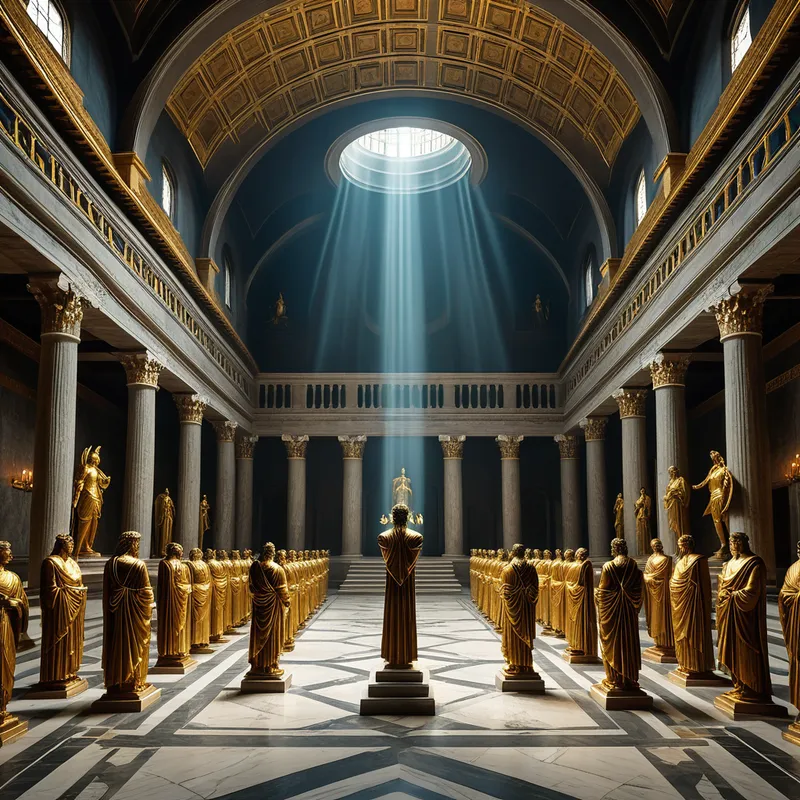
Cultural Origins & Context
This potent vignette comes to us not from the grand epic cycles of Homer, but from the philosophical and poetic depths of the Symposium. It is recounted by Plato, who puts the tale in the mouth of Aristophanes in his dialogue exploring the nature of love. This is critical. The myth is not presented as a theological dogma, but as a powerful allegory within a philosophical debate.
Its function was not to explain natural phenomena or detail heroic genealogy, but to illustrate a metaphysical and psychological point about unity, power, and the fundamental nature of reality. In the context of the Symposium, it is used to argue for the primordial unity of beings. Culturally, it reflects a Greek intellectual shift from purely narrative mythology towards using myth as a tool for abstract thought. It was a story told among philosophers and poets, a mental model for contemplating the ultimate source of order (Dike) in a seemingly chaotic cosmos. It served as a reminder that behind the pantheon’s squabbles and the world’s chaos lay a single, sovereign principle.
Symbolic Architecture
The Golden Cord is perhaps one of the most concentrated symbols of absolute, non-negotiable order in Western myth. It is not a chain of bondage, but a cord of connection—the essential tether that binds the multiplicity of creation to its singular source.
The cord does not compel action; it defines relationship. It is the axis mundi made personal, the line that connects the peripheral many to the central One.
Zeus here transcends his personality as a philandering sky-god. He becomes the personification of Moira itself, the apportioner, the ruler who does not merely command armies but orchestrates reality. The other gods symbolize the various archetypal forces—love, war, craft, passion—that, while powerful, are ultimately subject to a higher, integrating principle. The psychological core is the tension between individual agency and the overarching pattern. We are all, in a sense, attached to our own golden cord—the thread of fate, the DNA of our psyche, the inescapable core of our being that connects us to a source beyond our ego’s control. The myth confronts the ego with the sobering, yet potentially liberating, reality of a sovereignty greater than its own.
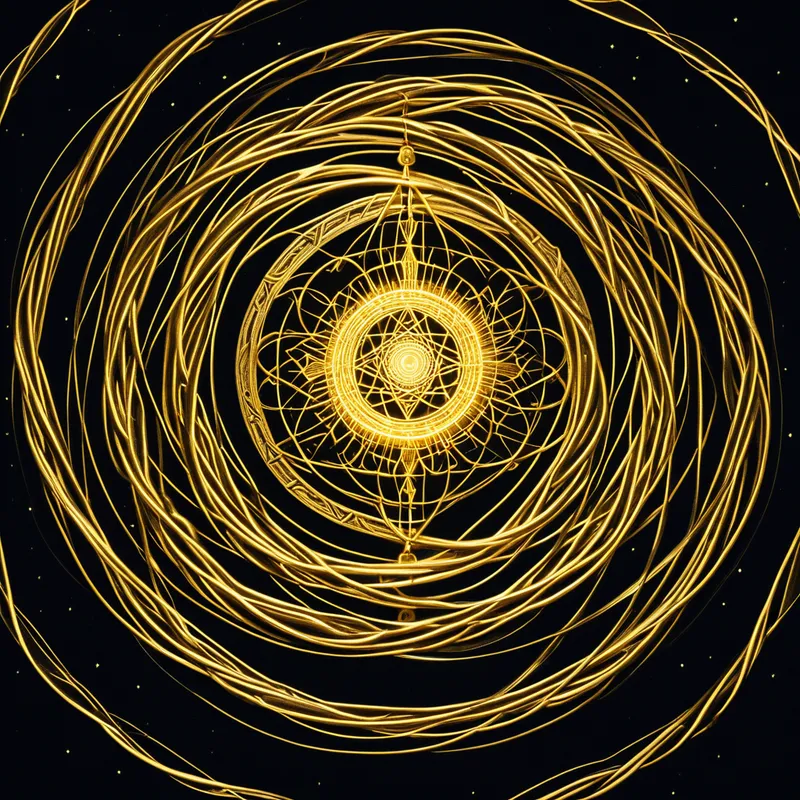
The Dreamer’s Resonance
When this myth pattern stirs in the modern unconscious, it rarely appears as a literal cord. Instead, one might dream of a single, unbreakable thread leading from the heart into a vast darkness or light; of being an instrument played by a greater musician; of finding oneself in a vast machine or system whose central control room is both awe-inspiring and unnerving.
Somatically, this can feel like a profound tension or pull in the center of the chest—not anxiety, but a deep, magnetic alignment. Psychologically, the dreamer is likely grappling with a confrontation with fate, necessity, or a non-negotiable aspect of their life path. It is the process of encountering what psychologist Carl Jung called the archetype of the Self, the central organizing principle of the psyche that transcends the ego. The dream is an invitation—or a demand—to acknowledge a sovereignty within oneself that is not of one’s own making, to surrender the ego’s illusion of total control and align with a deeper, more meaningful order.
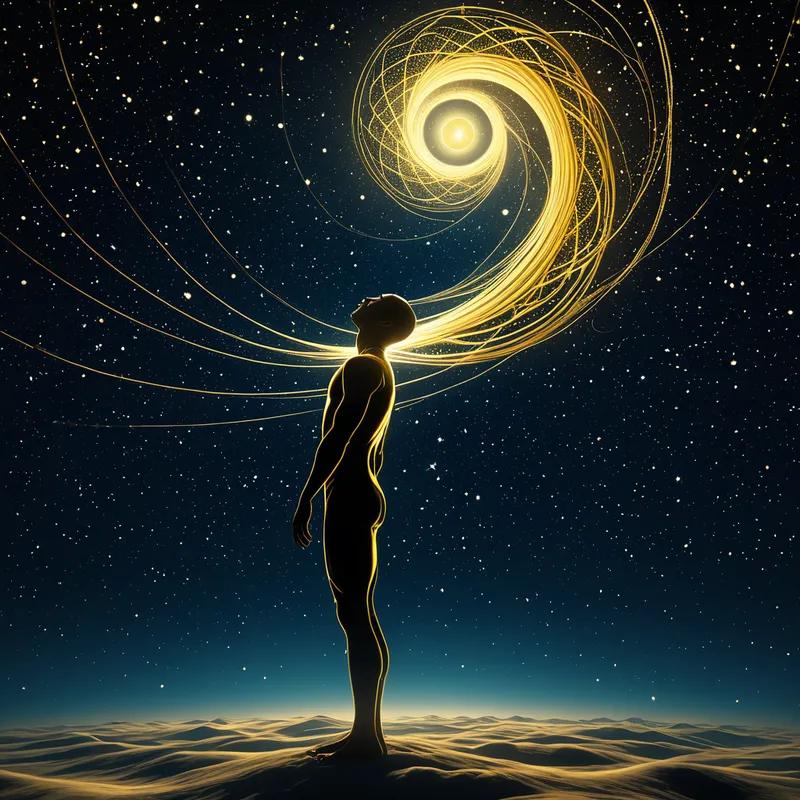
Alchemical Translation
The alchemical process mirrored here is not the solve (dissolution) but the ultimate coagula (coagulation). It is the stage where the diverse and conflicting elements of the psyche—the inner pantheon of our complexes, drives, and sub-personalities—are recognized as being part of a single, integrated system. The struggle is the ego’s rebellion against this knowledge; the triumph is its humble acceptance.
Individuation is not becoming the sole ruler of a private kingdom, but discovering the golden cord that connects you to the throne of a cosmos you did not create, yet are irrevocably part of.
For the modern individual, the “pulling of the cord” is the act of radical self-acceptance and alignment with one’s destiny. It is the moment we stop fruitlessly trying to cut the thread of our fundamental nature—our deepest wounds, our core gifts, our fateful encounters—and instead, grasp it. We acknowledge that this cord is what connects us to the source of our being. By pulling on it consciously, we do not drag the world to us in a show of arrogance. We draw ourselves up to our own highest potential, to the “peak of Olympus” within, which is the seat of inner authority and authentic existence. The myth teaches that true power lies not in dominating the multiplicity, but in realizing its inherent, graceful connection to the unifying One.
Associated Symbols
Explore related symbols from the CaleaDream lexicon: