The Golden Calf Myth Meaning & Symbolism
A story of a people's desperate creation of a tangible god in the desert, betraying the invisible covenant for a glittering idol of their own making.
The Tale of The Golden Calf
The mountain smoked and trembled, a great fist of stone punching the belly of heaven. Above, in thunder and thick darkness, their god spoke. Below, in the vast, aching bowl of [the desert](/myths/the-desert “Myth from Biblical culture.”/), the people waited. And waited. [Moses](/myths/moses “Myth from Biblical culture.”/) had vanished into that divine tempest, and the days stretched like a parched throat. The [pillar of cloud](/myths/pillar-of-cloud “Myth from Biblical culture.”/) that had led them was static, a silent sentinel against the mountain. Fear, that old companion from Egypt, began to whisper once more. “Where is he? What if the god of the mountain has consumed him? What if we are alone?”
The silence was unbearable. The absence of a leader, of a tangible sign, became a vacuum, and nature abhors a vacuum. The people gathered before Aaron, their voices a rising tide of anxiety. “Make us gods who will go before us. As for this Moses, we do not know what has become of him.”
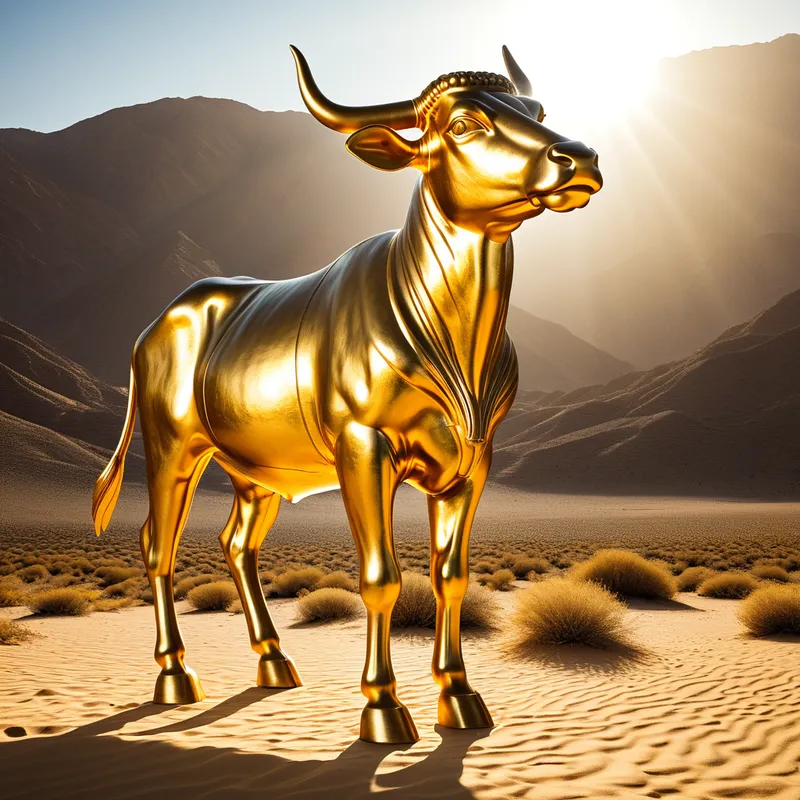
Aaron, caught between the absent prophet and the present panic, yielded. “Take off the gold rings that are on the ears of your wives, your sons, and your daughters, and bring them to me.” A collective sigh, almost of relief, went through the camp. Action. Something to do. The gold, plundered from their Egyptian captors, was heaped into a fire. From [the crucible](/myths/the-crucible “Myth from Alchemical culture.”/), under the craftsman’s tool, a form emerged: a calf of molten gold. And the people said, “This is your god, O Israel, who brought you up out of the land of Egypt!”
The next dawn was not for Yahweh. It was for the calf. An altar was built before it. The people rose early, offered sacrifices, and sat down to eat and drink. Then they rose to play. The play was a frenzied, ecstatic revelry—a chaotic, somatic release of all their pent-up terror and longing. The air grew thick with the smell of roasting meat, spilled wine, sweat, and the metallic tang of their new, shining god. The covenant, etched in lightning and law on the distant peak, was forgotten in the dust at the feet of a glittering idol.
But on the mountain, the true covenant was being broken. Yahweh spoke to Moses: “Go down at once! Your people, whom you brought up out of the land of Egypt, have acted perversely.” The divine wrath was a hot wind. “Now let me alone, that my wrath may burn hot against them.”
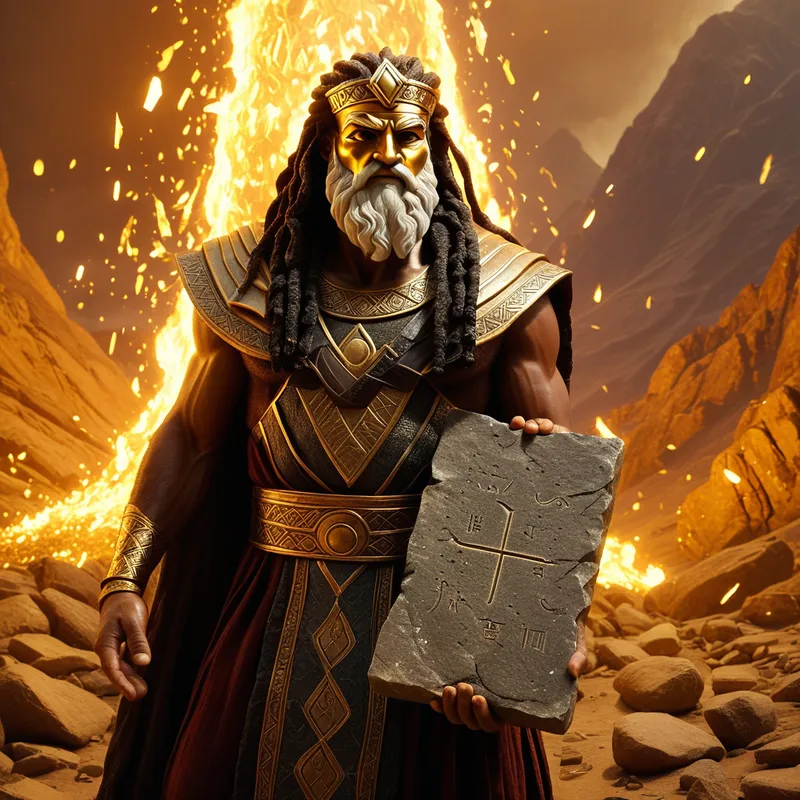
Moses descended, the two tablets of testimony in his hands, tablets written by the finger of God. As he neared the camp, he heard the sounds of the festival. He saw the calf and the dancing. His anger burned hot. He threw the tablets from his hands and shattered them at the foot of the mountain. He took the calf they had made, burned it with fire, ground it to powder, scattered it on the [water](/myths/water “Myth from Chinese culture.”/), and made the people of Israel drink it. The revelry was silenced, replaced by the bitter taste of their own sin. The Levites were summoned, and a terrible price was paid in the camp that day. The golden god was gone, leaving only ash, shame, and the daunting task of mending what was broken.
Cultural Origins & Context
This myth is embedded in the heart of the Torah, specifically in the Book of Exodus. It functions as the foundational crisis of the Mosaic Covenant. Historically, it likely reflects tensions within early Israelite society between the radical, aniconic (anti-image) worship of Yahweh and the pervasive religious cultures of the Ancient Near East, particularly Canaanite and Egyptian, where bull iconography symbolized power and fertility (e.g., the Egyptian god Apis).
The story was preserved and told by priestly and prophetic circles as a national parable of failure and a warning. Its societal function was multifaceted: to explain the origin of the Levitical priesthood’s exclusive role, to justify the severe laws against idolatry, and to dramatize the peril of spiritual impatience and assimilation. It served as a collective memory of a time when the fledgling nation, poised between slavery and promise, almost destroyed itself by reaching for a familiar, tangible divinity instead of enduring the terrifying mystery of the formless One.
Symbolic Architecture
The [Golden Calf](/myths/golden-calf “Myth from Biblical culture.”/) is not merely an idol; it is the archetypal [symbol](/symbols/symbol “Symbol: A symbol can represent an idea, concept, or belief, serving as a powerful tool for communication and understanding.”/) of the proximate god. It represents the [human](/symbols/human “Symbol: The symbol of a human represents individuality, complexity of emotions, and social relationships.”/) [psyche](/myths/psyche “Myth from Greek culture.”/)‘s intolerance for the unknown, the ambiguous, and the psychologically demanding process of sustaining [faith](/symbols/faith “Symbol: A profound trust or belief in something beyond empirical proof, often tied to spiritual conviction or deep-seated confidence in people, ideas, or outcomes.”/) in something unseen. Moses on the [mountain](/symbols/mountain “Symbol: Mountains often symbolize challenges, aspirations, and the journey toward self-discovery and enlightenment.”/) embodies the difficult, lonely [journey](/symbols/journey “Symbol: A journey in dreams typically signifies adventure, growth, or a significant life transition.”/) of confronting the ultimate [mystery](/symbols/mystery “Symbol: An enigmatic, unresolved element that invites curiosity and exploration, often representing the unknown or hidden aspects of existence.”/) (the Self). The people in the [valley](/symbols/valley “Symbol: A valley often symbolizes a period of transition or a place of respite between two extremes.”/) represent [the ego](/myths/the-ego “Myth from Jungian culture.”/)-[consciousness](/symbols/consciousness “Symbol: Consciousness represents the state of awareness and perception, encompassing thoughts, feelings, and experiences.”/) that cannot tolerate this [tension](/symbols/tension “Symbol: A state of mental or emotional strain, often manifesting physically as tightness, pressure, or unease, signaling unresolved conflict or anticipation.”/). They regress, constructing a god in their own [image](/symbols/image “Symbol: An image represents perception, memories, and the visual narratives we create in our minds.”/), from their own possessions.
The idol is always a concretization of a transcendent impulse—a desperate attempt to house the unhouseable, to see the unseeable, on our own compromised terms.
The gold itself is symbolic. It is the plundered [wealth](/symbols/wealth “Symbol: Wealth in dreams often represents abundance, security, or inner resources, but can also symbolize burdens, anxieties, or moral/spiritual values.”/) of Egypt—the glittering [residue](/symbols/residue “Symbol: What remains after a process or event; traces left behind that persist beyond the original occurrence.”/) of their old, enslaved [life](/symbols/life “Symbol: The symbol of ‘Life’ represents a journey of growth, interconnectedness, and existential meaning, encompassing both the joys and challenges that define human experience.”/). To forge a god from it is to secretly worship the psychological “Egypt” they claimed to have left: a state of dependency, [material](/symbols/material “Symbol: Material signifies the tangible aspects of life, often representing physical resources, desires, and the physical world’s influence on our existence.”/) [security](/symbols/security “Symbol: Security denotes safety, stability, and protection in one’s personal and emotional life.”/), and visible power structures. The calf, a young [bull](/symbols/bull “Symbol: The bull often symbolizes strength, power, and determination in many cultures.”/), symbolizes raw, untamed natural force and [fertility](/symbols/fertility “Symbol: Symbolizes creation, growth, and abundance, often representing new beginnings, potential, and life force.”/)—a drastic [reduction](/symbols/reduction “Symbol: A tool or process that simplifies, minimizes, or breaks down something into smaller components, often representing efficiency or loss.”/) of the cosmic [creator](/symbols/creator “Symbol: A figure representing ultimate origin, divine power, or profound authorship. Often embodies the source of existence, innovation, or personal destiny.”/) to a manageable engine of earthly prosperity. The shattered tablets represent the broken container of divine law, the [structure](/symbols/structure “Symbol: Structure in dreams often symbolizes stability, organization, and the framework of one’s life, reflecting how one perceives their environment and personal life.”/) that cannot hold the formless [reality](/symbols/reality “Symbol: Reality signifies the state of existence and perception, often reflecting one’s understanding of truth and life experiences.”/) once trust is violated.
The Dreamer’s Resonance
When this myth appears in modern dreams, it rarely manifests as a literal calf. Instead, the dreamer may find themselves in a situation of anxious waiting for a guide, a partner, or an answer that does not come. The tension becomes unbearable. The dream-ego then “commissions” a solution: a brilliant new career path (forged from the “gold” of social status), a savior-complex relationship, a rigid political ideology, or an addictive substance. This is the dream’s Golden Calf.
The somatic experience is often one of frenetic activity or numbed consumption—the “eating, drinking, and play” of the myth. It feels like relief, but a hollow, manic relief. Upon waking, the dreamer may feel a profound sense of shame, emptiness, or the bitter “taste” of self-betrayal. The psychological process is one of the ego, unable to endure the anxiety of a transitional period (the “desert”), regressing to a previous, simpler mode of being. It is a bypass of the necessary suffering of growth.

Alchemical Translation
The alchemical process modeled here is the [nigredo](/myths/nigredo “Myth from Alchemical culture.”/)—the blackening, the putrefaction, the necessary death of an immature attitude. [The promised land](/myths/the-promised-land “Myth from Biblical culture.”/) (individuation) lies ahead, but the journey requires passing through the desert of uncertainty, where the old, familiar gods of the personality (Egypt) no longer serve, and the new, unifying principle (the covenant with [the Self](/myths/the-self “Myth from Jungian culture.”/)) is not yet integrated.
The people’s demand for a god is, in itself, not wrong; it is the direction of the demand that is fatal. They look outward and downward, to their own hands and possessions, rather than inward and upward, to the mysterious mountain of the psyche where transformation occurs.
The crushing, grinding, and drinking of the idol is the brutal but essential alchemical stage. One must re-incorporate one’s own projected divinity, not as a glorious truth, but as a bitter, humbling poison that destroys the illusion from within.
Moses’ furious intervention represents the necessary, violent eruption of the Self’s authority into the complacent ego-complex. The shattered tablets must be shattered; the old contract, based on a misunderstanding, cannot stand. The true alchemical work begins only after the idol is destroyed—the long, slow process of hewing new tablets “like the first ones,” but now with the searing knowledge of one’s own capacity for betrayal etched into the soul. The [triumph](/myths/triumph “Myth from Roman culture.”/) is not in avoiding the creation of the calf, but in surviving its destruction and consenting to the harder, invisible covenant that follows.
Associated Symbols
Explore related symbols from the CaleaDream lexicon: