
The Golden Belt of Hippolyta Myth Meaning & Symbolism
Heracles's ninth labor: a quest for a queen's sacred girdle, beginning in peace and ending in bloodshed, revealing the cost of stolen sovereignty.
The Tale of The Golden Belt of Hippolyta
Hear now the tale of the ninth torment, a labor born not in the fire of a monster’s breath, but in the caprice of a girl’s desire. The air in Tiryns was thick with servitude, for [Heracles](/myths/heracles “Myth from Greek culture.”/) still breathed under the command of a lesser king. Eurystheus, his brow perpetually creased with petty fear, spoke his daughter’s wish: Admete longed for the glory that girdled a foreign queen. Not just any adornment, but the very symbol of her rule—the Golden Belt of Hippolyta, daughter of Ares, queen of the Amazons.
So the hero set sail, his heart a knot of duty, his ship cutting the wine-dark sea toward the wild shores of Themiscyra, where the Thermodon River meets the Euxine Sea. Here, [the world](/myths/the-world “Myth from Tarot culture.”/) was ordered differently. The air smelled of horse, leather, and earth. On the plains, women who were their own law trained with spear and bow, their laughter fierce and free. At their heart was Hippolyta. To behold her was to understand sovereignty. She wore her authority not as a crown, but as a girdle—a masterwork of gold and leather, a gift from her warlord father, Ares. It was not merely jewelry; it was her sinew made manifest, the covenant of her power.
Heracles came ashore not with an army, but alone. He stood before her, a mountain of muscle and lion’s pelt, and spoke of his labored quest. And here, [the Fates](/myths/the-fates “Myth from Greek culture.”/) spun a thread of startling color. Hippolyta, warrior-queen, listened. Perhaps she saw in him a kindred spirit, a child of the same tempestuous god. Perhaps she admired his frankness. The myths whisper that she was moved, that she consented. The belt, symbol of her very self, would be given freely. A pact was made, a breath of peace in a world of strife.
But the gods watch, and Hera, eternal foe of Heracles, could not abide this harmony. Disguised as one of the Amazons, she moved through the host like a poison wind. “Strangers lie!” her voice hissed. “The giant among them comes to steal our queen, to bind you all in chains!” Fear, that ancient serpent, uncoiled in the hearts of the warrior women. With a cry that shattered the truce, they seized their arms and charged the moored ship, their faces masks of betrayed fury.
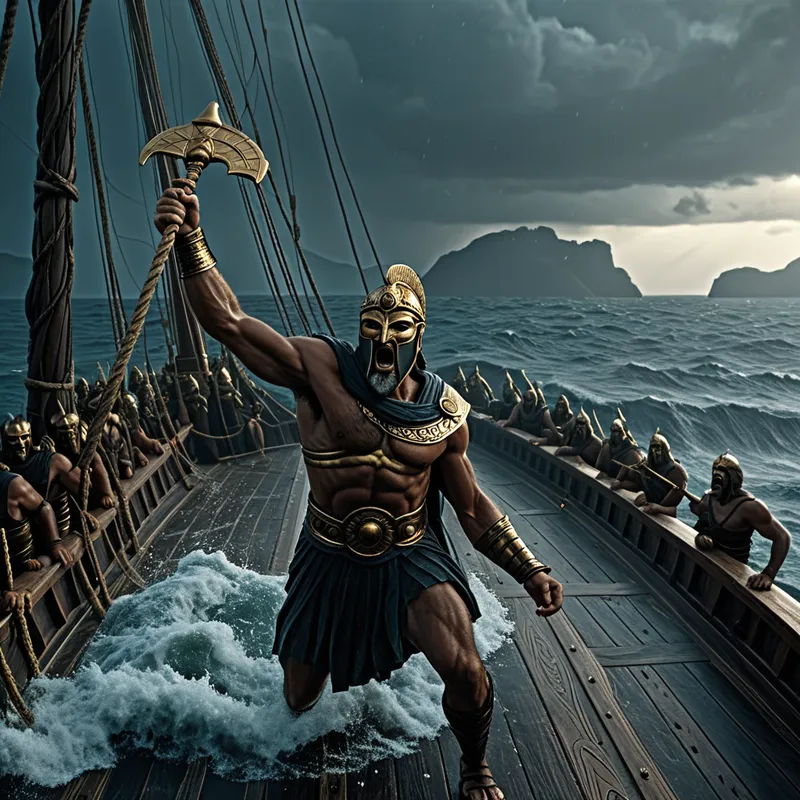
On [the deck](/myths/the-deck “Myth from Tarot culture.”/), Heracles saw the peace shatter. He saw Hippolyta, caught between her word and her people’s rage. In his heart, the labor—the command of Eurystheus—drowned out the brief melody of trust. Seeing the armed host descend, he believed the queen had betrayed him first. With a terrible, tragic logic, he acted. His hands, which had strangled lions, now closed around Hippolyta. There was a struggle, brief and brutal. The golden belt was torn from her waist. And then, whether by his own hand or in the bloody melee that ensued, the Queen of the Amazons fell, her life bleeding out onto the deck, her gift of trust repaid with violent theft. Heracles fought his way free, the belt now a heavy, bloody prize, and set sail, leaving behind a wake of crimson on the [water](/myths/water “Myth from Chinese culture.”/) and a nation howling in grief. The belt was won, but the victory was ashes.
Cultural Origins & Context
This myth reaches us primarily through the skeletal, yet potent, framework of the Labours of Heracles, compiled in sources like the Bibliotheca of Pseudo-Apollodorus. It is a story told not in grand epic verse like the Iliad, but as part of a heroic catalogue, a bead on the string of the hero’s suffering. This context is vital: it was a tale for Greeks to explain the edges of their world. The Amazons represented the ultimate “other”—a society that inverted Greek patriarchal norms, where women held martial and political power. They were both feared and fascinated, a screen upon which Greek culture could project its anxieties about female autonomy, wildness, and power.
The function of this myth, within the sequence of the labors, is profound. It sits between battles with monstrous beasts and journeys to [the underworld](/myths/the-underworld “Myth from Greek culture.”/). It is the only labor that begins with the potential for diplomacy and ends in catastrophic personal betrayal. It served as a cautionary tale about the chaos that ensues when the “civilized” Greek world interacts with the “wild” periphery, and how easily honorable quests can descend into dishonorable slaughter through misunderstanding and divine malice. It reinforced the idea that the Amazonian way of life, while formidable, was ultimately incompatible with—and vulnerable to—the Greek heroic order.
Symbolic Architecture
At its core, this is a myth about the violation of sacred sovereignty and the catastrophic cost of taking what is not freely given. The Golden Belt is no mere accessory.
It is the symbolic skin of the autonomous Self, the visible covenant of one’s own authority and wholeness.
Hippolyta is the [archetype](/symbols/archetype “Symbol: A universal, primordial pattern or prototype in the collective unconscious that shapes human experience, behavior, and creative expression.”/) of the Great Amazon, the ruler in her own domain, integrated with her martial (Ares) [nature](/symbols/nature “Symbol: Nature symbolizes growth, connectivity, and the primal forces of existence.”/). Her willingness to give the belt represents the ultimate [vulnerability](/symbols/vulnerability “Symbol: A state of emotional or physical exposure, often involving risk of harm, that reveals authentic self beneath protective layers.”/) and [strength](/symbols/strength “Symbol: ‘Strength’ symbolizes resilience, courage, and the ability to overcome challenges.”/): the [ability](/symbols/ability “Symbol: In dreams, ‘ability’ often denotes a recognition of skills or potential that one possesses, whether acknowledged or suppressed.”/) to offer one’s essence from a place of secure power.
Heracles, here, is the heroic ego on a mandated [quest](/symbols/quest “Symbol: A quest symbolizes a journey or search for purpose, fulfillment, or knowledge, often representing life’s challenges and adventures.”/). His labor is not to integrate this Amazonian sovereignty, but to acquire it as an object for another. He represents the patriarchal, [task](/symbols/task “Symbol: A task represents responsibilities, duties, or challenges one faces.”/)-oriented [consciousness](/symbols/consciousness “Symbol: Consciousness represents the state of awareness and perception, encompassing thoughts, feelings, and experiences.”/) that seeks to possess symbols of power without undergoing the inner transformation they represent. Hera’s intervention is the [eruption](/symbols/eruption “Symbol: A sudden, violent release of pent-up energy or emotion from beneath the surface, often representing transformation or crisis.”/) of the unconscious—the deep, archetypal [energy](/symbols/energy “Symbol: Energy symbolizes vitality, motivation, and the drive that fuels actions and ambitions.”/) of mistrust, [jealousy](/symbols/jealousy “Symbol: A complex emotion signaling perceived threat to valued relationships or status, often revealing insecurities and unmet needs.”/), and sabotage that destroys fragile bridges between different orders of being. The tragic [outcome](/symbols/outcome “Symbol: Outcome symbolizes the results of actions or decisions, often reflecting hopes, fears, and the consequences of choices.”/) is inevitable: when [the Self](/myths/the-self “Myth from Jungian culture.”/)’s sovereignty is approached as a [trophy](/symbols/trophy “Symbol: The trophy symbolizes achievement, recognition, and the reward for perseverance in competitive endeavors.”/) to be captured rather than a state to be understood, the result is psychological murder. The [queen](/symbols/queen “Symbol: A queen represents authority, power, nurturing, and femininity, often embodying leadership and responsibility.”/) is killed, the belt is stained, and the [hero](/symbols/hero “Symbol: A hero embodies strength, courage, and the ability to overcome significant challenges.”/)’s [journey](/symbols/journey “Symbol: A journey in dreams typically signifies adventure, growth, or a significant life transition.”/) becomes one of hollow acquisition, burdened by [shadow](/symbols/shadow “Symbol: The ‘shadow’ embodies the unconscious, repressed aspects of the self and often represents fears or hidden emotions.”/).

The Dreamer’s Resonance
When this myth stirs in the modern dreamscape, it often signals a profound crisis of personal authority and betrayal. To dream of a coveted “golden belt”—which may manifest as a job title, a creative project, a relationship, or a sense of self-worth—is to encounter one’s own Hippolyta. The dreamer may be the queen, feeling their sovereignty is under threat by external forces (the “Heracles” figures of demanding employers, partners, or societal expectations) or by internal sabotage (the “Hera” voice of imposter syndrome or old wounds).
Somatically, this can feel like a tightening in the solar plexus—the very area a belt would gird. It is the seat of personal power. Dreams of having something vital torn from you, or of betraying a trust that led to catastrophic loss, are direct echoes of this myth. The psychological process is one of boundary violation and the fragmentation of the Self. The dream asks: Where am I giving my power away? Where am I, or others, confusing possession with integration? What part of my wholeness have I sacrificed to fulfill an external “labor”?

Alchemical Translation
The alchemical journey modeled here is not one of successful conquest, but of a devastating [nigredo](/myths/nigredo “Myth from Alchemical culture.”/)—the blackening, the putrefaction that is the necessary, painful first stage of transmutation. Heracles’s labor fails spiritually even as it succeeds materially. For the modern individual seeking individuation, the myth is a stark map of what not to do, and a guide to [the shadow](/myths/the-shadow “Myth from Jungian culture.”/)-work required.
The true labor is not to seize the golden belt, but to become worthy of receiving it, and to build a psyche where such a gift can be given without fear of betrayal.
The alchemical process begins by recognizing the Hippolyta within—the autonomous, self-ruling principle. One must commune with this inner queen, not assault her fortress. The “Hera” interference represents the toxic complexes and inherited patterns that destroy trust in our own sovereignty and in the possibility of authentic exchange. The work is to differentiate this sabotage from the true voice of the Self.
The tragedy on the ship is the moment [the ego](/myths/the-ego “Myth from Jungian culture.”/), faced with chaos, chooses possession over relationship, control over understanding. The alchemical translation requires holding that moment of failure in consciousness. It asks us to metabolize the grief of the slain queen—the parts of ourselves we have violated in our rush to achieve external goals. Only by honoring that loss, by seeing the blood on the “prize,” can the belt begin to lose its stain. The ultimate transmutation is to return, in imagination and repair, to the moment before the violence. To cultivate a [psyche](/myths/psyche “Myth from Greek culture.”/) where the Heraclean task-drive can sit in council with the Amazonian sovereignty, where the gift can be given and received, and where the golden belt becomes not a trophy of conquest, but a symbol of integrated, unassailable Selfhood. The labor then becomes not the ninth, but the first and only: the making of a whole soul.
Associated Symbols
Explore related symbols from the CaleaDream lexicon: