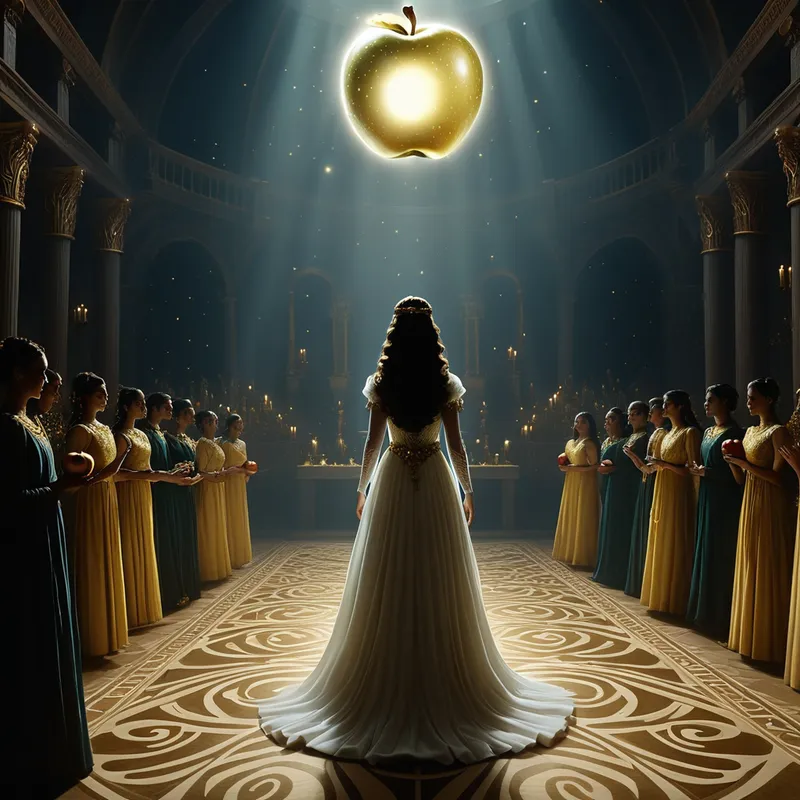
The Golden Apple of Discord in Myth Meaning & Symbolism
A wedding's peace shattered by a single inscribed apple, sparking a divine beauty contest that would launch a thousand ships and a legendary war.
The Tale of The Golden Apple of Discord
The air on Olympus was thick with the scent of nectar and the sound of immortal laughter. A feast was in full splendor, a celebration of the union of the sea-nymph Thetis and the mortal king Peleus. Every god and goddess of note was there, their radiance filling the hall—all but one. Eris, the sister of Ares, had been pointedly, cruelly, left uninvited. Her presence, it was whispered, was ill-omened, a shadow that could sour the sweetest wine.
And so, from the edges of the world, Eris watched. A cold fury settled in her heart, not of sadness, but of a creative, cunning wrath. If they would not have her at their feast of harmony, she would give them a feast of her own making. From the deep orchards of the Hesperides, she took a single fruit, a perfect apple of the purest, most hypnotic gold. With a nail sharp as a dagger’s point, she inscribed upon its shimmering skin three words in the language of the divine: Kallisti—To the Fairest.
Silent as a thought of malice, she appeared at the threshold of the glowing hall. No fanfare announced her. She simply drew back her arm and sent the apple rolling, a sphere of condensed sunlight, across the polished floor. It came to rest at the feet of the three most powerful goddesses: Hera, regal and imposing; Athena, stern and grey-eyed; and Aphrodite, from whom all grace seemed to flow. The music died. All eyes fell upon the gleaming provocation.
A hand reached for it—Hera’s, claiming her rightful due as queen. Another stayed it—Athena’s, cool and firm. A third simply touched it, and the apple seemed to burn brighter—Aphrodite’s. “It is mine,” each declared, their voices no longer harmonious but sharp with a sudden, divine vanity. The argument spiraled, a tempest in a jeweled cup, until even Zeus, the thunderer, would not dare to judge. He saw the snare. To choose one was to earn the eternal, bitter enmity of the other two.
With a wisdom that was also a cowardice, he cast the choice downward, to the mortal world. “Seek Paris,” he commanded, “the shepherd-prince on the slopes of Mount Ida. Let him, in his mortal simplicity, decide.”
And so the three descended, shedding their Olympian majesty for a moment, yet still blazing with an unbearable light before the bewildered Trojan youth. They did not ask. They offered. Hera promised empires, the scepter of all Asia laid at his feet. Athena offered victory in every battle, wisdom that would make his name immortal in song and strategy. Aphrodite simply smiled, and in that smile, Paris saw the face of Helen, a beauty that launched not just desire, but destiny itself. His choice was no choice at all for a heart ruled by longing. He placed the apple in Aphrodite’s hand.
The goddesses departed. Hera and Athena, their pride wounded into a cold, immortal hatred, turned their gaze toward the city of Troy, marking it for ash and ruin. Aphrodite kept her promise, weaving the spells that would draw Helen across the sea. And from that single, rolling apple, the Furies began to spin the threads of the Trojan War, a conflict of a thousand ships, countless heroes, and a city’s fiery end, all seeded in that one moment of discordant gold.

Cultural Origins & Context
This myth, often called the Judgment of Paris, is a foundational prelude embedded within the epic cycle of the Trojan War. Its primary sources are fragments and later syntheses, most notably in epic poems like the Cypria (part of the lost Epic Cycle) and in the works of later writers such as Euripides and the Roman poet Ovid. It functioned as the indispensable “why” for a Greek audience who knew the Iliad’s “how.” The war was not a random event but a cosmic drama set in motion by divine pettiness and human frailty.
Told by bards and poets, the story served multiple societal functions. It explained the origins of a legendary, world-altering conflict in terms of relatable, if elevated, passions: envy, vanity, and the peril of choice. It reinforced the Greek worldview of a universe where mortal lives were playthings in divine squabbles, where hubris (even for gods) and desire had catastrophic consequences. Furthermore, it established a moral and narrative causality, linking a seemingly small act of exclusion and pride to an unimaginably large-scale tragedy, teaching that no peace, however golden, is immune to the seed of strife.
Symbolic Architecture
The Golden Apple is the perfect symbol of the irresistible provocation. It is not merely a fruit, but a mirror. Its surface, inscribed “To the Fairest,” reflects not objective beauty, but the deepest vanity and insecurity of whoever beholds it. It represents the latent point of contention in any system—be it family, nation, or psyche—that, when activated, unravels unity.
The apple is the uninvited thought, the repressed truth, the question no one dares ask, which, once uttered, divides the world into before and after.
The three goddesses embody the tripartite divisions of the human soul and the impossible choices of life’s path. Hera is the archetype of Sovereignty and Power (social status, rule, structure). Athena is the archetype of Wisdom and Competence (strategy, skill, intellect). Aphrodite is the archetype of Love and Desire (beauty, passion, relatedness). Paris’s choice for Aphrodite is often framed as a “shallow” victory of lust, but psychologically, it is a choice for the anima, for the pull of eros and connection over the impersonal realms of power and wisdom. His “judgment” is less a rational decision and more a revelation of his ruling complex.
Eris, the excluded one, is the essential Shadow of the festive, ordered consciousness. To ignore, exclude, or deny the principle of strife, discord, and necessary tension is to guarantee its return in a more destructive, projected form. She is the truth that the “happy occasion” seeks to suppress.

The Dreamer’s Resonance
When this myth patterns a modern dream, the dreamer is likely at a psychic crossroads where a seemingly small choice or a neglected aspect of the self is threatening to destabilize their inner or outer peace. Dreaming of a beautiful, tempting fruit with a cryptic inscription suggests a nascent awareness of a brewing conflict of values. Which part of you feels unrecognized, uninvited to the feast of your own life?
To dream of being Paris, confronted by three imposing figures, speaks to a state of paralyzing indecision at a life-altering juncture. The promises offered are the soul’s own potentials, each demanding allegiance. The somatic experience may be one of anxious arousal, a feeling of being scrutinized and unprepared. Conversely, to dream of being Eris, watching a celebration from the outside, points to profound feelings of exclusion, resentment, and the potent, creative-destructive energy of the repressed shadow that is preparing to make itself known—to roll the apple into the tidy room of one’s conscious life.

Alchemical Translation
The alchemical process modeled here is the Nigredo—the blackening, the initial stage of chaos and dissolution that must precede any transformation. The wedding feast represents the unconscious unity of the psyche, a fragile coniunctio (union) that has not integrated its own shadow (Eris). The act of exclusion is the ego’s refusal to acknowledge its own capacity for discord. The golden apple, then, is the lapis, the philosopher’s stone in its most raw, volatile state—a divine, chaotic spark of consciousness that disrupts the stagnant peace.
The path to individuation is not paved with golden apples of easy choice, but ignited by them. The conflagration they cause burns away the persona of false harmony, forcing a confrontation with the warring gods within.
Paris’s judgment is the inevitable, if flawed, act of differentiation. The psyche must choose a dominant value, a ruling principle, to begin its journey. This choice, however, initiates the great war—the internal conflict between the rejected potentials (the scorned Hera and Athena within) and the chosen one. The ensuing Trojan War is the long, painful, and necessary process of psychic civil war, where the old city of Troy (the outmoded self-structure) must be besieged and ultimately destroyed so that a new consciousness can be forged.
For the modern individual, the myth teaches that striving for a conflict-free life is an illusion that invites catastrophic shadow projection. True peace comes not from excluding Eris, but from inviting her to the table, from recognizing that the golden apple of discord carries the inscription of our own wholeness. The choice is never between good and evil, but between competing goods and latent selves. The work of alchemy is to endure the war that choice unleashes, not to win it, but to be transformed by it, emerging from the ashes not as Paris, nor as any single goddess, but as a vessel complex enough to contain them all.
Associated Symbols
Explore related symbols from the CaleaDream lexicon: