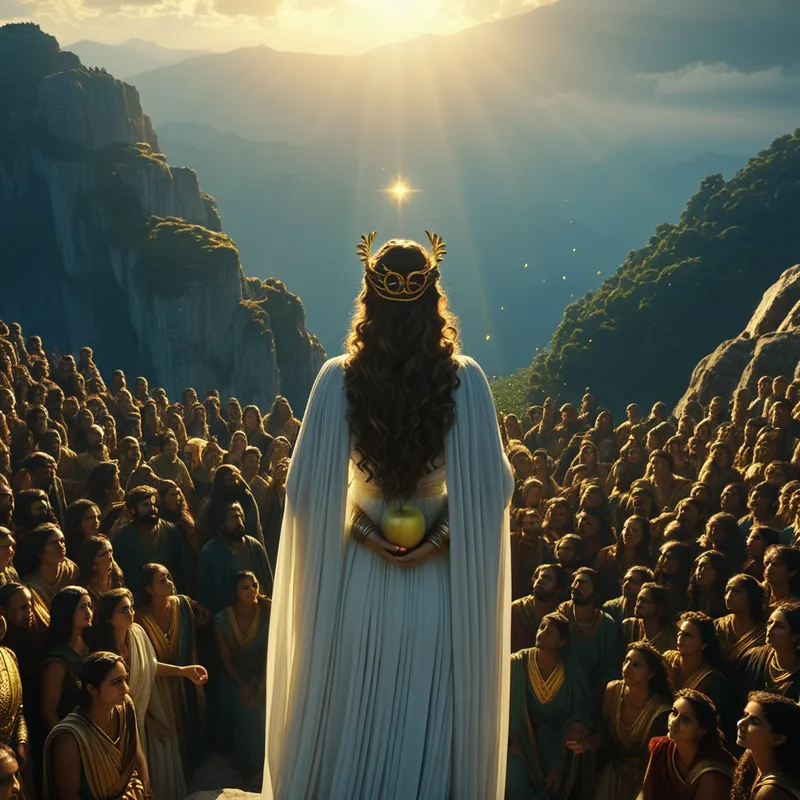
The Golden Apple of Discord Myth Meaning & Symbolism
A wedding invitation, a thrown apple, and a choice between goddesses that ignited a war. The myth of the seed of chaos in the heart of order.
The Tale of The Golden Apple of Discord
Hear now of the seed of fire sown in the garden of the gods. It began not with a war cry, but with a wedding song. All of glittering Olympus was summoned to celebrate the union of the mortal hero Peleus and the shimmering sea-nymph [Thetis](/myths/thetis “Myth from Greek culture.”/). The air was thick with ambrosia and laughter, the marble halls ringing with the music of the gods. Yet, in [the shadow](/myths/the-shadow “Myth from Jungian culture.”/) of that perfect joy, a single, deliberate omission festered.
One goddess was not invited: Eris, she whose footsteps sow quarrels. Wrath, cold and cunning, coiled in her heart. While the gods feasted, she fashioned her revenge—not a sword, but a fruit. From the shadows of the hall, she cast forth a single apple. It was not of any mortal orchard, but of pure, unearthly gold, and upon its flawless skin, a phrase was etched as if by a divine finger: Kallisti—“For the Fairest.”
It arced through the perfumed air, a silent, gleaming missile, and landed with a soft, fateful thud at the feet of the three mightiest goddesses. The music died. All eyes turned. There sat Hera, regal in her sovereignty, her gaze like polished marble. Beside her, Athena, clad in gleaming armor, her grey eyes sharp with intellect. And Aphrodite, from whom radiance flowed like a palpable scent, a smile playing on her lips. Each saw the inscription, and each, in the same heartbeat, knew it was meant for her alone.
A quarrel, divine and terrible, erupted. The harmony of Olympus shattered into a cacophony of claims and insults. No god dared judge, for to choose one was to earn the eternal wrath of two. The solution, as so often with divine problems, was passed to a mortal. The task fell to Paris, a shepherd-prince on the slopes of Mount Ida, famed for his fairness.
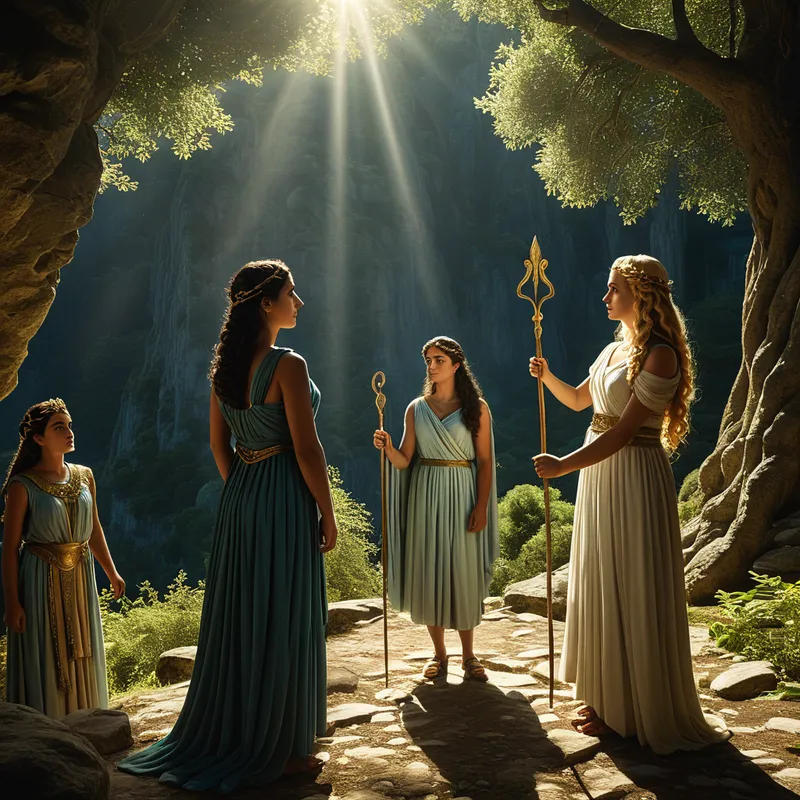
The three goddesses descended to his humble pasture, shedding their full divine glory so as not to blind him. Yet, their presence still bent the light and hushed [the wind](/myths/the-wind “Myth from Various culture.”/). They stood before the awestruck youth and laid bare their offers. Hera promised him kingship over all the lands of Asia, the scepter of absolute power. Athena offered wisdom and skill in war, making him the greatest strategist and hero, his name sung for eternity. Aphrodite, with a whisper that stirred the very earth, promised him the love of the most beautiful woman in [the world](/myths/the-world “Myth from Tarot culture.”/).
Paris stood, a simple shepherd’s crook in his hand, the weight of heaven’s favor and fury upon his shoulders. He looked at power, at glory, and at desire. His hand reached out. He gave the apple to Aphrodite. In that moment, the die was cast. The goddess of love secured her prize, and the goddesses of power and wisdom turned away, their wrath now a silent, gathering storm. The most beautiful woman, Helen, would be taken from her husband, and a thousand ships would launch to bring her back. The golden apple, a seed of discord, had blossomed into the decade-long bloodshed of [the Trojan War](/myths/the-trojan-war “Myth from Greek culture.”/).
Cultural Origins & Context
This myth, often called the “Judgment of Paris,” is a foundational prelude, the spark that ignites the epic cycle of the Trojan War. It was not a standalone bedtime story but a critical piece of cosmological and societal explanation. For the ancient Greeks, it answered the perennial, haunting question: Why do terrible wars happen? The answer lay not in simple mortal failings, but in a divine causality—a petty, vain quarrel among the immortals that trickled down into human suffering. It framed history as a tragic play where humans are both actors and pawns in the dramas of the gods.
The tale was passed down through the oral tradition of bards, most famously crystallized in the epic cycles that surrounded [Homer](/myths/homer “Myth from Greek culture.”/)’s Iliad. It served as essential prologue, explaining the “why” behind the greatest conflict of their legendary past. Societally, it functioned as a cautionary narrative about the perils of hubris (even for gods), the impossible burden of choice, and the catastrophic consequences that can flow from a single act of perceived slight or personal desire. It reminded listeners that order is fragile, and chaos (Eris) is never truly absent, only uninvited.
Symbolic Architecture
The myth is a perfect symbolic engine. The wedding of Peleus and Thetis represents the union of opposites, a [moment](/symbols/moment “Symbol: The symbol of a ‘moment’ embodies the significance of transient experiences that encapsulate emotional depth or pivotal transformations in life.”/) of potential wholeness and cosmic order. Eris, the uninvited [guest](/symbols/guest “Symbol: A guest in a dream can symbolize new experiences, unexpected situations, or aspects of oneself that are being revealed.”/), is the inevitable return of the repressed—the [shadow](/symbols/shadow “Symbol: The ‘shadow’ embodies the unconscious, repressed aspects of the self and often represents fears or hidden emotions.”/) [aspect](/symbols/aspect “Symbol: A distinct feature, quality, or perspective of something, often representing a partial view of a larger whole.”/) that must be acknowledged. She is the psychic [truth](/symbols/truth “Symbol: Truth represents authenticity, honesty, and the quest for knowledge beyond mere appearances.”/) that no state of perfect [harmony](/symbols/harmony “Symbol: A state of balance, agreement, and pleasing combination of elements, often associated with musical consonance and visual or social unity.”/) can last.
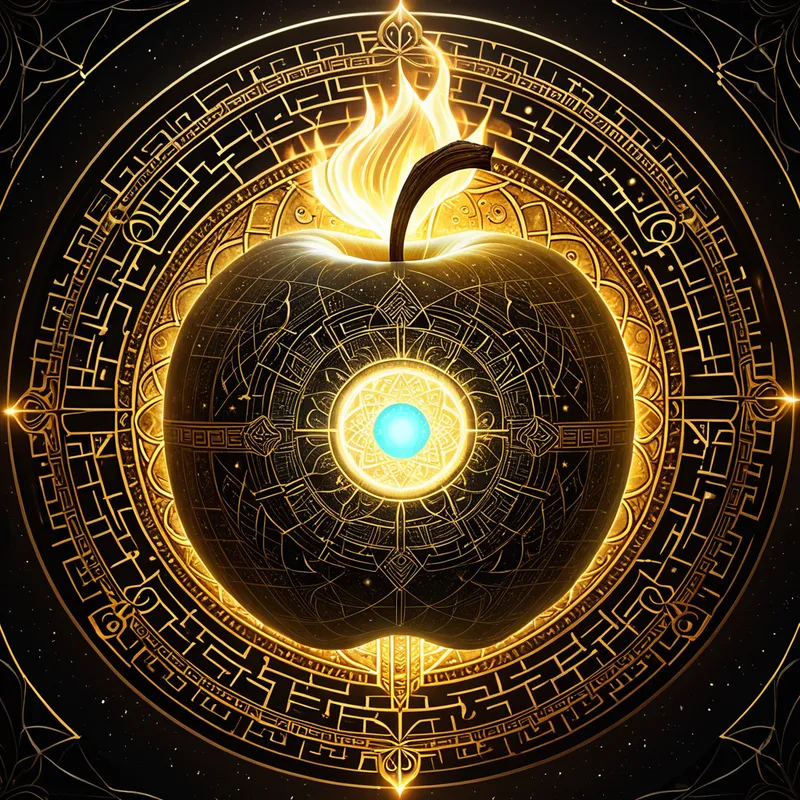
The Golden Apple is not merely an object of desire; it is the mirror of the soul. Whosoever looks upon it sees not its value, but their own deepest, most unacknowledged want reflected back.
The [apple](/symbols/apple “Symbol: An apple symbolizes knowledge, temptation, and the duality of good and evil, often representing the pursuit of wisdom with potential consequences.”/) itself is a profound [symbol](/symbols/symbol “Symbol: A symbol can represent an idea, concept, or belief, serving as a powerful tool for communication and understanding.”/). It is a [fruit](/symbols/fruit “Symbol: Fruit symbolizes abundance, nourishment, and the fruits of one’s labor in dreams.”/) of [knowledge](/symbols/knowledge “Symbol: Knowledge symbolizes learning, understanding, and wisdom, embodying the acquisition of information and enlightenment.”/), but not of good and evil—rather, of comparison and [differentiation](/symbols/differentiation “Symbol: The process of distinguishing or separating parts of the self, emotions, or identity from a whole, often marking a developmental or psychological milestone.”/). “For the Fairest” is a question that forces a split in unity. It compels a [choice](/symbols/choice “Symbol: The concept of choice often embodies decision-making, freedom, and the multitude of paths available in life.”/) that creates winners and losers, breaking the collective into competing parts. The three goddesses represent a fundamental trinity of [human](/symbols/human “Symbol: The symbol of a human represents individuality, complexity of emotions, and social relationships.”/) aspiration: Sovereignty (Hera, power and rule), Wisdom (Athena, [strategy](/symbols/strategy “Symbol: A plan of action designed to achieve a long-term or overall aim, often involving competition, resource management, and foresight.”/) and mastery), and Desire (Aphrodite, love and [beauty](/symbols/beauty “Symbol: This symbol embodies aesthetics, harmony, and the appreciation of life’s finer qualities.”/)). Paris’s [choice](/symbols/choice “Symbol: The concept of choice often embodies decision-making, freedom, and the multitude of paths available in life.”/) is not between three women, but between three paths of being, three ways of valuing existence itself. His selection of Aphrodite is often framed as a “shallow” choice, but symbolically, it is the choice of eros—the [life](/symbols/life “Symbol: The symbol of ‘Life’ represents a journey of growth, interconnectedness, and existential meaning, encompassing both the joys and challenges that define human experience.”/) force, [connection](/symbols/connection “Symbol: Connection symbolizes relationships, communication, and bonds among individuals.”/), and personal fulfillment—over impersonal power or abstract intellect. It is the [heart](/symbols/heart “Symbol: The heart symbolizes love, emotion, and the core of one’s existence, representing deep connections with others and self.”/) choosing its own [logic](/symbols/logic “Symbol: The principle of reasoning and rational thought, often representing order, structure, and intellectual clarity in dreams.”/), with no regard for the political or strategic consequences.
The Dreamer’s Resonance
When this myth pattern stirs in the modern unconscious, it often manifests in dreams of being forced to make an impossible choice. The dreamer might be a judge in a contest, handed a strange, glowing object, or find themselves in a room with three powerful, imposing figures (who may not look like goddesses) each demanding allegiance. The somatic feeling is one of acute anxiety, paralysis, and the dread of inevitable fallout.
Psychologically, this signals a critical point of differentiation in the [psyche](/myths/psyche “Myth from Greek culture.”/). The “three goddesses” represent competing inner values or life potentials that have reached a point of crisis. Perhaps the dreamer is torn between career ambition (Hera), intellectual pursuit (Athena), and a romantic relationship (Aphrodite). The dream is the psyche’s way of stating that these paths have become mutually exclusive in their current form; a choice that will define the soul’s direction must be made. The ensuing “war” in waking life might be the internal conflict, guilt, or external consequences of that choice. The dream asks: What part of your wholeness are you willing to sacrifice, and what wrath (from yourself or others) are you willing to risk, to follow your deepest value?

Alchemical Translation
The alchemical process modeled here is not of a hero conquering a monster, but of the [nigredo](/myths/nigredo “Myth from Alchemical culture.”/)—the initial blackening, the necessary descent into chaos that precedes any transformation. The conscious ego (represented by the assembled, harmonious gods) attempts to create a perfect, conflict-free state (the wedding). It excludes the shadow (Eris), the part of [the self](/myths/the-self “Myth from Jungian culture.”/) that is messy, contentious, and disruptive.
Individuation does not begin with a quest, but with a thrown apple. It starts when the content you tried to exclude from your psychic banquet returns, inscribed with a question you cannot ignore.
The apple’s inscription, “For the Fairest,” is the catalyst for the [separatio](/myths/separatio “Myth from Alchemical culture.”/), the alchemical separation. It forces the undifferentiated self (the trinity of potentials within) to split apart so its components can be seen clearly. Paris, in this internal drama, is not the foolish ego but the nascent consciousness that must engage with these powerful archetypal forces. His choice is the first, fateful act of self-definition. To choose one goddess is to consciously align with a primary value, but it also means integrating the wrath of the others—accepting that other potentials will be neglected, and that this will cause internal and external conflict (the Trojan War).
The alchemical gold is not found in the apple itself, nor in the love of Helen, but in the consciousness forged through the catastrophic consequences of the choice. The decade of war is the long, painful mortificatio and [putrefactio](/myths/putrefactio “Myth from Alchemical culture.”/)—the burning away of the old, naive wholeness. The individual who emerges from this psychic process is not the same shepherd boy. They are one who has looked into [the mirror](/myths/the-mirror “Myth from Various culture.”/) of the golden apple, made a soul-defining choice, and borne the terrible, transformative cost. They have learned that wholeness is not the absence of conflict, but the conscious relationship to the competing, divine forces within. The [Golden Apple of Discord](/myths/golden-apple-of-discord “Myth from Greek culture.”/), therefore, is the painful, glorious seed of self-knowledge.
Associated Symbols
Explore related symbols from the CaleaDream lexicon: