
The Golden Age Meadows Myth Meaning & Symbolism
A myth of a primordial paradise under Cronus, where humanity lived in effortless peace and harmony with the divine.
The Tale of The Golden Age Meadows
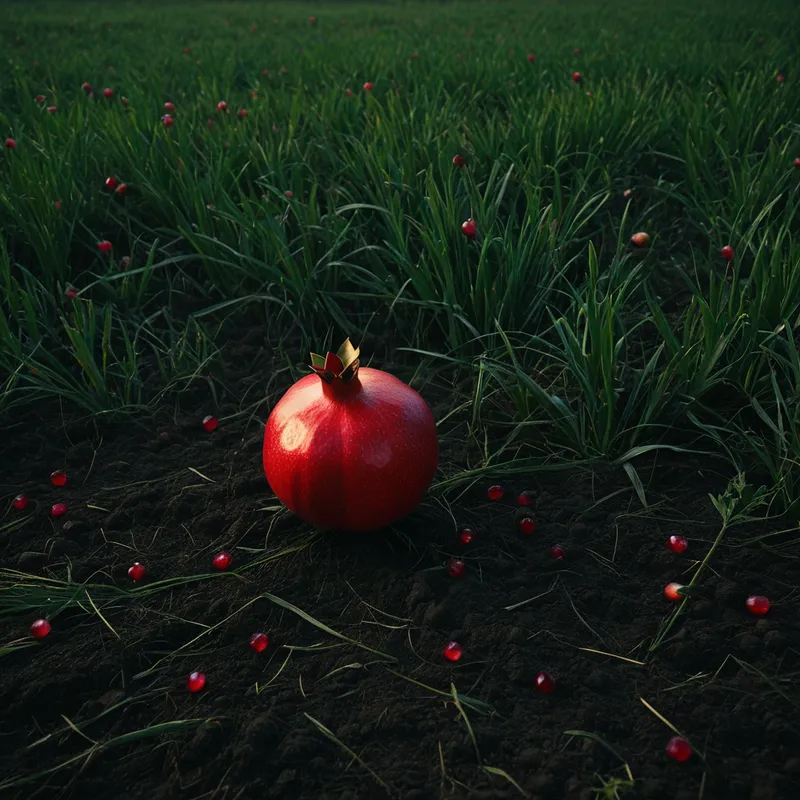
Listen. Before the groaning weight of years, before the ache in the bone and the doubt in the heart, there was a time. Not a time measured by the sun’s frantic chase or the moon’s pale tally, but a time that simply was. This was the Age of Gold, the reign of Cronus, and the world was his meadow.
Breathe the air of that first morning—it is forever morning there. It carries no chill, only the scent of ripe earth, of honey dripping unbidden from hollow oaks, of flowers that bloom without being planted. The sun, Helios, drives his chariot with a gentle hand, casting a light that nourishes but never burns. The great bowl of the sky, held aloft by Ouranos himself, is a flawless, tender blue.
Here, the race of humans sprung not from mud and toil, but from the very soul of the earth. Their bodies knew no stiffness, their hair no grey. They did not age; they simply lived, as the rivers live, as the oak lives. There were no cities, for why build walls against a world that is your mother and your home? They dwelt in gentle clearings, their homes the shade of broad trees, their beds of soft moss.
Conflict was a word without meaning. The earth, the great Gaia, provided in overflowing abundance. The soil gave up its fruits without the bite of the plough. Wheat and barley grew wild and full in the meadows. Rivers of milk and nectar wound through the grasses, and from the very rocks seeped streams of golden honey. Men and women feasted not out of hunger, but in joyful communion with the bounty. They had no need for ships, for every shore was their own. They had no need for laws, for their hearts were naturally inclined to justice and fellowship.
Their days were a graceful dance of leisure and gentle pleasure. When the gentle weariness of perfect contentment came upon them, death followed—but not as a grim specter. It came as a sleep deeper and more peaceful than any other, a seamless translation from one state of blessedness to another. Their spirits, slipping free, became benevolent daimones, cloaked in invisibility, walking the earth to guard and guide the generations to come.
This was the life under Cronus, the lord of this untroubled time. He ruled from afar, a presence felt in the perfect order of the seasons—or rather, the single, eternal season of spring. There was no rising action, for there was no fall. There was no conflict, for harmony was the law of existence.
But listen… the rhythm of that perfect world held within it the seed of its own ending. Time, even golden time, moves. In the high halls of the cosmos, the children of Cronus grew strong. A new order, louder, fiercer, hungrier, was stirring. The resolution of this age was not a battle within it, but a changing of the guard above it. When the son, Zeus</abbr, took the throne from the father, the Golden Age did not shatter like glass. It faded, like the last, lingering note of a song into silence. The meadows did not die; they receded, becoming not a place on any map, but a memory in the very stone and soil, a haunting echo of a truth that once was lived. The gates to that meadow closed, and humanity, born anew in the Silver Age, awoke to a world where bread must be earned by the sweat of the brow, and the heart must learn to bear the weight of its own longing.
Cultural Origins & Context
This vision of primordial bliss is not a singular story with one author, but a foundational stratum of Greek thought, articulated most famously by the poet Hesiod in his Works and Days. Hesiod, a Boeotian farmer, framed the myth within a grim view of his own Iron Age reality, using the Golden Age as the first in a sequence of declining metallic races (Silver, Bronze, Heroic, Iron). His telling served a profound societal function: it was both an explanation and a critique.
For the ancient Greeks, this myth was their “once upon a time,” a collective memory of a lost paradise that explained the human condition of labor, sickness, and moral strife. It was not merely nostalgia; it was a theological and philosophical benchmark. It established a cosmology where human fate is directly tied to divine governance—the rule of Cronus versus the rule of Zeus. The myth was passed down through epic poetry and later philosophical discourse, from Hesiod to Plato, who in his Statesman mythologized a similar age of automatic bounty under the direct piloting of the deity.
Its function was multifaceted. For the common person, it explained why life was hard. For the philosopher, it posed questions about the nature of justice, happiness, and the ideal state. It was a cultural touchstone for defining what was lost, and thus, what humanity must strive to remember or reconstruct through virtue, law, and piety in a far less perfect world.
Symbolic Architecture
The Golden Age Meadows represent the psyche’s deepest memory of undifferentiated wholeness. It is the pre-conscious state, the infant’s universe where need and fulfillment are identical, where the Self and the World are one.
The meadow is not a location, but a state of being—the original, unconscious unity of the psyche before the dawn of ego-consciousness.
Cronus here is not the later figure of the devouring tyrant, but the symbol of the containing principle. He is Time (Chronos) in its cyclical, seasonal, nurturing aspect. His rule represents a period where the conscious principle (later embodied by Zeus) is still latent, unborn. The effortless bounty symbolizes a life driven purely by instinct and natural law, without the friction of individual will or moral choice. Death as a gentle sleep signifies the absence of existential terror; the transformation into daimones represents the integration of this blissful state into the psychic substratum as guiding, protective complexes.
The end of the age, ushered in by Zeus, symbolizes the inevitable and necessary birth of consciousness. With consciousness comes separation, labor, morality, conflict, and death as a fearful mystery—but also comes the potential for achievement, culture, heroism, and individual identity. The lost meadow is the price of self-awareness.
The Dreamer’s Resonance
When this myth stirs in the modern dreamer, it rarely appears as a literal classical meadow. It manifests as a profound sense of nostalgia for a home you have never physically known. One might dream of a childhood home bathed in impossibly golden light, of a forgotten garden where everything is in perfect, silent bloom, or of a serene landscape that evokes a piercing sense of peace and belonging that vanishes upon waking.
This dream is a somatic and psychological experience of regression—not a pathological retreat, but a therapeutic return to the source. The body may feel weightless, unburdened by its usual aches. The emotion is one of profound, wordless contentment. Psychologically, this signals a psyche overwhelmed by the complexities and burdens of the conscious, “Iron Age” life: relentless striving, moral ambiguity, fractured relationships, and existential anxiety. The dream is the unconscious offering a restorative dip into the primal waters of the Self, a reminder of the foundational wholeness that exists beneath the fractures. It is the psyche’s way of healing burnout by reconnecting with the state of the “Innocent” archetype before the fall into experience.

Alchemical Translation
The alchemical journey of individuation is not a forward march to a new paradise, but a spiral that returns us, consciously, to the Golden Meadow. The first, unconscious unity must be lost (the separatio of the Ages) so that the conscious ego can be forged in the fires of experience (the labor of the Silver, Bronze, and Iron lives). The modern individual’s “core struggle” is the lifelong tension between the memory of that primal unity and the demands of a fragmented world.
The alchemical gold is not the recovery of childish innocence, but the hard-won achievement of a conscious wholeness that includes the memory of paradise while fully engaging with the world of time, choice, and sacrifice.
The process of psychic transmutation modeled here is one of sacred recollection. We cannot go back to the rule of Cronus, to an unconscious, automated bliss. The triumph of Zeus—consciousness—is irreversible. However, the alchemical work involves descending into the psychic substratum, retrieving the aurum philosophicum (philosophical gold) of that primordial state—its essence of peace, intrinsic worth, and connectedness—and bringing it up to illuminate the conscious mind.
This is the creation of an inner Golden Age. It is the state where, through introspection, shadow-work, and integration, we no longer seek the meadow as an external place to which we must return, but we cultivate its qualities within. We create moments of timelessness in meditation, experience effortless flow in creative acts, and find communion that feels divinely given in deep relationships. We transmute the longing for a lost paradise into the active creation of golden moments, building a soul-structure that can, at times, hold the very bliss that was once the automatic condition of the entire world. The myth teaches that our deepest longing is not a mistake, but a memory—and a map for the soul’s most profound homecoming.
Associated Symbols
Explore related symbols from the CaleaDream lexicon: