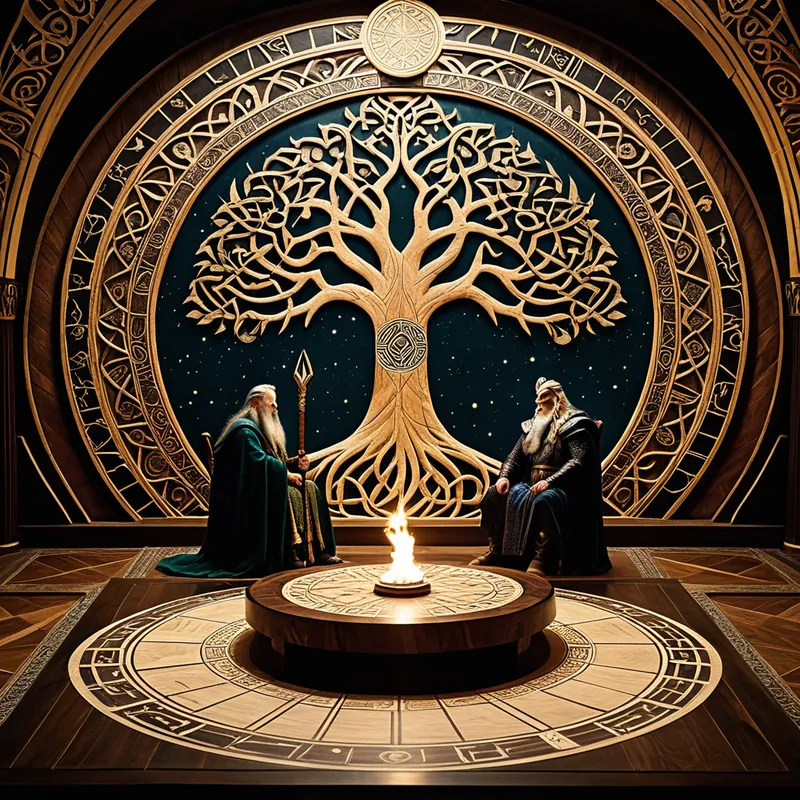
The Gods' Game of Tafl Myth Meaning & Symbolism
The gods play a game of Tafl, a contest of wits and fate that mirrors the cosmic order and the inevitable approach of Ragnarok.
The Tale of The Gods’ Game of Tafl
Listen now, and let the fire’s crackle fade. Let the wind outside the hall become the breath of giants. We are in Asgard, in a hall of high rafters and deep shadows. The air is thick with the scent of pine resin from the torches and the weight of things to come.
Here sits Odin, his one eye a well of dark water reflecting the flickering light. Across from him, a smile playing on lips that know too many secrets, is Loki. Between them rests the board. Not a simple thing of leisure, but the Tafl—a field of pale wood marked with squares, a kingdom in miniature. The pieces are carved from bone and dark horn: the king in his central fortress, his loyal thanes arrayed around him, and the encircling host of attackers, waiting at the board’s edges.
No words are spoken. The game is their speech. Odin’s move is deliberate, a thane shifted forward with a soft click that echoes like a footfall on frozen ground. It is a move of defense, of consolidation, of patience drawn from the waters of Mímisbrunnr. Loki counters with a swift, darting motion, a wolf-like piece sliding along a diagonal. It is aggression disguised as play, a probing of weaknesses. The fire pops, and for a moment, the shadows of the pieces stretch long across the board, becoming armies on a vast, twilight plain.
The game tightens. Loki’s forces weave a net, swift and cunning. Odin’s king, his hnefi, is pressed, his defenders falling one by one to sly, unexpected angles of attack. You can feel the tension, not of anger, but of a terrible, shared understanding. This is not just a game. It is a working-out of fates, a rehearsal in miniature. Each captured piece is a fallen hero from Midgard; each blocked path is a destiny diverted. Loki’s smile doesn’t fade, but it grows sharp, edged with the gleam of the inevitable trap about to spring.
Odin pauses. His single eye closes. He sees not the board, but the threads of ørlög—the web woven by the Norns at the root of the Yggdrasil. He sees the final configuration, the inescapable end. With a breath that is almost a sigh, he moves his king. Not to safety, but into a position of greater peril. It is a sacrifice. A deliberate offering of the central piece to the encircling doom.
Loki’s hand hovers, then strikes. The move is final. The king is surrounded, his escape to the board’s edge forever barred. The click of the capturing piece is the sound of a door closing in a distant, future hall. Loki leans back, his laugh a dry rustle of leaves. Odin does not smile. He only stares at the board, at the pattern of victory and defeat now frozen in wood and bone. The game is over. The pieces rest where they fell, a silent prophecy in the firelight. Outside, a wolf howls, and the roots of the World Tree tremble.
Cultural Origins & Context
The myth of the Gods’ Game of Tafl is not preserved in a single, canonical text like the tales in the Prose Edda. It is a haunting fragment, a ghost in the corpus of Norse lore, referenced in skaldic poetry and suggested by the profound cultural weight of the game itself. Hnefatafl (literally “king’s table”) was the premier strategy game of the Norse and wider Germanic world before the arrival of chess. It was a game of asymmetric conflict: a king and his defenders, positioned in the center, besieged by a larger force of attackers on all sides.
This myth likely lived in the space between the game’s rules and the worldview of those who played it. It was told in longhouses, where the click of pieces on a board was a familiar sound against the backdrop of saga-recitation. The storyteller, perhaps a grizzled veteran or a thoughtful skald, would use the game as a metaphor. To play Tafl was to engage in a microcosm of cosmic struggle. The gods themselves, the skalds implied, were not above this pastime; indeed, for them, it was no pastime at all. It was a ritual, a meditation on the structure of reality. The myth served to elevate a common cultural practice into a divine mirror, teaching that strategy, sacrifice, and the acceptance of a destined outcome were not just tactics for a board game, but principles woven into the fabric of existence, principles even the Allfather must confront.
Symbolic Architecture
At its heart, the myth presents the Tafl board as a model of the cosmos and the game as the process of fate itself. The pieces are not mere tokens; they are the animated forces of destiny.
The board is the ordered world, Midgard, and the game is the relentless interplay of creation and destruction that sustains and will ultimately unravel it.
Odin, the seeker of wisdom, represents consciousness, strategy, and the burden of foresight. He plays with the knowledge of the end, making him not a true opponent to Loki, but a participant in a necessary drama. Loki, the shape-shifter, embodies chaos, entropy, and the cunning of the unconscious. His role is to press, to test, to find the flaw in the structure. He is the necessary antagonist who makes the game—and by extension, the cosmos—dynamic and perilously alive.
The king piece, the hnefi, is the ultimate symbol. It is the sacred center, the self, the kingdom of the psyche, or the principle of order. Its goal is not to destroy the attackers but to escape to the edge of the board—a symbol of transcendence or preservation. Odin’s final, sacrificial move is the most profound element. It signifies that true wisdom, and perhaps the only “victory” within a fated system, lies in the conscious acceptance of sacrifice. The king must be risked, the central self must be offered up, to fulfill the pattern and allow the game to reach its destined conclusion. This is not defeat, but a sacred surrender to a higher logic.
The Dreamer’s Resonance
When this myth stirs in the modern unconscious, it may manifest in dreams of intricate games, of being trapped in a maze or a grid, or of facing an inescapable confrontation with a clever, mocking adversary. The dreamer might feel the somatic tension of being the “king”—cornered, pressured, with dwindling resources. Alternatively, they might dream from the perspective of the encircling forces, feeling a driven, relentless need to corner or solve a central problem.
Psychologically, this dream pattern signals a process of integration where the conscious ego (the king) is being challenged by disruptive, often shadowy aspects of the self (Loki’s forces). The dreamer is in a life situation requiring high-stakes strategy, where every move has consequence, and a known, difficult outcome is approaching—a career change, the end of a relationship, a moral dilemma. The dream is the psyche’s way of playing out the scenario, of rehearsing the inevitable confrontation and, crucially, exploring the possibility of a conscious, sacrificial choice within it. The anxiety is not about the conflict itself, but about finding the dignity and wisdom within the predetermined bounds of the conflict.
Alchemical Translation
The alchemical journey modeled here is not one of vanquishing an enemy, but of achieving clarity through engagement with an opposing principle. The individuation process requires us to sit at our own inner Tafl board.
First, we must recognize the board and the players. This is the stage of psychological differentiation: identifying the central, ruling principle of our current consciousness (the king) and the myriad opposing, chaotic, or neglected forces that surround it (Loki’s host). These are not “bad”; they are necessary for the game to exist.
Second, we play the game with foresight. This is the hard work of analysis, therapy, and introspection—making conscious moves, anticipating consequences, and seeing the broader pattern of our life’s narrative. Like Odin, we must use our hard-won wisdom to navigate.
The final, alchemical stage is the sacrifice of the central king. This is the ego’s surrender to a greater Self.
In our lives, this translates as the voluntary relinquishment of a rigid ego-position, a cherished identity, or a defensive strategy that, while once central to our being, now prevents our “escape to the edge”—our growth into a new, more holistic state of being. It is the conscious choice to let an old self “be captured” so that a new pattern can emerge from the completed game. The triumph in the myth of Tafl is not in winning by the attacker’s rules, but in playing the game to its fated, beautiful, and terrible conclusion with full awareness. It teaches that our ultimate sovereignty is found not in avoiding fate, but in choosing how we meet it, piece by deliberate piece.
Associated Symbols
Explore related symbols from the CaleaDream lexicon: