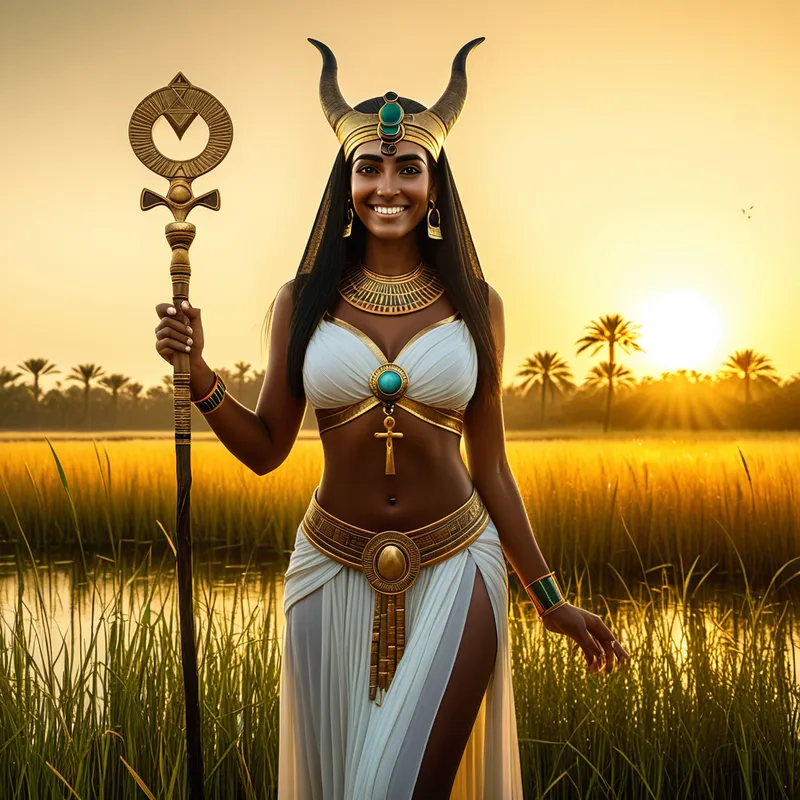
The Goddess Hathor Myth Meaning & Symbolism
The story of the Eye of Ra, the goddess Hathor, who transforms from a loving mother into a vengeful lioness, and is ultimately soothed back to her gentle form.
The Tale of The Goddess Hathor
In the First Time, when [the world](/myths/the-world “Myth from Tarot culture.”/) was young and the sun god Ra ruled from his golden barque, a murmuring arose. It began not as a shout, but as a whisper in the dust, a discontent slithering through the reeds of the [Nile delta](/myths/nile-delta “Myth from Egyptian culture.”/). Humanity, the children of Ra, had grown proud. They plotted in shadows, their hearts turning against the one who gave them light and life. They spoke of rebellion, of pulling the aged god from his celestial throne.
Ra heard. From his high seat, his single eye saw all. A cold fury, older than the primordial waters of Nun, settled in his heart. This was not a anger of fire, but of ice—a divine, calculated wrath. He summoned his daughter, the one whose laughter made the heavens ring, whose breasts nourished kings and commoners alike: [Hathor](/myths/hathor “Myth from Egyptian culture.”/), the Golden One.
“Daughter,” Ra spoke, his voice like stones grinding beneath [the earth](/myths/the-earth “Myth from Hindu culture.”/). “My children have forgotten their father. They seek my end. Go. Let them know the weight of my gaze.”
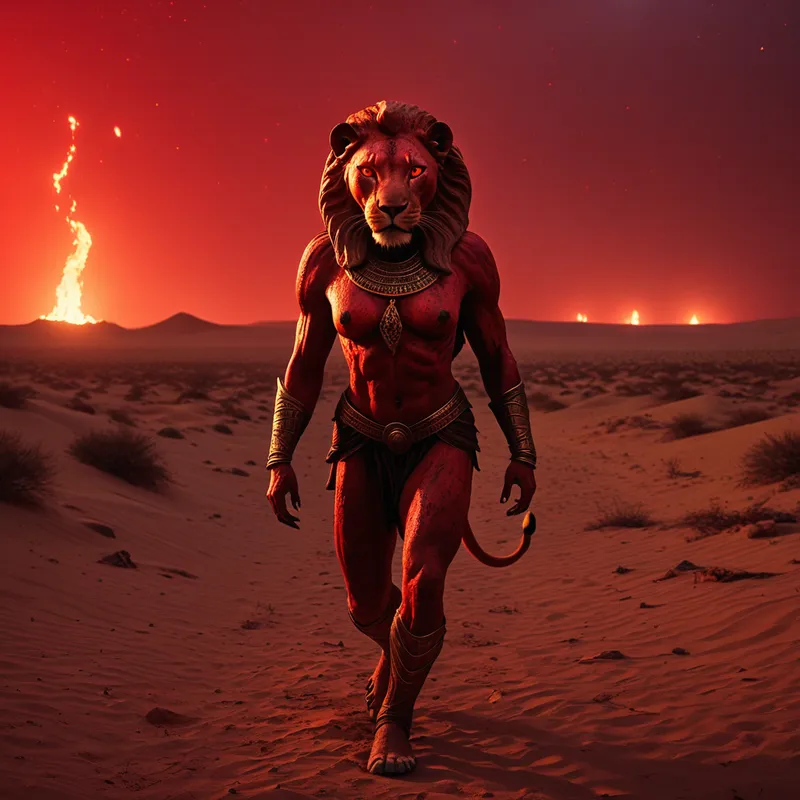
And as he spoke, he plucked his own eye from his brow—the Udjat Eye, the all-seeing one. He placed it in her hands. It was not a gentle orb of light, but a seething, molten [thing](/myths/thing “Myth from Norse culture.”/). The moment it touched Hathor’s skin, a shudder passed through the cosmos. The loving mother, the lady of drunken joy and sweet song, was unmade. Her gentle form stretched and twisted. Soft skin became tawny fur. Her benevolent smile ripped into a muzzle lined with teeth like shards of flint. Her eyes, once pools of honeyed wine, now burned with the ferocious, unthinking fire of [the desert](/myths/the-desert “Myth from Biblical culture.”/) sun at noon. Hathor was gone. In her place stood [Sekhmet](/myths/sekhmet “Myth from Egyptian culture.”/), the Powerful One.
She descended to the red lands of the desert, and her roar split [the sky](/myths/the-sky “Myth from Persian culture.”/). She did not walk; she flowed like a sandstorm, a wave of incarnate vengeance. Where the rebels gathered, she fell upon them. There was no battle, only slaughter. Her claws rent flesh from bone. The earth, thirsty and barren, drank deep of a new, terrible Nile—a river of human blood. The whispering of rebellion turned to screams, then to whimpers, and then to a silence more terrifying than any sound. Sekhmet reveled in it. The heat of the kill, the copper-tang in the air, became her new intoxication. She hunted not to fulfill her father’s command, but for the savage joy of it. She would cleanse the entire earth.
High above, Ra watched. His anger had cooled, replaced by a dawning horror. This was not [justice](/myths/justice “Myth from Tarot culture.”/); this was the end of his creation. The balance was shattered. He must stop his own daughter, the monster he had unleashed.
But how does one cage a hurricane? How does one reason with pure, divine fury? Ra called upon his swiftest messengers. “Go to Elephantine,” he commanded. “Fetch the red ochre of that sacred earth, and bring it to the priests of Hikuptah.”
Under the night sky, as Sekhmet prowled the edges of the world, the priests worked with desperate haste. They ground the red earth. They took barley and brewed not beer, but seven thousand jars of a potent, sleep-inducing draught, staining it the deep, bloody red of the ochre. They poured this ocean of ruddy liquid across the fields where Sekhmet would pass at dawn.
The lioness goddess, her jaws still wet, came with the first light. She saw the fields awash in red. She smelled not blood, but something sweet and heavy. Believing it to be the last of her father’s enemies, she let out a roar of [triumph](/myths/triumph “Myth from Roman culture.”/) and fell upon it. She drank and drank, lapping up the red beer until the fields were dry. The divine fire in her veins was quenched, not by [water](/myths/water “Myth from Chinese culture.”/), but by a deep, sudden languor. The killing rage seeped from her limbs. Her fierce head drooped. The lioness’s snarl softened, the sharp teeth receded. The tawny fur melted away into warm, golden skin. There, in the morning light, curled peacefully among the empty jars, was Hathor once more, the Lady of Drunkenness, the mistress of love, asleep and harmless.
Ra lifted her gently and brought her home. Balance was restored, but it was a balance forever changed. For now, everyone knew that within the benevolent Cow of Heaven, within the mother who nurses the [pharaoh](/myths/pharaoh “Myth from Egyptian culture.”/), slept the Awful One, the Lady of Slaughter. And within the Destroyer, dreaming, was the Healer.
Cultural Origins & Context
This myth, often called “The Destruction of Mankind,” is preserved in the tombs of New Kingdom pharaohs like Seti I and Ramesses III, inscribed on the walls of their royal burial chambers in the Valley of the Kings. It was not a folktale for the masses, but a core state myth, recited by priests to affirm the cosmic and political order. The story functioned as a theodicy—an explanation for divine violence—and a potent symbol of royal ideology. [The pharaoh](/myths/the-pharaoh “Myth from Egyptian culture.”/) was the living heir of Ra, tasked with maintaining Maat. He alone wielded the terrifying power of Sekhmet in battle against Egypt’s enemies, yet he was also the beneficiary of Hathor’s life-giving milk, which legitimized his rule. The myth explained the necessity of controlled, righteous violence to preserve creation from chaos, while also warning of its inherently addictive and all-consuming nature. The ritual re-enactment of Hathor’s pacification, likely involving music, dance, and ceremonial intoxication during her festivals, served as a societal pressure valve, a way to acknowledge and safely integrate the destructive forces necessary for the state’s survival.
Symbolic Architecture
At its [heart](/symbols/heart “Symbol: The heart symbolizes love, emotion, and the core of one’s existence, representing deep connections with others and self.”/), this is not a myth about external rebellion, but about the internal rebellion of a [system](/symbols/system “Symbol: A system represents structure, organization, and interrelated components functioning together, often reflecting personal or social order.”/) against its own [source](/symbols/source “Symbol: The origin point of something, often representing beginnings, nourishment, or the fundamental cause behind phenomena.”/). Humanity’s [plot](/symbols/plot “Symbol: A plot symbolizes the unfolding of a story, representing personal narratives and life direction.”/) against Ra symbolizes [the ego](/myths/the-ego “Myth from Jungian culture.”/)’s inevitable revolt against the ruling [consciousness](/symbols/consciousness “Symbol: Consciousness represents the state of awareness and perception, encompassing thoughts, feelings, and experiences.”/), the Self. Ra’s [response](/symbols/response “Symbol: Response in dreams symbolizes how one reacts to situations, often reflecting the subconscious mind’s processing of events.”/) is not to engage directly, but to deploy a deeper, autonomous [aspect](/symbols/aspect “Symbol: A distinct feature, quality, or perspective of something, often representing a partial view of a larger whole.”/) of his own being: the feminine principle of connectedness and nurture, which, when weaponized by the ruling ego, becomes pure, unmediated instinctual [fury](/symbols/fury “Symbol: An intense, overwhelming rage that consumes the dreamer, often representing suppressed anger or a primal emotional eruption.”/).
The greatest danger to the soul is not the enemy without, but the protector within who forgets its purpose and begins to love the ruin it makes.
Hathor-as-Sekhmet represents the [Shadow](/symbols/shadow “Symbol: The ‘shadow’ embodies the unconscious, repressed aspects of the self and often represents fears or hidden emotions.”/) of the [life](/symbols/life “Symbol: The symbol of ‘Life’ represents a journey of growth, interconnectedness, and existential meaning, encompassing both the joys and challenges that define human experience.”/)-giving [mother](/symbols/mother “Symbol: The symbol of ‘Mother’ represents nurturing, protection, and the foundational aspect of one’s emotional being, often associated with comfort and unconditional love.”/) [archetype](/symbols/archetype “Symbol: A universal, primordial pattern or prototype in the collective unconscious that shapes human experience, behavior, and creative expression.”/). She is the [mother](/symbols/mother “Symbol: The symbol of ‘Mother’ represents nurturing, protection, and the foundational aspect of one’s emotional being, often associated with comfort and unconditional love.”/) who devours, the love that becomes possessive rage, the creative joy that turns destructive when its source is threatened. The red [beer](/symbols/beer “Symbol: Beer often symbolizes social connection, celebration, and relaxation, reflecting both enjoyment and excess.”/) is the masterstroke of the myth’s [symbolism](/symbols/symbolism “Symbol: The use of symbols to represent ideas or qualities, often conveying deeper meanings beyond literal interpretation. In dreams, it’s the language of the unconscious.”/). It does not defeat Sekhmet through force, but through deception and substitution. It meets her in her own symbolic [language](/symbols/language “Symbol: Language symbolizes communication, understanding, and the complexities of expressing thoughts and emotions.”/)—the color of [blood](/symbols/blood “Symbol: Blood often symbolizes life force, vitality, and deep emotional connections, but it can also evoke themes of sacrifice, trauma, and mortality.”/)—and transforms its meaning. It is an alchemical trick: the blood of [life](/symbols/life “Symbol: The symbol of ‘Life’ represents a journey of growth, interconnectedness, and existential meaning, encompassing both the joys and challenges that define human experience.”/) (the rebels) is replaced by the “blood” of the [earth](/symbols/earth “Symbol: The symbol of Earth often represents grounding, stability, and the physical realm, embodying a connection to nature and the innate support it provides.”/) (red ochre [beer](/symbols/beer “Symbol: Beer often symbolizes social connection, celebration, and relaxation, reflecting both enjoyment and excess.”/)), which induces sleep, not [death](/symbols/death “Symbol: Symbolizes transformation, endings, and new beginnings; often associated with fear of the unknown.”/). This is the [psyche](/myths/psyche “Myth from Greek culture.”/)’s innate healing intelligence offering a symbolic container for unmanageable affect, transmuting blind aggression into fertile unconsciousness.
The Dreamer’s Resonance
When this myth stirs in the modern dreamer, it often manifests as dreams of terrifying, unstoppable feminine figures—a pursuing lioness, a raging mother, or a wave of crimson violence. The dreamer may feel both terror and a strange identification with this force. Somaticly, this can correlate with experiences of explosive, “out-of-character” anger that feels foreign and all-consuming, or conversely, with a feeling of being hunted by one’s own repressed fury.
Psychologically, this dream pattern signals a critical rupture in the [persona](/myths/persona “Myth from Greek culture.”/). The adapted, “civilized” self (the orderly reign of Ra) has been challenged, often by a deep betrayal of personal values or a profound injustice. In response, a primal, archetypal defense mechanism (Sekhmet) has been autonomously activated. The dreamer is not experiencing simple anger, but a righteous, annihilating wrath that threatens to burn down their entire internal world—their relationships, their stability, their self-image. The process underway is the terrifying, yet necessary, descent of a life-affirming complex (love, care, nurture) into its shadow aspect, because the conscious attitude has become too one-sided and vulnerable.

Alchemical Translation
The individuation process modeled here is the integration of [the Devouring Mother](/myths/the-devouring-mother “Myth from Various culture.”/) complex, a crucial step in moving from a childlike relationship to the inner feminine (as solely nourishing) to a mature, whole one. The myth provides a precise map.
First, Acknowledgment of [the Shadow](/myths/the-shadow “Myth from Jungian culture.”/) Nurturer: The conscious ego (Ra) must recognize that its own one-sided, perhaps rigid, rule has provoked a rebellion. It must own its part in creating the monster by delegating its “dirty work” to an unconscious function (sending Hathor to punish).
Second, Containment, Not Conquest: The ego’s task is not to battle the fury directly—this would only amplify it. Its task is to create a symbolic container. In the psyche, this is the work of active imagination, art, or deep therapy: to find the “red ochre,” the earthy, primal material that can mirror the rage back to itself in a new form. This is writing the furious letter you never send, painting with violent red strokes, or pounding clay.
The alchemy of healing lies not in stopping the storm, but in learning to brew a potion that changes the storm’s very nature from within.
Finally, Transmutation through Symbolic Substitution: The red beer represents the act of giving the destructive complex a new object. The rage is not denied; it is allowed to “drink” its fill of a symbolic representation until it exhausts itself and reveals its core. The fury, satiated on symbol, collapses into its opposite: a healed, sleeping potential. Sekhmet becomes Hathor again, but a Hathor who now carries the memory of Sekhmet within her. This is integration. The individual no longer fears their capacity for righteous destruction because they know its source and its limits. They become whole, capable of fierce protection and deep compassion, understanding that true love holds the potential for fury, and true power knows when to sleep.
Associated Symbols
Explore related symbols from the CaleaDream lexicon: