The Ginnungagap Myth Meaning & Symbolism
Before worlds existed, there was only Ginnungagap—a yawning void between fire and ice where the cosmos was dreamed into being from nothingness.
The Tale of The Ginnungagap
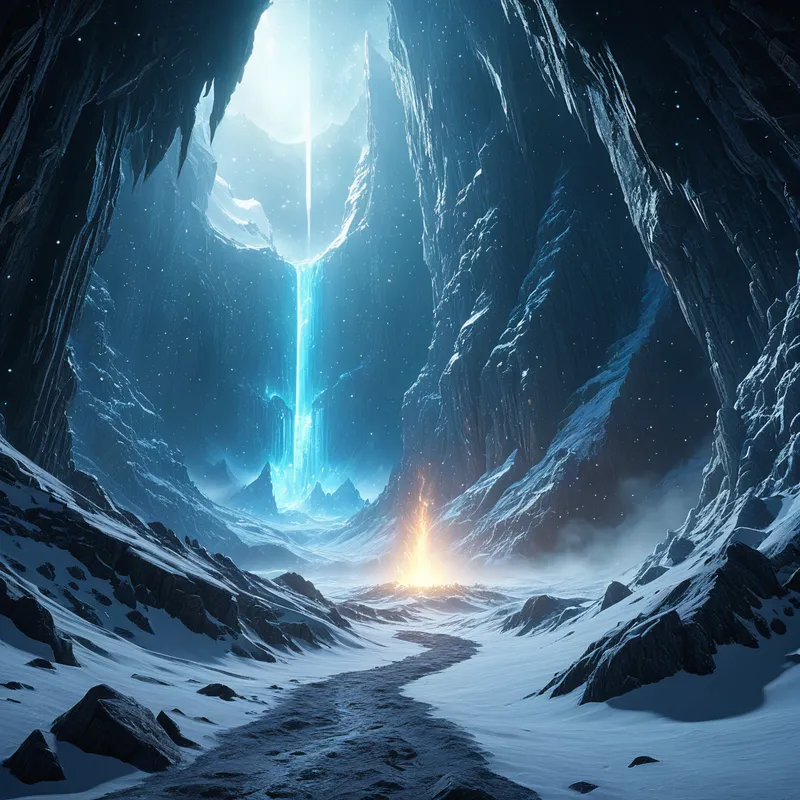
Listen. Before the eagle’s cry, before the serpent’s coil, before the whisper of a single leaf on the great tree, there was… nothing. But not a nothing of emptiness. A nothing of profound, pregnant, yawning potential. They called it Ginnungagap.
It was a gap so vast it had no measure, a chasm between realms that were not yet realms. To the north of it lay Niflheim, a wellspring of freezing rivers named Élivágar. Their waters were not water as we know it, but the essence of primal cold, a rime that was the very concept of stillness. To the south blazed Muspelheim, a realm of sparks, flame, and unformed light, where heat danced without form.
And between them—the Gap. It was not a place, but a condition. A waiting. A breath held for eternity.
Then, the slow magic began. From Niflheim, the icy rivers spilled their essence into the void. The rime crept into Ginnungagap, meeting the nothingness and freezing into vast, glittering sheets of hoar frost. A silence of crystal spread. And from Muspelheim came the answer: not a roaring flame, but gentle, persistent sparks, like golden motes on a cosmic wind. They floated into the Gap, meeting the encroaching frost.
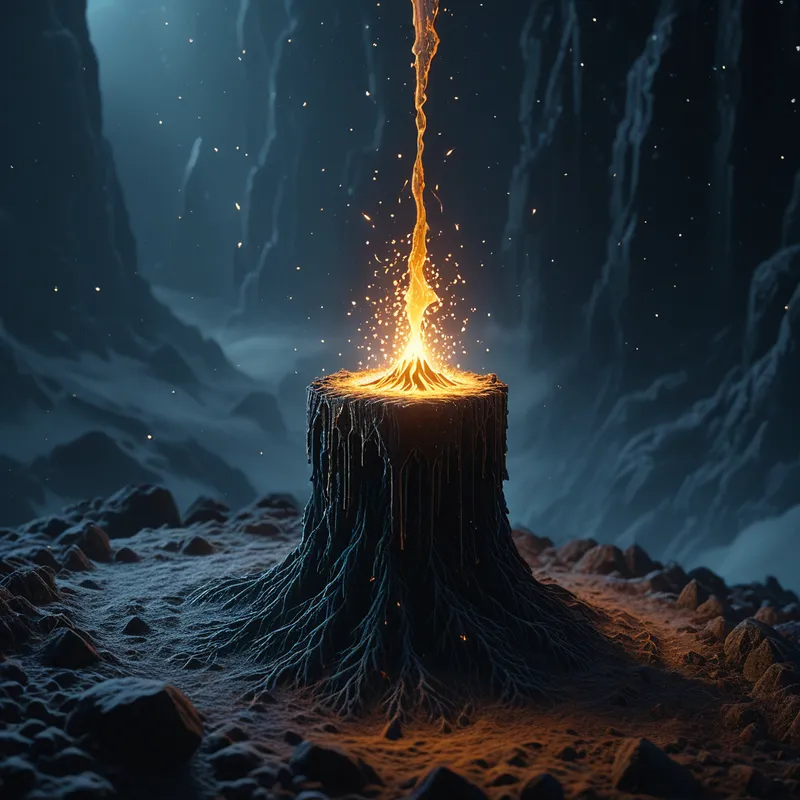
Where the fiery ember met the frozen breath, a thaw was born. Not a violent melting, but a weeping, a dripping. And in that drip—a reaction of cosmic alchemy—life stirred. From the melted rime of the void, the first substance coalesced. It was not yet a shape, but a potential for shape, a proto-matter humming with the latent power of both ice and fire.
And from this substance, warmed by the southern sparks, the first being emerged. He was Ymir, the Aurgelmir, the roaring clay. A giant of frost, yet coursing with the warmth of creation. He slept. And as he slept, more life sweated from his limbs. From his left armpit, a male and female giant dripped forth. One of his legs begat a son with the other. The void was no longer void. It was a womb.
And from the same dripping rime that formed Ymir came another: Auðumbla, the nourisher. She licked the salty ice blocks, and with each lick of her great tongue, more form was revealed. On the first day, hair appeared in the ice. On the second, a head. On the third, an entire man emerged, freed from the frost. This was Búri, beautiful and powerful.
From Búri came Borr, and from Borr and the giantess Bestla came three sons: Óðinn and his brothers Vili and Vé. They looked upon the teeming, chaotic life of Ymir and his offspring in the heart of the once-empty Gap, and they saw a world waiting to be made. The void had dreamed a giant. Now, the gods would shape a cosmos from his body. The story of the Nine Worlds begins here, in the first act of distinction, born from the unity of the Gap. But that is a tale for another telling. Remember the beginning: the breath, the wait, the meeting of opposites in the sacred, yawning nothing.
Cultural Origins & Context
This myth of cosmic origin is preserved primarily in two 13th-century Icelandic texts: the Prose Edda of Snorri Sturluson and the earlier, poetic fragments of the Poetic Edda. Snorri, a Christian scholar, was systematizing a pagan cosmology that was, by his time, fading from living belief. His account is our most detailed, but it is a retelling, filtered through a medieval lens.
The myth was not a single, dogmatic scripture, but a living narrative passed down through skalds (poets) and storytellers in the halls of the Viking Age. Its function was profound: it answered the fundamental human question of origins without a creator god ex nihilo. Instead, it presented a universe born from impersonal, dynamic forces—fire and ice—interacting within a receptive void. This reflected a worldview that saw the cosmos as a place of constant struggle, transformation, and emergent order from chaos. The myth established the ontological “ground zero,” providing the sacred backdrop against which all other myths, of gods, giants, and heroes, would play out. It rooted the Norse people in a universe that was fundamentally alchemical, born from a process, not a command.
Symbolic Architecture
Ginnungagap is the ultimate symbol of the potential state, the fertile void that precedes all form. It is not mere absence; it is the pregnant darkness of the unmanifest, the cosmic womb. Its symbolic power lies in its structure as a liminal space defined by the tension of opposites.
The void is not an emptiness to be feared, but the necessary silence before the first note of the symphony. It is the blank page, the held breath, the unformed thought in the mind of the universe.
The opposing realms of Muspelheim (fire, energy, dynamism) and Niflheim (ice, structure, potential form) represent the fundamental dualities of existence: active and passive, masculine and feminine (in the classical, symbolic sense), conscious and unconscious, spirit and matter. Ginnungagap is the vessel that holds this tension, allowing the third thing—the living cosmos, symbolized by Ymir—to emerge. Psychologically, this maps onto the emergence of ego consciousness from the undifferentiated unconscious. The ego (the first distinct form, Ymir) is born from the interaction between innate psychic energy (fire) and the latent, structured contents of the unconscious (ice), within the containing space of the psyche itself (the Gap).
The Dreamer’s Resonance
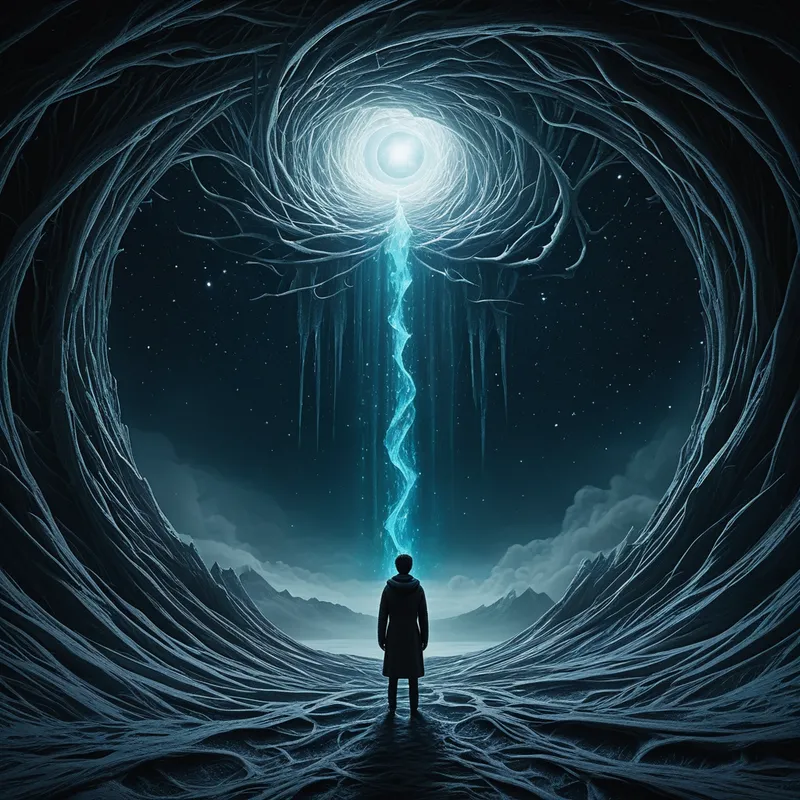
When the archetype of Ginnungagap stirs in the modern psyche, it often manifests in dreams of vast, empty, or liminal spaces: standing at the edge of a bottomless canyon, floating in starless space, or being in an empty, echoing hall of immense size. These are not nightmares of abandonment, but dreams of potential. They signal a somatic and psychological process of deconstruction and pre-creation.
The dreamer may be in a life transition—after a great loss, before a new beginning, or in the midst of an identity crisis where old structures have dissolved. The body may feel weightless, ungrounded, or filled with a strange, anticipatory stillness. This is the psyche’s regression to its own “cosmogonic moment.” It is clearing the stage, returning to the primal void where the constituent elements of fire (passion, drive) and ice (memory, frozen trauma, old patterns) can meet anew. The anxiety felt is not of the void itself, but of the latent, unformed possibilities within it. The dream is an invitation to tolerate this fertile nothingness, to wait for the drip of new life to form, rather than rushing to fill the space with old, familiar shapes.
Alchemical Translation
The myth of Ginnungagap models the initial, and most critical, phase of psychic transmutation or individuation: the nigredo, the blackening, the descent into the chaotic prima materia. For the modern individual, this is the courageous act of allowing one’s perceived identity to dissolve back into the unconscious matrix from which it came.
Individuation does not begin with building a better self, but with the willing dissolution of the current one into the generative void. The first creation is always a sacrifice of the known.
The alchemical work is to become the Gap itself—to cultivate an inner vessel capable of holding the fierce, contradictory forces of one’s own nature (the fire of ambition and the ice of fear, the heat of anger and the cold of grief) without prematurely forcing a resolution. It is the practice of active waiting. From this contained tension, the “Ymir” of a new psychic structure—a more authentic, complex, and resilient sense of self—can spontaneously coalesce. The gods (Óðinn, Vili, Vé) who later slay Ymir to fashion the world represent the next phase: the conscious, discerning mind taking the raw, instinctual material born from the void and shaping it into a livable inner cosmos. But without first honoring the sacred, yawning gap within, there is only rearrangement of old furniture, not the birth of a new world.
Associated Symbols
Explore related symbols from the CaleaDream lexicon: