The Ginkgo of Tsurugaoka Hachimangu Myth Meaning & Symbolism
A sacred ginkgo tree witnesses a shogun's betrayal, is felled in an act of violence, and returns from its roots as a symbol of unkillable life.
The Tale of The Ginkgo of Tsurugaoka Hachimangu
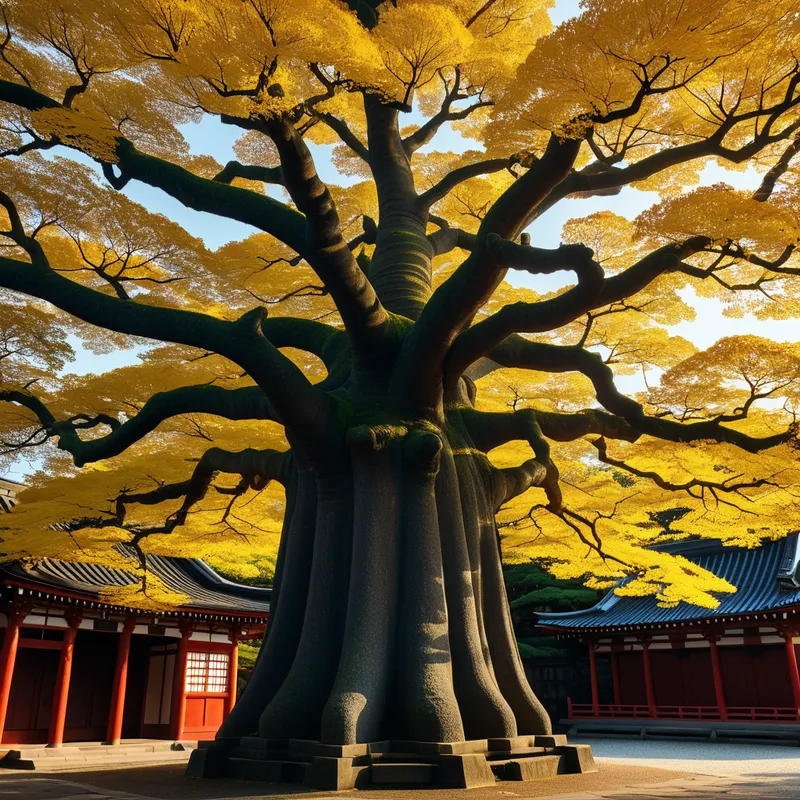
Listen, and let the wind through the leaves carry you back. To the age of the samurai, when the fate of the shogun was written in steel and blood. In the sacred precincts of Tsurugaoka Hachimangu, a guardian stood that was neither stone nor soldier. It was the Great Ginkgo, Icho-no-Ogushi. For eight hundred years, its roots drank deep from the earth of Kamakura, its branches a vaulted ceiling of fan-shaped leaves that turned the sun to molten gold each autumn. It was a pillar between worlds, a silent witness to the prayers of emperors and the whispers of plotting men.
The tree watched over the third shogun, Minamoto no Sanetomo. A man torn, a ruler who penned wistful verses to the moon, yearning for the refined court of Kyoto while bound by duty to the warrior government his dynasty had forged. His reign was a delicate vase, beautiful but perched on a ledge shaken by the ambitions of the shikken. The air in Kamakura grew thick with the scent of coming rain and conspiracy.
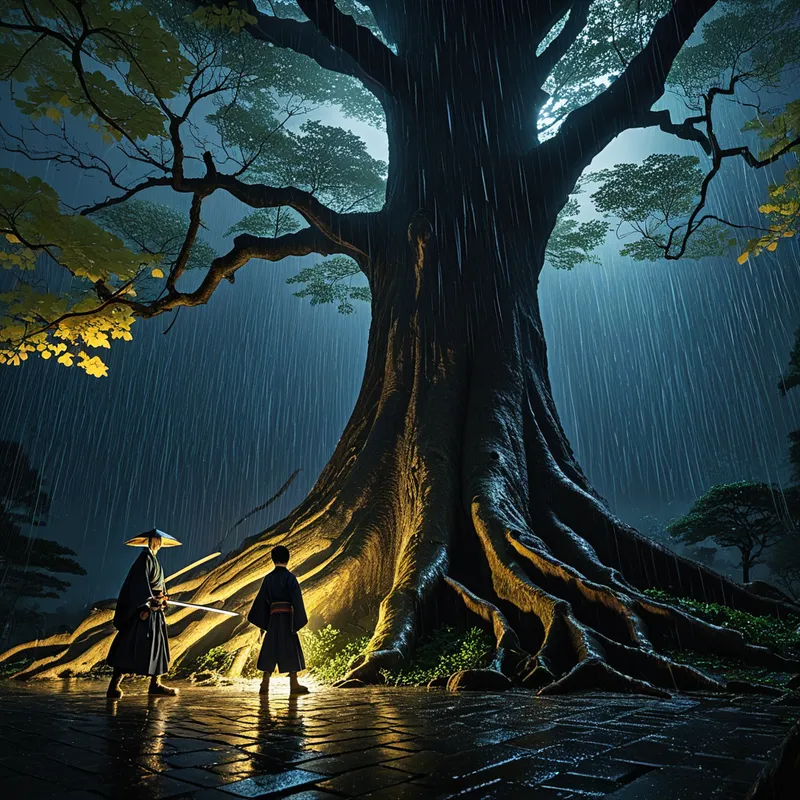
On a night when the moon was a sliver of cold silver, hidden by scudding clouds, Sanetomo made his way to the shrine. He was to perform a ceremony, to offer prayers to Hachiman Dai-Bosatsu for the stability of his realm. The stone steps glistened with a fine, misting rain. The only light came from the paper lanterns swaying in the wind, casting frantic shadows that danced upon the ginkgo’s colossal trunk. He reached the haiden, the offering hall, his robes heavy with damp and foreboding.
Then, from behind the great tree—that ancient, trusted sentinel—a figure emerged. It was his nephew, Kugyo. Sanetomo’s blood. His heir. In Kugyo’s eyes was not familial duty, but the hard, reflected gleam of a polished blade. No words passed between them that history remembers, only the terrible, swift language of betrayal. The katana flashed, a brief, cruel star in the shrine’s darkness. The shogun-poet fell, his life bleeding out onto the sacred stones, his final sight the impassive bark of the ginkgo.
The tree, it is said, did not stir. It absorbed the shock, the horror, the metallic scent of regicide into its rings. For centuries, it stood, a living monument to that night. Pilgrims would touch its bark and feel the echo. Then, in the spring of 2010, a storm of unnatural fury roared through Kamakura. Winds that seemed to carry the rage of that ancient betrayal tore at the old giant. With a groan that shook the earth, the Great Ginkgo fell. Its trunk shattered across the stone staircase, a fallen titan. The city wept. An era, it seemed, had truly ended.
But the roots of a ginkgo run deeper than memory. From the vast, hidden network left in the earth, a miracle was already stirring. Green shoots, tender and defiant, pushed through the soil where the parent tree had stood. New life, born directly from the old wound. The guardian was not dead. It had performed its most profound teaching: it had returned from the source.
Cultural Origins & Context
This is not a myth of the distant, divine age of the Kojiki. It is a legend born from the volatile soil of history, from the Kamakura</ab title> and Muromachi periods where political power was a blade ever at one’s own kin’s throat. The tale was woven into the fabric of Shinto practice at Tsurugaoka Hachimangu, passed down by shrine priests and local storytellers not as a fairy tale, but as a keben, a true account of a miraculous event tied to a specific, hallowed place.
Its societal function was multifaceted. First, it served as an etiological narrative, explaining the unique, venerated status of that particular tree. Second, it was a moral and political cautionary tale about the cyclical nature of violence and betrayal within dynastic power structures—a story every samurai and courtier would understand in their bones. Finally, and most enduringly, it transformed a historical tragedy (the assassination of Sanetomo in 1219) into a testament to the resilience inherent in the sacred landscape itself. The tree became the true, enduring protagonist, outliving the short, violent dramas of men and embodying the Shinto belief in the animate spirit of nature—kami—that persists through all change.
Symbolic Architecture
At its core, the myth presents the ginkgo as the ultimate axis mundi. It is the still point around which human chaos revolves, the silent witness that absorbs trauma into its very being. The assassination beneath its boughs symbolizes a profound rupture in the natural and social order—a king sacrificed at the foot of the world tree.
The true wound is not the cut that fells the individual, but the tear in the fabric of meaning. The tree receives this tear into its body.
Psychologically, the ginkgo represents the Self in its enduring, archetypal form. The shogun Sanetomo represents the conscious ego—cultured, striving, but ultimately fragile and betrayed by elements of its own psychic family (the shadow, represented by Kugyo). The felling of the tree by the storm mirrors the ego-shattering experience of profound psychological catastrophe: depression, loss, or the collapse of a lifelong identity. The crucial, luminous symbolism lies in the response. The tree does not resurrect from its broken trunk (the old ego). It returns from its roots—the hidden, autonomous, and indestructible foundation of the psyche, the unconscious matrix of the Self.
The Dreamer’s Resonance
When this myth pattern stirs in the modern dreamer, it often signals a process of confronting a foundational betrayal or a catastrophic loss of structure. One may dream of a great, familiar tree being cut down, of a trusted pillar in one’s life collapsing, or of witnessing a violent act in a sacred, familiar place. The somatic sensation is often one of deep, resonant shock—a tremor in the dream-body that echoes the fall.
This is not merely a dream of anxiety; it is the psyche initiating a crucial operation. The felling of the tree represents the necessary, if brutal, deconstruction of an outworn complex or a false persona that has stood for stability but is now rotten at its core. The dreamer is in the liminal space between the fall and the regrowth, a period that feels like barren ground. The psyche is gathering its resources at a level far below daily awareness, preparing to send up new shoots from the rootstock of innate potential and core identity that has been waiting, dormant, beneath the surface drama of life.
Alchemical Translation
The alchemical journey modeled here is solve et coagula: dissolve and coagulate. The assassination and the storm represent the nigredo, the blackening, the utter dissolution of a form. The old shogunate (the ruling conscious attitude) is dead. The old tree (the symbolic structure that housed meaning) is gone. All is ruin.
The alchemical gold is not found in preserving the form, but in the fidelity to the source. The new life is not a replica, but a renaissance of the essential pattern.
The miracle of the regrowth from the roots is the albedo, the whitening, and the beginning of the citrinitas, the yellowing. It is the emergence of a new, authentic consciousness not built upon the rubble of the old ego, but sprouting directly from the Self. This is the process of individuation in its most visceral form. The modern individual is not tasked with “getting over” a trauma or “rebuilding” the same life. The myth instructs something more profound: to have the courage to let the old, shattered form lie, and to attend, with patience and faith, to the small, green shoots emerging from within. These shoots are the new directions, the authentic interests, the resilient core values that were always there, nourished by a depth we could not see until the towering, familiar structure above was removed. We are asked to become gardeners of our own roots, trusting that the pattern of life, like the fan-shaped leaf of the ginkgo, is eternal and will find its way back to the light.
Associated Symbols
Explore related symbols from the CaleaDream lexicon: