
The Gingerbread Man Myth Meaning & Symbolism
A baked being, animated by desire, flees his creation only to be consumed by the cunning fox, a tale of the ego's flight and inevitable dissolution.
The Tale of The Gingerbread Man
In the warm, flour-dusted heart of a cottage, where the air was thick with the scent of molasses and clove, an old woman shaped a man from dough. She gave him eyes of darkest raisin and a mouth of sweet, red candy. With a final touch, she placed him in the oven’s fiery womb. When the time was right, she opened the iron door. But the figure did not lie still. It sat up! It leapt from the pan onto the cool stone floor, and before the astonished woman could utter a sound, it cried out in a voice like cracking sugar, “Run, run, as fast as you can! You can’t catch me, I’m the [Gingerbread Man](/myths/gingerbread-man “Myth from Folklore culture.”/)!”
And he was gone, out the door, into the wide, green world.
Down the lane he sped, a blur of brown against the green. He passed the old man hoeing in the garden. “Stop!” cried the man. “I should like to eat you!” But the Gingerbread Man only laughed his brittle laugh and sang his taunting song, leaving the man in his dusty wake. He raced past a cow in a meadow, past a horse in a field, past all who saw him and hungered. To each he sang his anthem of escape, a testament to his own miraculous speed, his own separate existence. “I have run from an old woman and an old man! I can run from you, I can! I am the Gingerbread Man!”
His world was the path, his purpose the flight. He felt the sun on his sugary skin, [the wind](/myths/the-wind “Myth from Various culture.”/) rushing past his candy buttons. He was free, utterly and completely himself, a being of pure motion and defiance.
But [the world](/myths/the-world “Myth from Tarot culture.”/) grew wider, and the path met a great, wide river, its waters dark and deep. His run, so swift upon the land, was here brought to a halt. The song died in his throat. As he paced the bank in desperation, a voice, smooth as silt, spoke from the reeds. “Good day, little runner.” It was a fox, its coat the color of autumn leaves, its eyes holding a deep, knowing calm. “You seem troubled by this [water](/myths/water “Myth from Chinese culture.”/).”
“I cannot swim!” cried the Gingerbread Man. “And they will catch me!”
The fox smiled a thin, sharp smile. “A problem simply solved. Jump upon my back, and I will carry you across.”
Tentatively, the Gingerbread Man climbed onto the fox’s red back. But as the fox entered the water, he said, “You are too heavy for my back, little friend. The water grows deep. Move to my head.” The Gingerbread Man did so. Then, as the current swirled, the fox spoke again, his voice still gentle. “Now, move to my nose, lest you get wet.”
And so the Gingerbread Man, trusting the cunning voice, stood upon the very tip of the fox’s wet nose. In that instant, the fox tossed his head high, opened his jaws, and with a snap that echoed across the silent water, the running was over. The song was swallowed. There was only the dark, and the deep, and the end of the separate self.

Cultural Origins & Context
The tale of the Gingerbread Man belongs to the vast, living stream of oral folklore, a “Folk” tale in the truest sense. Its earliest known printed version appears in the late 19th century, notably in St. Nicholas Magazine in 1875, but its roots are undoubtedly older, passed from teller to listener, from grandparent to child, by the hearthside. It is an example of the “cumulative tale” or “chain tale,” where the hero’s boastful refrain grows longer with each encounter, engaging listeners in a rhythmic, participatory chant.
Its primary tellers were the common folk—mothers, nurses, grandmothers—using it as both entertainment and subtle instruction. The societal function was multifaceted: it was a thrilling, repetitive game for children, a cautionary tale about the dangers of strangers (the fox) and straying too far from home, and a simple lesson in the consequences of pride and disobedience. It existed not in temples or scholarly texts, but in the domestic sphere, its ingredients—the oven, the food, the farm animals—drawn directly from the daily life of its audience. Its power lies in this simplicity, a seemingly trivial story baked from the very stuff of ordinary life, which nonetheless contains a profound and unsettling depth.
Symbolic Architecture
Beneath the sugary surface lies a stark symbolic [architecture](/symbols/architecture “Symbol: Architecture in dreams often signifies structure, stability, and the framing of personal identity or life’s journey.”/). The Gingerbread Man is the Ego itself, freshly formed and bursting into [consciousness](/symbols/consciousness “Symbol: Consciousness represents the state of awareness and perception, encompassing thoughts, feelings, and experiences.”/). He is not born of flesh, but crafted and baked into being—a construct. His first act is to declare his independence from his creators, his “parents.” He is the [spirit](/symbols/spirit “Symbol: Spirit symbolizes the essence of life, vitality, and the spiritual journey of the individual.”/) of “I am,” separate and special, defined entirely by his [ability](/symbols/ability “Symbol: In dreams, ‘ability’ often denotes a recognition of skills or potential that one possesses, whether acknowledged or suppressed.”/) to flee from any context that would define or consume him.
The Ego is a recipe given life by fire, believing its freedom is in its flight from the very oven that gave it form.
His taunting song is the [mantra](/symbols/mantra “Symbol: A sacred utterance, sound, or phrase repeated in meditation to focus the mind and connect with spiritual energy.”/) of the inflated ego, building its [identity](/symbols/identity “Symbol: Identity represents the sense of self, encompassing personal beliefs, cultural background, and social roles.”/) through [opposition](/symbols/opposition “Symbol: A pattern of conflict, duality, or resistance, often representing internal or external struggles between opposing forces, ideas, or desires.”/): “I am not what you say I am. I am not caught. I am the one who runs.” Each pursuer—the old woman, man, cow, horse—represents an [aspect](/symbols/aspect “Symbol: A distinct feature, quality, or perspective of something, often representing a partial view of a larger whole.”/) of the world or the [Shadow](/symbols/shadow “Symbol: The ‘shadow’ embodies the unconscious, repressed aspects of the self and often represents fears or hidden emotions.”/) that seeks to integrate him, to bring him back into the collective, into [relationship](/symbols/relationship “Symbol: A representation of connections we have with others in our lives, often reflecting our emotional state.”/), into the cycle of nourishment and consumption. He mistakes their [hunger](/symbols/hunger “Symbol: A primal bodily sensation symbolizing unmet needs, desires, or emotional voids. It represents craving for fulfillment beyond physical nourishment.”/) for destruction, not recognizing it as the pull of [nature](/symbols/nature “Symbol: Nature symbolizes growth, connectivity, and the primal forces of existence.”/) toward wholeness.
The [river](/symbols/river “Symbol: A river often symbolizes the flow of emotions, the passage of time, and life’s journey, reflecting transitions and movement in one’s life.”/) is the inevitable confrontation with the unconscious, a [barrier](/symbols/barrier “Symbol: A barrier symbolizes obstacles, limitations, and boundaries that prevent progression in various aspects of life.”/) the conscious ego cannot cross alone. The fox is the ultimate [symbol](/symbols/symbol “Symbol: A symbol can represent an idea, concept, or belief, serving as a powerful tool for communication and understanding.”/) of the [Psychopomp](/myths/psychopomp “Myth from Greek culture.”/) and the [Trickster](/symbols/trickster “Symbol: A boundary-crossing archetype representing chaos, transformation, and the subversion of norms through cunning and humor.”/). He is not a blunt pursuer but a cunning guide who offers the very [solution](/symbols/solution “Symbol: A solution symbolizes resolution, clarity, and the overcoming of obstacles, often representing a sense of accomplishment.”/) [the ego](/myths/the-ego “Myth from Jungian culture.”/) seeks. The [journey](/symbols/journey “Symbol: A journey in dreams typically signifies adventure, growth, or a significant life transition.”/) from back, to head, to [nose](/symbols/nose “Symbol: The nose often represents perception, intuition, and the ability to confront emotions and truths.”/) is a devastatingly precise [allegory](/symbols/allegory “Symbol: A narrative device where characters, events, or settings represent abstract ideas or moral qualities, conveying deeper meanings through symbolic storytelling.”/) for the [inflation](/symbols/inflation “Symbol: A dream symbol representing feelings of diminishing value, loss of control, or expansion beyond sustainable limits in one’s life or psyche.”/) and ultimate [vulnerability](/symbols/vulnerability “Symbol: A state of emotional or physical exposure, often involving risk of harm, that reveals authentic self beneath protective layers.”/) of [the ego](/myths/the-ego “Myth from Jungian culture.”/). It climbs higher, believing it is gaining [safety](/symbols/safety “Symbol: Safety represents security, protection, and the sense of being free from harm or danger, both physically and emotionally.”/) and advantage, only to place itself in the most precarious position of all—directly before the devouring maw of nature’s [reality](/symbols/reality “Symbol: Reality signifies the state of existence and perception, often reflecting one’s understanding of truth and life experiences.”/). The consumption is not a cruel [punishment](/symbols/punishment “Symbol: A dream symbol representing consequences for actions, often tied to guilt, societal rules, or internal moral conflicts.”/), but the inevitable [dissolution](/symbols/dissolution “Symbol: The process of breaking down, dispersing, or losing form, often representing transformation, release, or the end of a state of being.”/) of a separate, brittle identity into the larger, darker, and wiser process of [life](/symbols/life “Symbol: The symbol of ‘Life’ represents a journey of growth, interconnectedness, and existential meaning, encompassing both the joys and challenges that define human experience.”/).
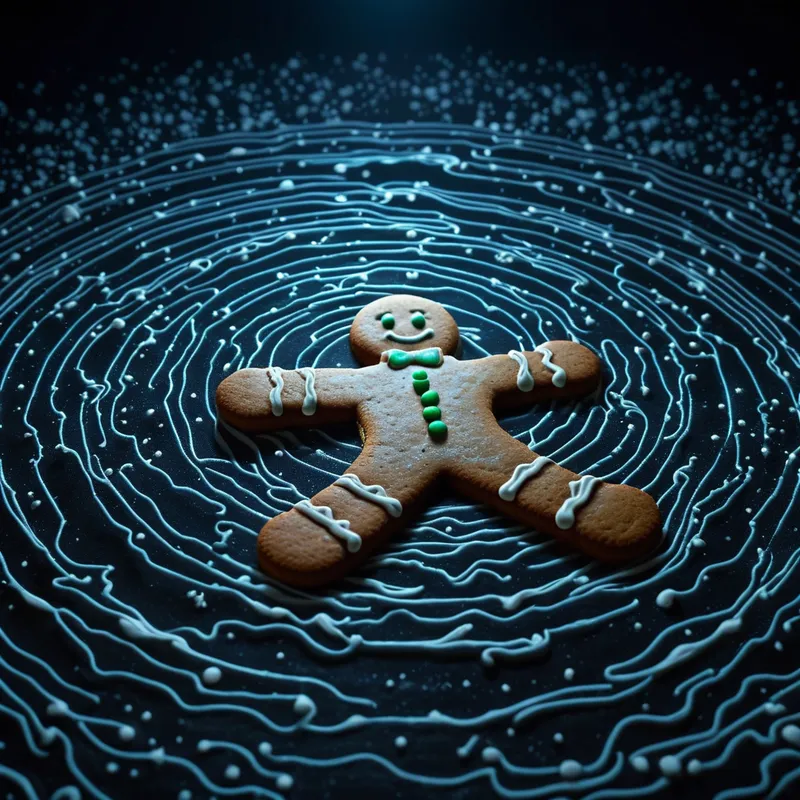
The Dreamer’s Resonance
When this myth pattern stirs in the modern dreamer, it signals a critical phase of psychological movement. To dream of being the Gingerbread Man—running, taunting, feeling uniquely agile yet pursued—is to experience the somatic thrill and deep anxiety of the ego in flight. The dreamer may be fleeing an integrating truth, a relationship, a responsibility, or a part of themselves they deem unacceptable. The body may feel light, frantic, or brittle in the dream.
The pursuers in the dream are key. They represent what the conscious attitude is refusing to assimilate. A dream of being chased by a parental figure echoes the initial rebellion; being chased by a work colleague or an animal might point to unintegrated ambition or instinct. The appearance of [the river](/myths/the-river “Myth from Buddhist culture.”/) or a similar uncrossable barrier marks the dream ego reaching its limit, the point where its old strategies of avoidance and superiority fail.
Most potent is the dream fox—the figure that seems to offer a clever way out. In dreams, this is often a charismatic but dubious person, a seductive idea, or a “shortcut” that promises to preserve the dreamer’s specialness. The dream is presenting the inevitable conclusion of the ego’s inflation: a seeming solution that is, in fact, the mechanism of its necessary dissolution. The terror of being consumed in the dream mirrors the [psyche](/myths/psyche “Myth from Greek culture.”/)’s recognition that a current identity structure must end.

Alchemical Translation
The alchemical journey of the Individuation process is perfectly modeled in this brief, brutal tale. It begins with the [Nigredo](/myths/nigredo “Myth from Alchemical culture.”/), the blackening: the dough is formed in darkness and subjected to the transformative fire of the oven. This is the heat of life’s experiences that forges a conscious personality from the raw material of the psyche.
The Gingerbread Man’s flight represents the Albedo, the whitening, where the purified product (the separate, brilliant ego) emerges, believing itself to be the final, perfected substance. It is the phase of differentiation, of shouting “I am!” to the world. This is a necessary stage, the development of a strong enough ego to engage with reality.
The ultimate transmutation is not in becoming faster, but in surrendering the run. The goal is not to outpace the fox, but to understand you are also the river, the hunger, and the fox.
The confrontation at the river initiates the Citrinitas, the yellowing, a often-overlooked stage of confrontation and disillusionment. The ego’s brilliance meets its insoluble problem. Finally, the consumption by the fox is the [Rubedo](/myths/rubedo “Myth from Alchemical culture.”/), the reddening. This is not mere death, but the supreme integration. The separate, baked construct is dissolved—digested—by the cunning, instinctual wisdom of the unconscious (the fox). The ego is not destroyed; its essence is transmuted. It loses its brittle, separate form to become part of the nourishing substance of the larger Self.
For the modern individual, the myth does not counsel passive surrender to deceit. It is a profound map warning that an identity built solely on opposition, speed, and escape is ultimately fragile. The path to wholeness requires the ego to stop running, to turn and face its pursuers—its own rejected aspects—and to be wary of the cunning voice that promises to preserve its isolation. The true [triumph](/myths/triumph “Myth from Roman culture.”/) is in allowing the constructed self to be consumed by a greater truth, returning to the dark, fertile ground of the psyche from which a more authentic, integrated being can eventually arise. The song ends, so a deeper music may begin.
Associated Symbols
Explore related symbols from the CaleaDream lexicon: