The Gates of Ivory and Horn fr Myth Meaning & Symbolism
A myth of two gates through which dreams pass, one of ivory bearing false visions, one of horn bearing true ones, revealing the soul's nightly journey.
The Tale of The Gates of Ivory and Horn fr
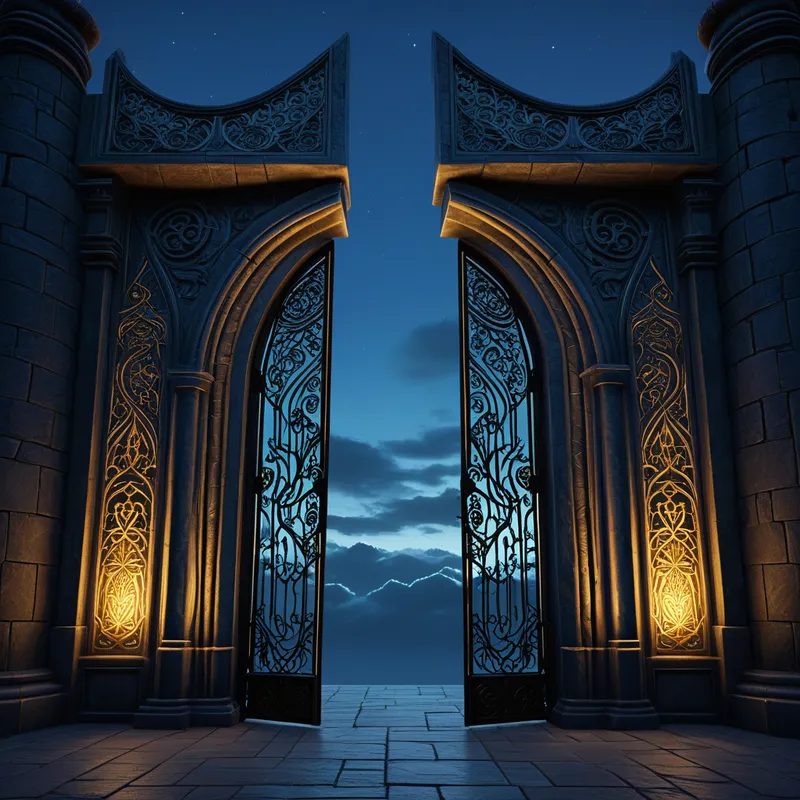
Listen, and let your mind travel to the shores where [the world](/myths/the-world “Myth from Tarot culture.”/) of waking dissolves into mist. Here, at the edge of all maps, lies the silent kingdom of [Hypnos](/myths/hypnos “Myth from Global/Universal culture.”/). His palace is not of stone, but of gathered twilight and the sighs of the weary. From its threshold, two paths diverge into the deep, shadowed woods of the night. And at the head of each path stands a gate.
The first is a marvel of craft, built from the tusks of celestial beasts. It is the Gate of Ivory, polished to a cold, faultless sheen that reflects not what is, but what the heart most desperately wishes to see. Its surface is smooth, inviting, a blank slate for desire. The dreams that pass this way are sculptors themselves; they take the raw clay of memory and fear and fashion it into plausible lies. They show you reunions with the lost, victories unearned, warnings of terrors that will never come. They are perfect narratives, seamless and seductive, and they slip into the slumbering mind like thieves, leaving behind the glittering dust of illusion.
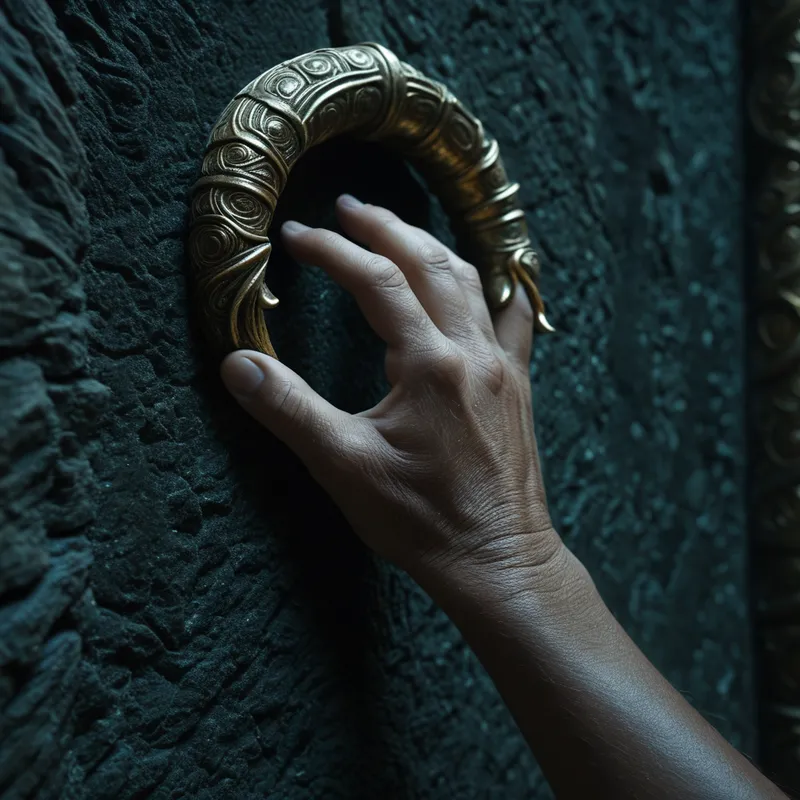
The second is a humbler arch. This is the Gate of Horn, fashioned from the core of the ancient aurochs, material dense with life, slightly cloudy, warm to the touch. It does not reflect; it allows passage. The dreams that come through here are not crafted. They are born. They are the raw, unvarnished whispers of the soul, the truths too potent or too strange for daylight. They arrive as fragments—a forgotten scent, a surge of inexplicable joy, the visceral memory of a childhood fall, or a silent vision of a future choice. They are often puzzling, sometimes terrifying in their clarity, and they resist the tidy stories the waking mind demands.
Each night, the silent procession of Oneiroi, the dream-shades, approaches these gates. They do not choose their path. Their nature dictates their gate. The false, beguiling dreams line up before the ivory, their forms shimmering with deceptive coherence. The true dreams, often awkward and pulsating with unformed meaning, gather at the horn. And as [the moon](/myths/the-moon “Myth from Tarot culture.”/) climbs its arc, the gates swing open on silent hinges. A river of visions pours forth, one of glittering deception, one of resonant truth, both flowing into the vast, receptive sea of sleeping humanity. The gates stand sentinel, forever dividing the night’s harvest, a silent testament to the double-edged gift of the dream.
Cultural Origins & Context
This crystalline allegory finds its most famous articulation in the epic poetry of the ancient Greek world, specifically in [Homer](/myths/homer “Myth from Greek culture.”/)’s Odyssey. In Book XIX, the disguised [Odysseus](/myths/odysseus “Myth from Greek culture.”/), speaking to his wife [Penelope](/myths/penelope “Myth from Greek culture.”/), recounts the parable of the two gates as an explanation for the nature of dreams. It is presented not as a fantastical invention, but as a known and accepted piece of cosmological lore. The myth served a critical societal function in a culture where dreams were considered direct messages from the divine realm, often sought for prophecy and guidance. It provided a framework for discernment. A troubling or auspicious dream was not to be taken at face value; one had to weigh its origin. Was it a oneiros di’ elephantos (dream through ivory)—a deceptive phantom? Or was it a oneiros di’ keraton (dream through horn)—a genuine portent? This myth effectively placed the burden of interpretation on the dreamer and their community, fostering a sophisticated, cautious engagement with the unconscious. It was a tool for navigating the uncertainty of divine communication, acknowledging that the gods could speak in both truths and lies.
Symbolic Architecture
The myth’s power lies in its stark, binary [symbolism](/symbols/symbolism “Symbol: The use of symbols to represent ideas or qualities, often conveying deeper meanings beyond literal interpretation. In dreams, it’s the language of the unconscious.”/), which maps perfectly onto fundamental structures of the [human](/symbols/human “Symbol: The symbol of a human represents individuality, complexity of emotions, and social relationships.”/) [psyche](/myths/psyche “Myth from Greek culture.”/).
The Gate of [Ivory](/symbols/ivory “Symbol: A precious material from elephant tusks, symbolizing purity, luxury, and mortality due to its source and value.”/) symbolizes the [Persona](/symbols/persona “Symbol: The social mask or outward identity one presents to the world, often concealing the true self.”/) and [the ego](/myths/the-ego “Myth from Jungian culture.”/)’s [defense](/symbols/defense “Symbol: A protective mechanism or barrier against perceived threats, representing boundaries, security, and resistance to external or internal challenges.”/) mechanisms. [Ivory](/symbols/ivory “Symbol: A precious material from elephant tusks, symbolizing purity, luxury, and mortality due to its source and value.”/) is beautiful, hard, and lifeless—a [material](/symbols/material “Symbol: Material signifies the tangible aspects of life, often representing physical resources, desires, and the physical world’s influence on our existence.”/) carved into a pleasing shape. It represents the mind’s [capacity](/symbols/capacity “Symbol: A measure of one’s potential, limits, or ability to contain, process, or achieve something, often reflecting self-assessment or external demands.”/) for self-deception, for constructing coherent, ego-syntonic narratives that protect us from harsh realities. These are the dreams that tell us what we want to hear, that rationalize our fears into manageable fictions, or that inflate our sense of self. They are the work of the psychic censor, smoothing the rough edges of [truth](/symbols/truth “Symbol: Truth represents authenticity, honesty, and the quest for knowledge beyond mere appearances.”/) into palatable falsehoods.
The Gate of Ivory is the architecture of the lie we tell ourselves to make the night bearable.
The Gate of [Horn](/symbols/horn “Symbol: A horn symbolizes primal power, warning signals, and spiritual connection, often representing strength, alertness, or divine communication in dreams.”/), in contrast, is the [gateway](/symbols/gateway “Symbol: A threshold between states, representing transition, opportunity, or initiation into new phases of life or consciousness.”/) of the Unconscious and the Self. [Horn](/symbols/horn “Symbol: A horn symbolizes primal power, warning signals, and spiritual connection, often representing strength, alertness, or divine communication in dreams.”/) is organic, grown, and slightly translucent. It is a living filter. This gate represents direct, unmediated psychic content—the raw data of the [soul](/symbols/soul “Symbol: The soul represents the essence of a person, encompassing their spirit, identity, and connection to the universe.”/), the movements of the archetypes, the voice of [intuition](/symbols/intuition “Symbol: The immediate, non-rational understanding of truth or insight, often described as a ‘gut feeling’ or inner knowing that bypasses conscious reasoning.”/) and instinct. These truths are not packaged for comfort. They emerge as symbols, emotions, and sensations that require active engagement, [digestion](/symbols/digestion “Symbol: Represents processing, assimilation, and elimination of experiences, emotions, or information. Often symbolizes how we handle life’s challenges and absorb what nourishes us.”/), and interpretation to be understood.
The two gates together depict the psyche’s nightly production: a [mixture](/symbols/mixture “Symbol: A mixture in dreams represents integration, blending of ideas, or conflicts between differing aspects of the self.”/) of defensive fiction and profound truth, flowing from a single [source](/symbols/source “Symbol: The origin point of something, often representing beginnings, nourishment, or the fundamental cause behind phenomena.”/) but diverging at the final threshold of [consciousness](/symbols/consciousness “Symbol: Consciousness represents the state of awareness and perception, encompassing thoughts, feelings, and experiences.”/).
The Dreamer’s Resonance
When this mythic pattern stirs in a modern dream, the dreamer is at a critical juncture of inner discernment. One does not simply dream of literal ivory and horn gates. Instead, one encounters the pattern of the two ways.
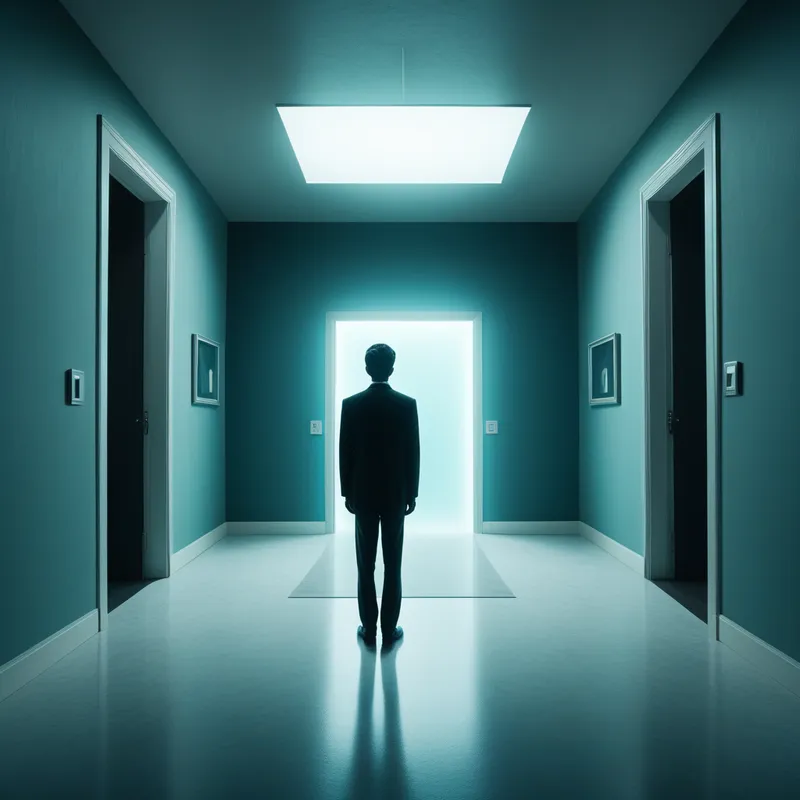
You may dream of two doors, two paths in a wood, two identical figures where one feels “off,” two versions of a loved one, or a choice between a clear, easy answer and a difficult, murky one. The somatic experience is key. The “ivory” choice often brings a feeling of superficial relief coupled with a deep, nagging dissonance—a hollow victory. The “horn” choice may provoke anxiety, resistance, or fear, but is accompanied by a strange sense of rightness, a resonant hum in the body.
This dream motif signals that the psyche is presenting a choice between clinging to a comfortable illusion (a relationship narrative, a self-image, a belief) and facing a more complex, painful, but authentic truth. The dream is [the threshold](/myths/the-threshold “Myth from Folklore culture.”/) itself, asking the dreamer to develop the inner “gatekeeper”—the capacity for discernment between the ego’s stories and the soul’s communications.
Alchemical Translation
The journey of individuation, the alchemical work of becoming whole, is fundamentally the process of learning to distinguish the ivory from the horn within one’s own psyche. It is the opus of discernment.
Initially, we are passive recipients of the night’s procession. Our waking lives are often governed by the persuasive, coherent narratives from the Gate of Ivory—the stories we inherit about who we are, what we deserve, and how the world works. The alchemical process begins with the [nigredo](/myths/nigredo “Myth from Alchemical culture.”/), the blackening, which often arrives as a “horn” dream or a horn-truth in life: a disruptive emotion, a failure that defies our ego’s story, a glimpse of a shadowy aspect of ourselves. This raw, unpolished truth is the [prima materia](/myths/prima-materia “Myth from Alchemical culture.”/), the base material for transformation.
The work is not to stop the dreams from the Gate of Ivory, but to recognize their substance, and to courageously court the truths that arrive, rough-hewn, through the Gate of Horn.
The subsequent stages—albedo (whitening), citrinitas (yellowing), and [rubedo](/myths/rubedo “Myth from Alchemical culture.”/) (redding)—involve repeatedly engaging in this discrimination. We learn to question the smooth, polished certainties of the ego (ivory) and to sit with, interpret, and integrate the disturbing, vital truths from [the Self](/myths/the-self “Myth from Jungian culture.”/) (horn). We build a relationship with the gatekeeper, our inner Sage. The ultimate goal is not to destroy the Gate of Ivory—for it is part of the psychic ecology—but to understand its function, and to consciously choose, more and more, to align one’s life with the authentic visions that pass through the Gate of Horn. In doing so, we transmute the lead of unconscious deception into the gold of self-knowledge, building a personality grounded not in illusion, but in the resonant, living truth of the horn.
Associated Symbols
Explore related symbols from the CaleaDream lexicon: