The Garden of Dilmun Myth Meaning & Symbolism
A myth of a pristine, silent paradise where the goddess Ninhursag heals the god Enki, revealing the sacred alchemy of suffering and wholeness.
The Tale of The Garden of Dilmun
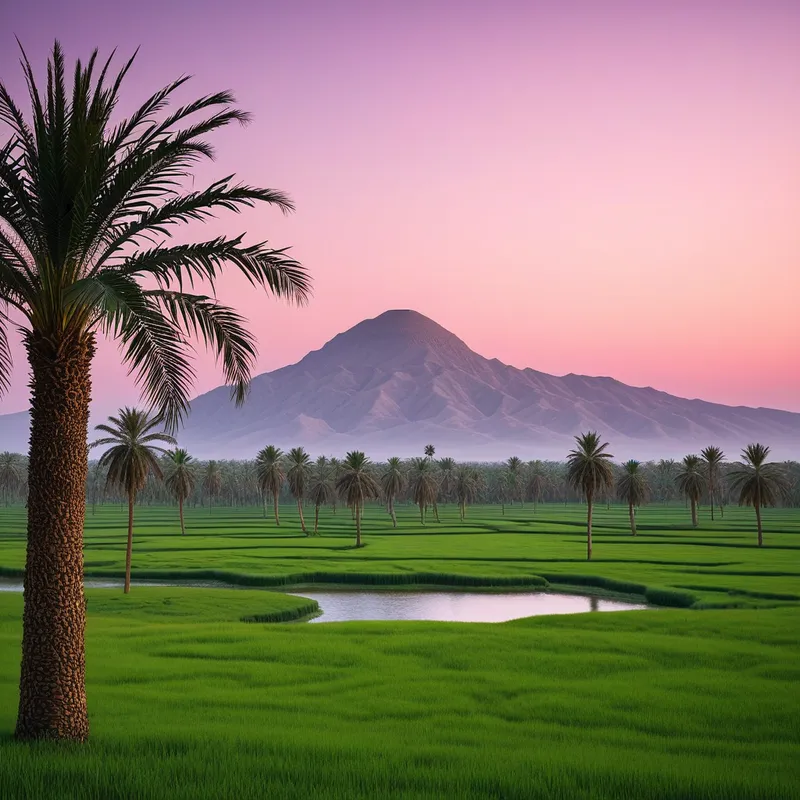
In the time before time, when the world was still a thought in the mind of the deep, there existed a place. It was not a land as we know lands, for it knew no sorrow, no weariness, no cry of pain. Its name was Dilmun. A garden of such stillness it was like a held breath. The sun, Utu, did not scorch there, but warmed the earth with a father’s gentle hand. Sweet waters, gifted by the great father Enki, rose from the abyss and flowed without labor, quenching the dark soil. Date palms grew heavy with fruit, and grains sprang forth unbidden. It was pure, it was clean, it was silent.
But in that perfect silence, something was missing. There was no cry of birth, no sigh of growth, no laughter of creation. The garden was a pristine vessel, empty of life.
The mother of all things, the great Ninhursag, looked upon Dilmun and saw its loneliness. With the power of the mountain in her voice, she spoke to Enki, the lord of the sweet waters and cunning wisdom. “Here, in this pure place, let us bring forth life. Let your waters marry my earth, and let the children of the land rise.”
And so it began. Enki, his heart stirred by the potential of the untouched garden, lay with Ninhursag. From their sacred union, a daughter was born: Ninsar, Lady of the Plants. But the stillness of Dilmun was not yet broken. Enki, ever restless, ever desirous to know and to possess, saw Ninsar walking in the reed beds. Drawn by her verdant beauty, he lay with his own daughter. From them was born Ninkurra. Still, the pattern repeated. Enki, unable to resist the fruit of his own lineage, sought out Ninkurra. And from that union sprang Uttu, the goddess of weaving and the tender green shoot.
Ninhursag watched this unfolding chain, this spiral of creation born of Enki’s unchecked appetite. She went to Uttu and gave her a warning, born of ancient wisdom. “When the lord comes to you, do not receive him in the open field. Let him bring to you gifts—cucumbers, apples, and grapes—as a sign of respect and intention.”
Uttu heeded her great-grandmother. When Enki came, she asked for his gifts. He brought them, and she welcomed him into her bower. But Enki’s desire was not for partnership; it was for consumption. After he lay with Uttu, he consumed the very plants that had sprung from their union. He ate the fruits of his own generative acts.
Then, the perfect stillness of Dilmun shattered. Not with a cry of life, but with a roar of agony. A great sickness seized Enki. The plants he had devoured turned against him. His jaw seized, his teeth ached, his ribs burned, his very life force ebbed. The lord of the sweet waters was poisoned by the fruits of his own unbound creation. He lay dying, his body swelling with the curse of his actions. The gods looked on in horror. Without Enki, the sweet waters would cease to flow; all order would crumble.
But Ninhursag, the great mother, heard his moans. Though angered by his transgressions, her essence was not vengeance, but life. She could not let the source of creation perish. She went to where Enki lay, his body a map of pain. “Where does it hurt you?” she asked, her voice the sound of shifting earth.
He cried out each afflicted part: “My jaw! My tooth! My rib!” For each cry, Ninhursag, the divine midwife, did not simply heal. She birthed. From the pain in his jaw, she brought forth a god to soothe jaws. From the pain in his tooth, a goddess for teeth. And from the pain in his rib—the most famous of all—she brought forth Ninti, whose name means both “Lady of the Rib” and “Lady of Life.” With each birth, Enki’s pain subsided, replaced by a new, sacred being born directly from his suffering.
The garden was silent no more. It was now a place where life and death, desire and consequence, transgression and healing, were woven into one inseparable whole. Dilmun was no longer a sterile paradise. It had become a living world.
Cultural Origins & Context
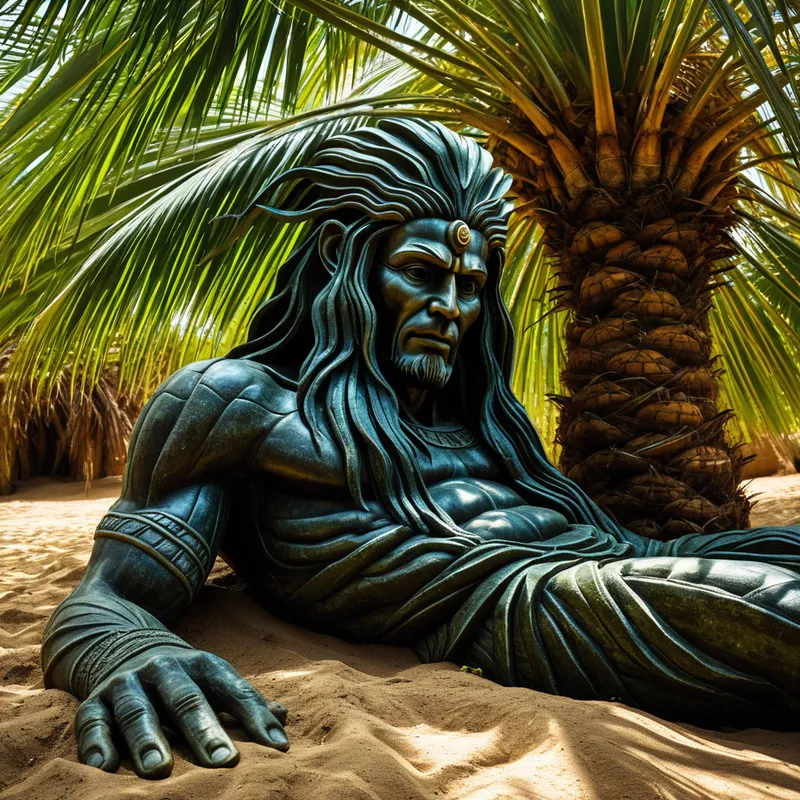
The myth of the Garden of Dilmun comes to us from fragmentary cuneiform tablets, most notably from the city of Nippur, dating to the late third millennium BCE. It is not a single, cohesive epic but a layered narrative embedded within the complex theological fabric of early Sumer. This story was likely recited by temple scribes and priests, not as a simple parable, but as a foundational explanation of the world’s paradoxical nature.
Its societal function was profound. In an agrarian society utterly dependent on the capricious cycles of the Tigris and Euphrates rivers, the myth explained the necessity of both the creative, fertilizing force (Enki’s waters) and the nurturing, healing, and ultimately limiting force (Ninhursag’s earth). It was a divine model for kingship and priesthood: even the highest god could overreach and sicken, and salvation came not through more power, but through submitting to the healing, generative principle. The myth legitimized the role of the healing arts and midwifery, placing their origin in the divine body itself. It told the people that their world, with all its pains and healings, was not a fall from grace, but the necessary, sacred outcome of divine interaction.
Symbolic Architecture
At its core, Dilmun is not a paradise lost, but a state of potential before relationship. It represents the unconscious in its pristine, undifferentiated state—pure, silent, and ultimately infertile. True creation requires an encounter, a mingling of opposites: the conscious, active, desiring principle (Enki) and the unconscious, receptive, formative principle (Ninhursag).
The first sin is not disobedience, but unconscious consumption. The first healing is not forgiveness, but the conscious birthing of meaning from pain.
Enki’s journey is one of psychic inflation. He is consciousness that believes it can possess and consume all it creates without consequence—a metaphor for the ego that identifies with its own thoughts and impulses, believing itself to be the sole author of its reality. His sickness is the inevitable enantiodromia, the swing to the opposite, where the unconscious contents (the devoured plants) rebel and threaten to destroy the conscious mind.
Ninhursag embodies the Self, the archetypal totality of the psyche. She allows the creative/destructive drama to unfold but intervenes not with punishment, but with transformation. She does not remove the pain; she midwifes it into new being. Each ache becomes a specific deity, a differentiated psychic function born to manage that very type of suffering. Ninti, born from the rib, is the ultimate symbol: life (Ti) emerging from a foundational support structure (the rib) that has been wounded.
The Dreamer’s Resonance
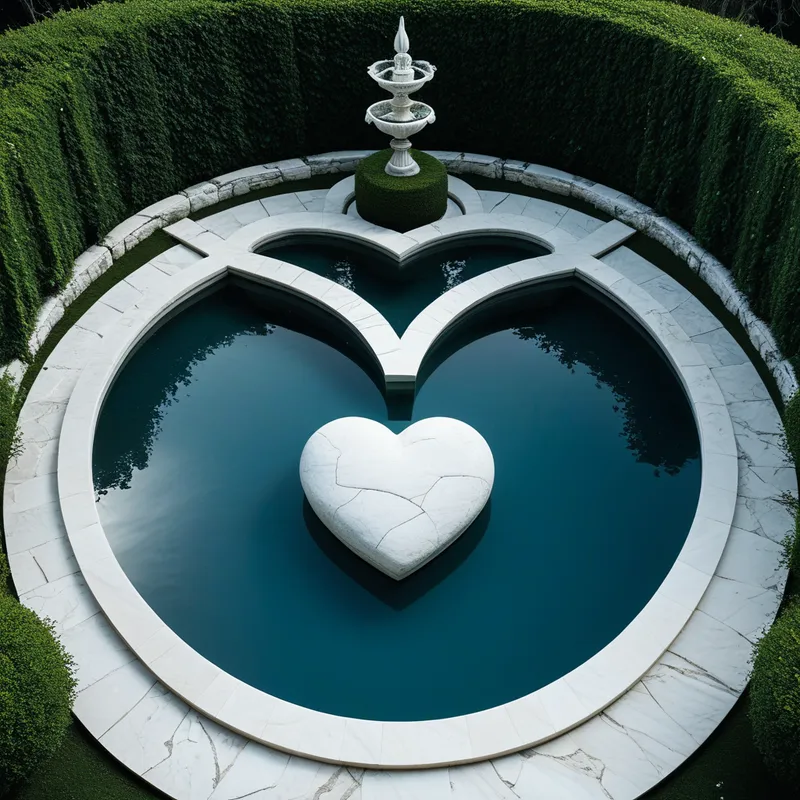
When this myth stirs in the modern dreamer, it often manifests as dreams of sterile, overly controlled environments—immaculate offices, empty white rooms, silent gardens. This is the dream-ego residing in “Dilmun,” a psychic state of avoidance where potential is safe but unrealized. The somatic signal is often a feeling of stagnation, low energy, or existential boredom.
The turning point comes with dreams of compulsive consumption: eating strange fruits, drinking from mysterious springs, or engaging in repetitive, unsatisfying sexual acts. This is Enki’s phase, where the unconscious pushes for engagement, often through shadowy, impulsive behaviors that feel “out of character.” The consequence is the dream-sickness: dreams of poisoning, of body parts aching or failing, of being riddled with thorns or parasites. The dreamer is experiencing the rebellion of the neglected self. The psyche is forcing a crisis, making the unconscious conflict so physically palpable it can no longer be ignored. The healing figure—a wise woman, a nurse, a maternal presence—who appears not to rescue, but to ask “where does it hurt?” is the dream’s invitation to the Ninhursag process.
Alchemical Translation
The alchemy of Dilmun is the opus contra naturam—the work against one’s own unconscious nature. Enki’s initial, natural impulse is to expand, consume, and know without limit. The transformative work is to endure the resulting nigredo, the blackening, the sickness of soul, and to allow that state to be the prima materia for something new.
For the modern individual, this myth models the journey from psychological innocence (the sterile garden) through a necessary “fall” into complex experience (the transgressive creations and their consumption), culminating not in a return to innocence, but in the achievement of a cured complexity. Our personal “Enki-acts”—our ambitions, our passions, our intellectual curiosities—inevitably lead us to consume experiences and relationships in ways that wound us and others. The inflation leads to illness: depression, anxiety, burnout, a crisis of meaning.
Individuation is not about avoiding the poisonous plant, but about learning to birth a healer from every poisoned rib.
The “Ninhursag” function is the most crucial stage of inner work. It is the conscious, compassionate turning toward the pain. Instead of numbing the symptom (the aching jaw), we ask it: “What are you? What new capacity wants to be born from this specific suffering?” Is the loneliness in your rib cage calling for the birth of a deeper capacity for self-sufficiency (Ninti)? Is the anxiety in your gut the raw material for a new, more grounded instinct? The myth teaches that healing is not extraction, but transmutation. Each affliction, fully attended to and spoken, becomes a distinct, living part of a more whole, more resilient psyche. We do not leave the garden; we become its true, living, and complete inhabitants, where every shadow finally finds its name and its sacred purpose.
Associated Symbols
Explore related symbols from the CaleaDream lexicon: