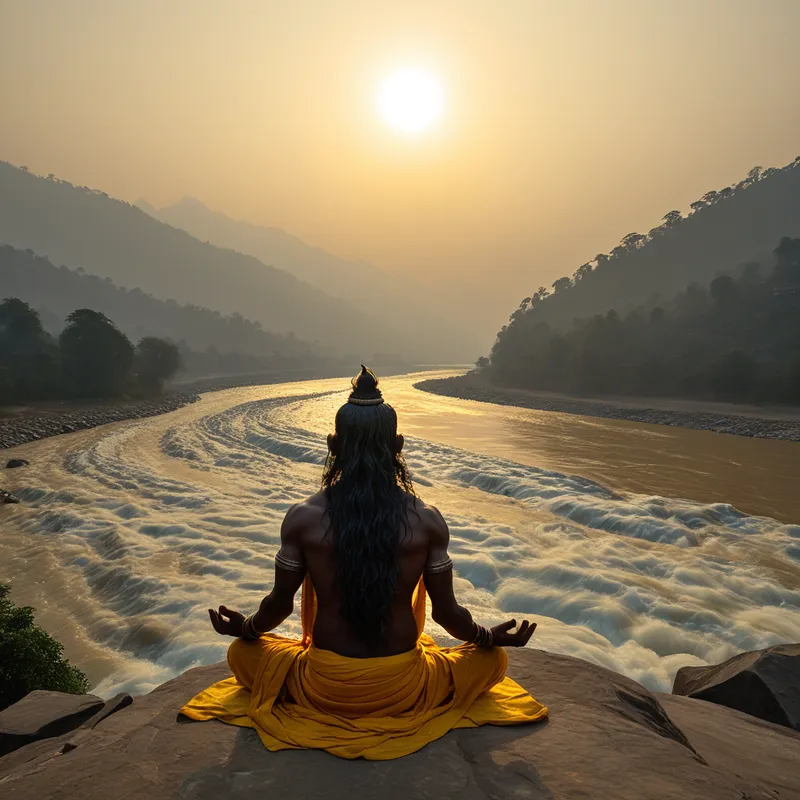
The Ganges River Myth Meaning & Symbolism
A celestial river, brought to earth through divine sacrifice and penance, to purify the ashes of ancestors and nourish the soul of a nation.
The Tale of The Ganges River
Hear now the tale of the river that flows from heaven to earth, a story of fire, ash, and the unbearable weight of memory.
In a time when the world was younger and the gods walked closer, a great king named Sagara performed a royal sacrifice to proclaim his supremacy. His prize horses, roaming the earth, were stolen, and in his fury, he sent his sixty thousand sons to scour the world. They dug deep, tearing into the very flesh of the planet, until they found the horses near the sage Kapila. Mistaking the silent sage for the thief, they charged. Kapila, his meditation shattered, opened his eyes. From his gaze erupted not anger, but a pure, annihilating fire. In an instant, sixty thousand princes were reduced to ashes.
Their souls could not ascend. They were trapped, cursed to wander as restless ghosts, for their final rites—the sacred offering of water—had not been performed. Only the waters of Ganga, the divine river that flows in the highest heaven, could purify their ashes and grant them peace.
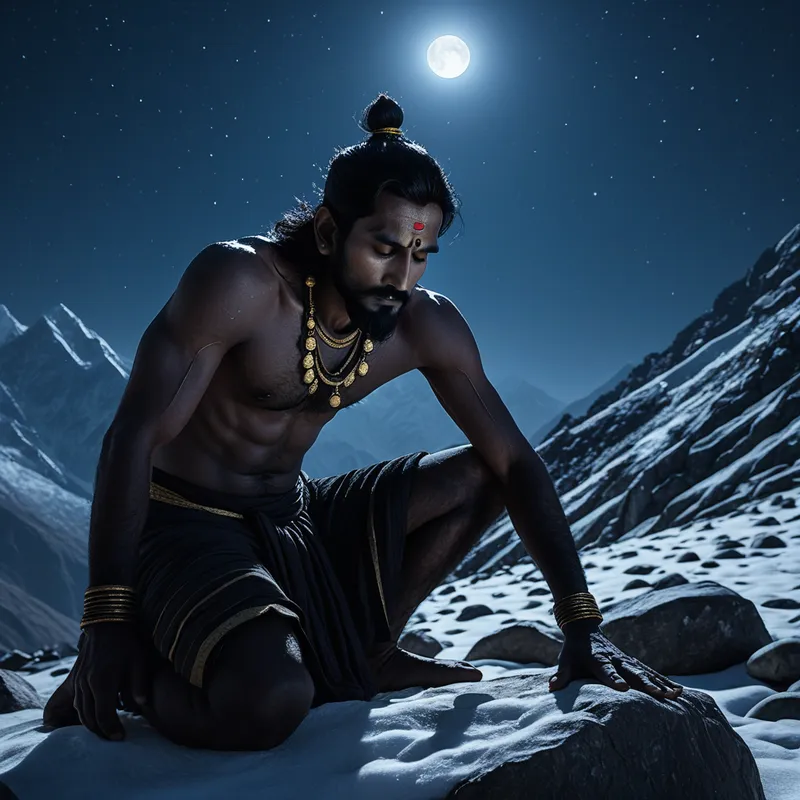
Generations passed under this shadow of unresolved grief. Then came a descendant, King Bhagiratha. He renounced his throne, his comforts, his very humanity. He walked into the frozen, silent fastness of the Himalayas. For centuries, he stood on one foot, then on his head, then buried in snow, his penance so fierce it heated the ice around him. He called out not for power or wealth, but for a river. The gods, shaken by his resolve, relented. Brahma appeared, his voice like distant thunder. “The Ganges will descend. But her fall from heaven would shatter the earth. Only one can break her force.”
Bhagiratha turned his austerities now to the great ascetic, the lord of stillness and dissolution, Shiva. On the peak of Mount Kailash, where time itself slows, Shiva, moved by the king’s selfless duty, agreed. He raised his matted, tangled locks—a forest of cosmic absorption.
Then, with a roar heard across the three worlds, the goddess Ganga descended. She was not a gentle stream but a torrent of arrogant, celestial might, a tsunami of white fury intent on washing the earth into the netherworld. As she plunged toward the mortal realm, Shiva simply smiled. He caught the entire colossal force of her descent in the infinite labyrinth of his hair. The mighty river, confused and humbled, became lost in that cosmic maze, swirling for what seemed like ages, her pride dissolved into the god’s profound stillness. Tamed, she emerged from his locks not as one raging cascade, but as seven gentle, sacred streams.
Bhagiratha, his heart pounding with awe, led the foremost stream south. They followed the path of his chariot wheels across the plains of Bharat</abarsha. When they finally reached the ocean and the pit where the ashes of the sixty thousand lay, the waters of Ganga touched them. A sound like a sigh of release filled the air. The gray ashes shimmered, purified, and the spirits of the ancestors, finally free, rose like a column of light toward the sun. The river that had come to release the dead then turned to nourish the living, flowing ever since as the soul of a nation, a liquid prayer across the land.
Cultural Origins & Context
This myth, primarily found in the Itihasas and the Puranas, is not a single, fixed story but a living narrative stream that has absorbed tributaries from various regional and philosophical traditions over millennia. It was passed down orally by bards, priests, and storytellers at firesides, in temple courtyards, and during pilgrimages. Its societal function is multifaceted: it is an etiological myth explaining the river’s sacred origin, a charter for the profound ritual of antyeshti and ancestral veneration (shraddha), and a theological narrative establishing the hierarchy and cooperation of the divine—Brahma’s grant, Ganga’s power, Shiva’s necessary grace, and the human agency of Bhagiratha.
The myth sanctifies the entire geography of the Gangetic plain, transforming a physical river into a theological entity. It provides the cosmological justification for the relentless human practice of pilgrimage (tirtha-yatra) to her banks, asserting that to bathe in her waters is to literally touch a divine current that has passed through Shiva himself. It bridges the cosmic and the domestic, making every act of drawing her water an engagement with this primordial drama of descent, containment, and release.
Symbolic Architecture
At its core, the myth is a profound allegory of the descent of spirit into matter, and the transformation required to make that descent bearable, even salvific.
The river is consciousness itself, descending from the unified, celestial state into the fractured world of form. Its raw, undifferentiated power must be broken, channeled, and made conscious to be of service.
The ashes of the ancestors represent the unresolved karma, the unprocessed grief, and the psychic burdens of the past that we inherit. They are the weight of history, personal and collective, that binds the soul to repetitive, ghostly patterns. The penance of Bhagiratha symbolizes the focused, disciplined, and often painful effort of the ego-consciousness to confront this inherited shadow. It is the will to heal, pursued with single-minded dedication.
Shiva’s matted hair (jata) is the master symbol. It represents the containing, transformative matrix of the unconscious—specifically, a transcendent function that can receive and process overwhelming psychic energy. It is the principle of meditation, of holding powerful forces without being shattered by them, of allowing a chaotic influx to be slowed, tangled, and ultimately integrated into a manageable flow.

The Dreamer’s Resonance
When this myth stirs in the modern psyche, it may manifest in dreams of overwhelming floods, of being tasked with an impossible journey to heal a family wound, or of discovering a secret, life-giving stream in a barren landscape. Somatic sensations might include a pressure in the crown of the head (the point of descent), a feeling of being weighed down by a gray, ashy substance, or a profound thirst for cleansing.
Psychologically, this signals a process of confronting ancestral or personal shadow material. The dreamer is in the role of Bhagiratha, feeling the burden of a legacy—be it familial trauma, cultural conditioning, or repressed personal history—that requires resolution. The dream points to the necessity of a dedicated, perhaps ascetic, focus on this inner work. The appearance of a chaotic, powerful force (the flood) suggests that raw emotional or spiritual energy is being released from the unconscious. The crucial question the dream poses is: Where is your Shiva? Where is that inner capacity for containment, for patient absorption, that can prevent this release from becoming a destructive flood of anxiety, obsession, or acting out?

Alchemical Translation
The myth models the complete arc of psychic transmutation, or individuation. It begins in a state of crisis and fixation: the ashes are the prima materia, the leaden weight of unresolved psychic content that paralyzes forward movement.
The alchemical work does not begin with the sought-after elixir, but with the recognition of the base, heavy matter that needs to be dissolved.
Bhagiratha’s penance is the stage of nigredo, the blackening. It is the conscious, often dark and painful, engagement with this material—the introspection, the therapy, the journaling, the facing of uncomfortable truths. This dedicated effort attracts the attention of the Self (the gods), signaling that the ego is aligned with a deeper purpose.
The descent of Ganga and her capture by Shiva is the central conjunctio and coagulatio. The divine (transcendent function) meets the human need. The overpowering, spiritual energy (which can manifest as a manic episode, a spiritual emergency, or an influx of creative inspiration) is received and contained by the deeper, stabilizing structures of the psyche (Shiva). This is the act of holding the experience in meditation, in art, in symbolic understanding, rather than being identified with it. The matted hair is the vessel of the opus, where the chaotic waters are “tangled” and slowed, allowing their essential, purifying nature to emerge without destroying the conscious personality.
The final release of the ancestors is the albedo, the whitening—the purification and liberation of energy that was once bound in compulsive, ghostly patterns. The river flowing to the sea represents the rubedo, the reddening or life-giving phase, where this transmuted energy now nourishes the conscious life of the individual. The once-paralyzing ancestral complex becomes a source of vitality, wisdom, and connection. The myth teaches that liberation is not an escape from the past, but a sacred process of descending into it, containing its turbulent forces, and transmuting its weight into a flowing, life-sustaining current of conscious being.
Associated Symbols
Explore related symbols from the CaleaDream lexicon: