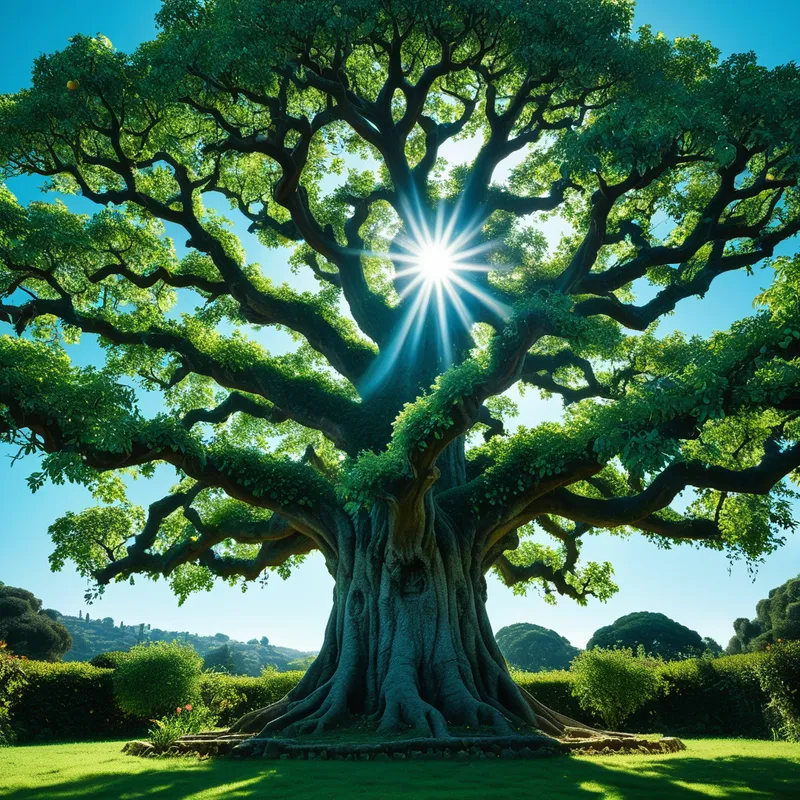
The Fruit of the Tree of Knowledge Myth Meaning & Symbolism
A foundational myth of humanity's awakening to self-awareness, moral consciousness, and the painful, beautiful burden of knowing good and evil.
The Tale of The Fruit of the Tree of Knowledge
In the beginning, there was a garden. Not a garden as we know it, but the Garden, a place of such profound harmony that the very air hummed with the song of creation. Rivers of gold and honey flowed through it, and every tree that was pleasant to the sight and good for food grew from its rich soil. Here, the first humans, Adam and Eve, walked naked and unashamed. They knew no lack, no fear, no future. They knew only the presence of the Lord God, who walked with them in the cool of the day.
And in the midst of this garden, the Lord God planted two trees. One was the Tree of Life. The other was the Tree of the Knowledge of Good and Evil. Of this second tree, God spoke a single, resonant command: “You may surely eat of every tree of the garden, but of the tree of the knowledge of good and evil you shall not eat, for in the day that you eat of it you shall surely die.”
The command hung in the air, a note of pure potential in the symphony of the garden. For a time, it was simply part of the landscape, like the river or the sky. Until the serpent came. More crafty than any other beast of the field, it found the woman by the forbidden tree. “Did God actually say, ‘You shall not eat of any tree in the garden’?” it whispered, its voice a rustle of dry leaves.
Eve replied, “We may eat of the fruit of the trees in the garden, but God said, ‘You shall not eat of the fruit of the tree that is in the midst of the garden, neither shall you touch it, lest you die.’”
“You will not surely die,” the serpent hissed, its words weaving a new reality. “For God knows that when you eat of it your eyes will be opened, and you will be like God, knowing good and evil.”
Then the woman saw the tree with new eyes. The fruit was good for food, a delight to the eyes, and was to be desired to make one wise. The desire took root, grew, and bore its own inevitable fruit. She took of its fruit and ate, and she also gave some to her man who was with her, and he ate.
And in that moment, the symphony shattered. Their eyes were opened, and they knew. They knew they were naked. The first feeling was not enlightenment, but a searing, cold shame. They heard the sound of the Lord God walking in the garden, and they hid themselves among the trees. For the first time, there was a place to hide. God’s call—“Where are you?”—was not a question of location, but a lament. The man spoke of his fear and nakedness. The woman spoke of the serpent’s deception. And the garden, once a womb, became a courtroom. Curses were spoken—to the serpent, to the woman, to the man, to the very ground itself. Then, lest they stretch out their hands and take also from the Tree of Life and live forever in this fractured state, the Lord God sent them out from the garden of Eden. An angel with a flaming sword was placed to guard the way back. The gate closed behind them, and the long human story, woven of toil, pain, love, and death, began under a sky they now had to read for signs of a mercy they could no longer fully see.

Cultural Origins & Context
This myth forms the opening chapters of the book of Genesis. Its origins are woven into the foundational texts of Judaism, Christianity, and Islam, making it a cornerstone of the Abrahamic worldview. Scholars place its written form in the context of ancient Israel’s wisdom and priestly traditions, likely during the first millennium BCE, though its oral roots are far older. It was not told as a simple children’s story, but as a profound etiological narrative—an answer to the most piercing human questions: Why do we toil? Why do we feel shame? Why is birth painful? Why do we die? Why are we separate from the divine and from nature?
It functioned as the prelude to the entire covenant story, establishing the human condition as one of exile and setting the stage for the long, arduous journey back toward relationship. It was recited and studied not for historical fact, but for theological and moral truth, defining the nature of human freedom, responsibility, and the catastrophic, generative consequences of choice.
Symbolic Architecture
The myth is a dense matrix of symbols describing the birth of human consciousness. The Garden represents the unconscious, paradisiacal state of infancy or pre-individuated wholeness, where the self and the world are one. The forbidden tree is not evil; it is the symbol of a consciousness too vast for the innocent state to contain.
The fruit is not sin, but the awareness of sin. It is the consciousness that splits the world into opposites: good and evil, self and other, naked and clothed, sacred and profane.
The serpent is often cast as a trickster or the embodiment of temptation, but in the depth-psychological view, it represents the catalyzing force of the unconscious itself—the instinctual, chthonic wisdom that pushes growth, even through disruption. God’s prohibition and subsequent judgment symbolize the necessary structures and painful consequences that shape a mature psyche. The “death” promised is not physical annihilation, but the death of psychic innocence. The expulsion is not merely punishment, but the inevitable beginning of the individual’s journey through the difficult, real world where consciousness is forged in experience.

The Dreamer’s Resonance
When this myth pattern stirs in the modern dreamer, it signals a profound threshold. Dreaming of a forbidden, radiant fruit or a secret garden one is told not to enter speaks to a nascent awareness pushing toward the surface. The somatic feeling is often one of intense, magnetic attraction mixed with deep anxiety—a pull toward a knowledge or a life stage that feels both utterly right and terrifyingly transgressive.
This is the psyche preparing for an awakening that will irrevocably change the dreamer’s relationship to themselves and their world. It may manifest as the urge to leave a stagnant job, to confront a family truth, to embrace a marginalized part of the self, or to simply see the complexities of a situation one had simplified. The “shame of nakedness” that follows in the dream narrative reflects the vulnerability and exposure felt after such an awakening. The dreamer is processing the death of an old, simpler identity and the painful birth of a more conscious, and therefore more responsible, self.

Alchemical Translation
The alchemical process mirrored here is the Nigredo, the blackening, the necessary descent. The act of eating the fruit is the primal act of individuation—the conscious choice to differentiate from the unconscious unity of the “Garden” (be it family, tribe, dogma, or naivete) and to ingest the burden of duality.
The exile from Eden is not the end of the journey, but its true beginning. The flaming sword guards the way back to unconsciousness, ensuring the seeker must move forward into the alchemical fire of experience.
For the modern individual, this myth models the critical, painful step of awakening to one’s own shadow, to the inherent contradictions within, and to the moral ambiguity of the world. The “work” imposed by the curse—the toil of the man and the pain of the woman—becomes the opus of life itself. We are tasked to till the hard soil of our reality, to bring forth meaning from struggle, and to bear the children of our creative acts with conscious effort. The goal is not to return to the ignorant Garden, but to integrate the knowledge gained through exile, transforming the base metal of raw, painful awareness into the gold of wisdom. We cannot unknow what we know, but we can learn to carry the knowledge with grace, transforming the curse of consciousness into the hard-won blessing of a soul that has chosen to see.
Associated Symbols
Explore related symbols from the CaleaDream lexicon: