The Frog Prince Myth Meaning & Symbolism
A princess's broken promise to a frog forces her to confront her revulsion, leading to a transformative kiss that reveals a prince.
The Tale of The Frog Prince
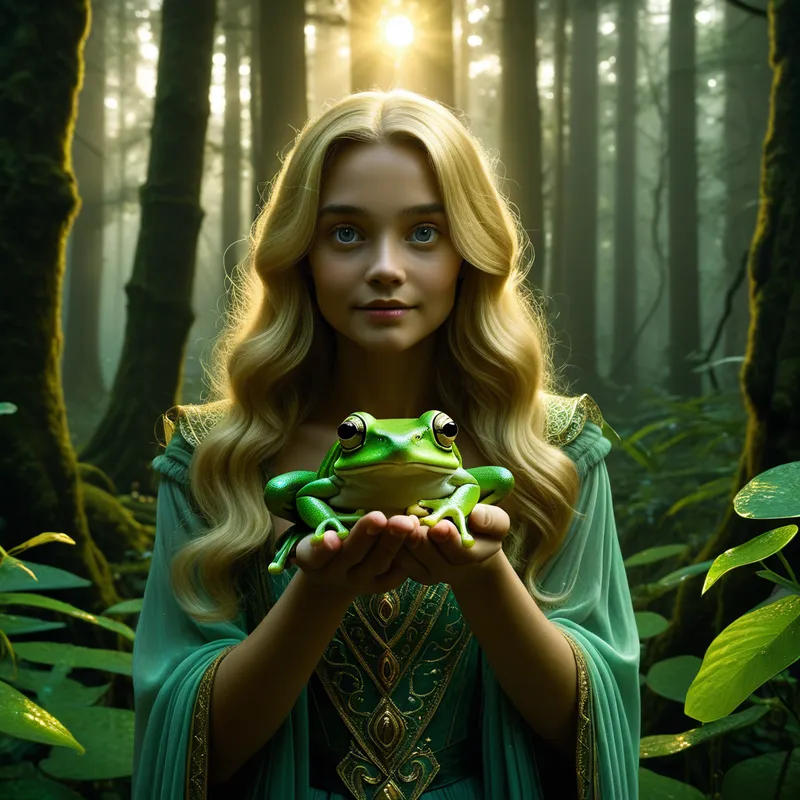
In the deep, whispering heart of an ancient forest, where sunlight fell in dappled coins upon the moss, there lived a princess of such beauty that even the roses turned their heads to watch her pass. Her greatest treasure was a small, perfect ball of purest gold, a sun she could hold in her hands. One afternoon, by the edge of a dark, still well, she tossed her golden sun into the air, laughing as it caught the light. But her laughter turned to a gasp as the sphere slipped from her fingers and fell—not with a splash, but with a soft, final plunk—into the deep, dark [water](/myths/water “Myth from Chinese culture.”/), lost forever.
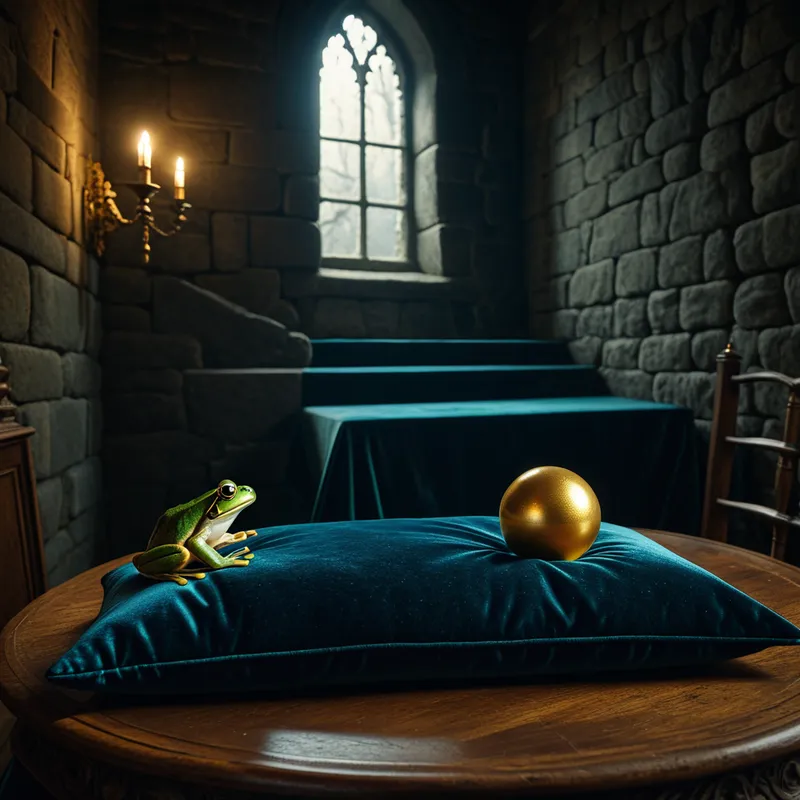
From the murky rim of that well, a voice spoke, thick and moist. “Why do you weep, King’s daughter?” And there he was: a great, slick frog, his skin the color of pond scum and wet leaves, his eyes like polished obsidian. He had retrieved her treasure. In her desperate joy, the princess promised him anything—her pearls, her crown—but the frog desired none of these. “I wish to be your companion,” he croaked. “To eat from your plate, drink from your cup, and sleep upon your pillow.” With a shudder she agreed, thinking only of her golden ball. But once it was safe in her grasp, she fled, leaving the frog and her promise in the gloom.
That evening, as the royal family dined, a slow, wet tap-tap-tapping came at the great oak door. A voice called out, “King’s daughter, youngest, open the door for me! Have you forgotten the promises you made by the cool water of the well?” The king, a man of honor, demanded the truth. Upon hearing it, his decree was iron: “What you have promised, you must perform.” So, with revulsion chilling her blood, she let the creature in. He ate from her plate, leaving a sheen on the silver. He drank from her cup, the wine barely touching his wide mouth. And when he demanded to be lifted to her pillow, her skin crawled.
Yet, in that moment of supreme disgust, as she looked into his ancient, unblinking eyes, something shifted. Not with passion, but with a grim acceptance of the pact she had made, she picked him up. The instant his cold, damp skin met her own, he did not ask for a kiss—she flung him with all her might against the stone wall. But in the Brothers Grimm’s original telling, it is not the kiss that breaks the spell, but this act of violent repudiation. As he struck the wall, he did not fall as a broken amphibian. Instead, he fell as a man. The spell was shattered. There stood a prince with kind eyes, whose enchantment could only be broken by the one who made a promise at [the world](/myths/the-world “Myth from Tarot culture.”/)’s dark edge and was forced, by honor and by will, to keep it.
Cultural Origins & Context
The tale, known as “Der Froschkönig oder der eiserne Heinrich” (The Frog King or Iron Henry), holds the esteemed position of Tale Number One in the seminal 1812 collection by the Brothers Grimm. Its roots, however, sink far deeper into the Germanic soil, intertwining with a pre-Christian animistic worldview where spirits inhabited springs, wells, and marshes. The frog or toad was often a guardian or a shape-shifted being connected to these liminal, watery places—gateways to [the underworld](/myths/the-underworld “Myth from Greek culture.”/) and the unconscious.
This was not merely a children’s story but a Märchen—a “little story” with profound ethical and social function. Told by firesides, often by women (Märchenfrauen), it served as a narrative vessel for transmitting core cultural values: the sacred, unbreakable nature of a promise (especially one made to a seemingly lowly creature), the king’s role as the enforcer of moral law, and the hard, necessary journey from a capricious childhood into a responsible adulthood governed by duty. The story’s persistence speaks to its role in modeling the psychological confrontation with the “other,” a foundational rite of passage.
Symbolic Architecture
At its core, the myth is a masterful map of the [psyche](/myths/psyche “Myth from Greek culture.”/)’s transformative process. The golden [ball](/symbols/ball “Symbol: The ball symbolizes playfulness, joy, and the cyclical nature of life, often representing the search for balance and wholeness.”/) is the [symbol](/symbols/symbol “Symbol: A symbol can represent an idea, concept, or belief, serving as a powerful tool for communication and understanding.”/) of the [princess](/symbols/princess “Symbol: The symbol of a princess embodies themes of power, privilege, and feminine grace, often entailing a journey of self-discovery.”/)’s nascent, undeveloped Self—perfect, whole, and radiant, but also inert and prone to being lost in the [depths](/symbols/depths “Symbol: Represents the subconscious, hidden emotions, or foundational aspects of the self, often linked to primal fears or profound truths.”/). The dark well is the personal unconscious, the place where valuable parts of ourselves sink if we are not careful.
The [frog](/symbols/frog “Symbol: A frog symbolizes transformation, adaptability, and connection to nature.”/) is the ultimate symbol of the [shadow](/symbols/shadow “Symbol: The ‘shadow’ embodies the unconscious, repressed aspects of the self and often represents fears or hidden emotions.”/). He is everything the polished, royal [consciousness](/symbols/consciousness “Symbol: Consciousness represents the state of awareness and perception, encompassing thoughts, feelings, and experiences.”/) rejects: the damp, the ugly, the instinctual, the “lowly.” He emerges from the murky [water](/symbols/water “Symbol: Water symbolizes the subconscious mind, emotions, and the flow of life, representing both cleansing and creation.”/) holding the very [treasure](/symbols/treasure “Symbol: A hidden or valuable object representing spiritual wealth, inner potential, or divine reward.”/) she has lost. This is the central, paradoxical [truth](/symbols/truth “Symbol: Truth represents authenticity, honesty, and the quest for knowledge beyond mere appearances.”/) of [shadow](/symbols/shadow “Symbol: The ‘shadow’ embodies the unconscious, repressed aspects of the self and often represents fears or hidden emotions.”/)-work:
The despised and rejected part of ourselves is often the keeper of our most vital wholeness.
The princess’s [journey](/symbols/journey “Symbol: A journey in dreams typically signifies adventure, growth, or a significant life transition.”/) is one of reluctant [integration](/symbols/integration “Symbol: The process of unifying disparate parts of the self or experience into a cohesive whole, often representing psychological wholeness or resolution of internal conflict.”/). She must dine with her disgust, let it share her cup, and ultimately allow it onto her [pillow](/symbols/pillow “Symbol: A pillow represents rest, comfort, and the subconscious mind, often signifying emotional support.”/)—the intimate [space](/symbols/space “Symbol: Dreaming of ‘Space’ often symbolizes the vastness of potential, personal freedom, or feelings of isolation and exploration in one’s life.”/) of rest and dreams. The violent act of throwing the frog against the [wall](/symbols/wall “Symbol: Walls in dreams often symbolize boundaries, protection, or obstacles in one’s life, reflecting the dreamer’s feelings of confinement or security.”/) is critical. It represents not a gentle [acceptance](/symbols/acceptance “Symbol: The experience of being welcomed, approved, or integrated into a group or situation, often involving validation of one’s identity or actions.”/), but a forceful, passionate engagement with [the shadow](/myths/the-shadow “Myth from Jungian culture.”/). The transformation occurs not through passive tolerance, but through an act of decisive, if initially repulsed, [relationship](/symbols/relationship “Symbol: A representation of connections we have with others in our lives, often reflecting our emotional state.”/). The [prince](/symbols/prince “Symbol: A prince symbolizes nobility, leadership, and aspiration, often representing potential or personal authority.”/) is the latent potential, the redeemed and conscious masculinity (or [animus](/symbols/animus “Symbol: In Jungian psychology, the masculine inner personality in a woman’s unconscious, representing logic, action, and spiritual guidance.”/), for a female psyche) that was trapped within the form of the unconscious, instinctual shadow.

The Dreamer’s Resonance
When this myth stirs in modern dreams, it signals a profound somatic and psychological crossroads. To dream of a frog, especially one that speaks or makes a demand, is to feel the insistent tap-tap-tapping of a disowned part of [the self](/myths/the-self “Myth from Jungian culture.”/) at the door of consciousness. The dreamer may feel a visceral revulsion—a “gut feeling” of disgust or unease towards a person, a situation, or an emerging aspect of their own personality.
This revulsion is the somatic marker of the shadow’s approach. The psychological process is one of recognition and containment. [The ego](/myths/the-ego “Myth from Jungian culture.”/), like the princess, wants to flee with its “golden ball”—its comfortable self-image. But the inner “king,” the Self or the moral conscience, insists the promise be honored. The dreamer is in the process of being forced to “sit at the table” with what they find most unpalatable. The emotional labor is immense: to feel the disgust fully, to not spiritually bypass it with a premature “kiss” of false acceptance, but to endure the shared meal, the shared cup. The transformation occurs in the endurance.

Alchemical Translation
The myth is a perfect allegory for the alchemical and Jungian process of individuation. The [prima materia](/myths/prima-materia “Myth from Alchemical culture.”/)—the base, leaden substance—is the frog-shadow: slimy, rejected, and seemingly worthless. The princess’s conscious ego is [the alchemist](/myths/the-alchemist “Myth from Various culture.”/) in her laboratory.
[The first stage](/myths/the-first-stage “Myth from Alchemical culture.”/), [nigredo](/myths/nigredo “Myth from Alchemical culture.”/) (the blackening), is her despair at the well and her subsequent horror at the frog’s demands. It is [the dark night of the soul](/myths/the-dark-night-of-the-soul “Myth from Christian Mysticism culture.”/), the confrontation with the blackness of the unconscious. The shared meal and drink represent albedo (the whitening), the washing and purification through the ordeal of relationship. One must converse with, and even nourish, the shadow.
The transmutation of lead into gold does not happen by ignoring the lead, but by submitting it to the fierce and precise fire of conscious attention.
The final, transformative act—the throwing of the frog against the wall—is the [rubedo](/myths/rubedo “Myth from Alchemical culture.”/) (the reddening). It is the passionate, catalytic engagement that releases the hidden gold. The prince is the [lapis philosophorum](/myths/lapis-philosophorum “Myth from Alchemical culture.”/), the Philosopher’s Stone: the integrated, conscious Self that was always present within the unintegrated shadow. For the modern individual, the myth instructs that our wholeness is not found in pursuing more light, but in retrieving what we have cast into the well. Our deepest promises are often made in moments of need to parts of ourselves we later wish to forget. Fulfilling those promises, however repulsive the task, is the only magic strong enough to turn a frog into a prince, and a fragmented soul into a sovereign one.
Associated Symbols
Explore related symbols from the CaleaDream lexicon: