The Frog Clan Myth Meaning & Symbolism
A myth of a clan who sacrificed their form to become frogs, holding the world's waters in their bodies to save the people from a great drought.
The Tale of The Frog Clan
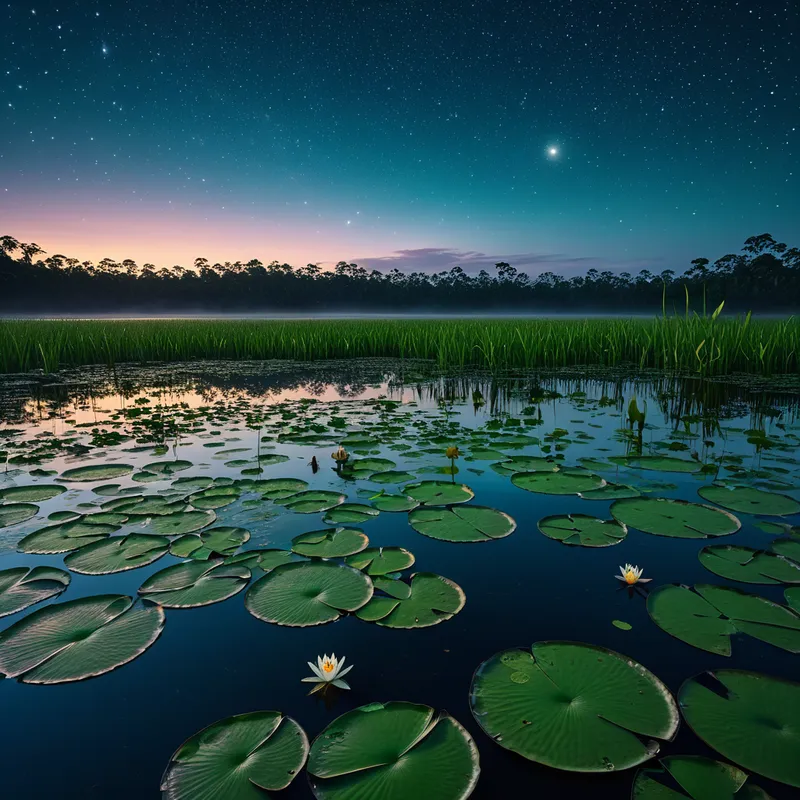
Listen. In the time before memory, when the earth was younger and the people were fewer, a great dryness came. The sun, a relentless eye of brass, stared down for seasons without blinking. The rivers shrank to silver threads, then to dust. The lakes became bowls of cracked mud. The corn withered in the fields, and the people’s throats became as parched as the earth.
Among them was a clan known for their deep connection to the water spirits, for their songs that could call the mist and their dreams that flowed like underground streams. They were the Water-Singers. As the elders grew weak and the children cried without tears, the clan’s chief, a woman named Seeping Spring, gathered her people at the last damp hollow, a place where a single, stubborn seep kept the clay dark.
She did not speak of war or flight. She spoke of a dream. In it, the Great Mystery showed her not a cloud, but a vessel. Not a storm, but a container. The last of the world’s free water was retreating into the heart of the earth, and if it went, life would go with it. The only way to hold it, the dream whispered, was to become a living vessel. To change their very form.
A profound silence fell, broken only by the drip… drip… of the seep. To save the people, the Water-Singer clan would have to cease being people. They would have to take on a new, humble shape, one that could live in the mud and hold the precious drops within their very skin. One by one, without a word of protest, they agreed. This was their song, their purpose.
Seeping Spring began a chant, low and guttural, like water over stones. The clan joined her, their voices merging not in lament, but in a prayer of becoming. As they sang, their proud, upright forms began to soften and shrink. Their skin grew moist and cool, taking on the mottled patterns of wet earth and algae. Their legs bent powerfully, made for swimming and leaping, not walking. Their eyes, last of all, changed—bulging, luminous, seeing the world reflected in a different way, seeing the shimmer of moisture in the air that no human eye could perceive.
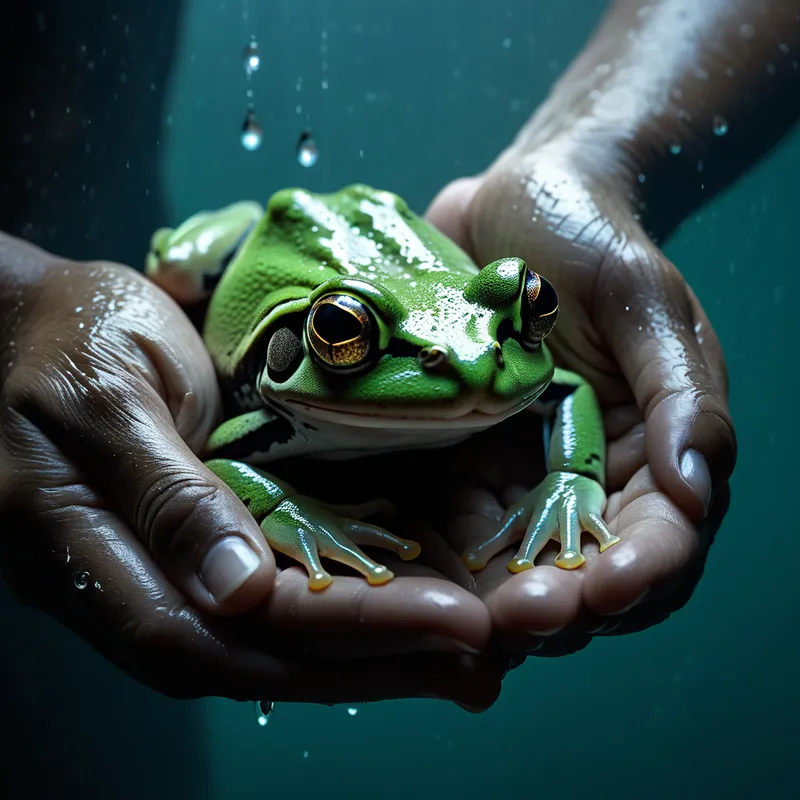
Where the Water-Singer clan had stood, now there was a congregation of frogs. The last human tear shed by Seeping Spring fell to the ground. Where it struck, the seep pulsed, and water began to well up, not from the earth, but from the very bodies of the transformed clan. They did not drink it; they held it. They became the keepers. They hopped into the drying riverbeds, into the cracked lake basins, and wherever they settled, their presence called the hidden moisture to the surface, held it in the land. The rains did not come that day, or the next. But the land began to weep again through these new, sacred vessels. Life returned, sustained not by the sky, but by the profound sacrifice held in the throat and skin of the Frog Clan.
Cultural Origins & Context
The myth of the Frog Clan finds its roots among several Algonquian and Anishinaabe peoples, where clan systems form the bedrock of social and spiritual identity. Clans (doodem) are not merely family lines; they are covenants with specific non-human kin, carrying responsibilities, gifts, and a shared destiny. This myth was not simple entertainment; it was a foundational narrative, told by elders and storyholders to explain the clan’s origin, its sacred duty, and its unique relationship to the ecosystem.
Its societal function was multifaceted. Firstly, it instilled a profound ethic of stewardship. If your ancestors became frogs to hold the water for all, then your clan’s very reason for being is to protect wetlands, springs, and the purity of water. It created a tangible, spiritual link between community survival and environmental integrity. Secondly, it modeled ultimate sacrifice for the collective good, reinforcing values of humility and service over individual glory. The heroes here do not conquer enemies; they transform into the most unassuming of creatures to perform a perpetual, essential service.
Symbolic Architecture
At its heart, this myth is an alchemical parable of containment and transmutation. The frog is a universal symbol of transformation (the tadpole’s metamorphosis) and a liminal creature of two worlds—water and land. In this story, that transformation is not a personal evolution but a collective descent for a cosmic purpose.
The ultimate sacrifice is not to die for something, but to change for everything. To become the vessel that holds the essence of life itself.
The drought represents a psychic or spiritual aridity, a crisis of meaning and vitality where the “waters” of emotion, intuition, and soul-force have receded. The clan’s decision symbolizes the conscious ego’s surrender to a greater, instinctual pattern. They do not seek to control the water (the unconscious); they agree to embody it, to let it reshape them. Their new form—the frog—is the archetypal container. Its permeable skin represents a state of profound openness and sensitivity, where the boundary between self and environment, between personal emotion and the collective waters of life, becomes thin and purposeful.
The water they hold is not just H₂O; it is the animating spirit, consciousness, feeling, and potential itself. By becoming its vessel, they perform the ultimate act of stewardship: they give form to the formless, making the invisible life-force sustainably accessible to the world.
The Dreamer’s Resonance
When this myth stirs in the modern dreamer, it often surfaces during periods of emotional or creative drought. You may dream of parched landscapes, of searching for water, or of feeling desiccated and brittle. The appearance of frogs in such dreams is rarely casual; they emerge as guides to a specific psychological process.
The somatic experience is key. Dream frogs often draw attention to the skin, to throat constriction, or to a feeling of bloating or holding. This is the psyche somatizing the myth’s core action: the need to become a vessel. The dreamer may be unconsciously “holding” unexpressed emotions, creative potential, or spiritual insights that are vital to their “people” (their community, family, or own future self) but which they have not yet learned to contain and mediate safely. The frog in the dream is an image of the nascent capacity to do so—to develop a permeable but resilient boundary that can hold this “water” without leaking it chaotically or evaporating it through anxiety.
It is a call to a humble, earthy transformation. The ego may need to relinquish a “human-centric” posture (pride, isolation, control) and adopt a more amphibious, adaptable one—learning to move between different emotional environments (land/water) and to hold vitality within.

Alchemical Translation
The individuation process modeled here is one of ego-to-vessel transmutation. Our modern crisis is often not a lack of resources, but a failure of containment. We are flooded with information (water) but have lost the cultural and psychic vessels—the “Frog Clans”—to hold it meaningfully. The myth instructs us that salvation lies not in seeking more, but in becoming the right container.
The alchemical work is not to acquire the philosopher’s stone, but to become the crucible in which base metal turns to gold.
First, we must acknowledge the “drought”—the feeling of emptiness, disconnection, or aridity in our lives. This is the nigredo, the blackening. The clan’s decision is the crucial moment of surrender, where the conscious personality (ego) agrees to be dissolved and reconstituted by a deeper, instinctual pattern (the Self). This is the albedo, the whitening.
The transformation into the frog is the citrinitas, the yellowing. It is the emergence of the new, functional form—the development of a psychic skin that is both permeable (able to receive intuition, emotion, the unconscious) and containing (able to hold it without being overwhelmed). Finally, the welling up of water through their presence is the rubedo, the reddening. It is the culmination: the transformed individual (or community) now acts as a conduit. Their very presence “moistens” their environment, bringing life, creativity, and connectivity not through forceful action, but through embodied being. They have become a vessel of the sacred, making the waters of the deep accessible to the surface world of daily life.
Associated Symbols
Explore related symbols from the CaleaDream lexicon: