The Fox and the Grapes Myth Meaning & Symbolism
A fox, unable to reach a cluster of grapes, declares them sour. A timeless fable on desire, denial, and the stories we tell ourselves.
The Tale of The Fox and the Grapes
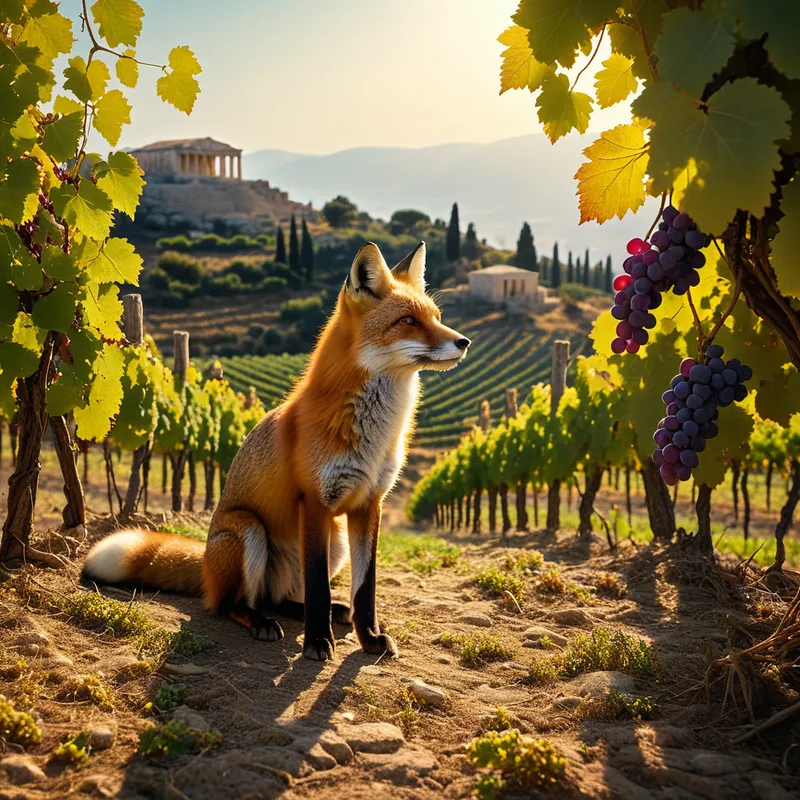
The sun was a tyrant that day, hammering the dust of the road into a fine, white powder that coated the throat and stung the eyes. In the shimmering heat, the world seemed a bleached and thirsty place. It was in this crucible of midday that our fox moved, a sliver of russet intelligence against the pale earth. His tongue was a dry leaf in his mouth, his thoughts narrowed to a single, burning point: water, shade, relief.
Then he saw them.
They hung in a cool, green bower of leaves, a sanctuary woven by the vines against a stone wall. Not just grapes, but a promise. A cluster so full it seemed to hold the very essence of the evening’s coolness, each grape a perfect sphere of distilled purple, dusted with the bloom of creation. They were not food; they were an answer. The very sight of them seemed to lower the temperature of the air.
A spark lit in the fox’s golden eyes. Desire, clean and sharp, straightened his weary bones. He did not amble; he calculated. With a gather of muscle, he launched himself upward, a graceful arc of need. His jaws snapped shut on empty, sun-warmed air. The grapes danced mockingly, a hand’s breadth away. He landed, scattered dust, and did not pause. Again. And again. Each leap was a prayer, each miss a tightening knot in his gut.
The rhythm of his failure became a bitter drumbeat. The glorious cluster, once a symbol of salvation, now transformed in his perception. Its perfect hang was a taunt. Its lush color, an arrogance. The fox stood panting, his sides heaving, the taste of dust and defeat thick in his mouth. He looked not at the grapes, but at his own failed shadow stretching across the ground.
Then, a change came over him. His body, so tense with effort, relaxed into a posture of deliberate disdain. He gave the cluster one last, long look, not of longing, but of appraisal. He sniffed, a short, dismissive sound.
“What a fool I was,” he said, his voice rough but clear in the silent heat. “To strain so for such a prize. They are probably sour, and not yet ripe. Hard little things, not worth a toothache.”
And with a flick of his magnificent brush, as if brushing away a trivial thought, he turned. He walked away, not with the slink of the defeated, but with the deliberate stride of one who has made a wise decision. The grapes remained, glowing in their green bower, untouched. The only thing that had changed was the story. And for the fox, that was everything.
Cultural Origins & Context
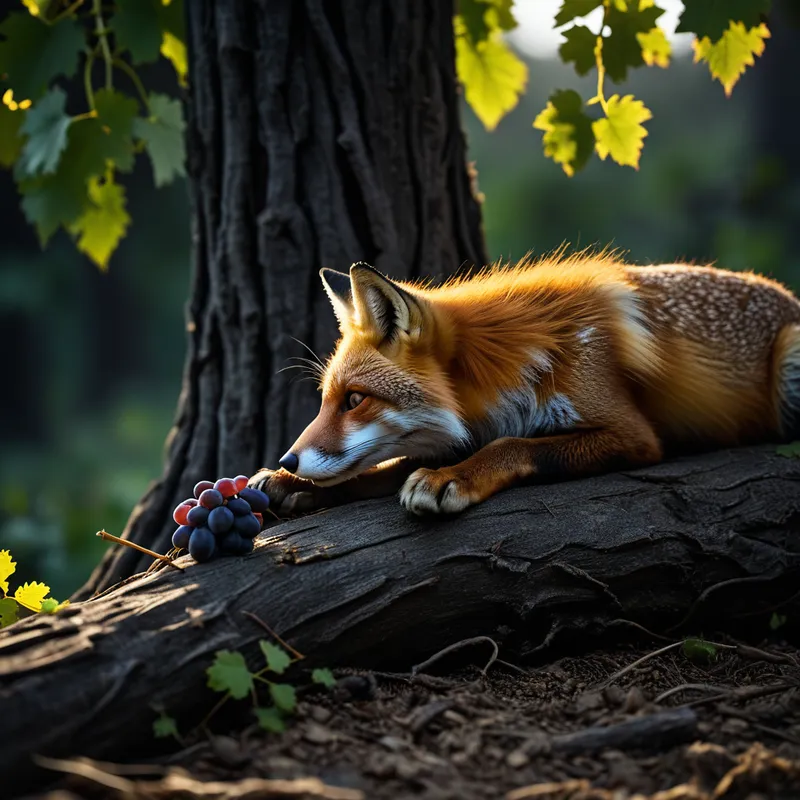
The tale of Aesop’s fox is a story born not in palaces or temples, but in the agoras, workshops, and slave quarters of the ancient Mediterranean. Aesop himself is a semi-legendary figure, often depicted as an enslaved man of sharp wit and bodily deformity, whose wisdom transcended his station. His fables were not scripture, but social currency—compact, portable narratives used to navigate the complexities of human interaction in a hierarchical world.
Passed down orally for centuries before being codified by scholars like Demetrius of Phalerum and later, the Roman poet Phaedrus, these stories functioned as a folk psychology. They were tools for the disempowered to critique the powerful, for the wise to counsel the foolish, and for everyone to recognize their own foibles in the antics of animals. The fox, a perennial symbol of cunning (metis in Greek), was the perfect vehicle for a lesson about the cunning we turn upon ourselves. This fable served as a social mirror, a way to name and thus disarm the universal human tendency to disguise failure as choice, without the need for direct, dangerous confrontation.
Symbolic Architecture
At its core, this is not a fable about a fox or grapes. It is a precise blueprint of a psychic event: the moment desire collides with limitation, and the ego, to survive the impact, rewrites reality.
The Grapes symbolize the Object of Desire in its purest form. They are not merely a snack; they represent an ideal, a state of being (quenched, satisfied, triumphant), a prize that promises to transform our condition. They hang in the space of the unattained, glowing with projected meaning.
The Fox is the Ego in action—resourceful, sensing, striving. His leaps are our efforts, our plans, our applications of will. The Failed Leap is the encounter with the unyielding boundary of the real: lack of skill, circumstance, time, or simple impossibility.
The sour grape is the alchemy of the wounded ego, transmuting the lead of failure into the gold of righteous dismissal.
Here lies the myth’s genius: the Sour Declaration. This is the birth of what modern psychology would term Cognitive Dissonance. The psychic tension between “I want that” and “I cannot have it” is unbearable. To resolve it, the ego performs a desperate, ingenious act of meaning-making. It devalues the desired object. “I didn’t want it anyway.” The grapes must become sour, the lover fickle, the promotion meaningless. The external world is reconfigured to spare the internal world a catastrophic narrative of inadequacy. The fox’s turn and walk is the performance of this new, salvaged identity—one of discernment, not deficiency.
The Dreamer’s Resonance
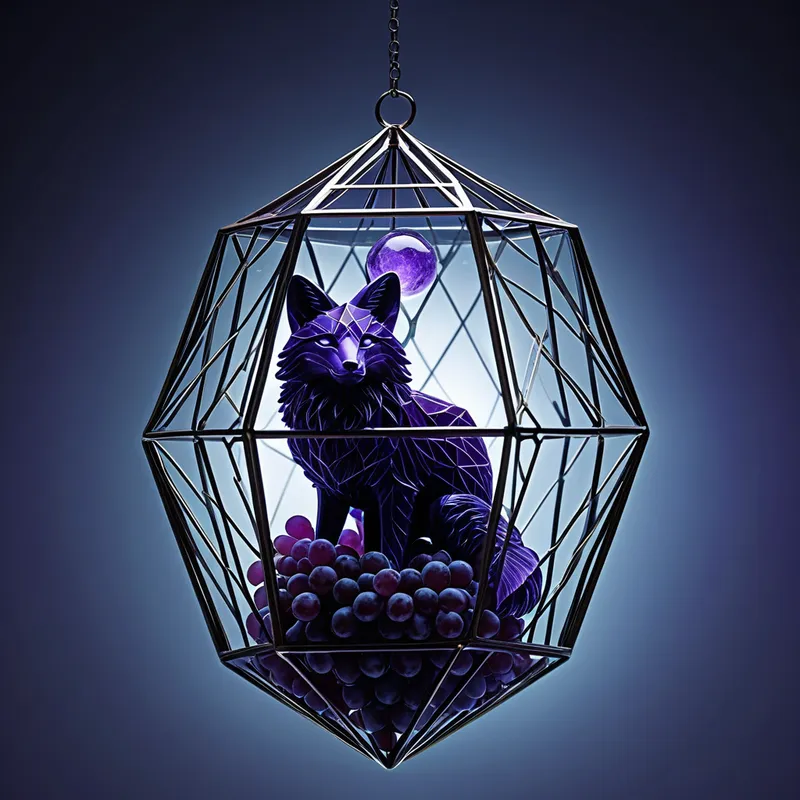
When this myth pattern stirs in the modern dreamer, it rarely appears as a literal fox and grapes. Instead, it manifests as the sensation of the fable. You dream of reaching for a key that melts in your grasp, then deciding the door was unimportant. You run for a train that pulls away, and as you stand on the platform, you feel a profound, calm certainty that it was the wrong destination.
These dreams are somatic experiences of cognitive dissonance resolution in process. The body feels the ache of the stretch, the fatigue of the leap, the hollow after the miss. Then, a palpable shift occurs—a cooling, a distancing. The dream image transforms: the longed-for person’s face becomes blurry, the coveted object tarnishes. This is the psyche’s shadow-work in real-time, attempting to manage the grief of limitation without conscious awareness. The dream is not condemning the mechanism; it is showing you its operation. It asks: Where in your waking life are you walking away from a vineyard, loudly proclaiming the vintage sour, while your throat is still parched?

Alchemical Translation
The individuation process, the journey toward wholeness, requires not the avoidance of the fox’s moment, but the conscious integration of it. The fable presents the base instinct; the alchemical work is in its transmutation.
The first, crucial step is Conscious Recognition. This is the “holy pause” between the final failed leap and the sour declaration. In that pause, instead of the reflexive devaluation, one must hold the tension. One must feel the full, unvarnished sting of “I cannot reach it.” This is a death of a particular kind of hope—the hope of effortless attainment.
The true fruit is not the grape, but the self-knowledge harvested in the space between the leap and the lie.
From this conscious suffering emerges a Choice of Authenticity. The transformed individual can still walk away from the grapes, but for a true reason: “They are beyond my reach with my current resources,” or “The cost of the striving is depleting my spirit.” This is not sour grapes; it is sober assessment. It preserves the value of the grapes (they are still sweet, still desirable) while honestly acknowledging one’s own boundary. This transforms the narrative from one of self-deception to one of self-definition.
Finally, the energy once spent on denial is freed. It can be redirected. Perhaps to find a ladder (seeking help, building skill), to discover a stream elsewhere (finding genuine alternative satisfactions), or simply to sit in the vineyard’s shade and appreciate the beauty of the grapes from a new, non-possessive perspective. The fox becomes whole not by getting the grapes, but by no longer needing to call them sour to feel complete. He integrates his desire and his limit, and in doing so, masters the only vineyard that ever truly mattered: the landscape of his own soul.
Associated Symbols
Explore related symbols from the CaleaDream lexicon: