The Four Humors from ancient G Myth Meaning & Symbolism
A cosmic physician's quest to heal a fractured world by mastering the four elemental fluids of existence: blood, phlegm, yellow bile, and black bile.
The Tale of The Four Humors from ancient G
Listen. Before the world knew its name, it was a formless, fevered dream. The great body of Gaia Mundi lay restless, her skies flushed with heat, her seas sluggish and cold, her winds erratic, her bones aching with a deep, melancholic chill. She was a being of magnificent potential, yet sick unto death with imbalance. Her breath came in fits—now a scorching sirocco, now a frozen gale. Her pulse was a discordant drum, racing then stalling. The song of creation had become a cacophony of distress.
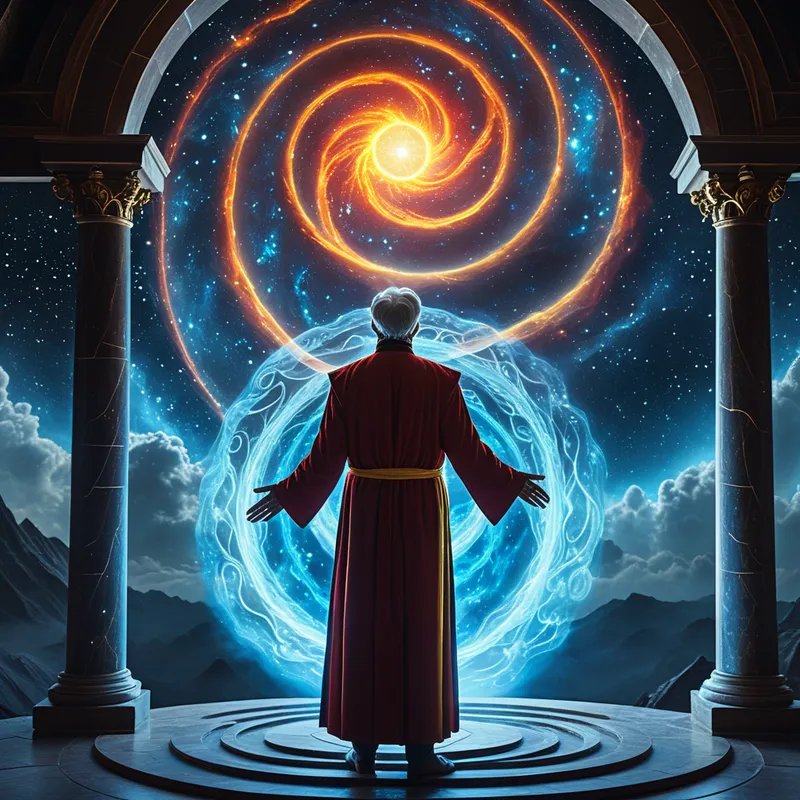
From the silence between stars came the Physikos, the First Physician. He was not a god of thunder or love, but of essence and relation. His eyes were not for seeing surfaces, but for perceiving the hidden humours—the vital fluids that were the very ink of life’s manuscript. He approached the shuddering form of Gaia Mundi and placed a hand upon her brow. He felt the dry, frantic heat. He placed an ear to her chest and heard the wet, congested rattle. He smelled the acrid bitterness on her breath and sensed the heavy, leaden weight in her limbs.
“The four rivers are dammed,” he whispered, his voice the sound of parchment turning. “They flow not in concert, but in rebellion.”
He beheld the four essences warring within her. The Sanguis, hot and wet, meant for joy and vitality, raged like a wildfire in her heart, causing frenzy. The Phlegma, cold and wet, meant for calm and thought, had flooded her mind, bringing stupor and chill. The Cholé, hot and dry, meant for passion and action, burned acidly in her liver, sparking wrath. The Melancholé, cold and dry, meant for introspection and form, had settled like stone in her spleen, breeding despair.
The Physikos opened his bag of wonders—not of knives or herbs, but of celestial instruments: a chalice of equilibrium, a blade of discernment, a crucible of transmutation, and a scale of exquisite sensitivity. His work was not to cut out the sickness, but to conduct the symphony. He sang to the Sanguis, cooling its fever with stories of the moon, coaxing it back to its steady, pulsing rhythm in the heart’s chamber. To the stagnant Phlegma, he brought the gentle, drying warmth of the east wind, urging it to flow clearly, to lubricate thought, not drown it.
The Cholé was a fierce adversary, a crackling yellow serpent of pure impulse. The Physikos did not fight it with water, but contained it within the sacred crucible, tempering its destructive heat into the focused fire of will and digestion. Lastly, he turned to the dense, black weight of the Melancholé. He did not try to lighten it, for its gravity was its gift. Instead, he honored it, giving it form and purpose—the fertile soil from which art, memory, and depth could grow.
One by one, he balanced them. Not by making them equal, but by putting each in its rightful dominion. When the last essence settled into its ordained place, a profound silence fell. Then, a new sound arose: the deep, resonant, and harmonious breath of a world in health. The skies cleared to azure, the seas moved with purposeful tides, the winds blew seasonably, and the earth felt firm and fruitful. The Physikos smiled, for he had not cured the world, but had taught it to cure itself. The recipe for wellness was now written in the very fluids of existence.

Cultural Origins & Context
This myth, while often attributed to the medical theories of Hippocrates and later Galen, transcends its Hellenistic cradle. It is a Global/Universal story because it articulates a fundamental human intuition: that our inner state and the state of the cosmos are mirrors. The “ancient G” is not just Greece, but the universal Ground from which such patterns emerge. It was passed down not only by physicians and philosophers but by storytellers and shamans who understood health as a cosmological art.
Its societal function was profound. It provided a diagnostic and narrative language for human experience. A person wasn’t merely “angry”; they had a surfeit of Cholé. Another wasn’t just “sad”; their Melancholé was speaking. This mythologized medicine created a bridge between the personal and the elemental, making every individual a microcosm—a little world whose internal weather of humors reflected the macrocosm’s seasons, climates, and planets. It was a system that demanded self-knowledge and offered a path to alignment, not just with society, but with the universe itself.
Symbolic Architecture
The myth is a masterclass in the symbolism of psychic ecology. The Four Humors are not outdated biology; they are the four primary colors of the human soul’s palette.
The body is the alembic where the cosmos performs its alchemy. Imbalance is not sin, but a call from one element to remember its kin.
The Sanguis symbolizes the animating spirit—our capacity for connection, optimism, and social flow. Its shadow is manic dispersal, a lack of depth. The Phlegma represents the containing vessel—calm, reflection, and memory. Its shadow is passivity, emotional numbness, and isolation. The Cholé** is the transformative fire—ambition, courage, and metabolic drive. Its shadow is unchecked aggression, bitterness, and burnout. The Melancholé is the grounding earth—introspection, creativity born of depth, and acceptance of limits. Its shadow is paralysis, depression, and morbid fixation.
The Physikos is the archetype of the conscious ego, or the Self, tasked not with eliminating parts of the psyche, but with orchestrating them. His tools—chalice, blade, crucible, scale—are the faculties of receptivity, discernment, transformation, and judgment we must cultivate within.
The Dreamer’s Resonance
When this myth stirs in modern dreams, it speaks of a somatic or psychological process of internal re-balancing. To dream of chaotic, colored fluids flooding or clogging the body indicates a profound felt sense of being “out of sorts.” The dream-ego is experiencing what the ancients called a dyscrasia—a bad mixture.
A dream of overheating, of fiery anger (Cholé) burning through, may follow a day of intense conflict or repressed frustration. A dream of drowning in slow, cold waters (Phlegma) may signal emotional overwhelm or mental fatigue. Dreams of exhilarating but directionless flight (Sanguis) can point to a lack of grounding, while dreams of being trapped in dark, heavy earth (Melancholé) often accompany periods of grief or deep creative incubation. The dream is the body’s innate Physikos at work, using symbolic imagery to diagnose the inner climate, pointing to which “humor” needs attention, containment, or expression.

Alchemical Translation
The individuation process modeled here is not one of conquering a dragon, but of becoming a master chemist of the self. The core struggle is against inner chaos and one-sidedness; the triumph is the achievement of eucrasia—the good mixture.
Individuation is the art of holding the crucible steady while the four fires of your nature learn to burn as one lamp.
The first step is Diagnosis (The Physician’s Gaze): Honest self-observation. Where am I inflamed? Where am I frozen? Where am I ungrounded or scattered? This is applying the blade of discernment to one’s own state.
The second is Containment (The Sacred Vessel): Creating the inner chalice—through mindfulness, ritual, or therapy—that can hold these conflicting energies without being shattered by them. We must stop projecting our excess Cholé as blame or our excess Melancholé as world-weariness.
The third is Transmutation (The Inner Crucible): This is the active work. It is channeling the fire of anger (Cholé) into the sustained fuel for a meaningful project. It is warming the cold waters of depression (Melancholé/Phlegma) with the gentle fire of small, compassionate actions. It is grounding the airy flight of mania (Sanguis) by giving it form through discipline.
The final stage is Integration (The Perfect Balance): Not a static state, but a dynamic equilibrium. The Sanguine joy gives energy to the Melancholic depth. The Choleric drive is cooled and directed by Phlegmatic patience. The individual becomes a coherent universe, a microcosm in right relation to the macrocosm. They become their own Physikos, capable of continual, creative self-healing, embodying the myth not as history, but as a living, internal reality.
Associated Symbols
Explore related symbols from the CaleaDream lexicon: