The Four Humors Myth Meaning & Symbolism
The cosmos births four elemental spirits whose struggle for dominance is resolved only when they learn to flow as one, creating the human soul and the world's seasons.
The Tale of The Four Humors
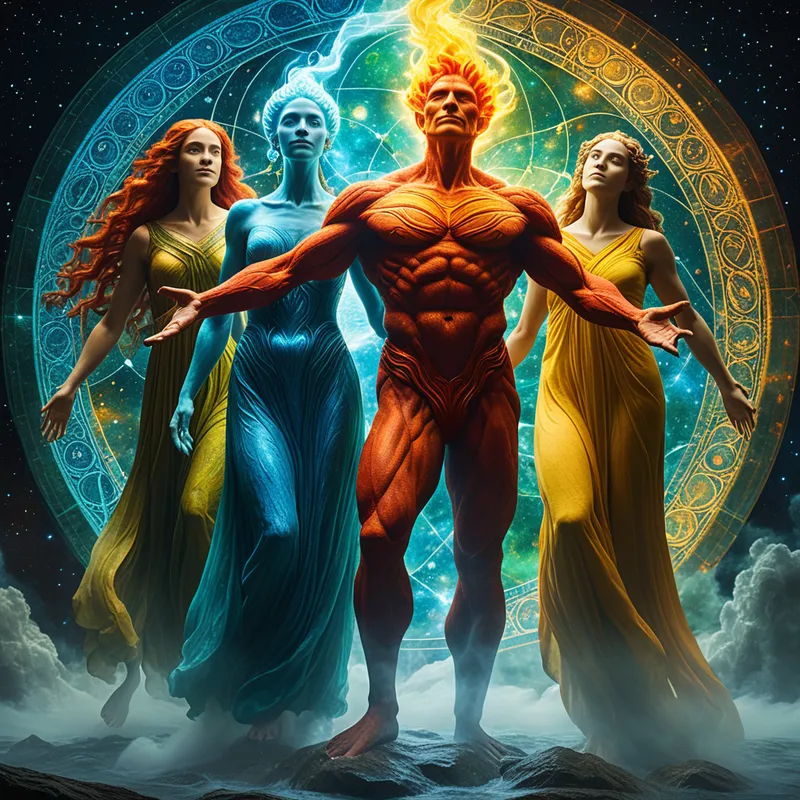
Before [the world](/myths/the-world “Myth from Tarot culture.”/) had shape, there was only the [Prima Materia](/myths/prima-materia “Myth from Alchemical culture.”/), a silent, dreaming sea of potential. From its depths, stirred by a thought older than time, four spirits were breathed into being. They were not born of flesh, but of essence, and each was a sovereign world.
First came Sanguis, a being of quick laughter and quicker passion. His form was warm and vibrant, the color of a rising dawn. He brought the gift of movement, of pulse and possibility. Where he danced, ideas blossomed like spring flowers, but they withered just as fast, for he could not stay.
Then rose Cholera, a figure of sharp angles and fierce light. His eyes were coals, his will a forge-fire. He brought the gift of action, of digestion and decisive force. He carved channels in the formless dark, but his flames, untempered, threatened to consume all they touched.
From the deeper, cooler currents emerged Phlegma, serene and vast as a winter ocean. Her pace was the patient turning of tides, her nature reflective and profound. She brought the gift of cohesion, of memory and fluid connection. Yet, left to her own devices, she would have let all solidity dissolve back into the dreamy sea.
Lastly, from the very bedrock of potential, condensed Melancholia. He was heavy with the weight of all that could be, his gaze deep as a mountain root. He brought the gift of form, of structure and enduring substance. He could give shape to a star, but his touch also brought stillness, a gravity so profound it verged on despair.
For an age, each spirit believed itself the rightful ruler of the nascent cosmos. Sanguis swirled in restless joy, Cholera burned with ambition, Phlegma flowed in placid dominion, and Melancholia sat in stony sovereignty. Their essences clashed—fire boiled [water](/myths/water “Myth from Chinese culture.”/), air scattered earth, earth choked fire, water dampened air. The Prima Materia churned in chaos, a symphony of creation perpetually on the verge of shattering into noise.
The conflict reached its zenith. Cholera, in a blaze of fury, sought to evaporate Phlegma entirely. Sanguis, trying to mediate, only fanned the flames. Melancholia, in grim response, began to crystallize everything, including the others, into immutable, lonely statues. It was not war, but a slow, cosmic sclerosis.
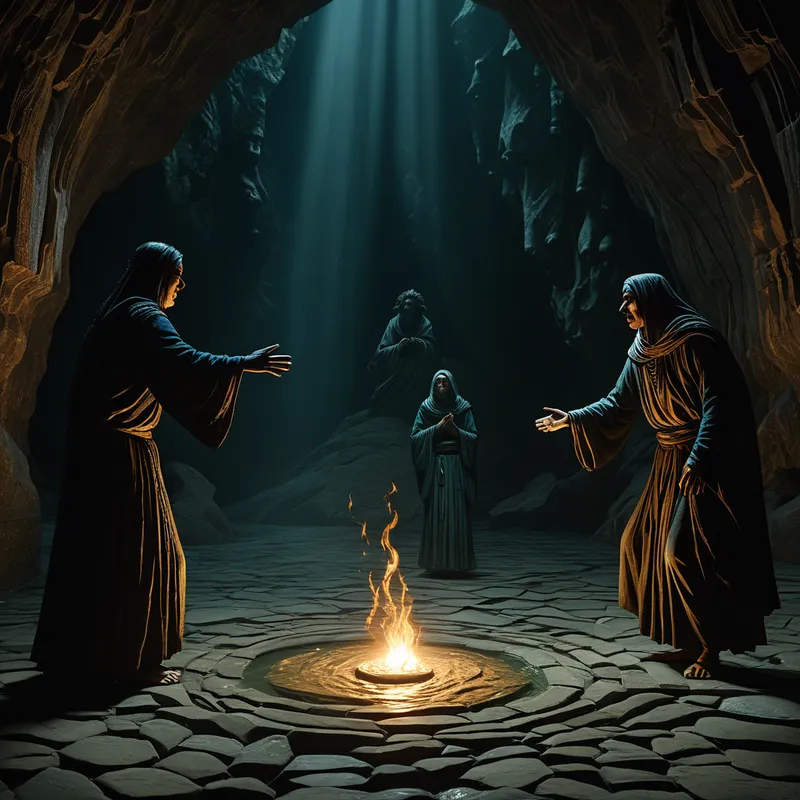
Resolution came not from a victor, but from a surrender. Exhausted by their own tyranny, a moment of quiet fell. In that silence, they perceived a faint, golden hum—the echo of the original thought that had birthed them. It was a call not to dominance, but to circulation. Tentatively, fearfully, Sanguis offered a thread of his warm vitality to Melancholia’s cold form. Instead of being snuffed out, it became a gentle glow within the stone. Cholera allowed a rivulet of Phlegma’s coolness to run through his core, and his fire burned cleaner, brighter. They began to flow, one into the other, in a sacred, circular dance.
From this dance, the first soul was woven—a microcosm of the four in dynamic, ever-shifting balance. From this dance, the world gained its rhythms: the passionate growth of spring (Sanguis), the fiery activity of summer (Cholera), the reflective harvest of autumn (Melancholia), and the quiet, fluid rest of winter (Phlegma). They learned they were not rulers, but reagents in the great [Vas Hermeticum](/myths/vas-hermeticum “Myth from Alchemical culture.”/) of existence.
Cultural Origins & Context
The myth of The Four Humors finds its roots not in a single culture, but in the syncretic, transnational world of Hellenistic and Medieval alchemy, medicine, and natural philosophy. It is a foundational narrative of the Ars Magna, passed down through encrypted texts, illuminated manuscripts, and oral teachings within guilds and scholarly circles.
Its primary tellers were the physician-alchemists, figures like Galen, who systematized it, and the anonymous adepts who saw in it a map of both the macrocosm (the universe) and the microcosm (the human being). It was not merely a story for entertainment, but a functional, pedagogical tool. It provided a framework for diagnosing illness—an excess of Choleric fire caused fever and anger; a surplus of Melancholic earth led to depression and stagnation. More importantly, it offered a model for health, which was not the absence of these forces, but their correct proportion and harmonious interaction.
Societally, it functioned as a grand unifying theory. It connected human temperament to the seasons, to the elements, to the planets, and to the foods one ate. It made the individual a participant in the cosmic order. To understand one’s own “complexion” or balance of humors was to understand one’s place in nature and to take responsibility for maintaining the inner equilibrium that mirrored the health of the world.
Symbolic Architecture
At its core, the myth is a profound [allegory](/symbols/allegory “Symbol: A narrative device where characters, events, or settings represent abstract ideas or moral qualities, conveying deeper meanings through symbolic storytelling.”/) for the [psyche](/myths/psyche “Myth from Greek culture.”/)’s constituent parts and their necessary, often tumultuous, [relationship](/symbols/relationship “Symbol: A representation of connections we have with others in our lives, often reflecting our emotional state.”/). Each humor represents a fundamental psychological function and its associated [shadow](/symbols/shadow “Symbol: The ‘shadow’ embodies the unconscious, repressed aspects of the self and often represents fears or hidden emotions.”/).
- Sanguis symbolizes the function of [Intuition](/symbols/intuition “Symbol: The immediate, non-rational understanding of truth or insight, often described as a ‘gut feeling’ or inner knowing that bypasses conscious reasoning.”/)—the spark of inspiration, [optimism](/symbols/optimism “Symbol: A hopeful outlook anticipating positive outcomes, often linked to emotional resilience and forward-thinking attitudes.”/), and social [connection](/symbols/connection “Symbol: Connection symbolizes relationships, communication, and bonds among individuals.”/). Its shadow is flightiness, lack of commitment, and manic [distraction](/symbols/distraction “Symbol: A state of diverted attention from a primary focus, often representing avoidance, fragmentation, or competing priorities in consciousness.”/).
- Cholera symbolizes the function of Thinking—[analysis](/symbols/analysis “Symbol: The process of examining something methodically to understand its components or meaning. In dreams, it represents the mind’s attempt to break down complex experiences.”/), will, ambition, and [boundary](/symbols/boundary “Symbol: A conceptual or physical limit defining separation, protection, or identity between entities, spaces, or states of being.”/)-setting. Its shadow is aggression, dogmatism, and corrosive criticism.
- Phlegma symbolizes the function of Feeling—[empathy](/symbols/empathy “Symbol: The capacity to understand and share the feelings of others, often manifesting as emotional resonance or intuitive connection in dreams.”/), calm, nurturance, and relational [harmony](/symbols/harmony “Symbol: A state of balance, agreement, and pleasing combination of elements, often associated with musical consonance and visual or social unity.”/). Its shadow is passivity, emotional inertia, and a [loss](/symbols/loss “Symbol: Loss often symbolizes change, grief, and transformation in dreams, representing the emotional or psychological detachment from something or someone significant.”/) of self in the other.
- Melancholia symbolizes the function of [Sensation](/symbols/sensation “Symbol: Sensation in dreams often represents the emotional and physical feelings experienced in waking life, highlighting one’s intuition or awareness.”/)—groundedness, [memory](/symbols/memory “Symbol: Memory symbolizes the past, lessons learned, and the narratives we construct about our identities.”/), [depth](/symbols/depth “Symbol: Represents profound layers of consciousness, hidden truths, or the unknown aspects of existence, often symbolizing introspection and existential exploration.”/), and [attention](/symbols/attention “Symbol: Attention in dreams signifies focus, awareness, and the priorities in one’s life, often indicating where the dreamer’s energy is invested.”/) to [material](/symbols/material “Symbol: Material signifies the tangible aspects of life, often representing physical resources, desires, and the physical world’s influence on our existence.”/) [reality](/symbols/reality “Symbol: Reality signifies the state of existence and perception, often reflecting one’s understanding of truth and life experiences.”/). Its shadow is depression, rigidity, and morbid [fixation](/symbols/fixation “Symbol: An obsessive focus on a single idea, object, or person, often representing a spiritual blockage or an unresolved archetypal pattern.”/).
The great work begins not by eliminating a part of oneself, but by ending its tyranny and inviting it into the sacred circulation of the whole.
The initial conflict represents the natural state of the undeveloped psyche, where one function dominates (the “superior function” in Jungian terms) and others are repressed or projectively identified with the outside world. The [resolution](/symbols/resolution “Symbol: In arts and music, resolution refers to the movement from dissonance to consonance, creating a sense of completion, release, or finality in a composition.”/)—the circular flow—is the [symbol](/symbols/symbol “Symbol: A symbol can represent an idea, concept, or belief, serving as a powerful tool for communication and understanding.”/) of psychic [integration](/symbols/integration “Symbol: The process of unifying disparate parts of the self or experience into a cohesive whole, often representing psychological wholeness or resolution of internal conflict.”/), where [consciousness](/symbols/consciousness “Symbol: Consciousness represents the state of awareness and perception, encompassing thoughts, feelings, and experiences.”/) learns to hold and value all four aspects in a dynamic, self-regulating [system](/symbols/system “Symbol: A system represents structure, organization, and interrelated components functioning together, often reflecting personal or social order.”/).
The Dreamer’s Resonance
When this myth activates in the modern dreamscape, it signals a profound somatic and psychological rebalancing. One does not dream of literal elemental spirits, but of their psychological correlates in conflict or seeking harmony.
A dream of being burned alive may speak of a Cholera excess—unprocessed anger, a critical inner voice, or a life lived at too frantic a pace. A dream of drowning or being trapped in slow, thick fluid may point to a Phlegma imbalance—emotional overwhelm or a sense of being stuck. Dreams of flying joyously but lost (Sanguis) or of being buried, carrying a crushing weight (Melancholia), are somatic communications from the unconscious.
The healing dream is one of transmutation: a dream where a blocked emotion (like sadness) is felt fully and, in the feeling, transforms into a tangible, beautiful object (earth giving form). Or a dream where a chaotic, scattered mind (air) is calmed by diving into a deep, still pool (water), emerging with a single, clear idea. These are dreams of the humors beginning to converse, to flow into one another, initiating the alchemical process within the dreamer’s own body and psyche.
Alchemical Translation
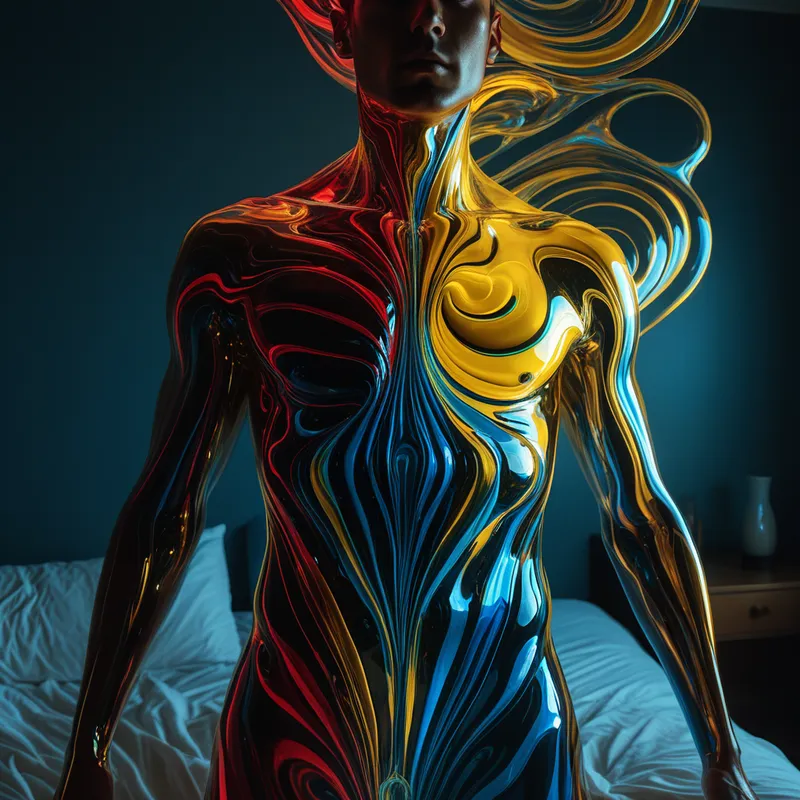
The myth of The Four Humors is a precise map of the individuation process, framed as [Nigredo](/myths/nigredo “Myth from Alchemical culture.”/), Albedo, Citrinitas, and [Rubedo](/myths/rubedo “Myth from Alchemical culture.”/). The initial state of separate, warring humors is the [Nigredo](/myths/nigredo “Myth from Alchemical culture.”/)—the blackening, the recognition of one’s inner conflict and fragmentation, often experienced as depression, anxiety, or a life crisis.
The moment of exhausted silence and the perception of the golden hum is the Albedo—the whitening. It is the dawn of self-reflection, where one ceases to blindly identify with the dominant humor (e.g., “I am just an angry person” or “I am just a dreamer”) and begins to observe the internal system. The beginning of the flow, the tentative offering of one essence to another, is the Citrinitas—the yellowing, the active work of engaging with the inferior functions. This is the difficult, conscious practice of letting feeling temper thinking, or letting intuition inform sensation.
The goal is not a static, perfect balance, but the faculty of circulation—the psychic agility to let the right essence flow to the needed place at the needed time.
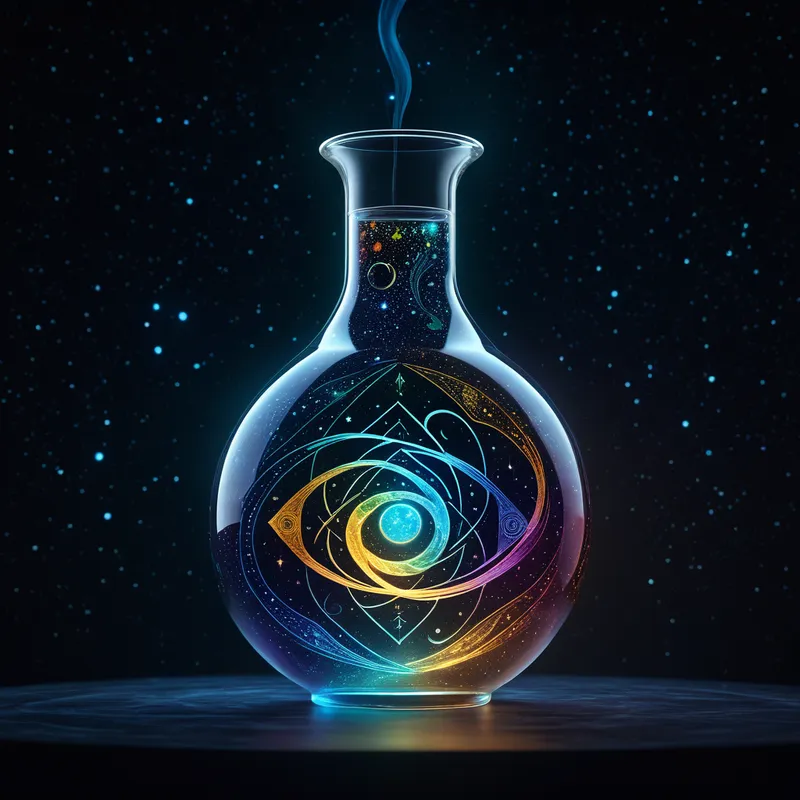
The final, ongoing dance is the Rubedo—the reddening, the creation of the philosophical gold. This is not a state of perfect, painless equilibrium, but the achievement of a resilient, self-regulating psyche. The integrated individual can access passionate action without rage, deep feeling without drowning, inspired vision without rootlessness, and sober reflection without despair. They become the living Vas Hermeticum, the sealed vessel where [the great work](/myths/the-great-work “Myth from Alchemical culture.”/) of turning the lead of a fragmented life into the gold of an authentic, whole self is perpetually underway. The myth teaches that wholeness is a verb, a process of continuous, courageous, and compassionate inner diplomacy.
Associated Symbols
Explore related symbols from the CaleaDream lexicon: